
Types of arthritis Explain psoriatic arthritis
Reading File
Now let me search the medical library for both types of arthritis and psoriatic arthritis in parallel.
Finding Sources
Finding Sources
Searching PubMed
"psoriatic arthritis"[MeSH Terms] AND treatment
Good results. Now let me read the key sections in parallel - Fitzpatrick's for detailed psoriatic arthritis, Goldman-Cecil for clinical details, and search for arthritis classification.
Reading File
Reading File
Reading File
Finding Sources
I found a great arthritis classification image. Let me fetch it, get the Goldman-Cecil treatment section, and look at the Frameworks for Internal Medicine arthritis classification.
Loading Image
Reading File
Reading File
Excellent! I now have comprehensive information. Let me also quickly fetch the treatment flowchart image and search for any psoriatic arthritis images.
Finding Sources
Searching the Web
types of arthritis classification 2024 overview
Let me fetch the Harrison's psoriatic arthritis image with the pencil-in-cup deformity.
Reading File
Loading Image
Reading File
I now have comprehensive, authoritative information. Let me compile the full answer.
Types of Arthritis
Arthritis is a broad term covering over 100 conditions involving joint inflammation or degeneration. The primary classification divides arthritis into noninflammatory and inflammatory categories.
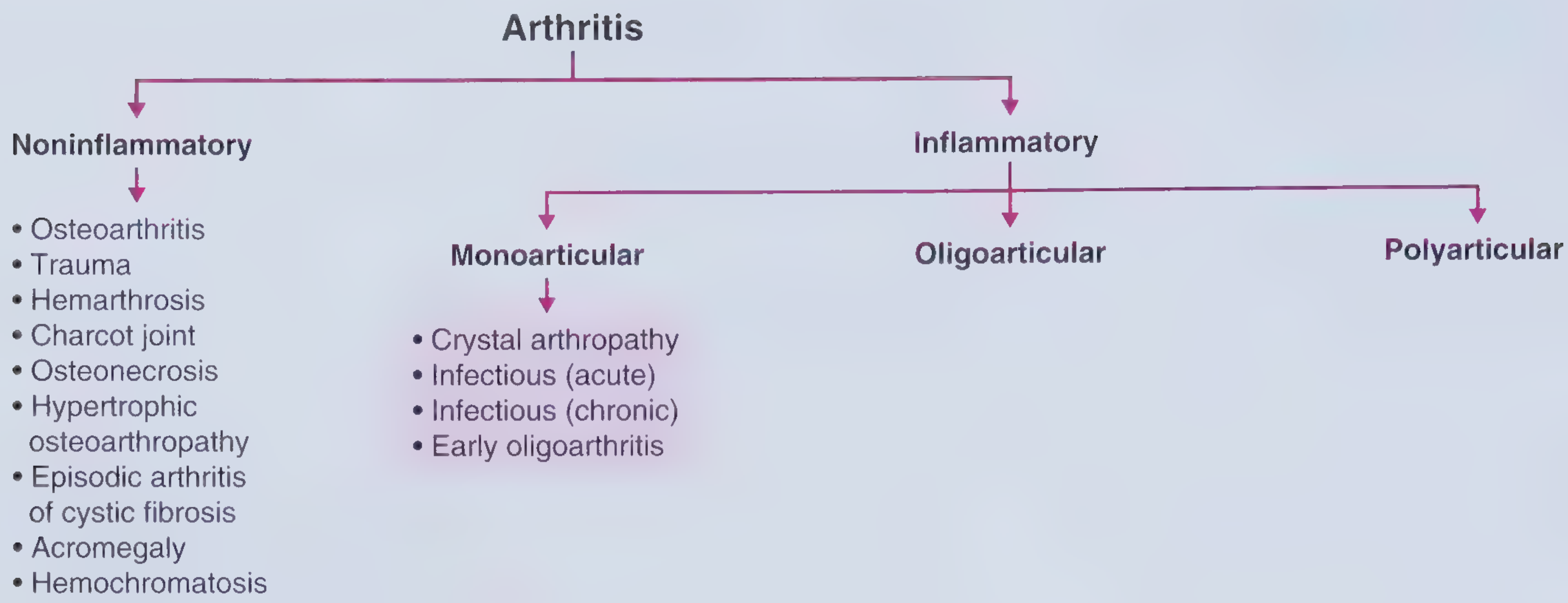
Arthritis Classification - Frameworks for Internal Medicine
Noninflammatory Arthritis
These conditions cause joint damage without significant immune-mediated inflammation:
| Type | Key Features |
|---|---|
| Osteoarthritis | Most common; cartilage degeneration; age-related |
| Traumatic arthritis | Post-injury joint damage |
| Hemarthrosis | Bleeding into the joint (e.g., hemophilia, trauma) |
| Charcot joint (neuropathic) | Joint destruction from loss of pain sensation |
| Osteonecrosis | Bone death due to vascular insufficiency |
| Hypertrophic osteoarthropathy | Periosteal new bone formation; often paraneoplastic |
| Acromegaly | GH excess causing cartilage and bone overgrowth |
| Hemochromatosis | Iron deposition in joints |
Inflammatory Arthritis
Characterized by synovial inflammation, warmth, swelling, and stiffness. Subdivided by joint count:
Monoarticular (1 joint)
- Crystal arthropathy: Gout (monosodium urate - needle-shaped, negatively birefringent crystals) and Pseudogout/CPPD (rhomboid-shaped, weakly positively birefringent crystals)
- Acute infectious (septic) arthritis - S. aureus and N. gonorrhoeae are most common
- Chronic infectious arthritis (Lyme disease, TB, fungal)
Oligoarticular (2-4 joints)
- Psoriatic arthritis (early/asymmetric form)
- Reactive arthritis
- Juvenile idiopathic arthritis (pauciarticular)
- Early spondyloarthropathy
Polyarticular (5+ joints)
- Rheumatoid arthritis (RA) - symmetric, RF+, erosive
- Psoriatic arthritis (symmetric polyarthritis subtype)
- Ankylosing spondylitis - axial predominant
- Systemic lupus erythematosus (SLE)
- Reactive arthritis (formerly Reiter's syndrome)
- Enteropathic arthritis (IBD-associated)
- Juvenile idiopathic arthritis (polyarticular)
Psoriatic Arthritis (PsA)
Definition and Epidemiology
Psoriatic arthritis is an inflammatory seronegative spondyloarthropathy that occurs in approximately 1 in 4 patients with psoriasis (up to 40% in some series). It can precede, follow, or occur simultaneously with skin disease - the extent of cutaneous psoriasis correlates poorly with arthritis development. Age of onset ranges from 30 to 55 years, with equal sex distribution for peripheral disease; psoriatic spondylitis has a slight male preponderance. Obesity is a significant risk factor. - Goldman-Cecil Medicine
Pathobiology
- The synovitis histology resembles other spondyloarthropathies - notably, rheumatoid factor is absent (seronegative), distinguishing it from RA
- Genetic associations are complex: HLA-Cw6 is dominant in psoriasis; HLA-B27 and HLA-B39 are associated with sacroiliitis and axial involvement
- 30-50% of patients with PsA are HLA-B27 positive
- No specific etiologic agent has been confirmed; the pathogenesis involves dysregulated T-cell activation, TNF-alpha, IL-17, and IL-23 pathways
Clinical Subtypes (Moll and Wright Classification)
Five patterns are recognized, per Andrews' Diseases of the Skin:
| Subtype | Frequency | Features |
|---|---|---|
| 1. Asymmetric oligoarthritis | ~70% | Swelling and tenosynovitis of one or a few hand joints - most common form |
| 2. Asymmetric DIP involvement | ~16% | Distal interphalangeal joints + nail damage |
| 3. Symmetric polyarthritis | ~15% | Mimics RA; "clawhand"; but RF negative |
| 4. Psoriatic spondylitis | ~2-4% | Axial disease (sacroiliitis, syndesmophytes); can be sole manifestation |
| 5. Arthritis mutilans | ~5% | Severe osteolysis; highly destructive; marked disability |
Key Clinical Features
Dactylitis ("sausage digit") - seen in 40-50% of patients; diffuse swelling of an entire digit; associated with more severe radiographic joint damage.
Enthesitis - inflammation at tendon/ligament insertions; present in 30-50%; most common sites are the Achilles tendon and plantar fascia.
Nail changes - onycholysis, subungual keratosis, pitting, and "oil drop" staining; highly associated with DIP joint involvement.
Axial disease - asymmetric sacroiliitis (vs. bilateral in ankylosing spondylitis); nonmarginal, chunky syndesmophytes (vs. marginal "bamboo spine" in AS).
Radiological Features
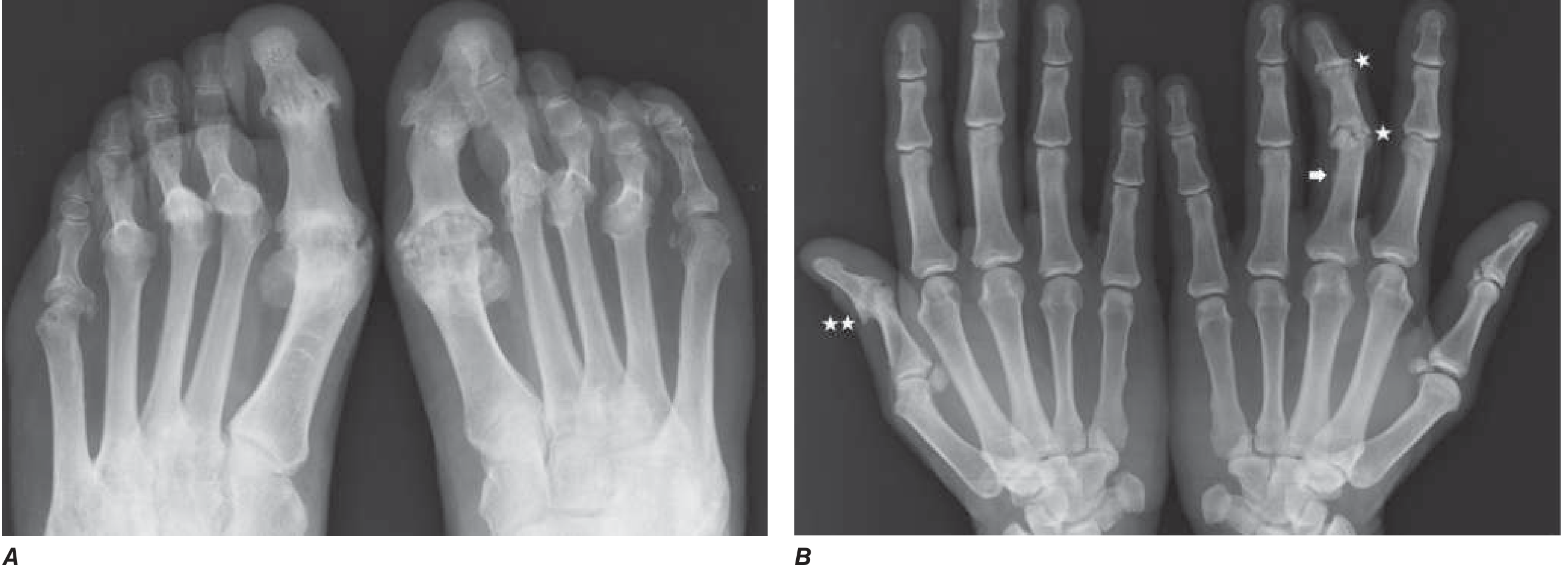
X-rays of the feet (A) and hands (B) in psoriatic arthritis - Harrison's Principles of Internal Medicine (22nd Ed, 2025)
Characteristic radiographic findings that distinguish PsA from RA include (Andrews' Diseases of the Skin, Goldman-Cecil):
- "Pencil-in-cup" deformity - tapering/whittling of phalanges with cupping of proximal ends; classic for arthritis mutilans/DIP disease
- Acrosteolysis - erosion of terminal phalangeal tufts
- Bony ankylosis - fusion in a ray distribution
- "Fluffy" periosteal new bone formation at erosion sites
- Asymmetric sacroiliitis (vs. bilateral in AS)
- Relative sparing of MCP/MTP joints (predilection for DIP/PIP joints)
- Soft tissue swelling (especially in dactylitis)
Diagnosis - CASPAR Criteria
The Classification of Psoriatic Arthritis (CASPAR) criteria require:
- Inflammatory articular disease (joint, spine, or entheseal), plus
- At least 3 points from 5 categories (current psoriasis = 2 pts; history of psoriasis = 1 pt; nail changes = 1 pt; negative RF = 1 pt; dactylitis = 1 pt; juxta-articular new bone formation = 1 pt)
Specificity: 98.7%, Sensitivity: 91.4% - Harrison's Principles of Internal Medicine (22nd Ed)
Differential diagnosis includes RA, seborrheic dermatitis (skin), dyshidrotic eczema, fungal infection, keratoderma blennorrhagicum.
Treatment
Management follows a treat-to-target approach. (Goldman-Cecil Medicine, Andrews' Diseases of the Skin)
Step 1 - Symptomatic relief
- NSAIDs - first-line for musculoskeletal symptoms; used at highest tolerable doses
Step 2 - Conventional DMARDs (for swollen joints, structural damage, or extra-articular features)
- Methotrexate (up to 25 mg/week)
- Sulfasalazine (up to 3 g/day)
- Leflunomide
- Cyclosporine / Tacrolimus
Note: Conventional DMARDs are NOT effective for axial disease
Step 3 - Biologic DMARDs (if conventional DMARDs fail or active disease persists after ~8 weeks of NSAIDs)
| Drug Class | Agents |
|---|---|
| Anti-TNF | Infliximab, Etanercept, Adalimumab, Golimumab, Certolizumab |
| Anti-IL-17A | Secukinumab, Ixekizumab |
| Anti-IL-12/23 | Ustekinumab (45 mg SC at 0 & 4 wks, then q3 months) |
| Anti-IL-23 (p19) | Guselkumab (100 mg SC at 0 & 4 wks, then q8 weeks) |
Step 4 - JAK inhibitors (oral targeted synthetic DMARDs)
- Tofacitinib 5 mg twice daily
- Upadacitinib 15 mg once daily
Adjuncts
- Apremilast (PDE4 inhibitor) - useful for mild-moderate disease
- Local glucocorticoid injections for specific joint flares
- Topical corticosteroids for mild skin disease
- Rest, splinting, passive motion for joint protection
Screening before biologics/JAK inhibitors: Latent TB, Hepatitis B, Hepatitis C testing required before initiating therapy.
Comorbidities
Patients with psoriasis and PsA have increased risk of:
- Metabolic syndrome (2.9x more frequent in psoriasis patients)
- Cardiovascular disease (hypertension in ~35%, hyperlipidemia in ~30%)
- Myocardial infarction (especially in younger patients with severe disease)
- Rheumatoid arthritis, Crohn's disease, ulcerative colitis
- Hodgkin's and cutaneous T-cell lymphoma
- Depression and psychosocial impairment
Sources: Goldman-Cecil Medicine (International Ed.) | Harrison's Principles of Internal Medicine (22nd Ed, 2025) | Andrews' Diseases of the Skin | Fitzpatrick's Dermatology | Frameworks for Internal Medicine | NIAMS Arthritis Overview
This is a shared conversation. Sign in to Orris to start your own chat.