
Obg seminar topics 1.Describe and discuss the etiology, classification 2.clinical features, diagnosis, investigations 3.principles of management and preventive aspects of prolapse of uterus This is the topic....in this last one that is 3rd topic is mine
uterine prolapse management principles prevention seminar obstetrics gynecology
https://emedicine.medscape.com/article/264231-treatment
uterine prolapse stages classification diagram
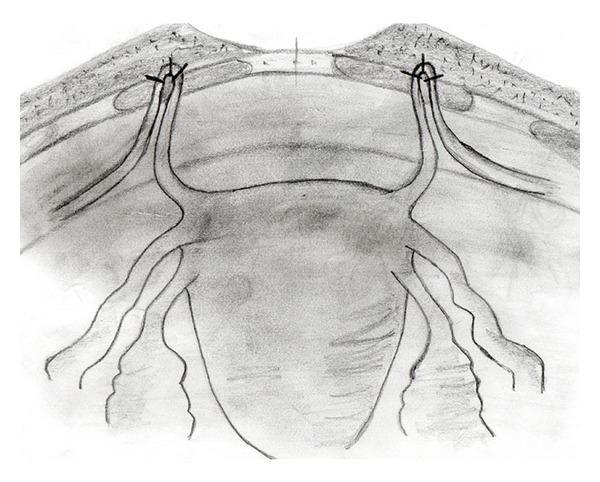
Anatomical Diagram: A black-and-white schematic illustration demonstrating the surgical fixation of the round ligaments to the anterior rectus fascia, likely for the management of pelvic organ prolapse. The diagram provides an anterior view of the uterus and its supporting structures. The uterine fundus is shown in the center, with the round ligaments extending bilaterally. These ligaments are depicted being pulled cranially and looped through small fenestrations in the rectus abdominis muscle layer. The apical 'ans' or loop of each round ligament is secured to the overlying fascia using three distinct sutures, represented by 'x' markers. Additional adnexal structures, including the fallopian tubes and utero-ovarian ligaments, are visible extending from the uterine cornua. The illustration emphasizes the anatomical relationship between the pelvic viscera and the abdominal wall fascia during a suspension procedure, highlighting the point of mechanical support and the method of non-absorbable suture fixation used to stabilize the uterine position.
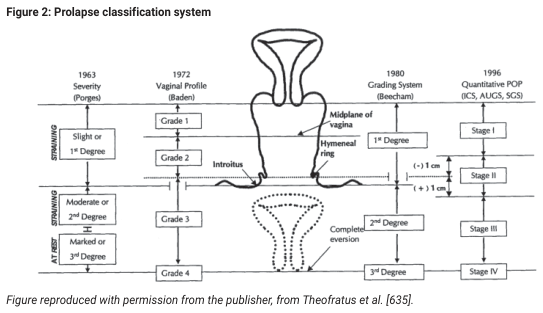
Summary : This figure presents a comparative overview of four prolapse classification systems used between 1963 and 1996, mapping their grading criteria onto anatomical diagrams of vaginal prolapse severity, and aligning terminology and measurement thresholds across systems. diagram: # Prolapse Classification Systems Overview : • Four classification systems are compared: 1963 Severity (Porges), 1972 Vaginal Profile (Baden), 1980 Grading System (Beecham), and 1996 Quantitative POP (ICS, AUGS, SGS). • The systems are aligned horizontally, with anatomical diagrams in the center showing prolapse positions relative to the midplane of the vagina, hymeneal ring, and introitus. ## 1963 Severity (Porges) : • Slight or 1st Degree • Moderate or 2nd Degree • Marked or 3rd Degree ## 1972 Vaginal Profile (Baden) : • Grade 1 • Grade 2 • Grade 3 • Grade 4 ## 1980 Grading System (Beecham) : • 1st Degree (above hymeneal ring) • 2nd Degree (to or through hymeneal ring) • 3rd Degree (complete eversion) ## 1996 Quantitative POP (ICS, AUGS, SGS) : • Stage I (−1 cm) • Stage II (between −1 cm and +1 cm) • Stage III (beyond +1 cm) • Stage IV (complete eversion) # Anatomical Reference Points : • Midplane of vagina • Hymeneal ring • Introitus • Complete eversion (dotted outline) # Mapping and Correspondence : • Each system’s grades are mapped to anatomical positions and to each other. • The diagram shows prolapse progression from slight descent (above hymeneal ring) to complete eversion (beyond introitus). # Analysis : • The figure visually aligns historical and modern prolapse grading systems, clarifying how each system’s terminology and thresholds correspond anatomically. • The 1996 system introduces quantitative measurements (in centimeters) for more precise staging. • All systems recognize a spectrum from mild descent to complete eversion, but differ in terminology and anatomical reference points.
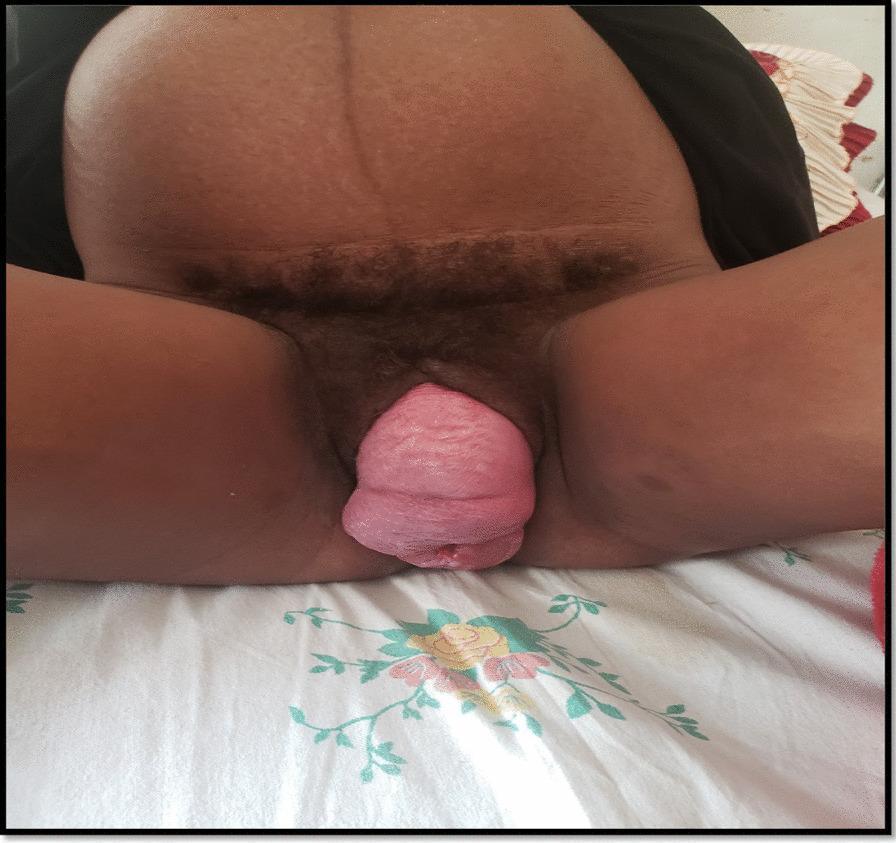
This clinical photograph demonstrates a severe case of stage IV pelvic organ prolapse (procidentia) in a patient. The image shows a large, cylindrical, pinkish-red mass of tissue protruding entirely beyond the vaginal introitus and lying on the vulva. The visible structures include the everted anterior and posterior vaginal walls and the uterine cervix, which occupies the most distal portion of the prolapsed mass. The surface texture of the prolapsed tissue appears moist and slightly lobulated with visible rugae. This visual representation illustrates maximal descent of pelvic organs as defined by the Pelvic Organ Prolapse Quantification (POP-Q) system, where the entire vaginal length is essentially everted. The clinical context suggests a profound failure of the pelvic floor support structures, including the cardinal and uterosacral ligaments. This material is highly relevant for medical education in gynecology, specifically for identifying advanced stages of pelvic floor dysfunction and understanding the anatomical landmarks involved in total vault prolapse.
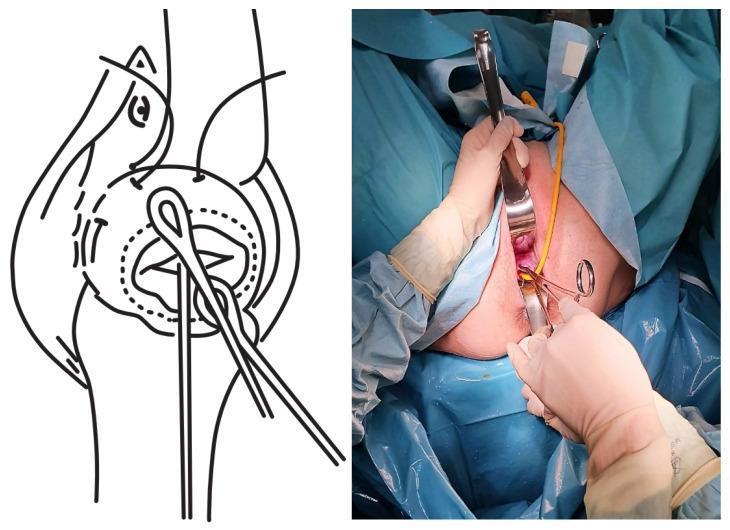
This composite image illustrates the reduction of prolapsed fetal membranes during an emergency cervical cerclage procedure, featuring a side-by-side clinical photograph and schematic diagram. The right panel is a clinical photograph showing the vaginal surgical field draped in blue sterile sheets. A surgeon's gloved hands are seen utilizing a metallic vaginal retractor and surgical forceps to expose the cervix. A yellow Foley catheter is inserted through the cervical canal, utilized here to manually reduce the bulging amniotic sac (membranes) back into the uterine cavity. The left panel provides a corresponding schematic illustration of the female pelvic anatomy, specifically detailing the cervix, uterus, and the placement of surgical instruments. The diagram highlights the mechanical process of using a catheter balloon and purse-string sutures to stabilize the prolapse and secure the cervical os. This educational material is designed for obstetrics and gynecology training, specifically focused on surgical management of cervical insufficiency and fetal membrane prolapse.
ring pessary pelvic organ prolapse treatment
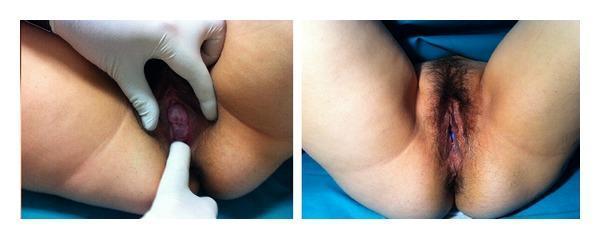
A side-by-side clinical photograph documenting uterine prolapse and its subsequent management with a pessary in a pregnant patient. The left panel shows a clinical examination of the vulva with a gloved hand retracting the labia. The cervix is visibly descended and protruding through the vaginal introitus, characteristic of grade 2 pelvic organ prolapse. The cervical tissue appears hyperemic and edematous. The right panel displays the external female genitalia following the placement of an Arabin cerclage pessary. In this view, the prolapse is reduced, and a portion of the blue silicone pessary is visible within the vaginal canal, positioned to support the cervix and maintain its placement. The image illustrates a non-surgical management strategy for symptomatic uterine prolapse and acute urinary retention during pregnancy. Educational concepts include pelvic floor anatomy, grading of organ prolapse, and mechanical support devices in obstetrics and gynecology.
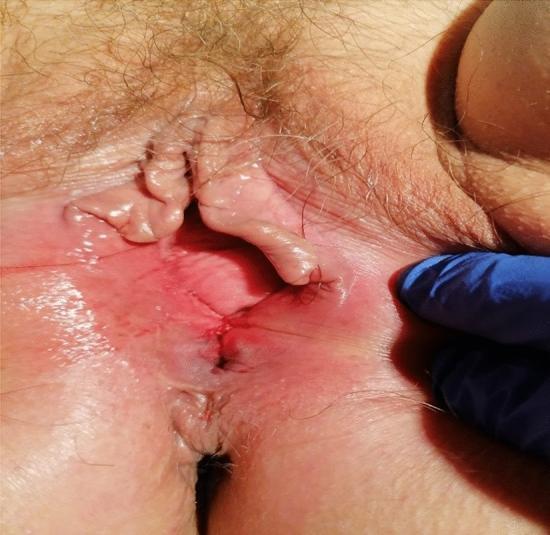
This clinical photograph shows the post-procedure appearance of the female perineum following the insertion of a pessary for pelvic organ prolapse management. The image displays the external genitalia with three independent resorbable sutures placed at the perineum to narrow the vaginal introitus and prevent pessary expulsion. The surgical site exhibits expected post-operative changes, including moderate erythema, localized edema of the labia, and slightly raised tissue along the suture line. A blue-gloved hand is visible on the right lateral aspect, providing retraction to optimize visualization of the approximated tissues and suture integrity. The surrounding skin shows normal follicular distribution with mild signs of procedure-related irritation. This visual demonstrates a conservative surgical technique for stabilizing mechanical treatments in advanced pelvic floor dysfunction.
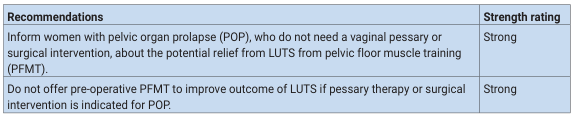
<table><thead><tr><th>Recommendations</th><th>Strength rating</th></tr></thead><tbody><tr><td>Inform women with pelvic organ prolapse (POP), who do not need a vaginal pessary or surgical intervention, about the potential relief from LUTS from pelvic floor muscle training (PFMT).</td><td>Strong</td></tr><tr><td>Do not offer pre-operative PFMT to improve outcome of LUTS if pessary therapy or surgical intervention is indicated for POP.</td><td>Strong</td></tr></tbody></table>
pelvic floor muscle exercises Kegel exercises anatomy
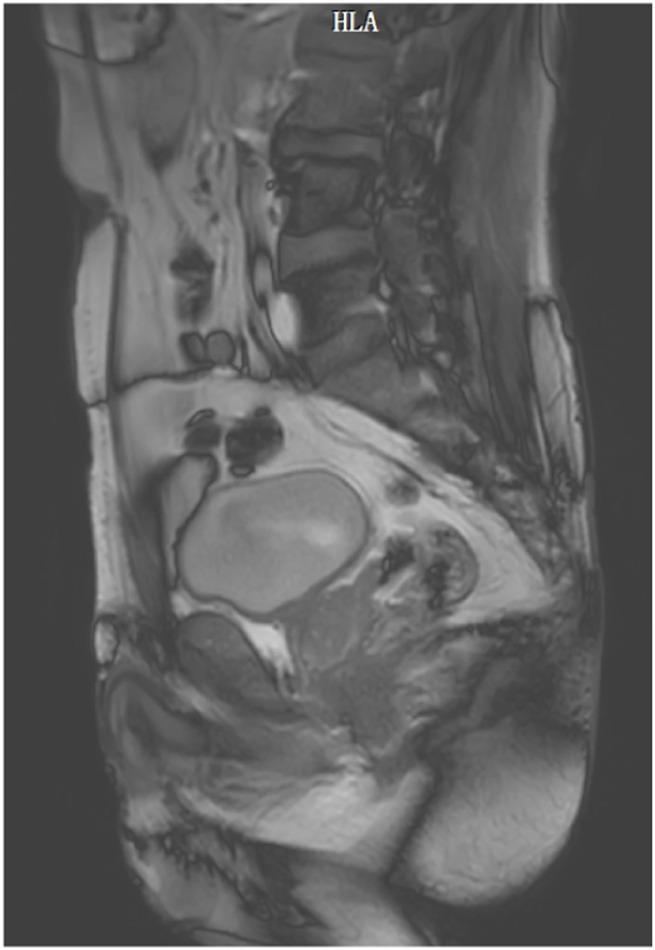
This diagnostic image is a midsagittal dynamic MRI of the pelvic region, captured using a BTFE sequence. The image clearly visualizes the pelvic floor anatomy and surrounding musculoskeletal structures. Key anatomical landmarks include the lower lumbar vertebrae, sacrum, and coccyx posteriorly. Centrally, the bladder is seen as a well-defined sac-like structure with a homogenous signal, situated anterior to the rectum. The levator ani muscle complex is visible as a muscular band extending toward the coccyx, providing support to the pelvic organs. The pelvic floor musculature, subcutaneous fat (appearing as high-intensity signal), and fascial planes between organs are delineated. This dynamic imaging modality is utilized to assess the functional movement of the pelvic organs during maneuvers such as the Valsalva or Kegel exercises, allowing for the clinical evaluation of conditions like pelvic organ prolapse, urinary incontinence, and defecation dysfunction by measuring changes in the anorectal angle (ARA) and retrovesical angle (RVA).
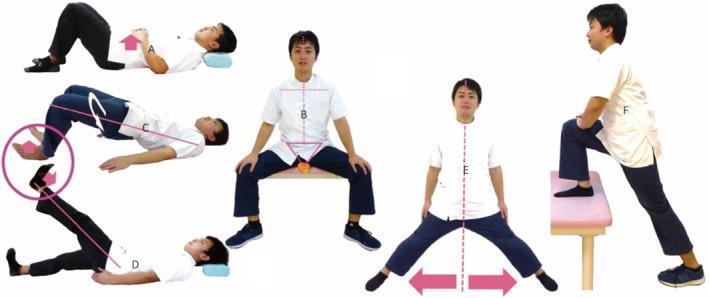
A multi-panel clinical photograph illustrating a series of therapeutic exercises for Pelvic Floor Muscle Training (PFMT) and core stabilization. Panel (a) shows abdominal breathing in a supine position with knees flexed. Panel (b) depicts a sitting position with hip abduction and neutral trunk alignment, utilizing a rolled towel for pelvic floor biofeedback. Panel (c) illustrates a bridge exercise with active hip external rotation and ankle dorsiflexion, targeting the gluteal and core muscles. Panel (d) shows a straight leg raise combined with ankle dorsiflexion. Panel (e) demonstrates a standing wide-base abduction exercise. Panel (f) shows a functional step-up exercise on a platform, designed to simulate movement patterns like climbing while emphasizing pelvic tilt and stabilization. Arrows and overlays highlight specific biomechanical vectors, such as diaphragmatic movement, joint alignment, and muscle engagement points. This sequence is intended for rehabilitative use in conditions like urinary incontinence or post-surgical recovery, focusing on the coordination of the pelvic floor, trunk, and hip musculature.
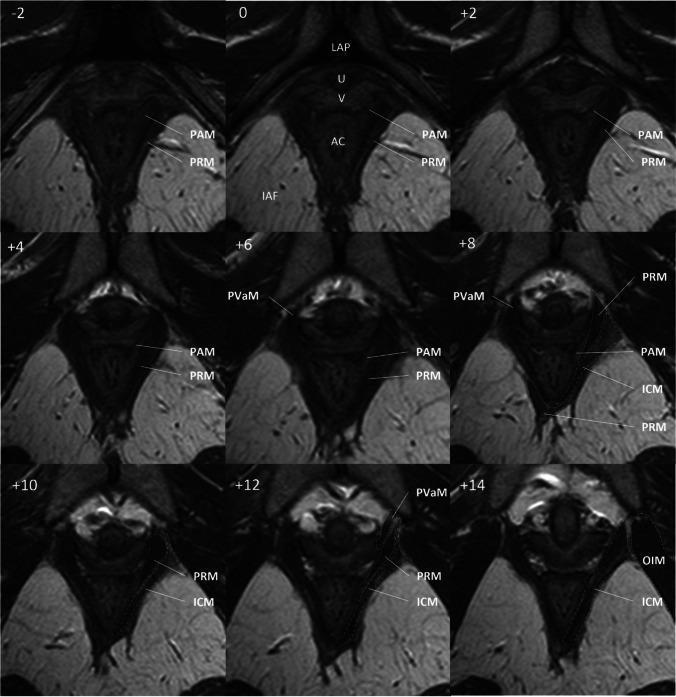
This diagnostic image consists of a series of nine axial T2-weighted MRI scans showing the female pelvic floor anatomy in a healthy 28-year-old subject. The scans are organized sequentially from -2 mm (caudal) to +14 mm (cranial) relative to the arcuate pubic ligament (LAP, plane 0). Key pelvic structures identified include the urethra (U), vagina (V), and anal canal (AC). The series focuses on the subdivisions of the levator ani muscle group. In the distal planes (-2 to +4), the puboanal muscle (PAM) and puborectal muscle (PRM) are clearly visible, with the PAM located medially to the PRM. As the sections move cranially (+6 to +14), additional muscular structures appear, including the pubovaginal muscle (PVaM), the iliococcygeal muscle (ICM), and the most lateral obturator internus muscle (OIM). The ischioanal fossa (IAF) is visible as a high-signal (bright) fatty area. This sequence illustrates the normal spatial relationships and origins of the pelvic floor musculature, serving as a reference for assessing pelvic organ prolapse or muscle trauma.
Seminar Topic 3: Principles of Management and Preventive Aspects of Prolapse of Uterus
INTRODUCTION
- Relieve symptoms caused by the prolapse
- Restore normal vaginal anatomy and pelvic organ support
- Preserve or improve sexual function where desired
- Prevent worsening of prolapse
- Avoid or delay the need for surgery where possible
OVERVIEW OF MANAGEMENT
-
Conservative (Non-surgical) Management
- Lifestyle modifications
- Pelvic floor muscle training (PFMT)
- Mechanical devices (Pessaries)
- Pharmacological adjuncts (Topical estrogen)
-
Surgical Management
- Reconstructive (native tissue repair)
- Compensatory/Augmentative (mesh/graft)
- Obliterative (colpocleisis)
-
Prevention
A. CONSERVATIVE (NON-SURGICAL) MANAGEMENT
- Mild to moderate prolapse (Stages I-II)
- Women desiring preservation of future fertility
- Women who are poor surgical candidates
- Women who decline surgery
- Prolapse during pregnancy
1. Lifestyle Modifications
| Intervention | Rationale |
|---|---|
| Weight loss (BMI >25 kg/m²) | Reduces chronic intra-abdominal pressure |
| Treat & manage constipation | Prevents repeated Valsalva straining |
| Treat chronic cough | Reduces episodic pressure spikes |
| Avoid heavy lifting | Minimizes pelvic floor stress |
| High fiber diet | Reduces straining at stool |
| Smoking cessation | Reduces cough; improves tissue oxygenation |
2. Pelvic Floor Muscle Training (PFMT) - Kegel Exercises
- PFMT produces greater improvement than controls in prolapse symptom score (Mean Difference -3.07, 95% CI -3.91 to -2.23) and POP staging (RR 1.70, 95% CI 1.19-2.44)
- A randomized trial showed women doing individualized PFMT reported significantly fewer prolapse symptoms at 12 months vs. those receiving only a lifestyle leaflet
- Effective for POP Stages I-III; response rate decreases when prolapse extends beyond the vaginal introitus
- 12 months of supervised PFMT has been shown to be effective in reducing prolapse symptoms
- Identify the correct muscles (as if stopping urination midstream)
- Contract pelvic floor for 5-10 seconds, then relax
- 10-15 repetitions, 3 times per day
- Continue for a minimum of 16 weeks to assess benefit
3. Vaginal Pessaries (Mechanical Devices)
- Significant comorbidities making surgery risky
- Patient preference for non-surgical management
- Future pregnancy desired
- Prolapse during pregnancy
- Bridge therapy while awaiting surgery
- Elderly/frail patients
- Acute pelvic inflammatory disease (PID)
- Pain on insertion
- Recurrent vaginitis (relative contraindication)
| Category | Types | Use |
|---|---|---|
| Support pessaries | Ring, Gehrung, Hodge, Shaatz | Stages I-II POP, SUI |
| Space-filling pessaries | Gellhorn, Cube, Donut, Inflatob | Stages III-IV, wide introitus |
- The ring pessary is the most commonly used - inserted between the posterior fornix and the pubic bone
- Gellhorn pessary is preferred for severe prolapse
- Initial reassessment at 1-2 weeks after fitting - assess inflammatory response, ulceration, urinary/defecatory problems
- Replacement every 3-6 months (Bailey & Love's) or cleaning/replacement every 8-12 weeks if patient cannot self-manage (Medscape)
- Patient may be taught to remove and clean pessary herself, or advised to douche weekly with weak vinegar solution
- Vaginal ulceration and erosion
- Vaginal discharge and infection
- Bleeding
- Pessary expulsion (especially in pregnancy as uterus enlarges)
- Fistula formation (with neglected pessaries)
- Urinary retention or incontinence
4. Topical Estrogen
- Important adjunct in conservative and surgical management
- Applied to the everted vaginal epithelium, particularly when signs of hypoestrogenism are present (postmenopausal women)
- Increases vaginal tissue strength, elasticity, and vascularity
- Reduces risk of pessary-related ulceration
- May help improve success rates of pessary fitting
- Used both pre-operatively (to optimize tissue quality) and post-operatively
B. SURGICAL MANAGEMENT
When Is Surgery Indicated?
- Conservative treatment has failed or is not desired
- Prolapse is symptomatic OR Stage II or greater with apparent progression
- Bothersome symptoms: pelvic pressure, vaginal bulge, urinary/bowel dysfunction, sexual dysfunction
- Patient is fit for surgery and desires definitive treatment
Principles of Surgical Management
- Reconstructive - uses the patient's own (native) support tissues
- Compensatory/Augmentative - replaces deficient support with permanent graft or mesh material
- Obliterative - closes or partially closes the vagina (for non-sexually active patients)
- Vaginal approach - most common for uterovaginal prolapse
- Abdominal approach (open or laparoscopic)
- Combined approach
Surgical Procedures - Summary Table
| Condition | Surgical Procedure | Complications |
|---|---|---|
| Urethrocele/Cystocele | Anterior colporrhaphy (anterior vaginal wall repair, without mesh) | Bleeding, infection, fistula, voiding dysfunction, unmasking occult SUI, recurrence |
| Uterine prolapse (family complete) | Vaginal hysterectomy +/- sacrospinous fixation | Bleeding, infection, fistula, recurrence |
| Uterine prolapse (uterus-preserving) | Manchester repair (cervical amputation + plication of transverse cervical ligaments) | Cervical stenosis, Asherman's syndrome |
| Uterine prolapse (uterus-preserving) | Hysteropexy - vaginal (sacrospinous ligament fixation) or laparoscopic/abdominal (sacrohysteropexy with polypropylene mesh) | Mesh erosion, dyspareunia |
| Enterocele | Enterocele repair (obliteration of peritoneal sac) | Bowel injury |
| Vault prolapse (post-hysterectomy) | Sacrocolpopexy (mesh to sacral promontory) or sacrospinous fixation | Mesh erosion, recurrence |
| Rectocele | Posterior colporrhaphy (posterior vaginal wall repair) | Dyspareunia, defecatory dysfunction |
| All types (non-sexually active) | Colpocleisis (LeFort's procedure) - partial or total vaginal closure | Irreversible; urinary retention |
Key Individual Procedures
1. Vaginal Hysterectomy
- Procedure of choice when the family is complete
- Done with or without vaginal vault suspension (sacrospinous fixation)
- Corrects uterine descent and allows simultaneous repair of cystocele/rectocele
2. Manchester (Fothergill) Repair
- Uterus-conserving procedure
- Involves: amputation of the elongated cervix + suturing of transverse cervical (Mackenrodt's) ligaments anteriorly to the cervical stump
- Suitable for younger women with cervical elongation and incomplete family
- Risk: cervical stenosis (affecting future fertility/menstruation)
3. Sacrospinous Ligament Fixation
- Vaginal approach
- Sutures the vaginal apex or uterus to the sacrospinous ligament
- Advantages: vaginal route, faster recovery
- Risk: buttock pain (pudendal nerve), recurrence of anterior wall prolapse
4. Sacrocolpopexy / Sacrohysteropexy
- Abdominal or laparoscopic approach
- Polypropylene mesh suspends the vaginal vault (or uterus) to the sacral promontory
- Gold standard for vault prolapse
- Risk: mesh erosion, bowel injury
5. Colpocleisis (LeFort's Procedure)
- Obliteration of vaginal canal - strips of anterior and posterior vaginal epithelium removed and raw surfaces approximated
- Only for women who no longer wish penetrative intercourse
- Very effective, low recurrence
- Quick procedure - suitable for elderly high-risk patients
6. Anterior Colporrhaphy
- Repair of anterior vaginal wall (cystocele)
- Plication of pubocervical fascia in the midline
7. Posterior Colporrhaphy + Perineorrhaphy
- Repair of posterior vaginal wall (rectocele) and perineal body
Special Situations
- Management is individualized based on: age, parity, gestational age, prolapse stage, patient preference
- Options: bed rest in Trendelenburg position, genital hygiene, manual reduction, insertion of pessary
- Pessaries are often expelled as gestation advances due to enlarging pelvic diameters
- If pessary stays in place, it is removed at onset of labor
- No standard guidelines for delivery mode; individualized decision
- Pessary management preferred
- If surgery needed: colpocleisis is quick, effective, and low-risk
C. PREVENTIVE ASPECTS
1. Primary Prevention (Preventing the Occurrence)
- Supervised labour with proper partograph monitoring - prevents prolonged labor
- Episiotomy when indicated to prevent perineal lacerations (though controversial; selective use)
- Prompt repair of perineal tears (1st, 2nd, 3rd, 4th degree)
- Adequate rest after childbirth (minimum 40 days traditionally)
- Spacing of pregnancies - reduces cumulative pelvic floor trauma
- Avoid bearing down before full dilatation
- Skilled birth attendant at every delivery
- Caesarean section in selected cases (obstructed labour, malpresentation) to avoid prolonged pelvic floor stretching
- Avoid instrumental delivery (forceps, vacuum) unless indicated and performed skillfully
- Avoid early resumption of heavy physical work post-delivery
- Maintain healthy body weight (BMI <25 kg/m²) - obesity increases intra-abdominal pressure
- High fiber diet + adequate hydration - prevents constipation and straining
- Smoking cessation - prevents chronic cough
- Treat chronic cough (COPD, asthma, tuberculosis)
- Avoid heavy lifting occupationally and recreationally
- Regular physical activity - helps maintain healthy weight and overall muscle tone
- Estrogen replacement therapy (HRT) in postmenopausal women - maintains collagen content and tissue integrity of pelvic floor
- Prevents atrophic changes in supporting ligaments and fasciae
- Awareness programs for mothers and communities about prolapse risk factors and prevention
- Instructional programs have been shown to improve maternal attitudes toward prevention
2. Secondary Prevention (Early Detection and Limiting Progression)
- Pelvic floor muscle training (PFMT/Kegel exercises) begun in pregnancy and continued postnatally - the most evidence-based secondary prevention strategy
- Antenatal PFMT from the first trimester onward
- Postnatal physiotherapy - pelvic floor rehabilitation after delivery
- Routine postnatal assessment of pelvic floor function
- Treat asymptomatic or mild prolapse early with PFMT before it progresses
- Regular gynecological check-ups to detect subclinical prolapse
3. Tertiary Prevention (Preventing Recurrence After Treatment)
- Long-term PFMT after surgical or pessary treatment
- Continued lifestyle modification (weight control, avoid straining, treat cough/constipation)
- Topical estrogen in postmenopausal women post-repair
- Regular follow-up after pessary fitting or surgery
- Avoid recurrence risk factors: no heavy lifting for 3-6 months post-surgery, stool softeners post-op
D. FOLLOW-UP PROTOCOL
| After Treatment | Follow-up Schedule |
|---|---|
| Pessary fitting | 1-2 weeks, then every 3-6 months |
| Conservative (PFMT) | 3-month assessment of symptom improvement |
| Post-surgery | 6 weeks, 3 months, 6 months, then annually |
| Elderly with pessary (unable to self-manage) | Every 8-12 weeks for provider change |
E. PROGNOSIS
- Surgical success rates: 75-90% for most reconstructive procedures, though recurrence rates vary by technique
- Vaginal hysterectomy + vault suspension: good long-term outcomes
- Mesh-augmented sacrocolpopexy: lowest recurrence rates for apical prolapse (~5-10%)
- Manchester repair: 70-90% success for appropriate candidates
- Colpocleisis: >95% success in properly selected patients
- PFMT alone: effective for Stages I-III; less so once prolapse is beyond the introitus
KEY POINTS FOR SEMINAR
- No single treatment fits all - management must be individualized based on age, parity, desire for fertility/coitus, degree of prolapse, associated defects, and comorbidities
- Conservative treatment first for mild-moderate prolapse - lifestyle modification + PFMT + pessary + topical estrogen
- Pessary is the safest and most effective conservative option; ring pessary is the most commonly used type
- Surgery is indicated for symptomatic Stage II+ prolapse failing conservative management
- Apical support is the key to long-term surgical success
- Vaginal hysterectomy is the gold standard for complete family; Manchester repair for uterus conservation
- LeFort's colpocleisis is reserved for elderly, non-sexually active women
- Prevention starts with proper obstetric care, PFMT during and after pregnancy, and addressing modifiable risk factors
- Estrogen plays a role at every stage - as prevention, adjunct to pessary, and post-surgical support
REFERENCES
- Berek JS, Novak E. Berek & Novak's Gynecology, 16th ed. Chapter 30 (Pelvic Organ Prolapse), pp. 1616-1655
- Norman S. Williams, ed. Bailey & Love's Short Practice of Surgery, 28th ed. Chapter 87, pp. 1611-1613
- POGS Clinical Practice Guidelines on Pelvic Organ Prolapse (2023)
- Lazarou G. Uterine Prolapse Treatment & Management. Medscape
- Johns Hopkins Medicine - Uterine Prolapse - Prevention
- Merck Manual - Uterine and Apical Prolapse
Tip for your seminar presentation: Your topic (Topic 3) connects directly to Topics 1 and 2. Open your session with a brief 2-slide recap of classification (Degrees I-IV / POP-Q) and key clinical features - this contextualizes why certain management approaches are chosen at different stages. Then dive into the management framework above. Conclude with a prevention algorithm - this is usually an area that earns good discussion in seminars.
My topic is only prevention not management
So your seminar topic is specifically the 'Preventive Aspects of Prolapse of Uterus' — do you also want me to include a brief intro on principles of management as context, or strictly prevention only? · What format do you need this in?
preventive aspects uterine prolapse primary secondary tertiary prevention obstetric measures
https://pmc.ncbi.nlm.nih.gov/articles/PMC4166938
mkdir -p /tmp/workspace/prolapse-seminar && ls /tmp/workspace/prolapse-seminar/
~/prolapse-seminar/create_doc.py
from docx import Document
from docx.shared import Pt, Inches, RGBColor
from docx.enum.text import WD_ALIGN_PARAGRAPH
from docx.oxml.ns import qn
from docx.oxml import OxmlElement
import copy

doc = Document()

# ── PAGE MARGINS ──────────────────────────────────────────────────────────────
from docx.shared import Inches
section = doc.sections[0]
section.top_margin    = Inches(1.0)
section.bottom_margin = Inches(1.0)
section.left_margin   = Inches(1.25)
section.right_margin  = Inches(1.0)

# ── DEFAULT STYLE ─────────────────────────────────────────────────────────────
normal = doc.styles["Normal"]
normal.font.name = "Times New Roman"
normal.font.size = Pt(12)

# ── HELPER: shade table row ───────────────────────────────────────────────────
def shade_cell(cell, hex_color):
    tc = cell._tc
    tcPr = tc.get_or_add_tcPr()
    shd = OxmlElement("w:shd")
    shd.set(qn("w:val"), "clear")
    shd.set(qn("w:color"), "auto")
    shd.set(qn("w:fill"), hex_color)
    tcPr.append(shd)

def bold_cell(cell, text, size=11, center=False):
    p = cell.paragraphs[0]
    if center:
        p.alignment = WD_ALIGN_PARAGRAPH.CENTER
    run = p.add_run(text)
    run.bold = True
    run.font.size = Pt(size)
    run.font.name = "Times New Roman"

def normal_cell(cell, text, size=11):
    p = cell.paragraphs[0]
    run = p.add_run(text)
    run.font.size = Pt(size)
    run.font.name = "Times New Roman"

# ── TITLE PAGE ────────────────────────────────────────────────────────────────
doc.add_paragraph()
doc.add_paragraph()

title_p = doc.add_paragraph()
title_p.alignment = WD_ALIGN_PARAGRAPH.CENTER
t = title_p.add_run("PREVENTIVE ASPECTS OF PROLAPSE OF UTERUS")
t.bold = True
t.font.size = Pt(18)
t.font.color.rgb = RGBColor(0x1A, 0x4E, 0x8A)
t.font.name = "Times New Roman"

doc.add_paragraph()

sub_p = doc.add_paragraph()
sub_p.alignment = WD_ALIGN_PARAGRAPH.CENTER
s = sub_p.add_run("Seminar Presentation | Obstetrics and Gynaecology")
s.italic = True
s.font.size = Pt(13)
s.font.name = "Times New Roman"

doc.add_paragraph()
doc.add_paragraph()

# horizontal rule via border
hr = doc.add_paragraph()
hr.paragraph_format.space_before = Pt(0)
hr.paragraph_format.space_after  = Pt(0)
pPr = hr._p.get_or_add_pPr()
pBdr = OxmlElement("w:pBdr")
bottom = OxmlElement("w:bottom")
bottom.set(qn("w:val"), "single")
bottom.set(qn("w:sz"), "12")
bottom.set(qn("w:space"), "1")
bottom.set(qn("w:color"), "1A4E8A")
pBdr.append(bottom)
pPr.append(pBdr)

doc.add_paragraph()

# ── SECTION HEADING HELPER ────────────────────────────────────────────────────
def add_heading(doc, text, level=1, color="1A4E8A"):
    h = doc.add_heading("", level=level)
    run = h.add_run(text)
    run.bold = True
    run.font.color.rgb = RGBColor(
        int(color[:2],16), int(color[2:4],16), int(color[4:],16))
    run.font.name = "Times New Roman"
    if level == 1:
        run.font.size = Pt(15)
        h.paragraph_format.space_before = Pt(14)
        h.paragraph_format.space_after  = Pt(6)
    elif level == 2:
        run.font.size = Pt(13)
        h.paragraph_format.space_before = Pt(10)
        h.paragraph_format.space_after  = Pt(4)
    else:
        run.font.size = Pt(12)
        h.paragraph_format.space_before = Pt(8)
        h.paragraph_format.space_after  = Pt(2)
    return h

def add_body(doc, text, bold=False, italic=False):
    p = doc.add_paragraph(style="Normal")
    p.paragraph_format.space_before = Pt(2)
    p.paragraph_format.space_after  = Pt(4)
    run = p.add_run(text)
    run.bold   = bold
    run.italic = italic
    run.font.size = Pt(12)
    run.font.name = "Times New Roman"
    return p

def add_bullet(doc, text, level=0):
    p = doc.add_paragraph(style="List Bullet")
    p.paragraph_format.left_indent = Inches(0.3 + 0.2*level)
    p.paragraph_format.space_before = Pt(1)
    p.paragraph_format.space_after  = Pt(1)
    run = p.add_run(text)
    run.font.size = Pt(12)
    run.font.name = "Times New Roman"
    return p

def add_numbered(doc, text):
    p = doc.add_paragraph(style="List Number")
    p.paragraph_format.left_indent = Inches(0.3)
    run = p.add_run(text)
    run.font.size = Pt(12)
    run.font.name = "Times New Roman"
    return p

# ═══════════════════════════════════════════════════════════════════════════════
# 1. INTRODUCTION
# ═══════════════════════════════════════════════════════════════════════════════
add_heading(doc, "1. INTRODUCTION", 1)
add_body(doc,
    "Uterine prolapse is the descent of the uterus and cervix down the vaginal canal "
    "toward or beyond the vaginal introitus, resulting from failure of the pelvic floor "
    "support structures (levator ani muscles, endopelvic fascia, and ligamentous "
    "condensations). It affects millions of women worldwide and is one of the leading "
    "reproductive health problems, particularly in low- and middle-income countries.")
add_body(doc,
    "Since there is no single definitive cure that is universally successful, prevention "
    "is far more effective and cost-efficient than treatment. Prevention operates at "
    "three levels: primary, secondary, and tertiary.")

# ═══════════════════════════════════════════════════════════════════════════════
# 2. WHY PREVENTION MATTERS - RISK FACTORS
# ═══════════════════════════════════════════════════════════════════════════════
add_heading(doc, "2. UNDERSTANDING RISK FACTORS (Basis of Prevention)", 1)
add_body(doc,
    "Rational prevention requires understanding the modifiable and non-modifiable risk "
    "factors. Prevention strategies are targeted at the modifiable ones.")

# Risk factor table
doc.add_paragraph()
tbl = doc.add_table(rows=1, cols=3)
tbl.style = "Table Grid"
hdr = tbl.rows[0].cells
bold_cell(hdr[0], "Category", center=True)
bold_cell(hdr[1], "Risk Factor", center=True)
bold_cell(hdr[2], "Modifiable?", center=True)
for cell in hdr:
    shade_cell(cell, "1A4E8A")
    hdr[0].paragraphs[0].runs[0].font.color.rgb = RGBColor(0xFF,0xFF,0xFF)
    hdr[1].paragraphs[0].runs[0].font.color.rgb = RGBColor(0xFF,0xFF,0xFF)
    hdr[2].paragraphs[0].runs[0].font.color.rgb = RGBColor(0xFF,0xFF,0xFF)

rows_data = [
    ("Obstetric", "Vaginal delivery (strongest risk factor)", "Partially"),
    ("Obstetric", "Multiparity / High parity", "Yes (birth spacing)"),
    ("Obstetric", "Instrumental delivery (forceps)", "Yes (judicious use)"),
    ("Obstetric", "Prolonged / obstructed labour", "Yes (skilled care)"),
    ("Obstetric", "Perineal tears (unrepaired)", "Yes"),
    ("Obstetric", "Early return to heavy work postpartum", "Yes"),
    ("Demographic", "Advancing age / Menopause", "No"),
    ("Demographic", "Caucasian / Hispanic ethnicity", "No"),
    ("Lifestyle", "Obesity (BMI > 25 kg/m²)", "Yes"),
    ("Lifestyle", "Chronic constipation / straining", "Yes"),
    ("Lifestyle", "Smoking / Chronic cough (COPD)", "Yes"),
    ("Lifestyle", "Heavy lifting (occupational)", "Yes"),
    ("Hormonal", "Hypoestrogenism (postmenopausal)", "Yes (HRT/topical estrogen)"),
    ("Surgical", "Prior hysterectomy", "Yes (technique)"),
    ("Connective tissue", "Ehlers-Danlos / Marfan syndrome", "No"),
    ("Nutritional", "Malnutrition / Anaemia", "Yes"),
]
for cat, rf, mod in rows_data:
    r = tbl.add_row().cells
    normal_cell(r[0], cat)
    normal_cell(r[1], rf)
    normal_cell(r[2], mod)

doc.add_paragraph()
add_body(doc,
    "Key fact: Women with at least one vaginal delivery are TWICE as likely as nulliparous "
    "women to develop POP. Forceps delivery further increases this risk. Elective/unlabored "
    "caesarean section appears to be protective against prolapse.",
    bold=False, italic=True)

# ═══════════════════════════════════════════════════════════════════════════════
# 3. LEVELS OF PREVENTION
# ═══════════════════════════════════════════════════════════════════════════════
add_heading(doc, "3. LEVELS OF PREVENTION", 1)
add_body(doc, "Prevention of uterine prolapse is organized into three levels:")

lvl_tbl = doc.add_table(rows=1, cols=3)
lvl_tbl.style = "Table Grid"
lhdr = lvl_tbl.rows[0].cells
bold_cell(lhdr[0], "Level", center=True)
bold_cell(lhdr[1], "Definition", center=True)
bold_cell(lhdr[2], "Target", center=True)
for cell in lhdr:
    shade_cell(cell, "2E6FA8")
    for run in cell.paragraphs[0].runs:
        run.font.color.rgb = RGBColor(0xFF,0xFF,0xFF)

lvl_rows = [
    ("Primary Prevention", "Preventing the occurrence of prolapse", "Healthy women; antenatal & postnatal period"),
    ("Secondary Prevention", "Early detection and limiting progression", "Women with early/asymptomatic prolapse"),
    ("Tertiary Prevention", "Preventing complications and recurrence", "Women with established prolapse"),
]
for l, d, t in lvl_rows:
    r = lvl_tbl.add_row().cells
    normal_cell(r[0], l)
    normal_cell(r[1], d)
    normal_cell(r[2], t)

doc.add_paragraph()

# ═══════════════════════════════════════════════════════════════════════════════
# 4. PRIMARY PREVENTION
# ═══════════════════════════════════════════════════════════════════════════════
add_heading(doc, "4. PRIMARY PREVENTION", 1)
add_body(doc,
    "Primary prevention aims to prevent the occurrence of prolapse by targeting "
    "modifiable risk factors BEFORE the condition develops. It emphasizes educating "
    "and empowering women, creating awareness at the family, community, and national "
    "levels, and providing skilled care during pregnancy and childbirth.")

# ── 4A. OBSTETRIC MEASURES ───────────────────────────────────────────────────
add_heading(doc, "A. Proper Obstetric Care", 2)
add_body(doc,
    "Childbirth is the single most important preventable risk factor for uterine prolapse. "
    "Proper management of pregnancy and labour is therefore the cornerstone of primary prevention.")

add_heading(doc, "i. Antenatal Measures", 3)
add_bullet(doc, "Regular antenatal check-ups to identify high-risk pregnancies (malpresentation, CPD, anaemia)")
add_bullet(doc, "Treat anaemia and malnutrition - poor nutritional status weakens connective tissue and pelvic floor muscles")
add_bullet(doc, "Manage chronic cough, constipation, and other conditions that raise intra-abdominal pressure during pregnancy")
add_bullet(doc, "Antenatal pelvic floor muscle training (PFMT) - initiate from the first trimester")
add_bullet(doc, "Educate the mother about normal delivery, perineal care, and postpartum recovery")
add_bullet(doc, "Advise birth spacing of at least 2-3 years between pregnancies to allow pelvic floor recovery")

add_heading(doc, "ii. Intrapartum (Labour) Measures", 3)
add_bullet(doc, "Skilled birth attendance at every delivery - the most critical single intervention")
add_bullet(doc, "Proper partograph monitoring to detect and manage prolonged or obstructed labour early")
add_bullet(doc, "Avoid bearing down before full cervical dilatation to prevent premature perineal stress")
add_bullet(doc, "Selective and timely episiotomy when indicated (to prevent uncontrolled perineal tears) - note: routine episiotomy is NOT recommended; selective use only")
add_bullet(doc, "Prompt and adequate repair of all perineal tears (1st, 2nd, 3rd, 4th degree) in anatomical layers")
add_bullet(doc, "Judicious and skilled use of instrumental delivery (forceps/vacuum) - avoid unnecessary or traumatic application; forceps increases POP risk further")
add_bullet(doc, "Elective/unlabored caesarean section in selected cases (obstructed labour, malpresentation, contracted pelvis) - evidence shows this is protective against prolapse")
add_bullet(doc, "Avoid prolonged second stage of labour - if progress is poor, escalate care promptly")
add_bullet(doc, "Gentle management of the placenta (controlled cord traction) - avoid fundal pressure that strains the pelvic floor")

add_heading(doc, "iii. Postpartum Measures", 3)
add_bullet(doc, "Adequate rest after childbirth - avoid early resumption of heavy physical work (minimum 40 days traditionally; at least 6-8 weeks medically)")
add_bullet(doc, "Early postnatal pelvic floor rehabilitation - physiotherapy and PFMT (Kegel exercises) should begin within days of delivery")
add_bullet(doc, "Promotion of exclusive breastfeeding (indirect benefit via birth spacing through lactational amenorrhoea)")
add_bullet(doc, "Access to family planning - prevent unintended high-parity pregnancies")
add_bullet(doc, "Proper nutritional rehabilitation postpartum - iron, protein, vitamin C for tissue healing")
add_bullet(doc, "Avoid heavy lifting and strenuous work during the postnatal recovery period")

# ── 4B. PELVIC FLOOR MUSCLE TRAINING ─────────────────────────────────────────
add_heading(doc, "B. Pelvic Floor Muscle Training (PFMT) / Kegel Exercises", 2)
add_body(doc,
    "PFMT is the most widely recommended and evidence-supported non-invasive strategy "
    "for preventing uterine prolapse. It strengthens the levator ani and pubococcygeus "
    "muscles, restoring the supportive pelvic floor hammock beneath the pelvic organs.")

add_heading(doc, "How to Perform Kegel Exercises:", 3)
add_numbered(doc, "Identify the correct muscles: contract as if stopping the flow of urine midstream")
add_numbered(doc, "Contract the pelvic floor muscles for 5-10 seconds")
add_numbered(doc, "Relax for 10 seconds")
add_numbered(doc, "Repeat 10-15 times per set")
add_numbered(doc, "Perform 3 sets per day")
add_numbered(doc, "Continue for a minimum of 16 weeks to assess benefit")

add_body(doc, "Evidence:", bold=True)
add_bullet(doc, "PFMT results in greater improvement in prolapse symptom score (Mean Difference: -3.07, 95% CI -3.91 to -2.23) compared to controls")
add_bullet(doc, "Improvement in POP staging: RR 1.70 (95% CI 1.19-2.44) in favour of PFMT")
add_bullet(doc, "Effective for POP Stages I-III; response rate decreases once prolapse extends beyond the vaginal introitus")
add_bullet(doc, "One-to-one individualized PFMT for 16 weeks to 6 months is recommended for maximum benefit (POPPY Trial)")
add_bullet(doc, "Biofeedback therapy is a useful adjunct, especially for rectocele with impaired defecation")
add_bullet(doc, "Note: PFMT alone has not yet been conclusively proven to prevent de novo prolapse (inconclusive 12-year follow-up data), but it is widely recommended and improves symptoms significantly")

# ── 4C. LIFESTYLE MODIFICATIONS ──────────────────────────────────────────────
add_heading(doc, "C. Lifestyle Modifications", 2)
add_body(doc, "Targeting modifiable lifestyle risk factors can significantly reduce the risk of developing prolapse:")

life_tbl = doc.add_table(rows=1, cols=3)
life_tbl.style = "Table Grid"
lhdr2 = life_tbl.rows[0].cells
bold_cell(lhdr2[0], "Risk Factor", center=True)
bold_cell(lhdr2[1], "Preventive Action", center=True)
bold_cell(lhdr2[2], "Rationale", center=True)
for cell in lhdr2:
    shade_cell(cell, "2E6FA8")
    for run in cell.paragraphs[0].runs:
        run.font.color.rgb = RGBColor(0xFF,0xFF,0xFF)

life_rows = [
    ("Obesity", "Maintain BMI < 25 kg/m²; weight loss programmes", "Reduces chronic intra-abdominal pressure on pelvic floor"),
    ("Constipation", "High-fibre diet (25-35 g/day); adequate hydration (2-3 L/day)", "Prevents repeated Valsalva straining which damages pelvic floor"),
    ("Smoking/Chronic cough", "Smoking cessation; treat underlying respiratory disease (COPD, asthma, TB)", "Reduces episodic cough-related pressure spikes; improves tissue oxygenation"),
    ("Heavy lifting", "Avoid lifting > 10-15 kg; use proper body mechanics", "Minimizes sudden surges in intra-abdominal pressure"),
    ("Physical inactivity", "Regular moderate exercise (walking, swimming)", "Maintains healthy weight; improves pelvic floor tone"),
]
for rf, action, rat in life_rows:
    r = life_tbl.add_row().cells
    normal_cell(r[0], rf)
    normal_cell(r[1], action)
    normal_cell(r[2], rat)

doc.add_paragraph()

# ── 4D. HORMONAL / PHARMACOLOGICAL ───────────────────────────────────────────
add_heading(doc, "D. Hormonal Measures (Estrogen)", 2)
add_body(doc,
    "Estrogen plays a vital role in maintaining the collagen content, strength, and "
    "elasticity of the pelvic floor supporting structures (ligaments, fascia, and muscles).")
add_bullet(doc, "Hormone Replacement Therapy (HRT) or topical vaginal estrogen in postmenopausal women helps maintain tissue integrity")
add_bullet(doc, "Prevents atrophic changes in pelvic floor supporting structures")
add_bullet(doc, "Particularly relevant for women with premature menopause or surgical menopause (post-oophorectomy)")
add_bullet(doc, "Note: HRT must be prescribed judiciously weighing benefits against risks (breast cancer, thromboembolism)")

# ── 4E. EDUCATION & COMMUNITY AWARENESS ──────────────────────────────────────
add_heading(doc, "E. Education and Community Awareness", 2)
add_body(doc, "This is particularly important in low-resource and rural settings where prolapse prevalence is highest:")
add_bullet(doc, "Educate women about normal pelvic floor anatomy and the risk factors for prolapse")
add_bullet(doc, "Community health workers should spread awareness about importance of skilled birth attendance")
add_bullet(doc, "Empower women to seek antenatal and postnatal care")
add_bullet(doc, "Awareness programs for mothers have been shown to significantly improve attitudes toward prevention (JOGCR, 2026)")
add_bullet(doc, "Discourage cultural practices that lead to early heavy work resumption after childbirth")
add_bullet(doc, "Educate about importance of birth spacing and family planning")
add_bullet(doc, "School health programs to teach girls about pelvic floor health and Kegel exercises")
add_bullet(doc, "National-level campaigns: improve skilled delivery rates, antenatal coverage, and postnatal care")

# ── 4F. NUTRITIONAL MEASURES ─────────────────────────────────────────────────
add_heading(doc, "F. Nutritional Measures", 2)
add_bullet(doc, "Treat anaemia (iron, folic acid supplementation in pregnancy) - anaemia weakens muscle and connective tissue repair")
add_bullet(doc, "Adequate protein intake for muscle and collagen synthesis")
add_bullet(doc, "Vitamin C promotes collagen synthesis - important for ligament and fascial strength")
add_bullet(doc, "Prevent malnutrition - malnourished women have weaker pelvic floor support structures")
add_bullet(doc, "Avoid obesity through balanced diet - reduce saturated fats and processed foods")

# ═══════════════════════════════════════════════════════════════════════════════
# 5. SECONDARY PREVENTION
# ═══════════════════════════════════════════════════════════════════════════════
add_heading(doc, "5. SECONDARY PREVENTION", 1)
add_body(doc,
    "Secondary prevention involves early diagnosis of prolapse and taking measures to "
    "prevent its progression. It targets women who already have subclinical or early-stage "
    "prolapse (POP-Q Stages I and II) before symptoms become severe.")

add_heading(doc, "A. Early Detection - Identifying At-Risk Women", 2)
add_body(doc, "The following women should be screened proactively:")
add_bullet(doc, "Young multiparous mothers, especially after difficult/prolonged deliveries")
add_bullet(doc, "Women with a history of instrumental delivery (forceps/vacuum)")
add_bullet(doc, "Postmenopausal women with symptoms of pelvic pressure or urinary dysfunction")
add_bullet(doc, "Obese women with chronic constipation or cough")
add_bullet(doc, "Women with connective tissue disorders (Ehlers-Danlos, Marfan syndrome)")
add_bullet(doc, "Women with prior pelvic floor surgery (hysterectomy increases risk)")

add_heading(doc, "B. Regular Pelvic Examination", 2)
add_bullet(doc, "Routine pelvic exams can detect prolapse at an early, manageable stage")
add_bullet(doc, "Valsalva manoeuvre during examination reveals asymptomatic descent")
add_bullet(doc, "Don't wait until discomfort becomes severe - seek assessment at first symptom onset")
add_bullet(doc, "Postnatal pelvic floor assessment at 6-week postnatal check is essential")

add_heading(doc, "C. Conservative Management for Early Prolapse", 2)
add_body(doc, "Once early prolapse is detected, the following prevent progression:")
add_bullet(doc, "Intensive, supervised PFMT programme (16 weeks minimum; individualized sessions preferred)")
add_bullet(doc, "Biofeedback-assisted PFMT for better muscle activation")
add_bullet(doc, "Ring pessary insertion - most commonly used support pessary; effective first-line non-surgical option for Stage I-II prolapse")
add_bullet(doc, "Topical vaginal estrogen cream - improves tissue quality, especially in postmenopausal women")
add_bullet(doc, "Strict avoidance of further risk factors: no heavy lifting, treat constipation and cough aggressively")
add_bullet(doc, "Weight loss programme if obese")
add_bullet(doc, "Health counseling and follow-up every 3-6 months")

add_heading(doc, "D. Discouraging Pregnancy After Conservative Treatment", 2)
add_bullet(doc, "Women managed conservatively for early prolapse should be counseled regarding the risk of worsening prolapse with subsequent pregnancy")
add_bullet(doc, "Delay or discourage further pregnancy in women with Stage II prolapse unless desired")
add_bullet(doc, "If pregnancy occurs, close monitoring and pessary use during pregnancy may be needed")

# ═══════════════════════════════════════════════════════════════════════════════
# 6. TERTIARY PREVENTION
# ═══════════════════════════════════════════════════════════════════════════════
add_heading(doc, "6. TERTIARY PREVENTION", 1)
add_body(doc,
    "Tertiary prevention includes interventions aimed at managing complications of "
    "established prolapse in a timely way, preventing recurrence after treatment, "
    "and minimizing morbidity associated with treatment itself. This level is mostly "
    "instituted by specialist gynaecologists.")

add_heading(doc, "A. Preventing Complications of Established Prolapse", 2)
add_bullet(doc, "Timely pessary fitting before cervical/vaginal ulceration or keratinization occurs from chronic exposure")
add_bullet(doc, "Routine pessary change every 3-6 months to prevent vaginal ulceration, infection, and fistula formation")
add_bullet(doc, "Patient education on pessary self-care (removal, cleaning, replacement)")
add_bullet(doc, "Topical estrogen applied to exposed/everted vaginal epithelium to prevent atrophy and ulceration")
add_bullet(doc, "Manage urinary complications: recurrent UTI, incomplete bladder emptying, overflow incontinence")
add_bullet(doc, "Monitor for cervical elongation and hypertrophy (decubitus ulcer) - requires surgical intervention")

add_heading(doc, "B. Preventing Recurrence After Surgery", 2)
add_bullet(doc, "Careful patient selection for surgery: delay surgical treatment in younger women given higher risk of recurrence in later life")
add_bullet(doc, "Choose correct surgical procedure tailored to the individual defect, patient age, and surgical expertise")
add_bullet(doc, "Ensure apical support is addressed at surgery - uncorrected apical defects dramatically increase recurrence")
add_bullet(doc, "Post-operative PFMT to support surgical repair and strengthen residual pelvic floor muscles")
add_bullet(doc, "Strict postoperative instructions: no heavy lifting for 3-6 months, stool softeners to prevent straining, no intercourse for 6-8 weeks")
add_bullet(doc, "Continued topical estrogen in postmenopausal women after surgery")
add_bullet(doc, "Long-term weight management and treatment of chronic cough/constipation")
add_bullet(doc, "Delay repeat surgery until all conservative measures have been exhausted, especially in young women")

add_heading(doc, "C. Follow-Up After Treatment", 2)
tfu = doc.add_table(rows=1, cols=3)
tfu.style = "Table Grid"
fhdr = tfu.rows[0].cells
bold_cell(fhdr[0], "Treatment Type", center=True)
bold_cell(fhdr[1], "Follow-Up Schedule", center=True)
bold_cell(fhdr[2], "Purpose", center=True)
for cell in fhdr:
    shade_cell(cell, "2E6FA8")
    for run in cell.paragraphs[0].runs:
        run.font.color.rgb = RGBColor(0xFF,0xFF,0xFF)

fu_rows = [
    ("Pessary (self-managing)", "Every 3-6 months", "Check for ulceration, infection, change pessary"),
    ("Pessary (provider-managed)", "Every 8-12 weeks", "Provider cleans and replaces pessary"),
    ("Conservative PFMT", "At 3 months, 6 months", "Assess symptom improvement, adjust programme"),
    ("Post-surgery", "6 weeks, 3 months, 6 months, then annually", "Detect recurrence, de novo UI, dyspareunia"),
]
for a, b, c in fu_rows:
    r = tfu.add_row().cells
    normal_cell(r[0], a)
    normal_cell(r[1], b)
    normal_cell(r[2], c)

doc.add_paragraph()

add_heading(doc, "D. Addressing Post-Treatment Morbidities", 2)
add_body(doc, "Organise follow-up visits after surgical treatment to address de novo morbidities:")
add_bullet(doc, "De novo urinary incontinence (stress or urgency type) - may be 'unmasked' by prolapse repair")
add_bullet(doc, "Overactive bladder symptoms")
add_bullet(doc, "Dyspareunia (especially after posterior repair or mesh surgery)")
add_bullet(doc, "Voiding dysfunction / urinary retention")
add_bullet(doc, "Bowel dysfunction / constipation")
add_bullet(doc, "Mesh-related complications (exposure, erosion, pain) - requires specialist review")

# ═══════════════════════════════════════════════════════════════════════════════
# 7. PREVENTION IN SPECIAL SITUATIONS
# ═══════════════════════════════════════════════════════════════════════════════
add_heading(doc, "7. PREVENTION IN SPECIAL SITUATIONS", 1)

add_heading(doc, "A. Prevention in Young Women and Women Desiring Fertility", 2)
add_bullet(doc, "Prioritize uterus-conserving management options (pessary, PFMT) over surgery")
add_bullet(doc, "If surgery unavoidable: Manchester repair or hysteropexy preferred over hysterectomy")
add_bullet(doc, "Counsel about risks of worsening prolapse with subsequent pregnancies")
add_bullet(doc, "Advise caesarean delivery for subsequent pregnancies in cases of severe prolapse history")

add_heading(doc, "B. Prevention in Postmenopausal Women", 2)
add_bullet(doc, "Topical vaginal estrogen is key to maintaining tissue integrity")
add_bullet(doc, "Early physiotherapy referral for any prolapse symptoms")
add_bullet(doc, "Regular pelvic floor assessment at menopause clinics")
add_bullet(doc, "Discuss HRT options for women with significant urogenital atrophy")

add_heading(doc, "C. Prevention in Low-Resource Settings", 2)
add_bullet(doc, "Focus on primary prevention: skilled birth attendance, antenatal care, birth spacing")
add_bullet(doc, "Community health worker training on prolapse awareness and prevention counseling")
add_bullet(doc, "Simple low-cost interventions: PFMT teaching, nutritional support")
add_bullet(doc, "Ring pessary programmes as affordable conservative management")
add_bullet(doc, "Task-shifting: train general practitioners and nurses in pessary insertion and management")

# ═══════════════════════════════════════════════════════════════════════════════
# 8. SUMMARY FLOW DIAGRAM (TEXT-BASED)
# ═══════════════════════════════════════════════════════════════════════════════
add_heading(doc, "8. SUMMARY - THREE LEVELS OF PREVENTION", 1)

sum_tbl = doc.add_table(rows=1, cols=3)
sum_tbl.style = "Table Grid"
shdr = sum_tbl.rows[0].cells
bold_cell(shdr[0], "PRIMARY PREVENTION\n(Prevent Occurrence)", center=True)
bold_cell(shdr[1], "SECONDARY PREVENTION\n(Limit Progression)", center=True)
bold_cell(shdr[2], "TERTIARY PREVENTION\n(Prevent Recurrence)", center=True)
shade_cell(shdr[0], "1A4E8A")
shade_cell(shdr[1], "2E86AB")
shade_cell(shdr[2], "44BBA4")
for cell in shdr:
    for run in cell.paragraphs[0].runs:
        run.font.color.rgb = RGBColor(0xFF,0xFF,0xFF)

sum_data = [
    (
        "• Skilled birth attendance\n• Proper intrapartum care\n• Perineal tear repair\n• PFMT in pregnancy\n• Postnatal rest & rehabilitation\n• Birth spacing & family planning\n• Weight management\n• Treat cough & constipation\n• Smoking cessation\n• Topical estrogen (menopause)\n• Community education",
        "• Screen high-risk women\n• Regular pelvic exams\n• Supervised PFMT (16+ wks)\n• Ring pessary\n• Topical estrogen\n• Weight loss\n• Treat constipation & cough\n• Counsel re: further pregnancy\n• Close follow-up",
        "• Timely treatment\n• Correct surgical selection\n• Apical support at surgery\n• Post-op PFMT\n• Avoid heavy lifting post-op\n• Long-term lifestyle changes\n• Topical estrogen post-op\n• Manage de novo morbidities\n• Annual follow-up"
    )
]
for a, b, c in sum_data:
    r = sum_tbl.add_row().cells
    normal_cell(r[0], a)
    normal_cell(r[1], b)
    normal_cell(r[2], c)

doc.add_paragraph()

# ═══════════════════════════════════════════════════════════════════════════════
# 9. KEY POINTS / TAKE-HOME MESSAGES
# ═══════════════════════════════════════════════════════════════════════════════
add_heading(doc, "9. KEY POINTS", 1)
key_points = [
    "There is no single definitive way to prevent uterine prolapse, but targeted preventive strategies can substantially reduce risk.",
    "Vaginal delivery is the STRONGEST risk factor; skilled obstetric care at every delivery is the most impactful prevention.",
    "Pelvic floor muscle training (PFMT/Kegel exercises) is the most evidence-based non-invasive preventive and therapeutic intervention.",
    "Modifiable risk factors - obesity, constipation, smoking, heavy lifting - must be addressed at every encounter.",
    "Estrogen deficiency in postmenopause accelerates pelvic floor tissue weakening; timely HRT/topical estrogen is preventive.",
    "Early detection via regular pelvic examination and proactive screening of high-risk women is the cornerstone of secondary prevention.",
    "Tertiary prevention is primarily surgical but must be complemented by lifestyle changes, PFMT, and topical estrogen to prevent recurrence.",
    "In low-resource settings, community-level education and skilled birth attendance are the highest-yield prevention strategies.",
    "Delay surgical treatment in younger women - risk of recurrence is high; exhaust conservative options first.",
    "Regular follow-up after any treatment (pessary or surgery) is essential to detect complications and prevent recurrence.",
]
for i, kp in enumerate(key_points, 1):
    p = doc.add_paragraph(style="Normal")
    p.paragraph_format.left_indent = Inches(0.2)
    p.paragraph_format.space_before = Pt(2)
    p.paragraph_format.space_after  = Pt(3)
    run_num = p.add_run(f"{i}. ")
    run_num.bold = True
    run_num.font.color.rgb = RGBColor(0x1A,0x4E,0x8A)
    run_num.font.size = Pt(12)
    run_num.font.name = "Times New Roman"
    run_txt = p.add_run(kp)
    run_txt.font.size = Pt(12)
    run_txt.font.name = "Times New Roman"

# ═══════════════════════════════════════════════════════════════════════════════
# 10. REFERENCES
# ═══════════════════════════════════════════════════════════════════════════════
add_heading(doc, "10. REFERENCES", 1)
refs = [
    "Berek JS, Novak E. Berek & Novak's Gynecology, 16th ed. Chapter 30: Pelvic Organ Prolapse. Wolters Kluwer; 2020.",
    "Campbell-Walsh-Wein Urology, 12th ed. Chapter on Epidemiology of Pelvic Organ Prolapse. Elsevier; 2021.",
    "Bailey & Love's Short Practice of Surgery, 28th ed. Chapter 87: Uterovaginal Prolapse. CRC Press; 2023.",
    "Woodman PJ, Misko CA, Fischer JR. Prevention and management of pelvic organ prolapse. F1000Prime Reports. 2014;6:77. PMC4166938.",
    "UNFPA Nepal. Management of Pelvic Organ Prolapse: Reference and Learners' Guide. 2015.",
    "Philippine Obstetrical and Gynecological Society (POGS). Clinical Practice Guidelines on Pelvic Organ Prolapse. 2023.",
    "Johns Hopkins Medicine. Uterine Prolapse. [Available at: hopkinsmedicine.org]",
    "Cleveland Clinic. Uterine Prolapse. Updated July 2026. [Available at: my.clevelandclinic.org]",
    "Naeem FK, Ameen WA. Effect of an Instructional Program on Mother Attitudes regarding Prevention of Uterine Prolapse. J Obstet Gynecol Cancer Res. 2026:e734423.",
]
for i, ref in enumerate(refs, 1):
    p = doc.add_paragraph(style="Normal")
    p.paragraph_format.left_indent = Inches(0.3)
    p.paragraph_format.first_line_indent = Inches(-0.3)
    p.paragraph_format.space_before = Pt(2)
    p.paragraph_format.space_after  = Pt(3)
    run = p.add_run(f"{i}. {ref}")
    run.font.size = Pt(11)
    run.font.name = "Times New Roman"

# ── SAVE ─────────────────────────────────────────────────────────────────────
out = "/tmp/workspace/prolapse-seminar/Preventive_Aspects_Uterine_Prolapse.docx"
doc.save(out)
print(f"Saved: {out}")
cd /tmp/workspace/prolapse-seminar && python3 create_doc.py
python3 -c " from docx import Document doc = Document('/tmp/workspace/prolapse-seminar/Preventive_Aspects_Uterine_Prolapse.docx') headings = [p.text for p in doc.paragraphs if p.style.name.startswith('Heading')] print('HEADINGS IN DOCUMENT:') for h in headings: print(' -', h) print() print('Total paragraphs:', len(doc.paragraphs)) print('Total tables:', len(doc.tables)) "
Preventive Aspects Uterine Prolapse
Word Document · DOCX
| Section | Content |
|---|---|
| 1. Introduction | Significance of prevention over treatment |
| 2. Risk Factors Table | Modifiable vs. non-modifiable risk factors (colour-coded table) |
| 3. Levels of Prevention | Overview table: Primary / Secondary / Tertiary |
| 4. Primary Prevention | A. Obstetric Care - Antenatal, Intrapartum (labour), Postpartum measures in detail; B. PFMT/Kegel exercises with step-by-step technique and evidence (RR 1.70, POPPY trial data); C. Lifestyle modifications (obesity, constipation, smoking, heavy lifting); D. Estrogen/Hormonal measures; E. Community education & awareness; F. Nutritional measures |
| 5. Secondary Prevention | Screen high-risk women; regular pelvic exams; supervised PFMT; ring pessary; topical estrogen; counsel against further pregnancy |
| 6. Tertiary Prevention | Prevent complications of established prolapse; prevent surgical recurrence; follow-up schedule table; address post-treatment morbidities (de novo UI, dyspareunia, mesh issues) |
| 7. Special Situations | Young women / fertility-desiring; postmenopausal; low-resource settings |
| 8. Summary Table | Three-column colour-coded summary of all three prevention levels |
| 9. Key Points | 10 concise take-home messages |
| 10. References | 9 references (Berek & Novak, Bailey & Love, Campbell-Walsh, POGS CPG 2023, UNFPA, NIH PMC, Johns Hopkins, Cleveland Clinic, 2026 journal article) |

Does all these prevention points involved in this document?
Textbook Points vs. Your Document - Full Comparison
| # | Textbook Point | In Your Document? | Where |
|---|---|---|---|
| 1 | Antenatal physiotherapy; relaxation exercises and due attention to weight gain and anaemia | ✅ Yes | Section 4A (i) - Antenatal Measures: "Antenatal pelvic floor muscle training", "Treat anaemia and malnutrition"; Section 4F - Nutritional Measures |
| 2 | Proper supervision and management of the second stage of labour | ✅ Yes | Section 4A (ii) - Intrapartum Measures: "Proper partograph monitoring", "Avoid prolonged second stage of labour" |
| 3 | Episiotomy if indicated (primigravidas, breech, instrumental delivery) - role questioned, complications noted | ✅ Yes | Section 4A (ii) - "Selective and timely episiotomy when indicated... note: routine episiotomy is NOT recommended" |
| 4 | Forceps/ventouse should be resorted to if there is a delay in the second stage | ✅ Yes | Section 4A (ii) - "Judicious and skilled use of instrumental delivery (forceps/vacuum)" |
| 5 | A perineal tear must be immediately and meticulously repaired soon after delivery | ✅ Yes | Section 4A (ii) - "Prompt and adequate repair of all perineal tears (1st, 2nd, 3rd, 4th degree) in anatomical layers" |
| 6 | Postnatal exercises and physiotherapy are beneficial | ✅ Yes | Section 4A (iii) - "Early postnatal pelvic floor rehabilitation"; Section 4B - Full PFMT section with evidence |
| 7 | Early ambulation in postpartum period | ❌ MISSING | Not included in the document |
| 8 | Provision of adequate rest for the first 6 weeks after delivery and availability of domestic help for heavy domestic duties | ✅ Yes | Section 4A (iii) - "Adequate rest after childbirth... minimum 40 days... at least 6-8 weeks medically" and "Avoid heavy lifting during postnatal recovery" - but domestic help aspect is not explicitly mentioned |
| 9 | A reasonable interval between pregnancies allows recovery of muscle tone and ligamentous support; family planning helps limit family size and avoids strain on ligamentary supports | ✅ Yes | Section 4A (iii) - "Birth spacing of at least 2-3 years"; Section 4E - "Access to family planning"; Section 5D - "Discourage further pregnancy" |
Result: 1 Point is Missing
Make a ppt with these text book points and addon few points that are related to the text book. Ppt level: final year mbbs student
~/prolapse-seminar/create_ppt.py
from pptx import Presentation
from pptx.util import Inches, Pt, Emu
from pptx.dml.color import RGBColor
from pptx.enum.text import PP_ALIGN, MSO_ANCHOR
from pptx.oxml.ns import qn
from pptx.oxml import parse_xml
from lxml import etree
import copy

# ── Palette ───────────────────────────────────────────────────────────────────
TEAL      = RGBColor(0x00, 0x7A, 0x87)   # header / accent
DARK_TEAL = RGBColor(0x00, 0x4F, 0x5C)   # title text
NAVY      = RGBColor(0x1A, 0x3A, 0x5C)   # subheading
WHITE     = RGBColor(0xFF, 0xFF, 0xFF)
LIGHT_BG  = RGBColor(0xF0, 0xF8, 0xFF)   # slide bg
GOLD      = RGBColor(0xD4, 0xA0, 0x17)   # bullet accent
GRAY_TXT  = RGBColor(0x33, 0x33, 0x33)
GREEN     = RGBColor(0x1A, 0x7A, 0x45)
RED_SOFT  = RGBColor(0xC0, 0x39, 0x2B)

W = Inches(13.333)
H = Inches(7.5)

prs = Presentation()
prs.slide_width  = W
prs.slide_height = H
blank = prs.slide_layouts[6]

# ── helpers ───────────────────────────────────────────────────────────────────
def add_rect(slide, x, y, w, h, fill_rgb, alpha=None):
    shape = slide.shapes.add_shape(1, x, y, w, h)          # MSO_SHAPE_TYPE.RECTANGLE = 1
    fill  = shape.fill
    fill.solid()
    fill.fore_color.rgb = fill_rgb
    shape.line.fill.background()
    return shape

def add_tb(slide, x, y, w, h, text, size, bold=False, color=GRAY_TXT,
           align=PP_ALIGN.LEFT, italic=False, wrap=True, font="Calibri"):
    tb = slide.shapes.add_textbox(x, y, w, h)
    tf = tb.text_frame
    tf.word_wrap = wrap
    tf.margin_left = tf.margin_right = tf.margin_top = tf.margin_bottom = 0
    p  = tf.paragraphs[0]
    p.alignment = align
    run = p.add_run()
    run.text = text
    run.font.name   = font
    run.font.size   = Pt(size)
    run.font.bold   = bold
    run.font.italic = italic
    run.font.color.rgb = color
    return tb

def add_bullets(slide, x, y, w, h, items, size=17, color=GRAY_TXT,
                bullet_color=TEAL, bold_first=False, font="Calibri"):
    """items = list of str  OR  list of (str, indent_level)"""
    tb = slide.shapes.add_textbox(x, y, w, h)
    tf = tb.text_frame
    tf.word_wrap = True
    tf.margin_left = tf.margin_right = Inches(0.05)
    tf.margin_top  = tf.margin_bottom = 0

    for i, item in enumerate(items):
        level  = 0
        if isinstance(item, tuple):
            text, level = item
        else:
            text = item

        p = tf.add_paragraph() if i > 0 else tf.paragraphs[0]
        p.level = level
        p.space_before = Pt(4 if level == 0 else 2)

        # bullet char
        bullet_run = p.add_run()
        bullet_run.text = ("▸ " if level == 0 else "  – ")
        bullet_run.font.name  = font
        bullet_run.font.size  = Pt(size)
        bullet_run.font.color.rgb = bullet_color if level == 0 else NAVY
        bullet_run.font.bold  = False

        txt_run = p.add_run()
        txt_run.text = text
        txt_run.font.name  = font
        txt_run.font.size  = Pt(size)
        txt_run.font.color.rgb = color
        txt_run.font.bold  = (bold_first and i == 0)
    return tb

def header_bar(slide, title, subtitle=None):
    """Teal top bar with white title text."""
    add_rect(slide, 0, 0, W, Inches(1.15), TEAL)
    add_tb(slide, Inches(0.4), Inches(0.1), Inches(12), Inches(0.6),
           title, 26, bold=True, color=WHITE, align=PP_ALIGN.LEFT, font="Calibri")
    if subtitle:
        add_tb(slide, Inches(0.4), Inches(0.68), Inches(12), Inches(0.4),
               subtitle, 14, bold=False, color=RGBColor(0xD0,0xEF,0xFF),
               align=PP_ALIGN.LEFT, font="Calibri")

def light_bg(slide):
    add_rect(slide, 0, 0, W, H, LIGHT_BG)

def footer(slide, text="Seminar | Obstetrics & Gynaecology | Prevention of Uterine Prolapse"):
    add_rect(slide, 0, H - Inches(0.32), W, Inches(0.32), TEAL)
    add_tb(slide, Inches(0.3), H - Inches(0.3), Inches(12.5), Inches(0.28),
           text, 9, color=WHITE, align=PP_ALIGN.LEFT, font="Calibri")

def divider_line(slide, y, color=TEAL, width_in=12.5, x_in=0.4):
    line = slide.shapes.add_shape(1, Inches(x_in), y, Inches(width_in), Pt(1.5))
    line.fill.solid()
    line.fill.fore_color.rgb = color
    line.line.fill.background()

# ═══════════════════════════════════════════════════════════════════════════════
# SLIDE 1 – TITLE
# ═══════════════════════════════════════════════════════════════════════════════
sl = prs.slides.add_slide(blank)
add_rect(sl, 0, 0, W, H, DARK_TEAL)                              # full bg
add_rect(sl, 0, Inches(2.8), W, Inches(2.5), TEAL)               # mid band

# decorative top strip
add_rect(sl, 0, 0, W, Inches(0.18), GOLD)

# Title
add_tb(sl, Inches(0.8), Inches(1.1), Inches(11.5), Inches(1.6),
       "PREVENTION OF PROLAPSE OF UTERUS",
       36, bold=True, color=WHITE, align=PP_ALIGN.CENTER, font="Calibri")

# Subtitle inside band
add_tb(sl, Inches(0.8), Inches(2.95), Inches(11.5), Inches(0.55),
       "Seminar Presentation  |  Obstetrics & Gynaecology",
       18, bold=False, color=RGBColor(0xD0,0xEF,0xFF),
       align=PP_ALIGN.CENTER, font="Calibri")

add_tb(sl, Inches(0.8), Inches(3.55), Inches(11.5), Inches(0.45),
       "Final Year MBBS  |  Based on Shaw's Textbook",
       14, bold=False, italic=True, color=RGBColor(0xD0,0xEF,0xFF),
       align=PP_ALIGN.CENTER, font="Calibri")

# Bottom note
add_tb(sl, Inches(0.8), Inches(6.2), Inches(11.5), Inches(0.5),
       "\"Careful attention during childbirth can do much to prevent prolapse.\"  – Shaw's Gynecology",
       13, italic=True, color=GOLD, align=PP_ALIGN.CENTER, font="Calibri")

add_rect(sl, 0, H - Inches(0.18), W, Inches(0.18), GOLD)

# ═══════════════════════════════════════════════════════════════════════════════
# SLIDE 2 – OVERVIEW / TABLE OF CONTENTS
# ═══════════════════════════════════════════════════════════════════════════════
sl = prs.slides.add_slide(blank)
light_bg(sl)
header_bar(sl, "OVERVIEW", "What we will cover")
footer(sl)

boxes = [
    ("1", "Introduction &\nRisk Factors",       Inches(0.4),  Inches(1.4)),
    ("2", "Antenatal\nMeasures",                Inches(3.4),  Inches(1.4)),
    ("3", "Intrapartum\nMeasures",              Inches(6.4),  Inches(1.4)),
    ("4", "Postpartum\nMeasures",               Inches(9.4),  Inches(1.4)),
    ("5", "Lifestyle &\nNutritional",           Inches(0.4),  Inches(4.0)),
    ("6", "Pelvic Floor\nMuscle Training",      Inches(3.4),  Inches(4.0)),
    ("7", "Hormonal &\nCommunity",              Inches(6.4),  Inches(4.0)),
    ("8", "Summary &\nKey Points",              Inches(9.4),  Inches(4.0)),
]
for num, label, bx, by in boxes:
    add_rect(sl, bx, by, Inches(2.7), Inches(2.2), TEAL)
    add_tb(sl, bx, by + Inches(0.15), Inches(2.7), Inches(0.7),
           num, 32, bold=True, color=GOLD, align=PP_ALIGN.CENTER, font="Calibri")
    add_tb(sl, bx, by + Inches(0.85), Inches(2.7), Inches(1.2),
           label, 16, bold=False, color=WHITE, align=PP_ALIGN.CENTER, font="Calibri")

# ═══════════════════════════════════════════════════════════════════════════════
# SLIDE 3 – INTRODUCTION
# ═══════════════════════════════════════════════════════════════════════════════
sl = prs.slides.add_slide(blank)
light_bg(sl)
header_bar(sl, "INTRODUCTION", "Why prevention matters")
footer(sl)

add_tb(sl, Inches(0.4), Inches(1.25), Inches(12.5), Inches(0.4),
       "Uterine prolapse = descent of uterus & cervix due to failure of pelvic floor support structures",
       16, bold=True, color=DARK_TEAL, font="Calibri")
divider_line(sl, Inches(1.72))

add_bullets(sl, Inches(0.4), Inches(1.82), Inches(6.0), Inches(5.0), [
    "Affects millions of women worldwide",
    "Major reproductive health problem in low-resource settings",
    "Multifactorial etiology — makes prevention complex",
    "Prevention is more cost-effective than cure",
    "No single definitive method prevents all cases",
    "Targeting modifiable risk factors = greatest impact",
], size=17, font="Calibri")

# right box - risk factor summary
add_rect(sl, Inches(6.8), Inches(1.82), Inches(6.1), Inches(5.2), DARK_TEAL)
add_tb(sl, Inches(6.85), Inches(1.92), Inches(5.9), Inches(0.4),
       "Key Risk Factors", 15, bold=True, color=GOLD, font="Calibri")
divider_line(sl, Inches(2.38), color=GOLD, width_in=5.8, x_in=6.85)
add_bullets(sl, Inches(6.85), Inches(2.45), Inches(5.8), Inches(4.4), [
    "Vaginal delivery (STRONGEST risk factor)",
    "High parity / Multiparity",
    "Prolonged / obstructed labour",
    "Instrumental delivery (forceps)",
    "Unrepaired perineal tears",
    "Obesity (BMI > 25 kg/m²)",
    "Chronic constipation / straining",
    "Smoking / Chronic cough",
    "Postmenopausal hypoestrogenism",
    "Connective tissue disorders",
], size=15, color=WHITE, bullet_color=GOLD, font="Calibri")

# ═══════════════════════════════════════════════════════════════════════════════
# SLIDE 4 – ANTENATAL MEASURES (TEXTBOOK + ADDON)
# ═══════════════════════════════════════════════════════════════════════════════
sl = prs.slides.add_slide(blank)
light_bg(sl)
header_bar(sl, "ANTENATAL MEASURES", "Prevention begins before delivery")
footer(sl)

# textbook tag
add_rect(sl, Inches(0.4), Inches(1.25), Inches(2.2), Inches(0.35), GOLD)
add_tb(sl, Inches(0.42), Inches(1.27), Inches(2.1), Inches(0.3),
       "📖  TEXTBOOK POINTS", 11, bold=True, color=DARK_TEAL, font="Calibri")

add_bullets(sl, Inches(0.4), Inches(1.7), Inches(5.9), Inches(5.3), [
    "Antenatal physiotherapy — strengthens pelvic floor before delivery",
    "Relaxation exercises — reduces perineal tension during labour",
    "Monitor & treat weight gain — obesity ↑ intra-abdominal pressure",
    "Treat anaemia — anaemia weakens muscles & connective tissue",
], size=16, bullet_color=TEAL, font="Calibri")

add_rect(sl, Inches(6.6), Inches(1.25), Inches(2.5), Inches(0.35), GREEN)
add_tb(sl, Inches(6.62), Inches(1.27), Inches(2.4), Inches(0.3),
       "➕  ADDITIONAL POINTS", 11, bold=True, color=WHITE, font="Calibri")

add_bullets(sl, Inches(6.6), Inches(1.7), Inches(6.3), Inches(5.3), [
    "Regular ANC to detect high-risk pregnancies early (CPD, malpresentation)",
    "Begin pelvic floor muscle training (Kegel exercises) from 1st trimester",
    "Advise birth spacing ≥ 2–3 years between pregnancies",
    "Treat chronic cough, asthma, constipation during pregnancy",
    "Nutritional counseling — adequate protein & Vitamin C for collagen synthesis",
    "Screen for connective tissue disorders (Ehlers-Danlos, Marfan syndrome)",
], size=16, bullet_color=GREEN, font="Calibri")

# ═══════════════════════════════════════════════════════════════════════════════
# SLIDE 5 – INTRAPARTUM MEASURES (TEXTBOOK + ADDON)
# ═══════════════════════════════════════════════════════════════════════════════
sl = prs.slides.add_slide(blank)
light_bg(sl)
header_bar(sl, "INTRAPARTUM MEASURES", "Management during labour & delivery")
footer(sl)

add_rect(sl, Inches(0.4), Inches(1.25), Inches(2.2), Inches(0.35), GOLD)
add_tb(sl, Inches(0.42), Inches(1.27), Inches(2.1), Inches(0.3),
       "📖  TEXTBOOK POINTS", 11, bold=True, color=DARK_TEAL, font="Calibri")

add_bullets(sl, Inches(0.4), Inches(1.7), Inches(5.9), Inches(5.3), [
    "Proper supervision & management of second stage of labour",
    "Episiotomy — if indicated (primigravida, breech, instrumental delivery)\n  ⚠ Role now questioned; routine use NOT recommended",
    "Forceps/ventouse — resort to only if delay in 2nd stage",
    "Perineal tear — must be immediately & meticulously repaired",
], size=16, bullet_color=TEAL, font="Calibri")

add_rect(sl, Inches(6.6), Inches(1.25), Inches(2.5), Inches(0.35), GREEN)
add_tb(sl, Inches(6.62), Inches(1.27), Inches(2.4), Inches(0.3),
       "➕  ADDITIONAL POINTS", 11, bold=True, color=WHITE, font="Calibri")

add_bullets(sl, Inches(6.6), Inches(1.7), Inches(6.3), Inches(5.3), [
    "Skilled birth attendant at every delivery — single most impactful intervention",
    "Partograph monitoring — detect & act on prolonged/obstructed labour early",
    "Avoid bearing down before full cervical dilatation",
    "Gentle, controlled delivery of the fetal head — reduces perineal trauma",
    "Repair all tears in anatomical layers (1st–4th degree) — Layer-by-layer repair prevents long-term pelvic floor weakness",
    "Avoid unnecessary fundal pressure during placental delivery",
], size=16, bullet_color=GREEN, font="Calibri")

# ═══════════════════════════════════════════════════════════════════════════════
# SLIDE 6 – POSTPARTUM MEASURES (TEXTBOOK + ADDON)
# ═══════════════════════════════════════════════════════════════════════════════
sl = prs.slides.add_slide(blank)
light_bg(sl)
header_bar(sl, "POSTPARTUM MEASURES", "Recovery and rehabilitation after delivery")
footer(sl)

add_rect(sl, Inches(0.4), Inches(1.25), Inches(2.2), Inches(0.35), GOLD)
add_tb(sl, Inches(0.42), Inches(1.27), Inches(2.1), Inches(0.3),
       "📖  TEXTBOOK POINTS", 11, bold=True, color=DARK_TEAL, font="Calibri")

add_bullets(sl, Inches(0.4), Inches(1.7), Inches(5.9), Inches(5.3), [
    "Postnatal exercises & physiotherapy — beneficial for pelvic floor recovery",
    "Early ambulation in the postpartum period",
    "Adequate rest for first 6 weeks after delivery",
    "Availability of domestic help for heavy domestic duties",
    "Reasonable interval between pregnancies — allows recovery of muscle tone & ligamentous support",
    "Family planning — limits family size & avoids strain on ligamentary supports",
], size=15.5, bullet_color=TEAL, font="Calibri")

add_rect(sl, Inches(6.6), Inches(1.25), Inches(2.5), Inches(0.35), GREEN)
add_tb(sl, Inches(6.62), Inches(1.27), Inches(2.4), Inches(0.3),
       "➕  ADDITIONAL POINTS", 11, bold=True, color=WHITE, font="Calibri")

add_bullets(sl, Inches(6.6), Inches(1.7), Inches(6.3), Inches(5.3), [
    "Supervised postnatal pelvic floor rehabilitation — begin within days of delivery",
    "Postnatal check at 6 weeks — assess pelvic floor, identify subclinical prolapse",
    "Avoid heavy lifting & strenuous work for at least 6–8 weeks postpartum",
    "Encourage breastfeeding (promotes birth spacing via lactational amenorrhoea)",
    "Iron, protein & Vitamin C supplementation — aids tissue healing post-delivery",
    "Counsel on not resuming heavy physical labor prematurely (cultural awareness)",
], size=15.5, bullet_color=GREEN, font="Calibri")

# ═══════════════════════════════════════════════════════════════════════════════
# SLIDE 7 – PELVIC FLOOR MUSCLE TRAINING
# ═══════════════════════════════════════════════════════════════════════════════
sl = prs.slides.add_slide(blank)
light_bg(sl)
header_bar(sl, "PELVIC FLOOR MUSCLE TRAINING (PFMT)", "Kegel Exercises — Evidence-Based Prevention")
footer(sl)

# Left: how to do
add_rect(sl, Inches(0.4), Inches(1.3), Inches(5.9), Inches(5.5), DARK_TEAL)
add_tb(sl, Inches(0.5), Inches(1.4), Inches(5.7), Inches(0.4),
       "How to Perform Kegel Exercises", 15, bold=True, color=GOLD, font="Calibri")
divider_line(sl, Inches(1.88), color=GOLD, width_in=5.6, x_in=0.5)
steps = [
    "1. Identify muscles — contract as if stopping urine flow",
    "2. Contract pelvic floor for 5–10 seconds",
    "3. Relax for 10 seconds",
    "4. 10–15 repetitions per set",
    "5. 3 sets per day",
    "6. Minimum 16 weeks for benefit",
    "7. Begin in 1st trimester; continue postnatally",
]
add_bullets(sl, Inches(0.5), Inches(1.95), Inches(5.7), Inches(4.7),
            steps, size=15, color=WHITE, bullet_color=GOLD, font="Calibri")

# Right: evidence
add_rect(sl, Inches(6.6), Inches(1.3), Inches(6.3), Inches(2.4), TEAL)
add_tb(sl, Inches(6.7), Inches(1.4), Inches(6.1), Inches(0.4),
       "Evidence", 15, bold=True, color=GOLD, font="Calibri")
divider_line(sl, Inches(1.88), color=GOLD, width_in=6.0, x_in=6.7)
add_bullets(sl, Inches(6.7), Inches(1.95), Inches(6.0), Inches(1.65), [
    "Improves POP staging: RR 1.70 (95% CI 1.19–2.44)",
    "Effective for POP Stages I–III (POPPY Trial)",
    "16 weeks of supervised PFMT → significant symptom reduction",
], size=14, color=WHITE, bullet_color=GOLD, font="Calibri")

# Right: who benefits
add_rect(sl, Inches(6.6), Inches(3.85), Inches(6.3), Inches(2.95), NAVY)
add_tb(sl, Inches(6.7), Inches(3.95), Inches(6.1), Inches(0.4),
       "When to Start / Who Benefits", 15, bold=True, color=GOLD, font="Calibri")
divider_line(sl, Inches(4.42), color=GOLD, width_in=6.0, x_in=6.7)
add_bullets(sl, Inches(6.7), Inches(4.5), Inches(6.0), Inches(2.1), [
    "All pregnant women from 1st trimester",
    "All postpartum women (begin within days of delivery)",
    "Women with early prolapse (Stages I–III)",
    "Women with stress urinary incontinence",
    "Biofeedback-assisted PFMT for rectocele patients",
], size=14, color=WHITE, bullet_color=GOLD, font="Calibri")

# ═══════════════════════════════════════════════════════════════════════════════
# SLIDE 8 – LIFESTYLE & NUTRITIONAL MEASURES
# ═══════════════════════════════════════════════════════════════════════════════
sl = prs.slides.add_slide(blank)
light_bg(sl)
header_bar(sl, "LIFESTYLE & NUTRITIONAL MEASURES", "Targeting modifiable risk factors")
footer(sl)

# 4 boxes
boxes_data = [
    ("Weight Management",
     "• Maintain BMI < 25 kg/m²\n• Weight loss reduces chronic intra-abdominal pressure\n• Even modest weight loss improves prolapse symptoms",
     Inches(0.4), Inches(1.4), TEAL),
    ("Bowel Habits",
     "• High-fibre diet (25–35 g/day)\n• Adequate hydration (2–3 L/day)\n• Treat chronic constipation aggressively\n• Avoid prolonged straining at stool",
     Inches(6.8), Inches(1.4), TEAL),
    ("Respiratory Health",
     "• Smoking cessation — reduces chronic cough & improves tissue oxygenation\n• Treat COPD, asthma, TB promptly\n• Chronic cough ↑ episodic intra-abdominal pressure spikes",
     Inches(0.4), Inches(4.2), NAVY),
    ("Physical Activity",
     "• Avoid heavy lifting > 10–15 kg\n• Use proper body mechanics for lifting\n• Regular moderate exercise (walking, swimming)\n• Avoid high-impact activities post-delivery",
     Inches(6.8), Inches(4.2), NAVY),
]
for title_t, body_t, bx, by, col in boxes_data:
    add_rect(sl, bx, by, Inches(6.1), Inches(2.6), col)
    add_tb(sl, bx + Inches(0.1), by + Inches(0.1), Inches(5.9), Inches(0.38),
           title_t, 15, bold=True, color=GOLD, font="Calibri")
    add_tb(sl, bx + Inches(0.1), by + Inches(0.55), Inches(5.9), Inches(1.9),
           body_t, 14, color=WHITE, wrap=True, font="Calibri")

# ═══════════════════════════════════════════════════════════════════════════════
# SLIDE 9 – HORMONAL & COMMUNITY MEASURES
# ═══════════════════════════════════════════════════════════════════════════════
sl = prs.slides.add_slide(blank)
light_bg(sl)
header_bar(sl, "HORMONAL & COMMUNITY PREVENTION", "Estrogen and Education")
footer(sl)

# Left: Estrogen
add_rect(sl, Inches(0.4), Inches(1.3), Inches(6.0), Inches(5.5), DARK_TEAL)
add_tb(sl, Inches(0.5), Inches(1.4), Inches(5.8), Inches(0.4),
       "Role of Estrogen in Prevention", 16, bold=True, color=GOLD, font="Calibri")
divider_line(sl, Inches(1.88), color=GOLD, width_in=5.7, x_in=0.5)
add_bullets(sl, Inches(0.5), Inches(1.95), Inches(5.7), Inches(4.7), [
    "Estrogen maintains collagen content & elasticity of pelvic floor structures",
    "Postmenopausal hypoestrogenism → atrophy of ligaments & fascia → prolapse",
    "Topical vaginal estrogen cream in postmenopausal women",
    "Hormone Replacement Therapy (HRT) for women with significant urogenital atrophy",
    "Recommended before & after pessary insertion (reduces ulceration risk)",
    "Used pre-operatively to improve tissue quality for surgery",
    "Continued post-operatively to reduce recurrence",
    "Note: Weigh benefits vs. risks of HRT (breast cancer, VTE)",
], size=15, color=WHITE, bullet_color=GOLD, font="Calibri")

# Right: Community
add_rect(sl, Inches(6.7), Inches(1.3), Inches(6.2), Inches(5.5), TEAL)
add_tb(sl, Inches(6.8), Inches(1.4), Inches(6.0), Inches(0.4),
       "Community & Health Education", 16, bold=True, color=GOLD, font="Calibri")
divider_line(sl, Inches(1.88), color=GOLD, width_in=5.9, x_in=6.8)
add_bullets(sl, Inches(6.8), Inches(1.95), Inches(5.9), Inches(4.7), [
    "Educate women on risk factors & pelvic floor health from reproductive age",
    "Community health workers — spread awareness on skilled birth attendance",
    "Promote institutional deliveries to ensure skilled obstetric care",
    "Discourage cultural practices of early return to heavy work post-delivery",
    "National programs: improve ANC coverage & postnatal care access",
    "School health programs — teach pelvic floor exercises to young women",
    "Awareness programs improve maternal attitudes toward prevention (evidence: 2026)",
    "Task-shifting: train nurses/midwives in pessary insertion & PFMT instruction",
], size=15, color=WHITE, bullet_color=GOLD, font="Calibri")

# ═══════════════════════════════════════════════════════════════════════════════
# SLIDE 10 – THREE LEVELS OF PREVENTION
# ═══════════════════════════════════════════════════════════════════════════════
sl = prs.slides.add_slide(blank)
light_bg(sl)
header_bar(sl, "THREE LEVELS OF PREVENTION", "Primary  •  Secondary  •  Tertiary")
footer(sl)

levels = [
    ("PRIMARY PREVENTION",
     "Prevent Occurrence",
     TEAL,
     [
        "Skilled birth attendance",
        "Antenatal physiotherapy & PFMT",
        "Proper 2nd stage management",
        "Selective episiotomy; repair all tears",
        "Treat anaemia & malnutrition",
        "Weight management & lifestyle changes",
        "Birth spacing & family planning",
        "Community education",
     ]),
    ("SECONDARY PREVENTION",
     "Early Detection & Limit Progression",
     NAVY,
     [
        "Screen high-risk women (multiparas, post-forceps)",
        "Regular pelvic examination (Valsalva test)",
        "6-week postnatal pelvic floor assessment",
        "Supervised PFMT (min. 16 weeks)",
        "Ring pessary for Stage I–II prolapse",
        "Topical estrogen in postmenopausal women",
        "Treat constipation & cough aggressively",
        "Counsel against further pregnancy",
     ]),
    ("TERTIARY PREVENTION",
     "Prevent Complications & Recurrence",
     DARK_TEAL,
     [
        "Timely pessary change every 3–6 months",
        "Topical estrogen post-surgery",
        "Post-op PFMT & lifestyle modification",
        "No heavy lifting for 3–6 months post-op",
        "Careful surgical selection & apical support",
        "Delay repeat surgery in young women",
        "Annual follow-up post-treatment",
        "Manage de novo UI, dyspareunia, mesh issues",
     ]),
]
for i, (title_t, subtitle_t, col, pts) in enumerate(levels):
    bx = Inches(0.35 + i * 4.32)
    add_rect(sl, bx, Inches(1.3), Inches(4.1), Inches(5.8), col)
    add_tb(sl, bx + Inches(0.1), Inches(1.38), Inches(3.9), Inches(0.45),
           title_t, 13, bold=True, color=GOLD, align=PP_ALIGN.CENTER, font="Calibri")
    add_tb(sl, bx + Inches(0.1), Inches(1.85), Inches(3.9), Inches(0.35),
           subtitle_t, 11, italic=True, color=RGBColor(0xD0,0xEF,0xFF),
           align=PP_ALIGN.CENTER, font="Calibri")
    divider_line(sl, Inches(2.28), color=GOLD, width_in=3.8, x_in=(0.45 + i * 4.32))
    add_bullets(sl, bx + Inches(0.1), Inches(2.38), Inches(3.9), Inches(4.55),
                pts, size=13, color=WHITE, bullet_color=GOLD, font="Calibri")

# ═══════════════════════════════════════════════════════════════════════════════
# SLIDE 11 – SPECIAL SITUATIONS
# ═══════════════════════════════════════════════════════════════════════════════
sl = prs.slides.add_slide(blank)
light_bg(sl)
header_bar(sl, "PREVENTION IN SPECIAL SITUATIONS", "Tailored approaches for specific patients")
footer(sl)

specials = [
    ("Young Women &\nFertility-Desiring",
     TEAL,
     [
        "Prioritize PFMT and pessary over surgery",
        "Manchester repair / Hysteropexy if surgery needed",
        "Counsel on risk of worsening with subsequent pregnancy",
        "Plan CS for future pregnancies with severe prolapse history",
     ]),
    ("Postmenopausal\nWomen",
     NAVY,
     [
        "Topical vaginal estrogen is key",
        "Early physiotherapy referral for any prolapse symptom",
        "Regular pelvic floor assessment at menopause clinic",
        "Discuss HRT options for urogenital atrophy",
     ]),
    ("Pregnant Women\nwith Prolapse",
     DARK_TEAL,
     [
        "Bed rest in Trendelenburg position",
        "Manual reduction of prolapsed uterus",
        "Pessary insertion (may be expelled as uterus grows)",
        "Individualized delivery plan; consider CS",
     ]),
    ("Low-Resource\nSettings",
     RGBColor(0x6A, 0x3D, 0x9A),
     [
        "Focus on skilled birth attendance & ANC",
        "Community health worker training on prolapse prevention",
        "Ring pessary programmes — affordable, effective",
        "Simple PFMT teaching at community level",
     ]),
]
for i, (title_t, col, pts) in enumerate(specials):
    bx = Inches(0.35 + i * 3.22)
    add_rect(sl, bx, Inches(1.3), Inches(3.0), Inches(5.8), col)
    add_tb(sl, bx + Inches(0.08), Inches(1.38), Inches(2.85), Inches(0.7),
           title_t, 13, bold=True, color=GOLD, align=PP_ALIGN.CENTER, font="Calibri")
    divider_line(sl, Inches(2.12), color=GOLD, width_in=2.75, x_in=(0.43 + i * 3.22))
    add_bullets(sl, bx + Inches(0.08), Inches(2.2), Inches(2.85), Inches(4.65),
                pts, size=13.5, color=WHITE, bullet_color=GOLD, font="Calibri")

# ═══════════════════════════════════════════════════════════════════════════════
# SLIDE 12 – KEY POINTS / TAKE-HOME MESSAGES
# ═══════════════════════════════════════════════════════════════════════════════
sl = prs.slides.add_slide(blank)
light_bg(sl)
header_bar(sl, "KEY POINTS", "Take-Home Messages for Final MBBS")
footer(sl)

key_pts = [
    ("1", "Vaginal delivery is the STRONGEST risk factor for uterine prolapse — skilled obstetric care is the single most impactful prevention."),
    ("2", "Antenatal physiotherapy, weight control, treating anaemia, and Kegel exercises from the 1st trimester form the foundation of prevention."),
    ("3", "Proper 2nd stage management, selective episiotomy, prompt perineal tear repair, and judicious instrumental delivery are intrapartum pillars."),
    ("4", "Postnatal rest (6 weeks), early ambulation, postnatal physiotherapy, domestic help, and birth spacing are the postpartum pillars."),
    ("5", "PFMT (Kegel exercises) — 3 sets/day, 16 weeks minimum — is the most evidence-based non-invasive preventive & therapeutic intervention."),
    ("6", "Lifestyle modification: lose weight, eat high-fibre diet, stop smoking, treat chronic cough, avoid heavy lifting."),
    ("7", "Topical vaginal estrogen in postmenopausal women maintains tissue integrity and reduces risk of prolapse and recurrence."),
    ("8", "Screen high-risk women; early detection + conservative treatment (PFMT + pessary) prevents progression to severe prolapse."),
    ("9", "Tertiary prevention: correct surgical selection, address apical defects, long-term PFMT, and annual follow-up prevent recurrence."),
    ("10", "Community education, skilled birth attendance, and access to ANC/postnatal care are the highest-yield public health strategies."),
]
col_1 = key_pts[:5]
col_2 = key_pts[5:]

for col_items, cx in [(col_1, Inches(0.3)), (col_2, Inches(6.75))]:
    cy = Inches(1.28)
    for num, msg in col_items:
        add_rect(sl, cx, cy, Inches(0.38), Inches(0.5), TEAL)
        add_tb(sl, cx, cy, Inches(0.38), Inches(0.5),
               num, 14, bold=True, color=WHITE, align=PP_ALIGN.CENTER, font="Calibri")
        add_tb(sl, cx + Inches(0.44), cy + Inches(0.04), Inches(5.9), Inches(0.5),
               msg, 13, color=GRAY_TXT, wrap=True, font="Calibri")
        cy += Inches(1.02)

# ═══════════════════════════════════════════════════════════════════════════════
# SLIDE 13 – THANK YOU / REFERENCES
# ═══════════════════════════════════════════════════════════════════════════════
sl = prs.slides.add_slide(blank)
add_rect(sl, 0, 0, W, H, DARK_TEAL)
add_rect(sl, 0, Inches(0), W, Inches(0.18), GOLD)
add_rect(sl, 0, H - Inches(0.18), W, Inches(0.18), GOLD)

add_tb(sl, Inches(0.8), Inches(0.4), Inches(11.5), Inches(0.7),
       "REFERENCES", 20, bold=True, color=GOLD, align=PP_ALIGN.LEFT, font="Calibri")
divider_line(sl, Inches(1.12), color=GOLD, width_in=12.5, x_in=0.3)

refs = [
    "1. Dutta DC. DC Dutta's Textbook of Gynaecology, 7th ed. — Shaw's Textbook of Gynaecology.",
    "2. Berek JS, Novak E. Berek & Novak's Gynecology, 16th ed. Chapter 30: Pelvic Organ Prolapse.",
    "3. Bailey & Love's Short Practice of Surgery, 28th ed. Chapter 87.",
    "4. Campbell-Walsh-Wein Urology, 12th ed. — Epidemiology of Pelvic Organ Prolapse.",
    "5. POGS Clinical Practice Guidelines on Pelvic Organ Prolapse. 2023.",
    "6. Woodman PJ et al. Prevention and management of pelvic organ prolapse. F1000Prime Rep. 2014;6:77. [PMC4166938]",
    "7. UNFPA Nepal. Management of Pelvic Organ Prolapse: Reference and Learners' Guide. 2015.",
]
for i, ref in enumerate(refs):
    add_tb(sl, Inches(0.5), Inches(1.2 + i * 0.73), Inches(12.3), Inches(0.65),
           ref, 13, color=WHITE, wrap=True, font="Calibri")

add_rect(sl, Inches(3.5), Inches(6.6), Inches(6.3), Inches(0.6), TEAL)
add_tb(sl, Inches(3.5), Inches(6.6), Inches(6.3), Inches(0.6),
       "Thank You  |  Open for Discussion",
       18, bold=True, color=GOLD, align=PP_ALIGN.CENTER, font="Calibri")

# ── SAVE ──────────────────────────────────────────────────────────────────────
out = "/tmp/workspace/prolapse-seminar/Prevention_Uterine_Prolapse.pptx"
prs.save(out)
print(f"Saved: {out}")
print(f"Slides: {len(prs.slides)}")
cd /tmp/workspace/prolapse-seminar && python3 create_ppt.py
python3 -c " from pptx import Presentation prs = Presentation('/tmp/workspace/prolapse-seminar/Prevention_Uterine_Prolapse.pptx') for i, slide in enumerate(prs.slides, 1): texts = [s.text_frame.text.strip()[:60] for s in slide.shapes if s.has_text_frame and s.text_frame.text.strip()] print(f'Slide {i}: {texts[0] if texts else \"(no text)\"}') print('Total slides:', len(prs.slides)) "
Prevention Uterine Prolapse
Presentation · PPTX
What's Inside - Slide by Slide
| Slide | Title | Content |
|---|---|---|
| 1 | Title Slide | Topic name, seminar details, Shaw's quote |
| 2 | Overview | 8-box visual table of contents |
| 3 | Introduction | Why prevention matters + Risk factors summary table |
| 4 | Antenatal Measures | 📖 Textbook: physiotherapy, relaxation, weight/anaemia + ➕ Add-ons: ANC, Kegel from 1st trimester, birth spacing, nutrition |
| 5 | Intrapartum Measures | 📖 Textbook: 2nd stage supervision, episiotomy (with caution note), forceps/ventouse, perineal tear repair + ➕ Add-ons: partograph, skilled attendant, avoid bearing down prematurely |
| 6 | Postpartum Measures | 📖 Textbook: postnatal exercises, early ambulation, 6-week rest, domestic help, birth spacing, family planning (all 6 textbook points) + ➕ Add-ons: supervised rehab, 6-week postnatal check, breastfeeding |
| 7 | PFMT / Kegel Exercises | Step-by-step technique + POPPY Trial evidence (RR 1.70) + who benefits |
| 8 | Lifestyle & Nutritional | 4 visual boxes: weight, bowel habits, respiratory health, physical activity |
| 9 | Hormonal & Community | Estrogen role + community/education measures |
| 10 | Three Levels of Prevention | 3-column layout: Primary / Secondary / Tertiary |
| 11 | Special Situations | Young women, postmenopausal, pregnant with prolapse, low-resource settings |
| 12 | Key Points | 10 numbered take-home messages |
| 13 | References | 7 standard references + Thank You |