
Demonstration of vertebra
Reading File
Finding Sources
Searching Images
vertebra anatomy parts labeled diagram
Reading File
Reading File
Loading Image
Loading Image
Loading Image
Reading File
Loading Image
Reading File
Here is a comprehensive demonstration of the vertebra, drawn from Gray's Anatomy for Students and the THIEME Atlas of General Anatomy and Musculoskeletal System.
Demonstration of a Typical Vertebra
Overview
The vertebral column consists of 33 vertebrae: 7 cervical, 12 thoracic, 5 lumbar, 5 sacral (fused), and 4 coccygeal (fused). A typical vertebra has two main parts: the vertebral body and the vertebral arch.
1. Structural Components
A. Vertebral Body
- The anterior, weight-bearing part of the vertebra.
- Cylindrical in shape; contains cancellous (spongy) bone surrounded by a cortical shell.
- Increases in size from C2 → L5 as the weight it must support increases.
- Adjacent vertebral bodies are separated by fibrocartilaginous intervertebral discs.
B. Vertebral Arch
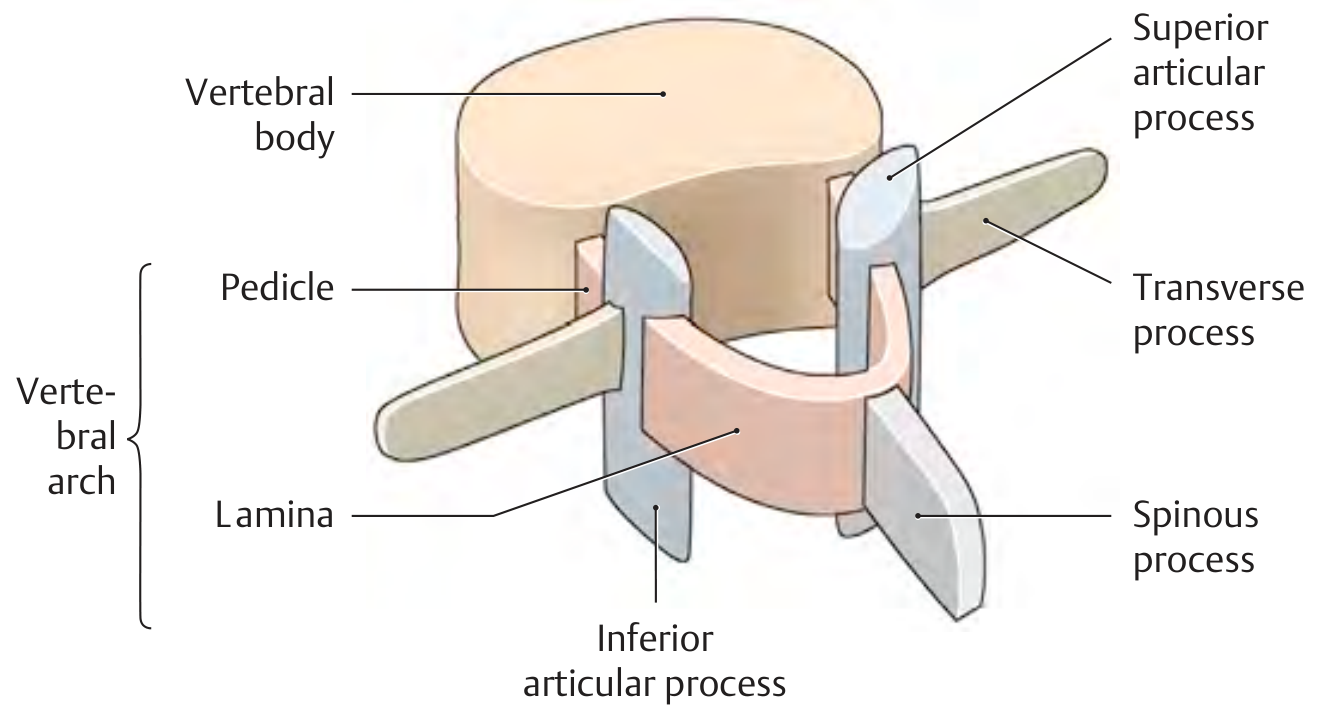
Attached firmly to the posterior surface of the vertebral body. It has two parts:
| Part | Description |
|---|---|
| Pedicles (×2) | Bony pillars anchoring the arch to the vertebral body; notched above and below to form intervertebral foramina |
| Laminae (×2) | Flat sheets of bone extending from each pedicle, meeting in the midline to form the "roof" of the arch |
The vertebral body + arch together enclose the vertebral foramen. All foramina aligned together constitute the vertebral (spinal) canal, which houses and protects the spinal cord.
2. Processes of the Vertebral Arch
Seven processes arise from the vertebral arch:
| Process | Number | Location | Function |
|---|---|---|---|
| Spinous process | 1 | Projects posteroinferiorly from junction of laminae | Muscle & ligament attachment |
| Transverse process | 2 | Projects posterolaterally from pedicle-lamina junction | Muscle & ligament attachment; rib articulation (thoracic) |
| Superior articular process | 2 | Projects superiorly from pedicle-lamina junction | Articulates with inferior articular process of vertebra above |
| Inferior articular process | 2 | Projects inferiorly from pedicle-lamina junction | Articulates with superior articular process of vertebra below |
3. Diagrams
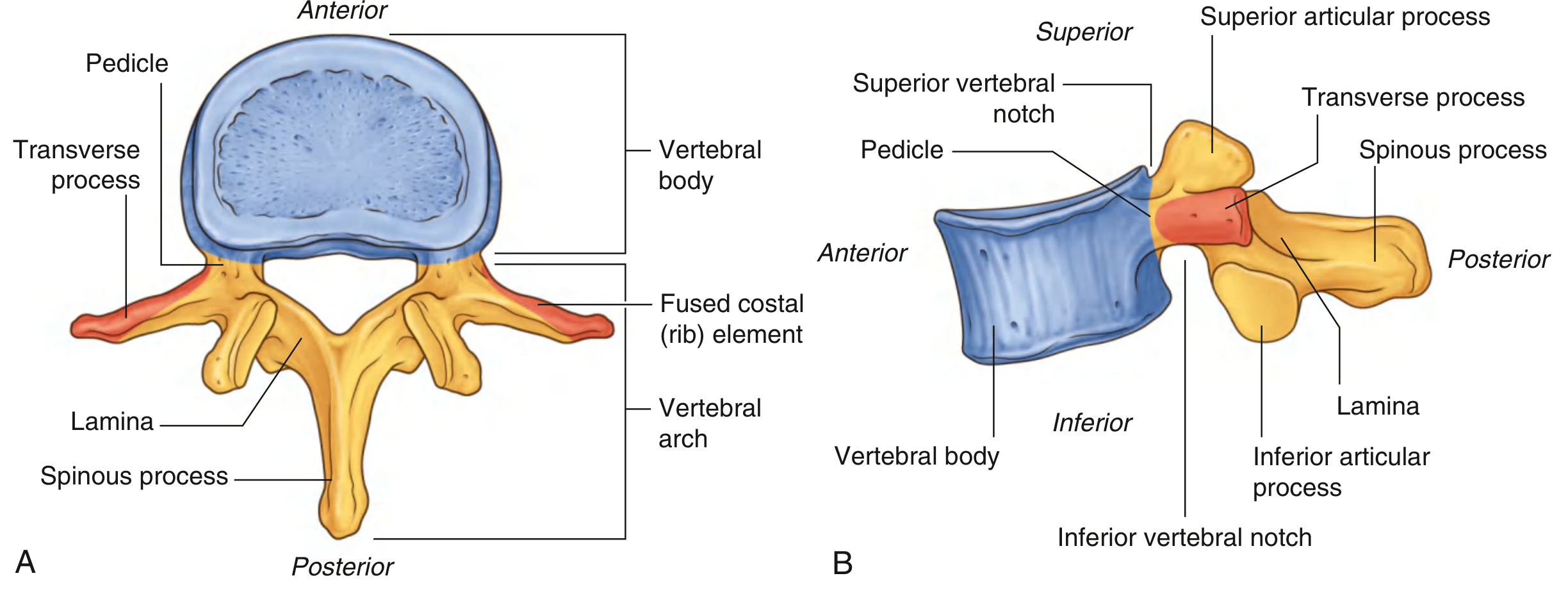
Superior & Lateral View — Gray's Anatomy for Students
3D Schematic — THIEME Atlas of General Anatomy
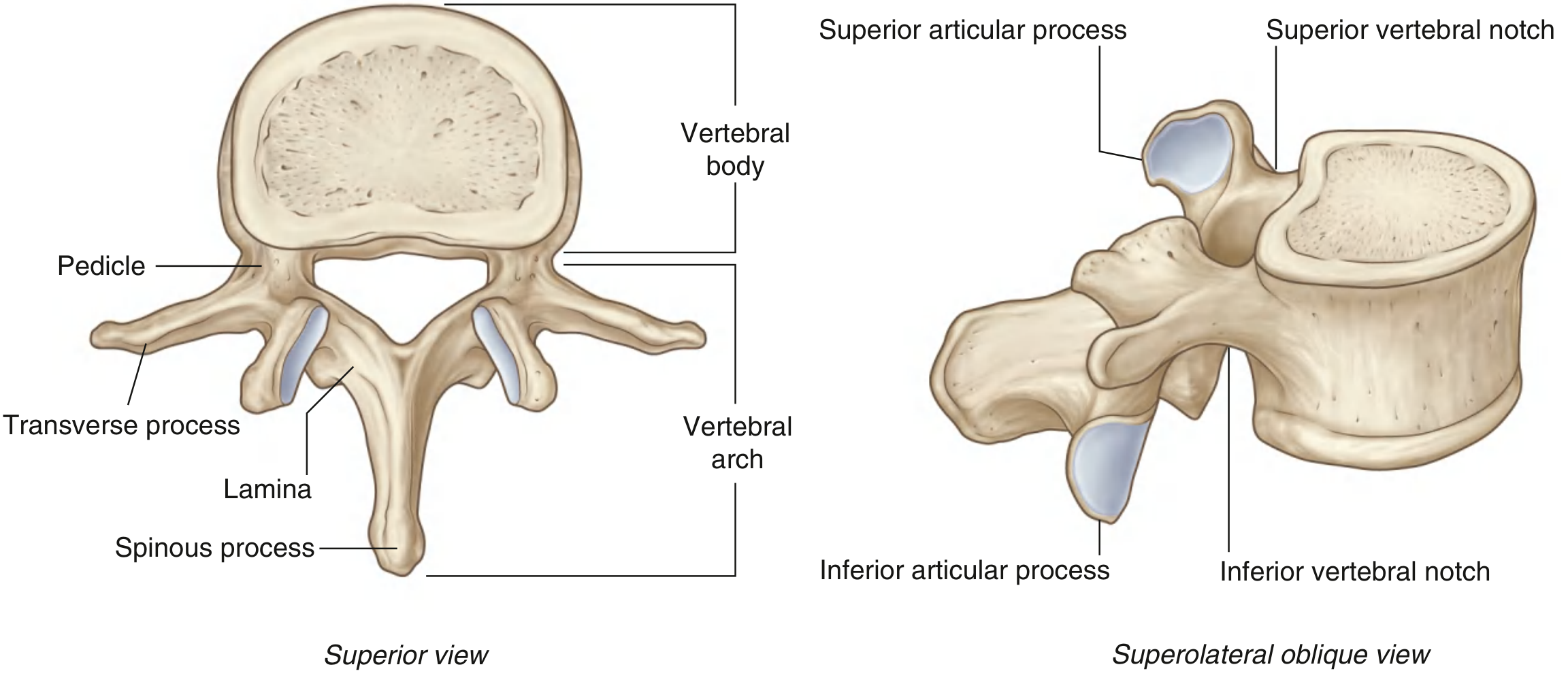
Superior & Superolateral Views — Gray's Anatomy for Students
4. Vertebral Notches & Intervertebral Foramina
Each pedicle has a superior vertebral notch (shallow) and an inferior vertebral notch (deep). When adjacent vertebrae articulate, the notches of one vertebra combine with those of the next to form the intervertebral foramen, through which spinal nerves and blood vessels pass.
5. Costal Elements
Every vertebra has a costal (rib) element, but its expression varies by region:
| Region | Costal Element Expression |
|---|---|
| Thoracic | Large — form the ribs, articulating with vertebral body and transverse process |
| Cervical | Small — form the anterior tubercle; together with posterior tubercle, enclose the transverse foramen |
| Lumbar | Incorporated into large costal (transverse) processes |
| Sacral | Fused into the lateral part (ala) of the sacrum |
Occasionally, cervical ribs develop (causing scalenus syndrome — compression of the brachial plexus and subclavian artery), or lumbar ribs appear (clinically insignificant).
6. Regional Variation Summary
| Feature | Cervical | Thoracic | Lumbar |
|---|---|---|---|
| Body size | Small | Medium | Large |
| Vertebral foramen | Triangular, large | Circular, small | Triangular, medium |
| Spinous process | Short, bifid (C3–C6); long at C7 (vertebra prominens) | Long, downward-sloping | Short, broad, horizontal |
| Transverse process | Bears foramen transversarium | Bears costal facet | Large costal processes |
| Special feature | Atlas (C1) & Axis (C2) — specialized for head movement | Rib articulations | Supports most body weight |
Sources:
- Gray's Anatomy for Students, pp. 73, 84
- General Anatomy and Musculoskeletal System (THIEME Atlas), pp. 127–128
This is a shared conversation. Sign in to Orris to start your own chat.