
Anti tubercular drugs
Reading File
Now let me search the medical library for comprehensive coverage of anti-tubercular drugs.
Finding Sources
Finding Sources
Reading File
Finding Sources
Excellent - I have great sources. Let me now read the comprehensive sections from Harrison's and Lippincott's in parallel.
Reading File
Reading File
Reading File
Reading File
Let me now get the second-line drugs from Harrison's and Katzung's summary table:
Reading File
Reading File
I now have comprehensive data from multiple authoritative textbooks. Let me also fetch the key images to include:
Loading Image
Searching PubMed
tuberculosis treatment regimen drug resistant
I now have all the information needed for a comprehensive, well-sourced answer. Let me compose it.
Anti-Tubercular Drugs
Anti-tubercular drugs (ATDs) are divided into first-line and second-line agents. Effective treatment always requires a combination of drugs to prevent resistance and achieve sterilization of both rapidly dividing and dormant ("persister") mycobacteria.
Standard Treatment Regimen
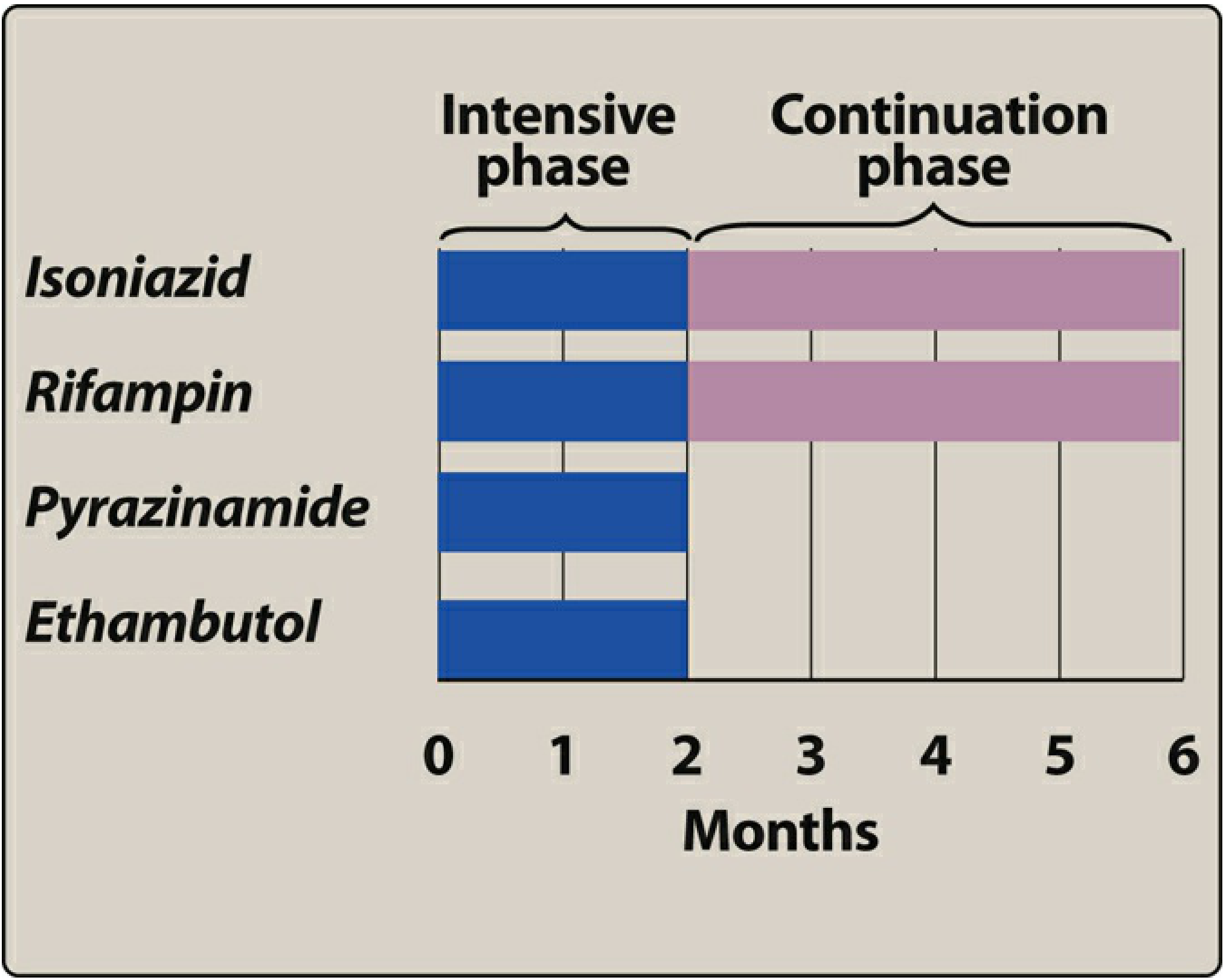
The traditional regimen consists of two phases:
- Intensive phase (2 months): Isoniazid (H) + Rifampin (R) + Pyrazinamide (Z) + Ethambutol (E) - mnemonic: HRZE
- Continuation phase (4 months): Isoniazid + Rifampin - mnemonic: HR
A newer 4-month regimen (rifapentine + moxifloxacin + isoniazid + pyrazinamide) has shown non-inferiority to standard therapy for drug-susceptible pulmonary TB. (Katzung's Basic and Clinical Pharmacology, 16th Ed.)
First-Line Drugs
1. Isoniazid (INH / H)
| Property | Detail |
|---|---|
| Mechanism | Prodrug activated by mycobacterial KatG catalase-peroxidase. Activated form inhibits InhA (ketoenoyl-reductase) and KasA (β-ketoacyl-ACP synthase), blocking mycolic acid synthesis. Also releases bactericidal free radicals (including nitric oxide). |
| Spectrum | Highly specific for M. tuberculosis; M. kansasii may be susceptible at higher concentrations. Active against both rapidly dividing and intracellular organisms. |
| Dose | 5 mg/kg/day in adults (max 300 mg/day); 10-15 mg/kg/day in children |
| Pharmacokinetics | Oral bioavailability high; distributes well into all body fluids including CSF. Metabolized by NAT2 (N-acetyltransferase 2) - fast vs slow acetylator phenotypes affect levels and toxicity. Bimodal half-life: ~90 min (fast) vs 3-4 hours (slow). |
| Adverse effects | Peripheral neuropathy (prevented by pyridoxine 25-50 mg/day), hepatotoxicity (most serious; idiosyncratic, more common in slow acetylators and older patients), drug-induced lupus, CNS toxicity (seizures, psychosis) |
| Drug interactions | Inhibits CYP450; raises levels of phenytoin, carbamazepine, warfarin, benzodiazepines |
| Resistance | Mutation/deletion of KatG; mutations in InhA; overexpression of InhA. Cross-resistance with ethionamide. |
(Harrison's Principles of Internal Medicine 22E; Lippincott Illustrated Reviews: Pharmacology)
2. Rifampin (Rifampicin / R)
| Property | Detail |
|---|---|
| Mechanism | Blocks bacterial RNA transcription by binding to the beta-subunit of RNA polymerase (rpoB gene product). Bactericidal against rapidly dividing and dormant bacteria. |
| Spectrum | Broad - M. tuberculosis, M. leprae, MAC, Staphylococcus, Neisseria meningitidis (prophylaxis). |
| Dose | 600 mg/day (10 mg/kg/day, max 600 mg) |
| Pharmacokinetics | Well-absorbed orally; widely distributed including CNS and macrophages. Strong CYP450 inducer. Hepatic metabolism; excreted primarily in bile/feces. Turns body fluids (urine, tears, sweat) orange-red. |
| Adverse effects | Flu-like syndrome (especially with intermittent dosing), hepatotoxicity, thrombocytopenia, orange discoloration of body fluids, GI disturbance |
| Drug interactions | Major CYP450 inducer - reduces levels of antiretrovirals (HIV drugs), oral contraceptives, warfarin, methadone, cyclosporin, and many others |
| Resistance | Single-step mutations in rpoB. Resistance to rifampin alone is uncommon but signals MDR-TB when combined with INH resistance. |
Rifampin must never be used as monotherapy for active TB due to rapid resistance development.
3. Pyrazinamide (PZA / Z)
| Property | Detail |
|---|---|
| Mechanism | Prodrug converted to pyrazinoic acid (POA) by mycobacterial pyrazinamidase. POA accumulates in acidic environment (within macrophage phagolysosomes), disrupting membrane energy and fatty acid synthesis. Bactericidal against slowly replicating, intracellular organisms. |
| Spectrum | Essentially limited to M. tuberculosis. Active in acidic pH (found inside macrophages and in caseous lesions). |
| Dose | 25 mg/kg/day (max ~2 g/day) |
| Pharmacokinetics | Well-absorbed orally; good CSF penetration. Hepatic metabolism. |
| Adverse effects | Hepatotoxicity (dose-dependent), hyperuricemia (inhibits urate excretion - can precipitate gout), arthralgia, GI disturbance. |
| Special note | Its inclusion in the intensive phase allows total treatment duration to be shortened from 9 to 6 months. Not routinely recommended in pregnancy in the USA (inadequate teratogenicity data). |
| Resistance | Mutations in pncA gene (pyrazinamidase enzyme). |
4. Ethambutol (EMB / E)
| Property | Detail |
|---|---|
| Mechanism | Bacteriostatic. Inhibits arabinosyltransferases, blocking the formation of arabinogalactan and lipoarabinomannan in the mycobacterial cell wall. |
| Spectrum | M. tuberculosis, M. kansasii, M. marinum, MAC. Least potent first-line drug. |
| Dose | 15-25 mg/kg/day |
| Pharmacokinetics | 75-80% oral absorption; poor CSF penetration (25 mg/kg needed). Excreted by kidneys - dose reduction required in renal insufficiency. |
| Adverse effects | Optic neuritis (most serious - dose-dependent; presents as reduced visual acuity, central scotoma, loss of red-green color discrimination). Risk increases with high dose and renal impairment. Usually reversible if caught early. |
| Monitoring | Baseline and monthly visual acuity, color vision testing required. Avoid routine use in young children (cannot report visual changes). |
| Role | Fourth drug added in case organism is INH or RIF resistant; can be dropped once susceptibility is confirmed. |
5. Rifapentine
A long-acting rifamycin used in the newer 4-month regimen (with moxifloxacin, isoniazid, pyrazinamide) and in 3-month weekly LTBI (latent TB) treatment. Dose: 1200 mg once daily. (Katzung)
Second-Line Drugs
Used when first-line agents fail, cause severe toxicity, or organisms are resistant (MDR-TB/XDR-TB).
| Drug | Class | Key Mechanism | Notable Adverse Effects |
|---|---|---|---|
| Bedaquiline | Diarylquinoline | Inhibits mycobacterial ATP synthase (F0 subunit) - novel mechanism | QTc prolongation, hepatotoxicity |
| Linezolid | Oxazolidinone | Inhibits 23S rRNA (50S ribosomal subunit), blocks protein synthesis | Peripheral neuropathy, optic neuropathy, myelosuppression |
| Moxifloxacin / Levofloxacin | Fluoroquinolones | Inhibit DNA gyrase (topoisomerase II) | QTc prolongation, tendinopathy |
| Pretomanid | Nitroimidazole | Inhibits mycolic acid synthesis; bactericidal under both aerobic and anaerobic conditions | Hepatotoxicity, peripheral neuropathy |
| Cycloserine | Amino acid analogue | Inhibits D-alanine racemase and D-Ala-D-Ala ligase (cell wall synthesis) | CNS toxicity (psychosis, seizures, depression) |
| Ethionamide / Prothionamide | Thioamide | Structural analogue of INH; blocks InhA (mycolic acid synthesis) | GI intolerance, hepatotoxicity, peripheral neuropathy |
| Amikacin / Kanamycin | Aminoglycosides | Bind 30S ribosomal subunit; disrupt protein synthesis | Nephrotoxicity, ototoxicity |
| Capreomycin | Polypeptide | Inhibits translation at 70S ribosome | Nephrotoxicity, ototoxicity |
| Aminosalicylic acid (PAS) | PABA analogue | Inhibits folate synthesis in mycobacteria; also inhibits salicylate biosynthesis | GI intolerance, hepatotoxicity |
| Rifabutin | Rifamycin | Same as rifampin (RNA polymerase inhibition) | Less CYP induction than rifampin - preferred with HIV antiretrovirals |
| Clofazimine | Phenazine | Binds DNA; generates cytotoxic oxygen radicals | Skin/GI discoloration (pink to brownish-black), enteritis |
| Streptomycin | Aminoglycoside | Binds 16S rRNA on 30S ribosome; bactericidal | Ototoxicity (vestibular > cochlear), nephrotoxicity |
(Katzung 16th Ed., Harrison's 22E)
MDR-TB and XDR-TB Regimens
- MDR-TB (resistant to INH + Rifampin): WHO now recommends the BPaL or BPaLM regimen - Bedaquiline + Pretomanid + Linezolid (± Moxifloxacin) for 6 months. A 2025 systematic review (PMID 39813501) confirms BPaLM achieves high treatment success rates with acceptable safety.
- XDR-TB (MDR + fluoroquinolone + injectable resistance): BPaL regimen (bedaquiline + pretomanid + linezolid).
Summary Mnemonic - First-Line Drugs
RIPE (or HRZE):
- R - Rifampin
- I - Isoniazid
- P - Pyrazinamide
- E - Ethambutol
Key adverse effect mnemonics:
- H (INH): Hepatitis, Hypersensitivity, Hyperreflexia/neuropathy (B6 deficient)
- R (Rifampin): Red-orange secretions, Rashes, enzyme inducer
- Z (PZA): Zap the uric acid (hyperuricemia), hepatotoxicity
- E (Ethambutol): Eye toxicity (optic neuritis)
Sources: Harrison's Principles of Internal Medicine 22E, p. 1462-1470 | Lippincott Illustrated Reviews: Pharmacology, pp. 1054-1066 | Katzung's Basic and Clinical Pharmacology, 16th Ed., pp. 1312-1325
This is a shared conversation. Sign in to Orris to start your own chat.