
Steatorrhea
Reading File
Finding Sources
Finding Sources
Searching PubMed
steatorrhea malabsorption pathophysiology
Reading File
Reading File
Reading File
Reading File
Reading File
Finding Sources
Reading File
Reading File
Reading File
Reading File
Reading File
Loading Image
I now have comprehensive information to write a full, well-structured answer on steatorrhea.
Steatorrhea
Definition
Steatorrhea is the passage of excessive fat in the stool, defined physiologically as fecal fat exceeding 7 g/day on a diet containing 100 g of fat per day. Clinically, it is recognized as fat malabsorption ≥ 14 g/day (with ≤ 7 g/day being normal on a 75-100 g fat diet). Under normal conditions, adults absorb 93-97% of ingested fat. - Yamada's Textbook of Gastroenterology, 7th ed., Symptom to Diagnosis, 4th ed.
Stool characteristics: bulky, frothy, greasy, yellow or clay-colored, foul-smelling, may float (though floating stools are not specific - bacterial gas can also cause stools to float).
Pathophysiology
Normal fat absorption requires four sequential phases. A defect in any one - or several - leads to steatorrhea:
| Phase | Process | Example Defect |
|---|---|---|
| Intraluminal digestion | Pancreatic lipase hydrolyzes triglycerides; bile salts form micelles | Pancreatic insufficiency, bile acid deficiency |
| Terminal digestion | Brush-border hydrolysis of carbohydrates/peptides | Mucosal disease |
| Transepithelial transport | Nutrient, fluid, and electrolyte transport across the enterocyte | Celiac disease, Crohn's disease |
| Lymphatic transport | Chylomicron export of absorbed lipids | Lymphangiectasia, Whipple disease |
- Robbins & Kumar Basic Pathology
Why fat is affected most severely
Several factors make lipid digestion uniquely vulnerable:
- Fat digestion depends primarily on pancreatic lipase and colipase - gastric lipase can only hydrolyze up to 20% of dietary fat.
- Lipase output falls earlier and more substantially than other enzymes (e.g., trypsin, amylase) as chronic pancreatitis progresses.
- Lipase is more sensitive to acid inactivation than other pancreatic enzymes. As bicarbonate secretion falls, duodenal pH drops and lipase is inactivated.
- Low duodenal pH also precipitates bile salts, preventing micelle formation and further impairing lipid digestion and absorption.
- Lipase is more susceptible to degradation by pancreatic proteases than other digestive enzymes.
- Sleisenger and Fordtran's GI and Liver Disease
Threshold for Steatorrhea
The pancreas has enormous exocrine reserve. Steatorrhea does not occur until pancreatic lipase secretion falls to less than 5-10% of maximum output (~10% of normal). This means steatorrhea is a feature of far-advanced pancreatic disease, not early insufficiency. Similarly, azotorrhea (protein maldigestion) only occurs when protease secretion drops below 10% of normal. - Sleisenger and Fordtran's
Major Causes
1. Maldigestion (Impaired Intraluminal Processing)
a) Exocrine Pancreatic Insufficiency (EPI)
The most common cause of severe steatorrhea. Causes include:
- Chronic pancreatitis (alcoholic is most common - ~70% of adult cases; median time to steatorrhea: 13.1 years in alcoholic CP, 16.9 years in late-onset idiopathic CP, 26.3 years in early-onset idiopathic CP)
- Cystic fibrosis (steatorrhea in 55-88%)
- Pancreatic duct obstruction (stones, tumor)
- Necrotizing acute pancreatitis, pancreatic surgery/resection
Features distinguishing pancreatic steatorrhea from mucosal disease: typically fewer, bulkier stools (3-4/day), less watery diarrhea, less excess gas/cramping; watery diarrhea and abdominal cramps are less common because carbohydrate absorption is better preserved.
Degree of steatorrhea: often >30 g fat/day with maldigestion (vs. lower with mucosal disease), and fecal fat concentration is higher (>9.5 g/100 g strongly suggests pancreatic/biliary cause).
b) Bile Acid Deficiency
- Advanced primary biliary cholangitis (PBC) - most important cause is decreased bile acid delivery with insufficient micellar concentration
- Ileal resection or disease (terminal ileum is the site of bile acid reabsorption; interruption of the enterohepatic circulation may prevent adequate compensation)
- When bile is completely excluded from the intestine, up to 50% of ingested fat may appear in feces, along with severe fat-soluble vitamin malabsorption
- Enterocolic fistula
c) Gastric Hypersecretion (Zollinger-Ellison syndrome)
Massive gastric acid hypersecretion lowers duodenal pH, inactivating lipase and precipitating bile salts.
d) Small Intestinal Bacterial Overgrowth (SIBO)
Causes steatorrhea by deconjugation of bile acids, reducing their ability to form micelles.
2. Malabsorption (Impaired Mucosal Transport)
- Celiac disease - the most common mucosal cause of malabsorption in Western countries
- Crohn's disease - mucosal damage and/or ileal involvement
- Whipple disease - lymphatic obstruction
- Abetalipoproteinemia - defective chylomicron assembly; patients also develop neurological manifestations and acanthocytosis
- Protein-losing enteropathy - lymphatic obstruction alters lymphatic flow for lipid-containing chylomicrons, causing steatorrhea
Clinical Features
| Feature | Detail |
|---|---|
| Stool appearance | Greasy, floating, foul-smelling, bulky, clay-colored or yellow |
| Weight loss | Usually due to reduced oral intake (pain, nausea), SIBO, or malignancy; patients often compensate by increasing intake |
| Fat-soluble vitamin deficiencies | Vitamins A, D, E, K |
| Osteomalacia/osteoporosis | From chronic vitamin D deficiency |
| Peripheral neuropathy | Vitamin E/B12 deficiency |
| Hypomagnesemia | Free fatty acids in the colon bind magnesium, preventing absorption |
| Coagulopathy | Vitamin K deficiency |
Maldigestion vs. Malabsorption - Distinguishing Features
| Maldigestion (e.g., EPI) | Malabsorption (e.g., celiac disease) | |
|---|---|---|
| Degree of steatorrhea | Often >30 g/day | Usually lower |
| Fecal fat concentration | High (>9.5 g/100 g) | Lower (stool fat diluted by unabsorbed water) |
| Stool fat type | Neutral fats (unhydrolyzed triglycerides) | Split fats (free fatty acids) |
| Appetite | Often increased | Often reduced |
| Watery diarrhea | Less common | More common |
- Sleisenger and Fordtran's, Yamada's Gastroenterology
Diagnostic Evaluation
Quantitative Fecal Fat (Gold Standard)
- Patient ingests a diet containing 100 g fat/day for 3 days, then stool is collected for 72 hours
- Normal: ≤ 7 g/day; steatorrhea: > 7 g/day (or > 14 g/day in the presence of significant watery diarrhea)
- A fecal fat concentration >9.5 g/100 g points to pancreatic/biliary maldigestion
Qualitative Stool Fat - Screening
- Sudan III staining of stool - indicates presence of steatorrhea but must be confirmed quantitatively
- Neutral fat droplets seen with EPI; free fatty acids with mucosal disease
Serum Carotenoid - Screening
- Carotenoids (major vitamin A precursors) require fat for intestinal absorption; low serum carotenoid is a simple screening test for steatorrhea
- Also low with: poor dietary intake, liver disease, high fever
- Also elevated in: hypothyroidism, diabetes, hyperlipidemia, excess dietary carotene
Pancreatic Function Tests
- Fecal elastase < 100 µg/g indicates EPI (better than fecal chymotrypsin, but not perfect sensitivity/specificity)
- Secretin stimulation test - most accurate but rarely performed (requires duodenal intubation)
- Serum trypsinogen: abnormally low levels in advanced chronic pancreatitis with steatorrhea (not decreased in other forms of steatorrhea - this distinguishes EPI from other causes)
- A therapeutic trial of pancreatic enzyme supplementation with objective monitoring (fecal fat or weight gain) is a practical diagnostic approach
Other Tests
- Anti-tissue transglutaminase (tTG) and endomysial antibodies - for celiac disease
- D-xylose absorption test - distinguishes pancreatic maldigestion (normal result) from enteropathy (abnormal)
- Schilling test for B12 - abnormal in enteric steatorrhea, not corrected by intrinsic factor
- Small bowel endoscopy with biopsy + quantitative luminal culture (for SIBO)
- CT/MRI/ERCP/EUS - for structural pancreatic/biliary assessment
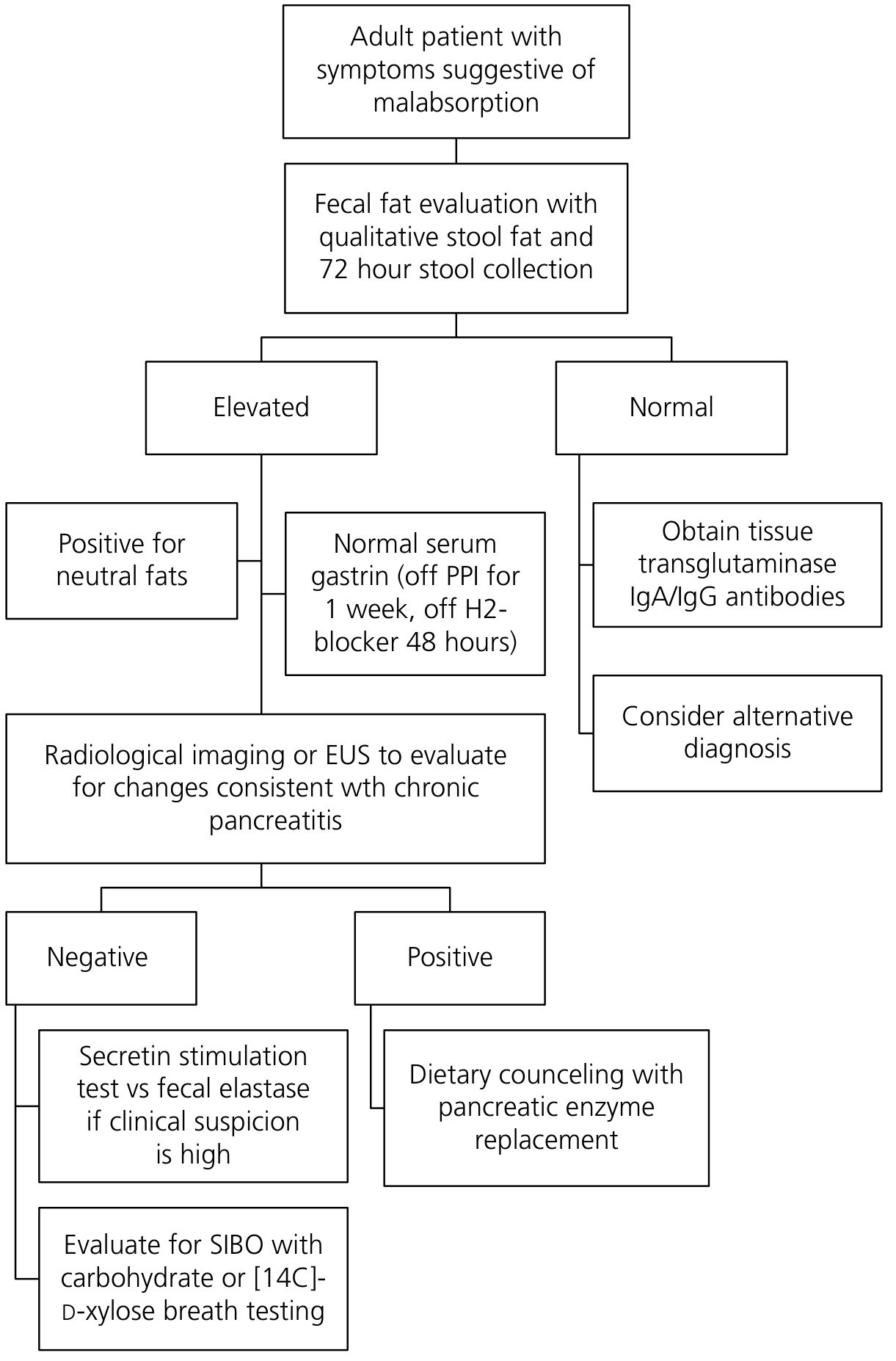
Diagnostic flowchart (Yamada's Textbook of Gastroenterology):
Treatment
Pancreatic Enzyme Replacement Therapy (PERT) - for EPI
- Goal: deliver ≥ 90,000 USP units of lipase with each meal in the prandial and postprandial phase
- Starting dose: 40,000-50,000 units of lipase per meal (Harrison's recommends 25,000-50,000 units, with possible increase to 100,000 units)
- Enzymes should be taken with each meal and snack
- Complete correction of steatorrhea to normal levels is uncommon even with PERT
- Monitor: stool consistency, visible fat in stool, body weight, fat-soluble vitamins (especially D), zinc, bone mineral density
Reasons for treatment failure:
- Inadequate dose (most common) - often patient non-compliance due to pill burden or cost
- Acid inactivation of lipase - co-administer proton pump inhibitor or H2 blocker (especially with non-enteric-coated preparations)
- Enteric-coated preparations releasing enzymes too distally (mid/distal small bowel) - adding acid suppression can help
- SIBO as a co-existing cause
Bile Acid Deficiency
- Substitute medium-chain triglycerides (MCTs) for long-chain triglycerides (MCTs are absorbed directly into portal blood without needing micelles)
- Reduce total fat intake
Celiac Disease
- Strict gluten-free diet
SIBO
- Intermittent broad-spectrum oral antibiotics
Nutritional Support
-
Fat-soluble vitamin supplementation (A, D, E, K)
-
Periodic bone mineral density assessment
-
Avoid very low-fat diets (worsen fat-soluble vitamin deficiencies); a Mediterranean or heart-healthy diet is reasonable
-
Sleisenger and Fordtran's GI and Liver Disease, Harrison's Principles of Internal Medicine 22E (2025), Ganong's Review of Medical Physiology 26th ed.
This is a shared conversation. Sign in to Orris to start your own chat.