
Co axial breathing system
I'll look up coaxial breathing systems in the medical library for you.
Searching sources...
Reading File
Finding Sources
Finding Sources
Good - found relevant sections in three major anesthesia textbooks. Let me read them in parallel.
Reading File
Reading File
Reading File
Good content retrieved. Let me get a bit more from the Barash text on the coaxial section and fetch a couple of diagrams.
Reading File
Reading File
Reading File
Excellent - I have comprehensive content. Let me fetch the key diagrams to include in the answer.
Loading Image
Loading Image
I now have all the content needed for a comprehensive answer. Here it is:
Coaxial Breathing Systems
A coaxial breathing system is a "tube-within-a-tube" arrangement in which one gas conduit is nested inside another, as opposed to separate dual-limb circuits. There are two main coaxial systems used in anesthesia:
1. The Bain Circuit (Coaxial Mapleson D)
The Bain circuit is the most well-known coaxial system and is a modification of the Mapleson D circuit.
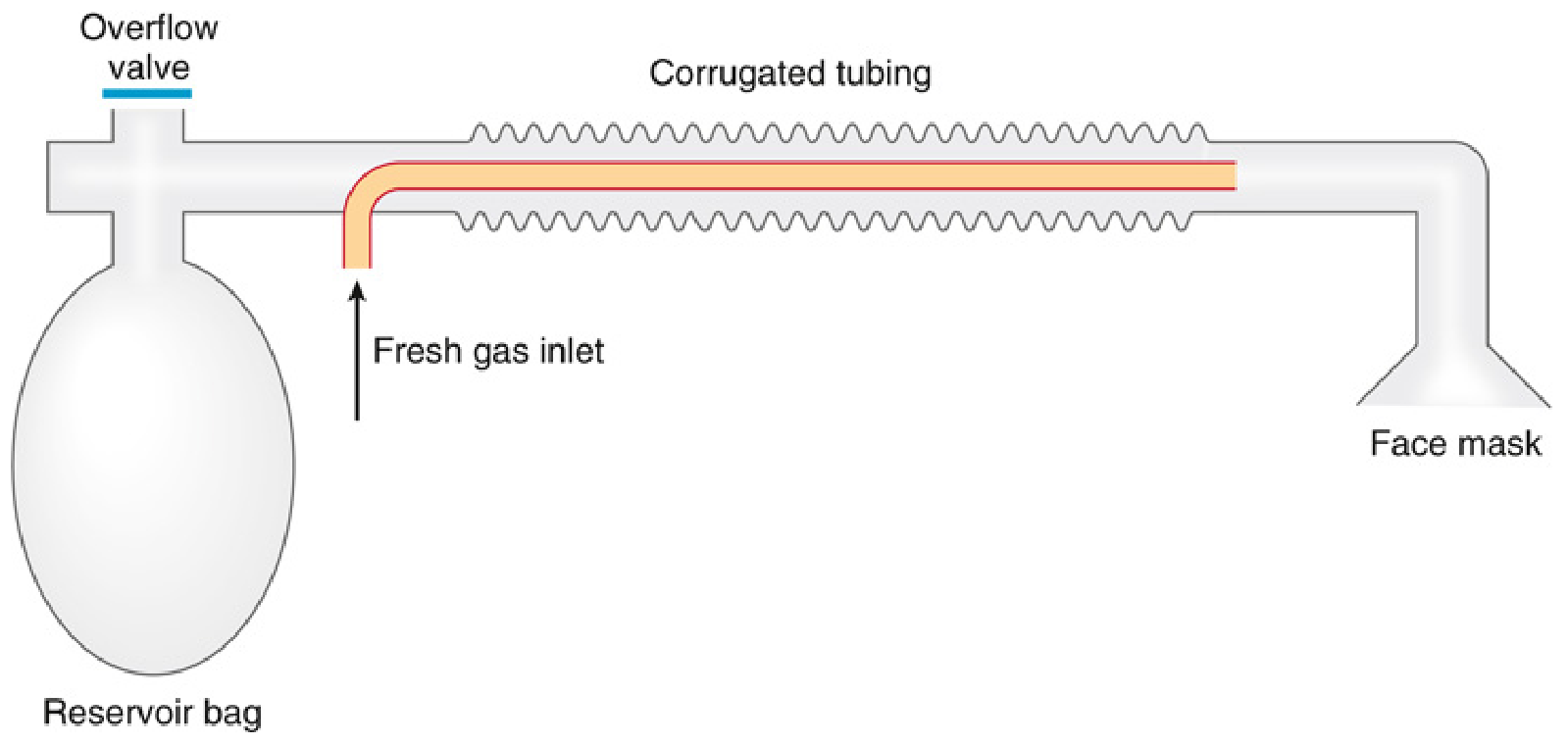
The Bain circuit - fresh gas flows through the narrow inner tube (red/orange), exhaled gas travels back through the corrugated outer hose.
Structure
- A narrow inner tube carries fresh gas from the machine to the patient end
- The outer corrugated hose carries exhaled gas back toward the reservoir bag and APL (overflow) valve
- Fresh gas inlet enters the system at the machine end; the APL valve and reservoir bag sit at the same (machine) end
- The patient connects at the distal end via a face mask or airway device
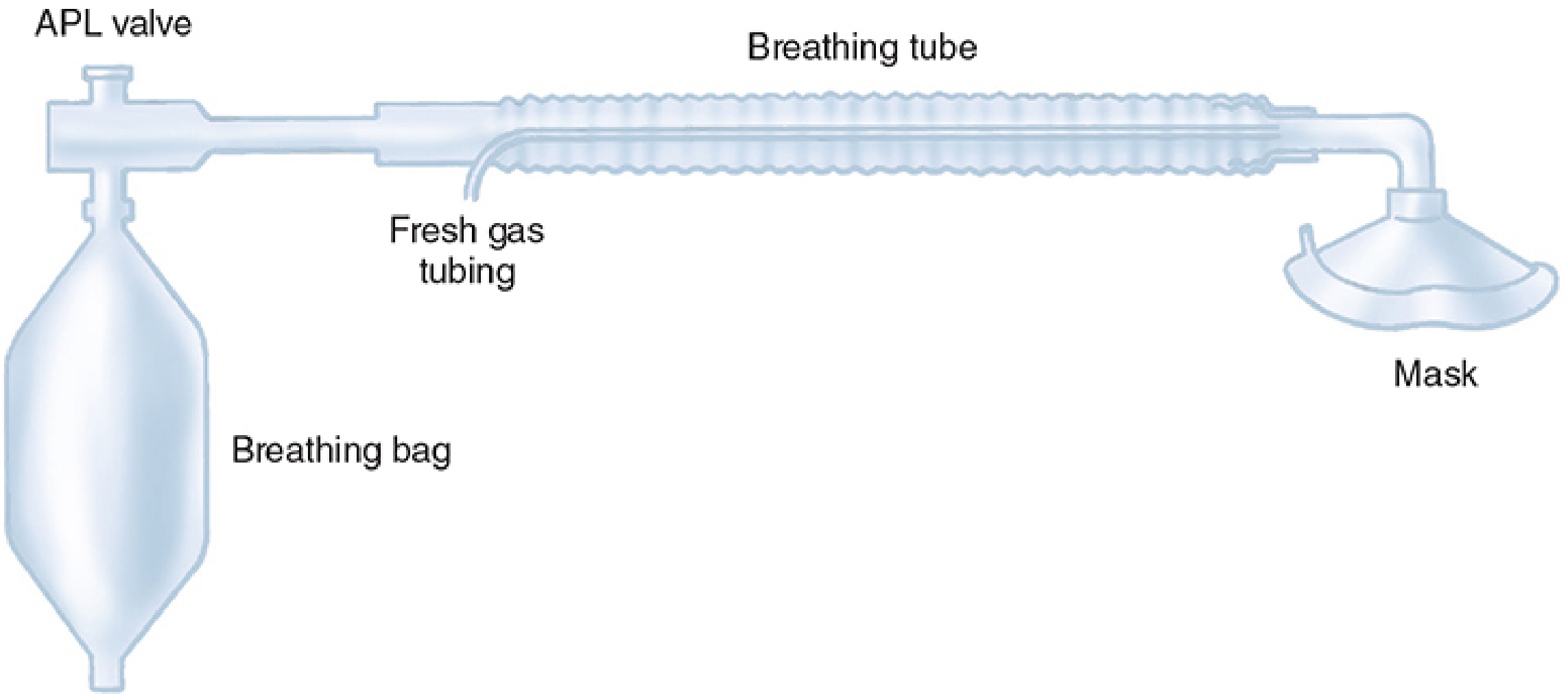
Gas Flow
- Fresh gas travels distally (toward the patient) through the inner tube
- Exhaled gas travels proximally (back toward the bag/APL valve) through the outer corrugated hose
- Exhaled gases passing down the outer hose add warmth to the inspired fresh gases by countercurrent heat exchange
Fresh Gas Flow Requirements
| Mode | Required FGF |
|---|---|
| Spontaneous ventilation | 200-300 mL/kg/min (~2x minute ventilation) |
| Controlled ventilation | 70-100 mL/kg/min (~1x minute ventilation) |
The Mapleson D is efficient for controlled ventilation because fresh gas flow forces alveolar gas away from the patient and toward the APL valve. It is less efficient for spontaneous breathing.
Advantages
- Lightweight, simple design
- Less bulky than dual-limb circuits
- Better heat and moisture conservation than conventional Mapleson D (due to countercurrent exchange)
- Rapid changes in anesthetic depth possible (no CO2 absorber)
- No risk of CO2 absorber-anesthetic interactions
Disadvantages / Hazards
- No CO2 absorber - requires higher fresh gas flows (wasteful of agent and carrier gas)
- Kinking or disconnection of the inner tube is the main hazard - leads to hypercapnia or hypoxemia; a kinked inner tube can mimic bronchospasm (wheezing, elevated peak airway pressures, desaturation)
- The outer tube must be transparent to allow continuous inspection of the inner tube
- Poor scavenging compared to circle systems
- Less efficient heat/humidity conservation compared to the circle system
Checking the Bain Circuit (Pethick's Test)
Occlude the inner tube at the patient end and activate the oxygen flush - if the inner tube is patent, the reservoir bag will NOT inflate (gas escapes distally). If the bag inflates, the inner tube is disconnected or kinked.
2. Coaxial Circle System (Universal F / Single-Limb Circuit)
A coaxial version of the traditional circle breathing system, also called the "Universal F" (King Systems) or "single-limb circuit."
Structure
- The inner tube is connected to the inspiratory port
- The outer tube is connected to the expiratory port
- Despite looking very different externally, the functional layout is identical to the traditional dual-limb circle system
- All other circle system components remain the same: CO2 absorber, unidirectional valves, APL valve, reservoir bag, Y-connector
Advantages over dual-limb circle
- Eliminates twisting of inspiratory and expiratory limbs
- Provides higher heat and moisture conservation
- Reduces clutter in the work area
Disadvantages vs dual-limb circle
- Damage or kinking in the circuit is harder to detect (compared to visible dual limbs)
- A kinked inner coaxial tube can mimic bronchospasm
- Longer tubing increases heat loss, moisture loss, circuit breathing resistance, and reduces system compliance (though it does NOT affect dead space or rebreathing)
Comparison: Bain vs Coaxial Circle
| Feature | Bain (Coaxial Mapleson D) | Coaxial Circle (Universal F) |
|---|---|---|
| CO2 removal | Washout (FGF-dependent) | CO2 absorber (soda lime) |
| Fresh gas requirement | High | Low (can use low-flow) |
| Rebreathing | Controlled by FGF | Controlled by unidirectional valves |
| Complexity | Simple | More complex |
| Heat/humidity | Partial (countercurrent) | Good |
| Scavenging | Difficult | Easy |
| Main hazard | Inner tube kink/disconnect | Valve malfunction, circuit disconnection |
| Use | Paediatrics, short cases, transport | Standard adult anesthesia |
Sources: Morgan and Mikhail's Clinical Anesthesiology, 7e, p. 87-88 | Barash et al. Clinical Anesthesia, 9e, p. 2002 | Miller's Anesthesia, 10e, p. 2353-2354
This is a shared conversation. Sign in to Orris to start your own chat.