Write a five mark short note on Tb lymphadenitis Make it compatible, compact but high yielding. So that... I can easily remember and, uh, write it in a... Systematic way being a 2nd year resident. make it in a way its interesting and easy to learn visually and Create a high density, high yielding image based(generate image) Flashcard I can use Before exam to revise and remember all the important points regarding this short-note. but it should be in a way so its easy to understand and remember also use flowcharts or mindmaps in the response wherever possible dont use code
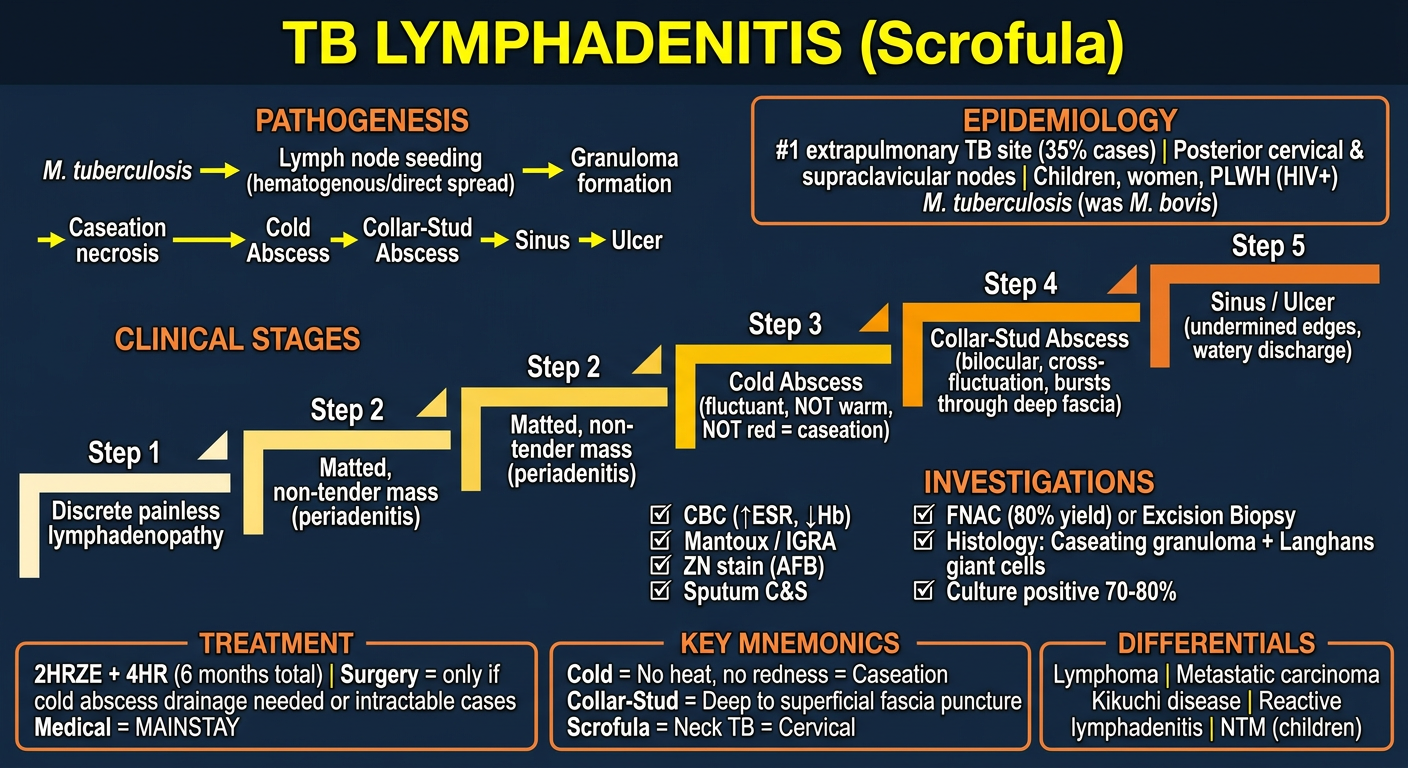
Medical exam flashcard for TB Lymphadenitis (Tuberculous Lymphadenitis) - high yield, high density, visually organized study card for a 2nd year medical resident. Include these sections clearly labeled: TITLE: TB LYMPHADENITIS (Scrofula) - bold header PATHOGENESIS mini flowchart: M. tuberculosis → Lymph node seeding (hematogenous/direct spread) → Granuloma formation → Caseation necrosis → Cold Abscess → Collar-Stud Abscess → Sinus → Ulcer EPIDEMIOLOGY box: #1 extrapulmonary TB site (35% cases) | Posterior cervical & supraclavicular nodes | Children, women, PLWH (HIV+) | M. tuberculosis (was M. bovis) CLINICAL STAGES visual ladder/steps: Stage 1: Discrete painless lymphadenopathy Stage 2: Matted, non-tender mass (periadenitis) Stage 3: Cold Abscess (fluctuant, NOT warm, NOT red = caseation) Stage 4: Collar-Stud Abscess (bilocular, cross-fluctuation, bursts through deep fascia) Stage 5: Sinus / Ulcer (undermined edges, watery discharge) INVESTIGATIONS checklist: CBC (↑ESR, ↓Hb) | Mantoux / IGRA | ZN stain (AFB) | Sputum C&S | FNAC (80% yield) or Excision Biopsy | Histology: Caseating granuloma + Langhans giant cells | Culture positive 70-80% TREATMENT box: 2HRZE + 4HR (6 months total) | Surgery = only if cold abscess drainage needed or intractable cases | Medical = MAINSTAY KEY MNEMONICS: "Cold = No heat, no redness = Caseation" | "Collar-Stud = Deep to superficial fascia puncture" | "Scrofula = Neck TB = Cervical" DIFFERENTIALS small box: Lymphoma | Metastatic carcinoma | Kikuchi disease | Reactive lymphadenitis | NTM (children) Color scheme: dark navy blue background with bright yellow, orange, and white text boxes. Use arrows, boxes, and clear visual hierarchy. Medical textbook flashcard style, clean, modern.
TB Lymphadenitis (Tuberculous Lymphadenitis / Scrofula)
Definition & Epidemiology
- Causative organism: Mycobacterium tuberculosis (previously M. bovis)
- Affected groups: Children, women (especially non-Caucasian), and PLWH (people living with HIV)
- Pulmonary TB co-exists in <50% of cases (more common in HIV+)
- Common in Indian subcontinent - young person from endemic area + cervical LN = TB unless proven otherwise
Pathogenesis - Flowchart
M. tuberculosis enters (lung primary focus)
          ↓
  Hematogenous / lymphatic spread
          ↓
  Seeding of lymph node
          ↓
  Granuloma formation (Epithelioid cells + Langhans giant cells)
          ↓
  Central Caseation Necrosis
          ↓
  COLD ABSCESS (deep to deep fascia)
  → Fluctuant, painless, NOT warm, NOT red
          ↓
  Bursts through deep fascia → "COLLAR-STUD ABSCESS"
  → Bilocular mass (deep + superficial component)
  → Cross-fluctuation present
          ↓
  Bursts through skin → SINUS → ULCER
  (undermined edges, watery discharge)
Clinical Stages (in sequence)
| Stage | Feature |
|---|---|
| 1. Adenitis | Discrete, firm, painless node(s) |
| 2. Periadenitis | Nodes become matted, non-tender |
| 3. Cold Abscess | Fluctuant, no signs of inflammation (no warmth, no erythema) |
| 4. Collar-stud Abscess | Bilocular, cross-fluctuation, dumbbell shape |
| 5. Sinus / Ulcer | Watery discharge, undermined edges |
Remember: "Cold = Caseation" - absence of inflammation signs IS the sign.
Systemic Features (Constitutional Symptoms)
- Evening pyrexia + night sweats
- Weight loss, malaise
- Cough (if pulmonary TB)
- Failure to thrive in children
Investigations - Mind Map
               TB LYMPHADENITIS
               INVESTIGATIONS
                    |
     _______________↓________________
     |          |          |         |
  Blood      Imaging    Micro     Histology
     |          |          |         |
 ↑ESR, ↓Hb  CXR        ZN Stain  Caseating
 IGRA/IGRA  (rule out    AFBs     Granuloma +
 (>Mantoux)  pulm TB)  Sputum C&S Langhans
                        (weeks)   Giant Cells
                 |
              FNAC / Biopsy
              FNAC yield = 80%
              Culture positive = 70-80%
              (send tissue FRESH + UNFIXED)
- FNAC - first-line, 80% diagnostic yield
- Excision biopsy - if mass is still in early stage or FNAC inconclusive
- ZN stain (Ziehl-Neelsen) - for AFBs (quick result)
- Culture & sensitivity - gold standard (weeks)
- IGRA (IFN-γ release assay) - has superseded Mantoux; not affected by BCG or endemic area status
Treatment
MEDICAL (MAINSTAY)
      ↓
2 months INTENSIVE: HRZE (Isoniazid + Rifampicin + Pyrazinamide + Ethambutol)
      ↓
4 months CONTINUATION: HR (Isoniazid + Rifampicin)
      ↓
Total = 6 months (same as pulmonary TB; responses may be slower)

SURGICAL (adjunct only)
- Drainage of cold/collar-stud abscess
- Excision biopsy for diagnosis
- NOT radical surgery
Differentials
- Reactive lymphadenitis (bacterial)
- Lymphoma (Hodgkin/Non-Hodgkin)
- Metastatic carcinoma (supraclavicular = Virchow's node alarm)
- Kikuchi disease (necrotizing histiocytic lymphadenitis)
- Kimura disease, Castleman disease
- NTM (M. scrofulaceum = #1 cause of cervical lymphadenitis in children <6 yrs in USA)
High-Yield Points for Exam
| Point | Fact |
|---|---|
| Most common extrapulmonary TB site | Lymph nodes |
| Classic site | Posterior cervical + supraclavicular |
| Historical name | Scrofula |
| Cold abscess = | Caseation necrosis |
| Collar-stud = | Bursts through deep fascia (bilocular) |
| Ulcer edge | Undermined edges |
| Best investigation | FNAC (80% yield) |
| Gold standard | Culture |
| Histology | Caseating granuloma + Langhans giant cells |
| Treatment duration | 6 months (2HRZE + 4HR) |
| HIV + TB | Granulomas less organized, higher bacterial load |
Clinical Photo (from Bailey & Love)
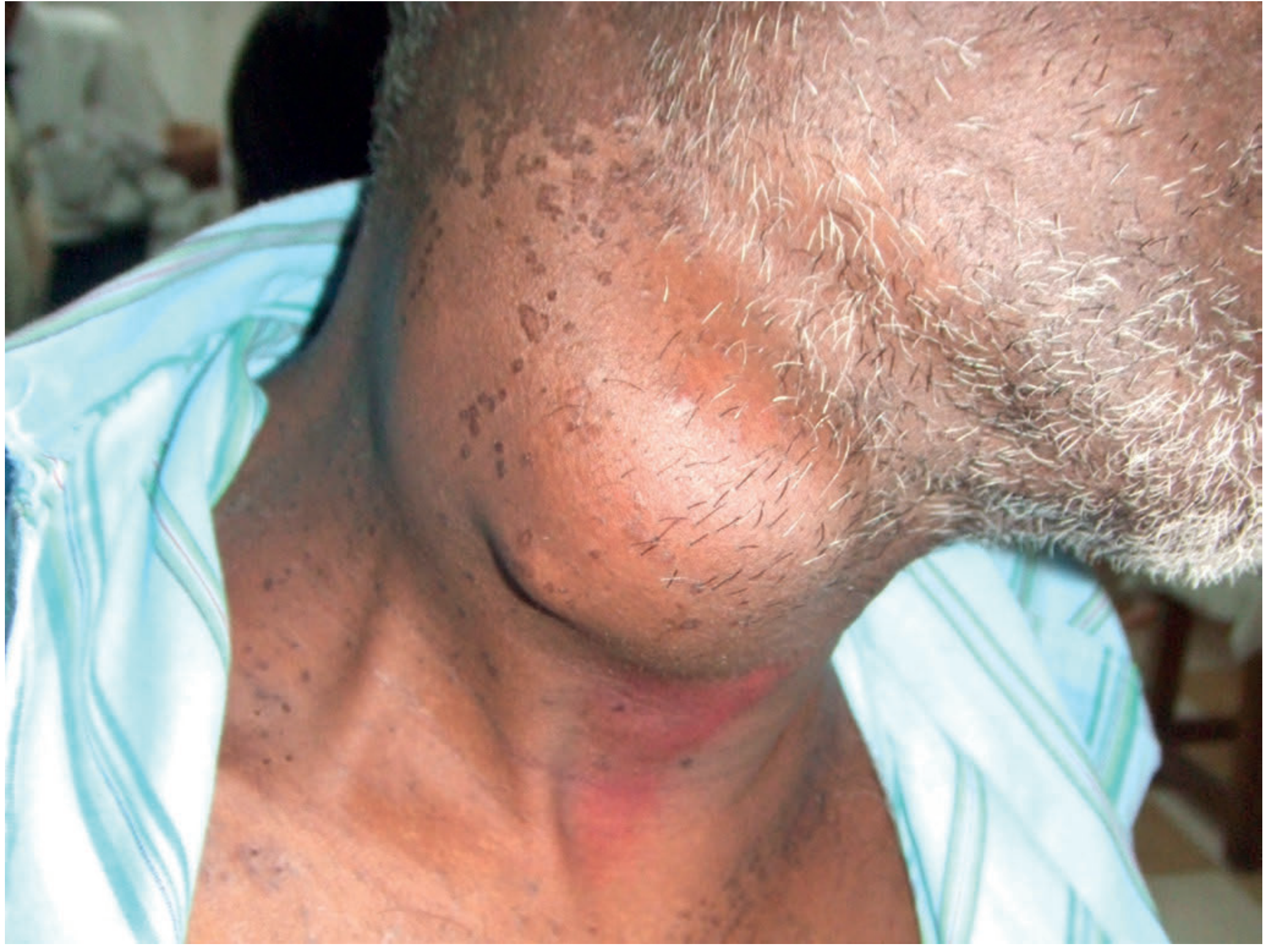
Revision Flashcard