
NSAIDs pharmacology in detail based on USMLE
Reading File
Finding Sources
Finding Sources
Finding Sources
Finding Sources
Reading File
Reading File
Reading File
Finding Sources
Searching PubMed
NSAID cardiovascular risk
NSAIDs Pharmacology - USMLE High-Yield Review
1. Mechanism of Action
All NSAIDs (aspirin included) work by inhibiting cyclooxygenase (COX), the enzyme that converts arachidonic acid into prostaglandins (PGE2, PGI2/prostacyclin) and thromboxane A2 (TXA2). Arachidonic acid itself is liberated from membrane phospholipids by phospholipase A2 (the enzyme blocked by corticosteroids).
- COX-1 ("housekeeping" enzyme): constitutively expressed everywhere - gastric mucosa (cytoprotective PGE2/PGI2), platelets (TXA2 for aggregation), kidney (afferent arteriolar dilation via PGE2/PGI2).
- COX-2: inducible at sites of inflammation (macrophages, synoviocytes) but also constitutive in kidney and vascular endothelium (PGI2 - antithrombotic).
"NSAID anti-inflammatory activity is mediated chiefly through inhibition of prostaglandin biosynthesis... Selectivity for COX-1 versus COX-2 is variable and incomplete for the older NSAIDs, but drugs that are selective in vitro COX-2 inhibitors have been synthesized." - Katzung's Basic and Clinical Pharmacology, p. 1007
Below is the arachidonic acid cascade showing where NSAIDs, aspirin, and lipoxygenase-pathway drugs act:
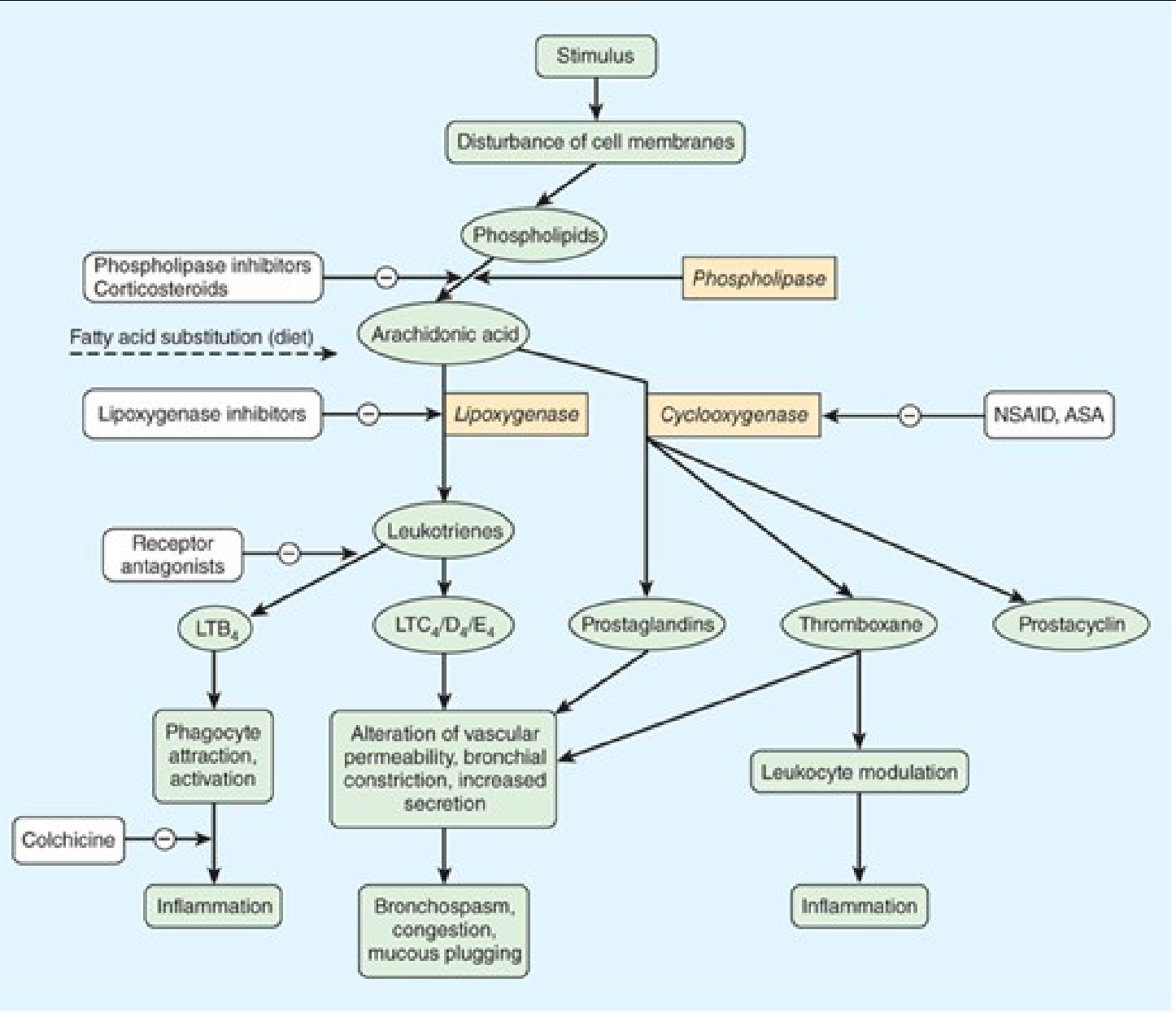
Key distinction - Aspirin vs. other NSAIDs:
- Aspirin irreversibly acetylates COX-1 and COX-2 (covalent modification) - this is why its antiplatelet effect lasts the lifetime of the platelet (~7-10 days, since platelets lack nuclei and cannot resynthesize COX).
- Non-aspirin NSAIDs (ibuprofen, naproxen, indomethacin, diclofenac) are reversible, competitive COX inhibitors.
- COX-2 selective agents (celecoxib) spare platelet COX-1, so they do not inhibit platelet aggregation.
2. Four Core Pharmacologic Effects
| Effect | Mechanism |
|---|---|
| Anti-inflammatory | Decreased PGE2/PGI2 → less vasodilation, less sensitization of nociceptors, decreased leukocyte chemotaxis |
| Analgesic | Decreased peripheral sensitization of nerve endings to bradykinin/other mediators; some central effect |
| Antipyretic | Decreased PGE2 in hypothalamus (blocks pyrogen-induced fever) |
| Antiplatelet | Decreased TXA2 (irreversible with aspirin only) |
3. Pharmacokinetics (General)
- Most NSAIDs are weak organic acids, well absorbed orally, highly protein-bound (~98%, mostly albumin) - this matters for drug interactions (displacement of warfarin, sulfonylureas, methotrexate).
- Hepatic metabolism (CYP2C9/CYP3A families) with renal excretion; significant enterohepatic recirculation contributes to lower-GI irritation.
- Accumulate in synovial fluid, providing sustained joint effect even for short-half-life drugs. (Katzung, p. 1006)
4. Individual Agents - USMLE Essentials
Aspirin
- Dose-dependent effects: low dose (<300 mg/day) = antiplatelet; intermediate (~2-4 g/day) = analgesic/antipyretic; high dose (4-8 g/day) = anti-inflammatory.
- Toxicity/overdose (salicylism): tinnitus, vertigo, hyperventilation. Classic acid-base picture = early respiratory alkalosis (direct stimulation of the medullary respiratory center) → mixed metabolic acidosis + respiratory alkalosis as toxicity progresses (uncoupling of oxidative phosphorylation → lactic acid, ketoacid accumulation).
- Reye syndrome: aspirin given to children/adolescents during a viral illness (especially influenza B, varicella) is linked to acute hepatic failure with cerebral edema - "aspirin and other salicylates are contraindicated in children and young adults less than 20 years of age with viral illness-associated fever." - Goodman & Gilman's Pharmacological Basis of Therapeutics, p. 3615. This is why acetaminophen is preferred for pediatric fever.
- Aspirin-exacerbated respiratory disease (Samter's triad: asthma, nasal polyps, aspirin/NSAID sensitivity) - due to shunting of arachidonic acid toward the leukotriene pathway when COX is blocked.
Ibuprofen, Naproxen - nonselective, standard first-line OTC NSAIDs; naproxen has longer half-life (twice daily dosing) and the most favorable cardiovascular safety profile among NSAIDs.
Indomethacin - potent nonselective NSAID; USMLE-classic dual use: closes a patent ductus arteriosus (inhibits PGE-mediated ductal patency) in premature infants, and treats acute gout. Notable for higher GI and CNS side effects (headache).
Ketorolac - potent parenteral NSAID used for short-term moderate-severe pain (post-op), opioid-sparing; limited to ≤5 days use due to GI/renal toxicity risk.
Diclofenac - achiral NSAID, available topically (for OA) and orally; notable hepatotoxicity risk.
Celecoxib - COX-2 selective; spares platelet function and reduces GI ulcer risk, but carries increased cardiovascular thrombotic risk (loses the protective vasodilatory/antithrombotic PGI2 from endothelial COX-2 while TXA2 from platelet COX-1 is unopposed) and is a sulfonamide (contraindicated in sulfa allergy).
5. Adverse Effects (High-Yield for USMLE)
GI toxicity - loss of PGE2/PGI2 cytoprotection (decreased mucus/bicarbonate secretion, decreased mucosal blood flow) → gastritis, peptic ulcers, GI bleeding. Misoprostol (PGE1 analog) is used prophylactically in patients on chronic NSAID therapy who are at high ulcer risk.
Renal toxicity - PGE2/PGI2 normally maintain afferent arteriolar vasodilation, especially when renal perfusion is compromised (CHF, cirrhosis, hypovolemia, elderly). NSAIDs → afferent arteriolar vasoconstriction → decreased GFR → acute kidney injury. Also causes acute interstitial nephritis (often with nephrotic-range proteinuria) and, with chronic use, analgesic nephropathy/papillary necrosis. "Triple whammy": NSAID + ACE inhibitor/ARB + diuretic markedly raises AKI risk.
Cardiovascular - fluid/sodium retention, hypertension (all NSAIDs); COX-2 selective agents and some nonselective agents (diclofenac) increase risk of MI/stroke with chronic use.
Hepatotoxicity - transaminitis, rare fulminant hepatitis (diclofenac has the highest reported risk among common NSAIDs).
Hematologic - GI bleeding risk from antiplatelet effect (especially aspirin, irreversible); reversible platelet dysfunction with other NSAIDs resolves within one drug half-life.
Hypersensitivity - AERD/Samter's triad as above; cross-reactivity between aspirin and other NSAIDs is common in these patients.
6. Drug Interactions
- Warfarin: displaces from albumin + additive GI bleeding risk.
- ACE inhibitors/ARBs + diuretics: additive nephrotoxicity ("triple whammy"), blunts antihypertensive effect (loss of vasodilatory prostaglandins).
- Methotrexate: NSAIDs decrease renal clearance of methotrexate → increased toxicity.
- Lithium: NSAIDs decrease renal lithium clearance → lithium toxicity.
- SSRIs: additive GI bleeding risk.
7. Special Populations / Contraindications
- Pregnancy: avoid in the third trimester - risk of premature closure of the ductus arteriosus and oligohydramnios (decreased fetal renal blood flow/urine output); this is the same PGE-dependent mechanism exploited therapeutically to close a PDA with indomethacin/ibuprofen after birth.
- Children with viral illness: avoid aspirin (Reye syndrome).
- Renal impairment, heart failure, cirrhosis with ascites, elderly, volume-depleted patients: use NSAIDs cautiously or avoid - these are prostaglandin-dependent states for renal perfusion.
- Active peptic ulcer disease / GI bleeding history: relative contraindication; consider COX-2 selective agent + PPI, or avoid entirely.
- Established cardiovascular disease: avoid NSAIDs when possible; naproxen has the best relative safety data among nonselective agents; avoid COX-2 selective agents.
Evidence check
A 2026 systematic review (PMID 41230625, Clinical Journal of Pain) on cardiovascular risks of NSAIDs is in press but did not surface data contradicting the standard teaching above (COX-2 selective and diclofenac carry the highest cardiovascular risk; naproxen the lowest among commonly used agents). No practice-changing update was identified beyond established textbook teaching.
Quick USMLE Pearls
- Only aspirin is irreversible; that's the one-line differentiator tested repeatedly.
- COX-1 = stomach/platelets/kidney (constitutive); COX-2 = inflammation site (inducible) but also kidney/endothelium.
- Reye syndrome = aspirin + kids + viral illness.
- Indomethacin closes PDA; NSAIDs in pregnancy risk keeping PDA open closed prematurely in utero (opposite direction, same mechanism).
- Renal injury from NSAIDs is a hemodynamic, prostaglandin-withdrawal phenomenon, not direct nephrotoxicity, in the acute setting.
- Celecoxib = sulfonamide, spares platelets, higher CV risk, lower GI risk.
This is a shared conversation. Sign in to Orris to start your own chat.