
Greek medicine from park psm textbook
Reading File
Searching sources...
Finding Sources
Finding Sources
The Park's PSM section on Greek medicine is at
/textbooks/9789382219163/9789382219163_block1.md, lines 255-301. Let me read it fully.Reading File
I have all the content. Here is the full account of Greek Medicine from Park's Textbook of Preventive and Social Medicine:
Greek Medicine
(Park's Textbook of Preventive and Social Medicine)
Period and Overview
The classic period of Greek medicine spans 460-136 B.C. The Greeks earned the reputation as the civilizers of the ancient world. Their singular contribution was teaching men to think in terms of "why" and "how" - replacing superstition with inquiry.
Aesculapius (1200 B.C.) - The Early Leader
An early leader in Greek medicine was Aesculapius (1200 B.C.). According to medical historian Douglas Guthrie, Aesculapius bore two daughters:
| Daughter | Role | Represents |
|---|---|---|
| Hygiea | Goddess of Health | Preventive Medicine |
| Panacea | Goddess of Medicine | Curative Medicine |
These two daughters gave rise to two dynasties:
- Hygienists - practitioners of preventive medicine (from Hygiea)
- Healers - practitioners of curative medicine (from Panacea)
Park's famous quote: "Thus the dichotomy between curative medicine and preventive medicine began early and we know it remains true today. Hygiea (prevention) is at present fashionable among the intellectuals; but Panacea (cure) gets the cash."
Aesculapius is still cherished in medical circles - his staff entwined by a serpent continues to be the symbol of medicine.
Hippocrates (460-370 B.C.) - Father of Medicine
By far the greatest physician in Greek medicine, Hippocrates was born on the island of Cos in the Aegean Sea around 460 B.C.
Key contributions:
-
Clinical method - Studied and classified diseases based on observation and reasoning. Challenged the tradition of magic in medicine and initiated application of clinical methods.
-
Corpus Hippocraticum - His lectures and writings, compiled by Alexandrian scholars into a 72-volume work, contain the first scientific clinical case histories, encompassing all branches of medicine.
-
Famous sayings:
- "Life is short, the art (of medicine) long, opportunity fleeting, experience treacherous and judgement difficult"
- "Where there is love for mankind, there is love for the art of healing"
-
Hippocratic Oath - His famous oath became the keystone of medical ethics, setting a high moral standard for the medical profession and demanding absolute integrity of doctors.
Hippocrates as the First Epidemiologist
Hippocrates was also an epidemiologist - he:
- Distinguished between epidemic diseases and endemic diseases, making him the first true epidemiologist
- Studied the causes of disease - climate, water, clothing, diet, habits of eating and drinking, and their effects in producing disease
- Wrote the book "Airs, Water and Places" - considered a treatise on social medicine and hygiene
- The Hippocratic concept of health and disease stressed the relation between man and his environment
Theory of Four Humors
The Greeks rejected the supernatural theory of disease and viewed disease as a natural process, not a visitation from a god.
They believed matter was made up of four elements:
| Element | Quality |
|---|---|
| Earth | Cold |
| Air | Dry |
| Fire | Hot |
| Water | Moist |
These were represented in the body by the four humors:
- Phlegm
- Yellow bile
- Blood
- Black bile
This is similar to the "Tridosha theory" in Ayurveda. Health was considered to result from a balance among these four humors, and disease from their imbalance.
Legacy and Downfall
The Greeks changed the destiny of medicine by:
- Separating it from magic
- Raising it to the status of a science
- Demonstrating scientific method, though they lacked modern scientific knowledge
Ultimately, the glorious Greek civilization fell, and with it, medicine reverted toward mysticism and superstition under Roman and later medieval influence - until the Renaissance brought a revival of scientific thinking.
- Park's Textbook of Preventive and Social Medicine, Block 1 (History of Medicine section)
Roman medicine from park psm textbook
Searching sources...
Finding Sources
Reading File
Here is the complete account of Roman Medicine from Park's PSM:
Roman Medicine
(Park's Textbook of Preventive and Social Medicine)
Historical Context
By the first century B.C., the centre of civilization shifted to Rome. The Romans borrowed their medicine largely from the Greeks whom they had conquered.
"While the politics of the world became Roman, medicine remained Greek."
In the political philosophy of the Romans, the State and not the individual was supreme.
Roman Contributions to Public Health
The Romans were a more practical-minded people than the Greeks. They had a keen sense of sanitation. Notably:
- Public health was born in Rome with the development of baths, sewers, and aqueducts
- Made fine roads throughout their empire
- Brought pure water to all their cities through aqueducts
- Drained marshes to combat malaria
- Built sewerage systems
- Established hospitals for the sick
Galen (130-205 A.D.) - The Outstanding Figure
The most outstanding figure among Roman medical teachers was Galen, born in the Greek city of Pergamon in Asia Minor (now Turkey). He served as physician to the Roman emperor Marcus Aurelius.
Key contributions:
| Area | Contribution |
|---|---|
| Anatomy | Comparative anatomy |
| Physiology | Experimental physiology |
| Preventive medicine | Views on health preservation |
| Pathology | Three-factor theory of disease |
On Health, Galen stated:
"Since both in importance and in time, health precedes disease, so we ought to consider first how health may be preserved, and then how one may best cure disease."
On Disease, Galen observed that disease is due to three factors:
- Predisposing factors
- Exciting factors
- Environmental factors
Park notes this was "a truly modern idea."
Hippocrates vs. Galen: The doctrines of Hippocrates and Galen were often in conflict since their approaches were so different - one is synthetic (Hippocrates), the other analytic (Galen).
Legacy:
- Author of some 500 treatises on medical subjects
- Literally a "medical dictator" in his time
- His writings influenced European medicine and were accepted as standard textbooks for 14 centuries
- His teachings were finally challenged by:
- Vesalius (anatomist) in 1543
- William Harvey (physiologist) in 1628
- ...almost 1500 years after his death
- Park's Textbook of Preventive and Social Medicine, Block 1 (History of Medicine section)
Germ theory from park psm textbook
Searching sources...
Finding Sources
Reading File
Also checking if there's more content around line 3475 (the second reference):
Reading File
Here is the complete account of Germ Theory from Park's PSM, drawing from both chapters where it is discussed:
Germ Theory of Disease
(Park's Textbook of Preventive and Social Medicine)
Background - Earlier Theories of Disease Causation
For long, man was groping in darkness about the causation of disease. Several theories were advanced from time to time:
- Supernatural theory of disease - disease as divine punishment
- Theory of humors - by Greeks and Indians (four humors / tridosha)
- Theory of contagion
- Miasmatic theory - attributed disease to noxious air and vapours
- Theory of spontaneous generation
The Breakthrough - Louis Pasteur (1822-1895)
The breakthrough came in 1860, when the French bacteriologist Louis Pasteur:
- Demonstrated the presence of bacteria in air
- Disproved the theory of "spontaneous generation"
- In 1873, advanced the "Germ Theory of Disease"
Robert Koch (1843-1910)
In 1877, Robert Koch showed that anthrax was caused by a bacterium. The discoveries of Pasteur and Koch together confirmed the germ theory of disease.
The Golden Age of Bacteriology
This ushered in the golden age of bacteriology - microbe after microbe was discovered in quick succession:
| Year | Discovery |
|---|---|
| 1847 | Gonococcus |
| 1880 | Typhoid bacillus, Pneumococcus |
| 1882 | Tubercle bacillus |
| 1883 | Cholera vibrio |
| 1884 | Diphtheria bacillus |
"Medicine finally shed the rags of dogma and superstition and put on the robes of scientific knowledge."
Impact on Preventive Medicine
The germ theory gave preventive medicine a firm foundation. Key milestones that followed:
| Year | Development |
|---|---|
| 1883 | Pasteur's anti-rabies treatment |
| 1892 | Cholera vaccine |
| 1894 | Diphtheria antitoxin |
| 1898 | Anti-typhoid vaccine |
| 1827-1912 | Antiseptics and disinfectants |
| 1896 | Bruce demonstrated African sleeping sickness transmitted by tsetse fly |
| 1898 | Ross demonstrated malaria transmitted by Anopheles mosquito |
The Disease Model of Germ Theory
The concept of cause embodied in the germ theory is generally referred to as a one-to-one relationship between causal agent and disease:
Disease agent → Man → Disease
Limitations of the Germ Theory
Though a revolutionary concept, the germ theory led many epidemiologists to take a one-sided view of disease causation - they could not think beyond the germ alone. Park highlights its limitations:
- Not everyone exposed to tuberculosis develops tuberculosis
- Not everyone exposed to beta-haemolytic streptococci develops acute rheumatic fever
- The same exposure in an undernourished or susceptible person may result in clinical disease
This showed that a disease is rarely caused by a single agent alone, but depends on multiple factors. Modern medicine has therefore moved away from strict adherence to the germ theory.
Evolution to the Epidemiological Triad
The limitations of the germ theory demanded a broader concept of disease causation, leading to the Epidemiological Triad:
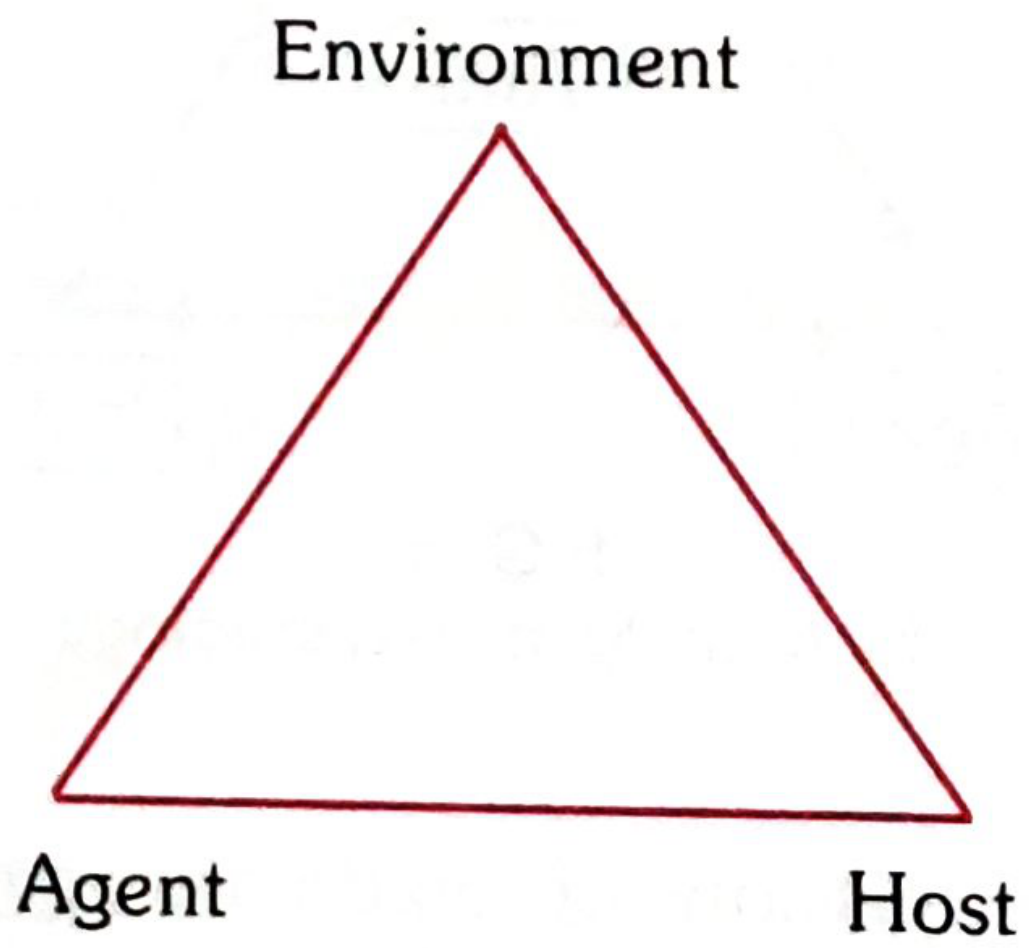
The triad recognizes three equally important classes of factors:
- Agent
- Host
- Environment
This model helped epidemiologists focus on different classes of factors, especially with regard to infectious diseases, and replaced the simplistic one-to-one germ theory model.
- Park's Textbook of Preventive and Social Medicine, Chapter 1 (History of Medicine) and Chapter on Epidemiology
Can you shorten this information for 5 marks
Germ Theory of Disease (5 marks)
Earlier theories: Disease causation was explained by supernatural theory, theory of humors, miasmatic theory (noxious air), and theory of spontaneous generation.
Pasteur's Breakthrough (1860): Louis Pasteur (1822-1895) demonstrated bacteria in air and disproved spontaneous generation. In 1873, he formally advanced the Germ Theory of Disease.
Koch's Contribution (1877): Robert Koch showed anthrax was caused by a bacterium, confirming the germ theory. This began the Golden Age of Bacteriology - typhoid bacillus and pneumococcus (1880), tubercle bacillus (1882), cholera vibrio (1883), diphtheria bacillus (1884).
Disease Model:
Disease Agent → Man → Disease (one-to-one relationship between agent and disease)
Limitations: Not all persons exposed to TB or streptococci develop disease. A single agent alone is insufficient - host and environmental factors are equally important. This led to the Epidemiological Triad (Agent - Host - Environment), replacing the strict germ theory model.
Concept of well being from park psm textbook
Searching sources...
Finding Sources
Reading File
Reading File
Here is the complete account of the Concept of Well-Being from Park's PSM:
Concept of Well-Being
(Park's Textbook of Preventive and Social Medicine)
Introduction
The WHO definition of health introduces the concept of "well-being". There is no single satisfactory definition of the term. Psychologists point out that well-being has two components:
| Component | Nature | Term Used |
|---|---|---|
| Objective | External, measurable concerns | Standard of living / Level of living |
| Subjective | Individual's own expression | Quality of life |
1. Standard of Living
Refers to the usual scale of expenditure, goods consumed, and services enjoyed. It includes:
- Level of education
- Employment status
- Food, dress, housing
- Amusements and comforts of modern living
WHO definition: Income and occupation, standards of housing, sanitation and nutrition, the level of provision of health, educational, recreational and other services - used collectively as an index of standard of living.
Differences between countries are measured by per capita GNP, on which the standard of living primarily depends.
2. Level of Living
The parallel UN term for "standard of living." Consists of nine components:
- Health
- Food consumption
- Education
- Occupation and working conditions
- Housing
- Social security
- Clothing
- Recreation and leisure
- Human rights
Health is the most important component - its impairment always means impairment of the level of living.
3. Quality of Life (Subjective Component)
The subjective component of well-being - the individual's own evaluation.
WHO definition (earlier): "The condition of life resulting from the combination of the effects of the complete range of factors such as those determining health, happiness (including comfort in the physical environment and a satisfying occupation), education, social and intellectual attainments, freedom of action, justice and freedom of expression."
WHO definition (recent): "The product of the interplay between social, health, economic, and environmental conditions which affect human and social development. It is a broad-ranging concept, incorporating a person's physical health, psychological state, level of independence, social relationships, personal belief and relationship to salient features in the environment."
A rise in standard of living alone is not enough - improvement of quality of life must also be added, meaning increased emphasis on social policy and reformulation of societal goals.
4. Physical Quality of Life Index (PQLI)
An attempt to measure quality of life through a composite index of three indicators:
- Infant mortality
- Life expectancy at age one
- Literacy
- Each component is scaled 0 to 100 (0 = worst, 100 = best)
- Composite PQLI = average of three indicators with equal weight
- Per capita GNP is NOT included - showing "money is not everything"
- Example: Oil-rich Middle East countries have high incomes but not very high PQLIs
- Sri Lanka and Kerala (India) have low per capita incomes but high PQLIs
- PQLI measures results of social, economic and political policies, not economic growth
- Ultimate objective: attain a PQLI of 100
5. Human Development Index (HDI)
A composite index focusing on three basic dimensions:
| Dimension | Measured By |
|---|---|
| Long and healthy life | Life expectancy at birth |
| Ability to acquire knowledge | Mean years of schooling + expected years of schooling |
| Decent standard of living | Gross National Income (GNI) per capita in PPP US$ |
HDI reflects achievements in the most basic human capabilities - living long, being knowledgeable, and enjoying a decent standard of living.
- Park's Textbook of Preventive and Social Medicine, Chapter on Concept of Health (Well-Being section)
Aim and scope of preventive social medicine from park psm textbook
Searching sources...
Finding Sources
Finding Sources
Finding Sources
Reading File
Let me now read the main definitions section for "Preventive medicine" and "Social medicine" headings starting earlier:
Reading File
Now let me read the Social Medicine and Community Medicine sections:
Reading File
Reading File
I now have all the material needed. Here is the complete account:
Aim and Scope of Preventive and Social Medicine
(Park's Textbook of Preventive and Social Medicine)
Overview - Branches of Medicine
Park discusses medicine under four distinct branches, each with its own aim and scope:
1. Curative Medicine
Aim: Removal of disease from the patient (rather than from the mass).
Scope:
- Employs diagnostic techniques and treatment
- Tools include diagnostic methods, surgical procedures, pharmacotherapy
- Mid-20th century revolution: introduction of antibacterial and antibiotic agents
- Has accumulated vast scientific knowledge - "not merely to treat disease but to preserve life itself"
Limitation: Specialization has raised standards but escalated costs, placing specialist care beyond the means of an average citizen - it has infringed upon the principle of "greatest good of the greatest number."
2. Preventive Medicine
Definition: Applied to "healthy" people, customarily by actions affecting large numbers or populations.
Aim: Prevention of disease and promotion of health.
Scope - Key milestones:
- Bacterial vaccines and antisera - conquered diphtheria, tetanus, typhoid fever
- Viral vaccines - tissue culture of viruses led to anti-viral vaccines (smallpox eradication)
- Nutrition - new dimension added; strategies against nutritional blindness, iodine deficiency
- Synthetic insecticides (DDT, HCH, malathion) - control of vector-borne diseases (malaria, plague, leishmaniasis)
- Chemoprophylaxis and mass drug treatment - sulpha drugs, antibiotics, anti-tubercular and anti-leprosy drugs
- Disease eradication - concept of eradication applied to smallpox; measles, tetanus, guineaworm on the agenda
- Screening - diagnosis in pre-symptomatic stage; identification of high-risk groups; early detection of cancer, diabetes, cardiovascular disease
- Family planning - prevention of population explosion; research in contraceptive technology and genetic counselling
Three levels of prevention:
| Level | Target | Purpose |
|---|---|---|
| Primary | Healthy people | Prevent disease from occurring |
| Secondary | Those with early disease | Limit progression |
| Tertiary | Those with established disease | Reduce chronic disability |
Modern definition of preventive medicine:
"The art and science of health promotion, disease prevention, disability limitation and rehabilitation."
Preventive medicine is described as a kind of "anticipatory medicine." The emergence of preventive paediatrics, geriatrics and preventive cardiology reflect its newer trends and expanding scope.
3. Social Medicine
Historical origin:
- Seeds sown by Neumann (1847) and Virchow (1848) - "medicine is a social science"
- Revived in 1911 by Alfred Grotjahn (1869-1931) of Berlin - stressed social factors in disease aetiology, calling it "social pathology"
- 1912 - Rene Sand founded the Belgian Social Medicine Association
- A Chair of Social Medicine was set up at Oxford in 1942
Definition: "By derivation, social medicine is the study of man as a social being in his total environment. Its focus is on the health of the community as a whole."
Park quotes Professor Crew: "Social medicine stands on two pillars - medicine and sociology."
Others stated: "The maiden sociology married public health and became social medicine."
McKeown's two meanings:
- Broad sense - humanitarian tradition in medicine; identified with care, prevention, medical services, health and welfare
- Restricted sense - body of knowledge embodied in epidemiology and study of medical needs of society
Core principle: Social medicine is not a new branch but a new orientation of medicine to the changing needs of man and society - disease has social causes, social consequences and social therapy.
4. Community Medicine (Public Health)
Evolution of public health through phases:
| Phase | Period | Features |
|---|---|---|
| Miasmatic phase | Pre-1880 | Environmental sanitation, clean water, sewerage |
| Bacteriological phase | 1880-1920 | Germ theory, vaccines, immunization, isolation |
| Social engineering phase | 1960-1980 | Chronic diseases (cancer, diabetes, CVD); concept of "risk factors"; behavioural and social aspects given priority |
| "Health for All" phase | 1981-2000 | Primary Health Care; narrowing health gap between rich and poor nations |
In the social engineering phase, the goals of public health and preventive medicine became identical: prevention of disease, promotion of health, and prolongation of life.
The term "community health" was preferred over public health to reflect its changed meaning - it incorporates services to the population at large as opposed to preventive or social medicine alone.
- Park's Textbook of Preventive and Social Medicine, Chapter 1 (Medicine - Aims and Scope)
This is a shared conversation. Sign in to Orris to start your own chat.