
Difference between NON Nitrogenous Hepatic encephalitis and Nitrogenous Hepatic encephalitis
Reading File
Searching sources...
Finding Sources
Finding Sources
Reading File
Reading File
Finding Sources
Reading File
Finding Sources
Reading File
Reading File
Reading File
Searching the Web
nitrogenous vs non-nitrogenous hepatic encephalopathy precipitating factors difference
Now I have enough material to give a thorough answer. The textbooks and web sources confirm that the "nitrogenous vs non-nitrogenous" classification of HE precipitating factors is a classic teaching framework. Let me fetch the pathophysiology image found in the textbook as well.
Loading Image
Here is a complete, well-structured answer:
Nitrogenous vs. Non-Nitrogenous Hepatic Encephalopathy
Hepatic encephalopathy (HE) is a neuropsychiatric syndrome caused by the liver's failure to clear neurotoxins - primarily ammonia - from the circulation. When classifying precipitating factors, clinicians traditionally divide them into nitrogenous (those that raise the nitrogen/ammonia load) and non-nitrogenous (those that worsen encephalopathy without directly increasing nitrogenous substrate).
Pathophysiology of the Baseline (Common to Both)
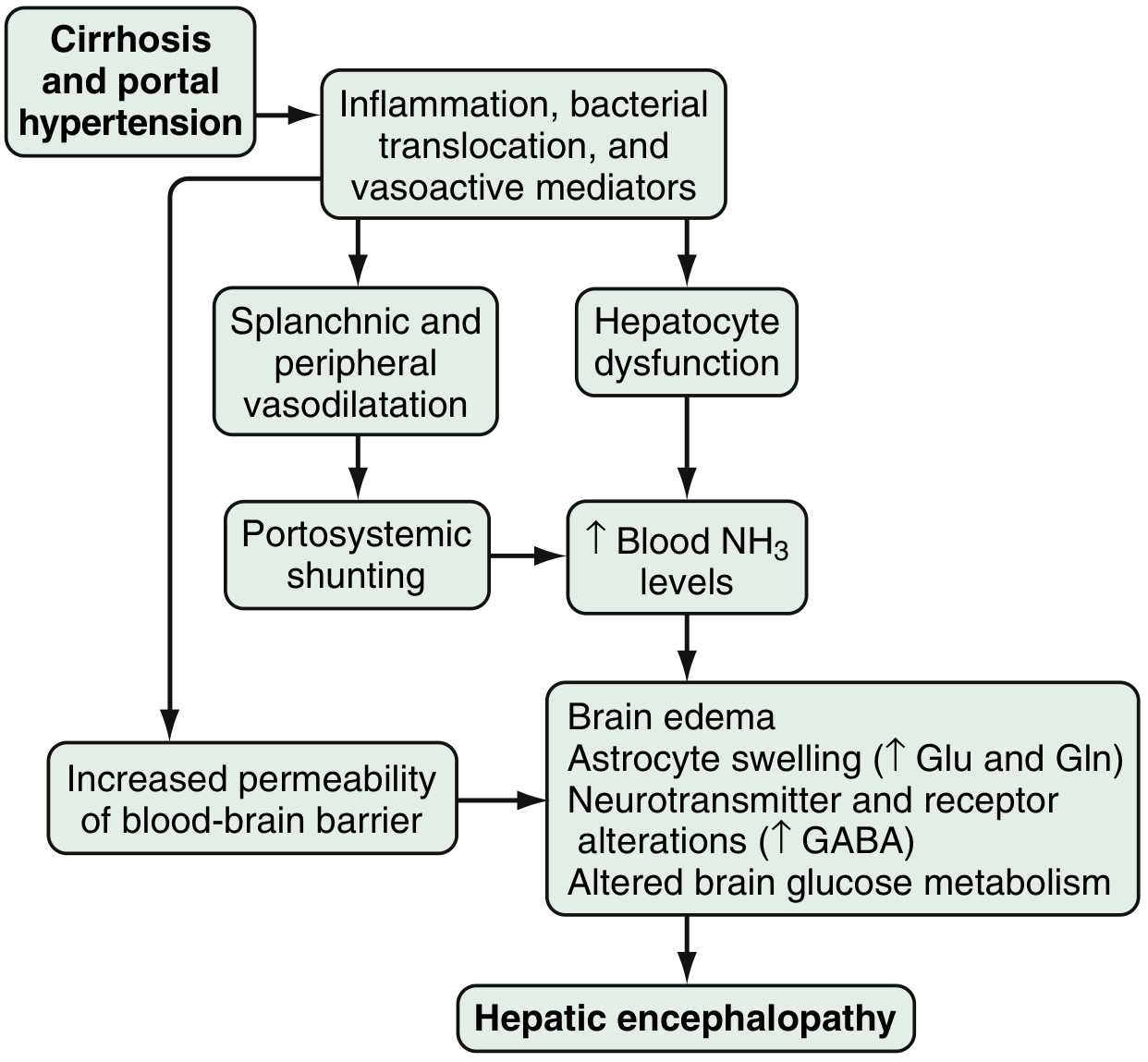
In cirrhosis, reduced hepatocyte function and portosystemic shunting allow ammonia (produced by gut bacteria from protein/nitrogen) to bypass the liver and enter the systemic circulation. This triggers brain edema, astrocyte swelling, increased GABA-ergic tone, and neurotransmitter alterations - all contributing to HE. - Sleisenger and Fordtran's Gastrointestinal and Liver Disease, p. 1486
Nitrogenous HE (Nitrogen-Loading Precipitants)
These factors precipitate HE by increasing the production or absorption of ammonia and other nitrogenous waste products in the gut.
| Precipitant | Mechanism |
|---|---|
| Upper GI bleeding | Blood (rich in protein) in the gut is broken down by bacteria → massive ammonia generation. The most common precipitant in clinical studies (up to 51%) |
| High dietary protein intake | Excess protein substrate → increased bacterial ammonia production |
| Constipation | Prolonged gut transit time → increased ammonia absorption from the colon (41% in one study) |
| Azotemia / renal failure | Urea diffuses back into the gut and is split into ammonia by urease-producing bacteria |
| Portosystemic shunts (TIPS) | Nitrogenous gut contents bypass the liver entirely and enter the systemic circulation |
Key feature: Serum ammonia levels are directly elevated. Treatment targets this load directly - lactulose (to acidify colon, trap NH₄⁺, and speed transit), rifaximin (to suppress ammonia-generating bacteria), dietary protein restriction, and correction of the precipitant.
Non-Nitrogenous HE (Non-Nitrogen-Loading Precipitants)
These factors precipitate HE by impairing the brain's ability to tolerate ammonia, reducing hepatic or muscular ammonia clearance, or directly depressing CNS function - without necessarily increasing the ammonia load itself.
| Precipitant | Mechanism |
|---|---|
| Hypokalemia | Promotes renal ammoniagenesis; also increases NH₃ diffusion into the brain |
| Metabolic alkalosis | Converts ionized NH₄⁺ (cannot cross BBB) to free NH₃ (crosses BBB freely) |
| Infection / sepsis / SBP | Systemic inflammation increases BBB permeability; inflammatory cytokines (TNF-α, IL-6) sensitize the brain to ammonia toxicity independent of ammonia levels |
| Hypovolemia / dehydration | Reduces cerebral perfusion; concentrates blood ammonia; often due to over-diuresis, vomiting, diarrhea, or paracentesis |
| Benzodiazepines / opioids / sedatives | Directly enhance GABAergic inhibition; can precipitate or deepen HE at normal ammonia levels |
| Hypoglycemia | Impairs neuronal energy metabolism; mimics and worsens HE |
| Hyponatremia | Increases brain edema (astrocyte swelling) synergistically with ammonia |
| Sarcopenia | Skeletal muscle is a major alternative site for ammonia detoxification via glutamine synthetase; muscle wasting reduces this buffer capacity |
| Hypoxia / respiratory failure | Impairs oxidative metabolism in neurons and astrocytes |
| Hypothyroidism | Reduces metabolic clearance and lowers conscious level |
Key feature: Ammonia may not be markedly elevated, yet encephalopathy is severe because the brain's tolerance threshold is lowered. Treatment addresses the underlying metabolic derangement (e.g., correct electrolytes, stop offending drugs, treat infection).
Summary Comparison Table
| Feature | Nitrogenous HE | Non-Nitrogenous HE |
|---|---|---|
| Primary mechanism | Increased ammonia/nitrogen load in the gut | Brain sensitization, reduced clearance, or direct CNS depression |
| Serum ammonia | Usually elevated | May be normal or mildly elevated |
| Key examples | GI bleed, excess protein, constipation, renal failure, TIPS | Infection, hypokalemia, alkalosis, benzodiazepines, hypovolemia, hyponatremia, sarcopenia |
| Treatment focus | Reduce nitrogen load (lactulose, rifaximin, protein restriction) | Correct underlying metabolic/pharmacologic cause |
| Reversibility | Highly reversible once nitrogen load removed | Depends on how quickly the non-nitrogenous factor is corrected |
Clinical Pearl
In practice, most episodes of HE are multifactorial - a patient may have GI bleeding (nitrogenous) combined with over-diuresis causing hypokalemia and alkalosis (non-nitrogenous). Both sets of factors should be systematically searched for and corrected together. Goldman-Cecil Medicine specifically lists the typical precipitants as: "infection, overdiuresis, gastrointestinal bleeding, high oral protein load, and constipation" - alongside narcotics and sedatives as important non-nitrogenous contributors. - Goldman-Cecil Medicine, p. 1620
This is a shared conversation. Sign in to Orris to start your own chat.