
Investigation for hyperaldostronism
Reading File
Finding Sources
Finding Sources
Searching PubMed
"primary aldosteronism" AND "diagnosis"
Now let me read the most relevant sections in parallel:
Reading File
Reading File
Reading File
Reading File
Finding Sources
Finding Sources
Reading File
Reading File
There's a diagnostic flowchart image in the Tietz textbook. Let me fetch it and also get the Endocrine Society guidelines indications for screening:
Loading Image
Finding Sources
Loading Image
Reading File
I now have comprehensive information from multiple authoritative textbooks. Here is a structured, evidence-based answer:
Investigation of Hyperaldosteronism
Hyperaldosteronism (primary/secondary) is the most common form of secondary hypertension. Investigation follows a structured three-stage approach: screen → confirm → subtype.
Stage 1: When to Screen (Indications)
Screen any hypertensive patient with:
| Indication |
|---|
| Hypertension + spontaneous or diuretic-induced hypokalemia |
| Treatment-resistant hypertension (≥3 antihypertensives + poor control) |
| Severe hypertension (≥160/100 mmHg) |
| Hypertension + incidental adrenal mass |
| Young-onset hypertension |
| Hypertension with a family history of PA or early stroke (<40 years) |
| Sleep-disordered breathing with hypertension |
Note: Hypokalemia is present in <50% of cases — eukalemic PA is now the majority. — Textbook of Family Medicine 9e
Stage 2: Screening Test — Aldosterone-to-Renin Ratio (ARR)
Test: Morning, ambulatory, paired plasma aldosterone concentration (PAC) and plasma renin activity (PRA) or plasma renin concentration (PRC).
| Parameter | Threshold for Positive Screen |
|---|---|
| PAC/PRA ratio (ARR) | ≥20–30 (ng/dL ÷ ng/mL/hr) |
| PAC (to reduce false positives) | ≥15 ng/dL |
| PAC <10 ng/dL | PA is rare |
Key pre-test conditions:
- Correct hypokalemia before testing (hypokalemia falsely lowers aldosterone)
- Can be performed on most antihypertensives except mineralocorticoid receptor antagonists (spironolactone, eplerenone) — stop ≥6 weeks before
Drugs causing false-positive ARR (raise ARR):
- Beta-blockers, central α₂-agonists (e.g., clonidine), NSAIDs, direct renin inhibitors, chronic kidney disease, sodium loading
Drugs causing false-negative ARR (lower ARR):
- Diuretics, ACE inhibitors, ARBs, dihydropyridine CCBs, sodium depletion
Safe drugs during screening (minimal effect on ARR): sustained-release verapamil, hydralazine, peripheral α₁-blockers (e.g., doxazosin)
— Brenner and Rector's The Kidney, Table 46.7
Stage 3: Confirmatory Tests
At least one confirmatory test is required before proceeding to imaging/AVS. Choose based on patient suitability:
| Test | Protocol | Positive Criterion |
|---|---|---|
| IV Saline Loading | 2 L 0.9% NaCl over 4 hours | PAC >10 ng/dL post-infusion (indeterminate 5–10) |
| Oral Sodium Loading | High-Na diet (~6 g/day × 3–5 days | 24-hr urinary aldosterone >12–14 µg/day |
| Fludrocortisone Suppression Test (FST) | Fludrocortisone 0.1 mg q6h × 4 days | Standing PAC >6 ng/dL with suppressed renin & cortisol |
| Captopril Challenge Test | 25–50 mg oral captopril; PAC at 0, 1, 2 hours | PAC remains elevated/unchanged from baseline |
Saline loading is contraindicated in heart failure, CKD, or uncontrolled hypertension. — Brenner and Rector's The Kidney
Stage 4: Subtype Differentiation — Imaging + AVS
Once PA is confirmed biochemically:
CT Adrenals (First-line Imaging)
- Detects large masses (>4 cm) suggesting adrenal carcinoma
- APA: typically small (<2 cm), hypodense, unilateral
- Idiopathic hyperaldosteronism (bilateral): normal or mildly nodular adrenals
- MRI offers no advantage over CT
- Limitations: CT sensitivity 78%, specificity 75% for lateralization — misses microadenomas and may misclassify bilateral disease
Adrenal Venous Sampling (AVS) — Gold Standard for Lateralization
- Sensitivity 95%, specificity 100% for detecting unilateral aldosterone production
- Recommended by Endocrine Society for most surgical candidates
- Performed at 8 AM with continuous cosyntropin infusion; simultaneous bilateral adrenal vein and IVC cortisol + aldosterone measured
- Cutoff: Cortisol-corrected aldosterone ratio (dominant:contralateral side) ≥4:1 = positive lateralization
When to proceed directly to adrenalectomy without AVS:
- Age <40 years + biochemically proven PA + single hypodense unilateral nodule on CT (some centres)
When to offer AVS:
- All surgical candidates >35 years
- Any case with discordance between imaging and biochemistry
Diagnostic Flowchart
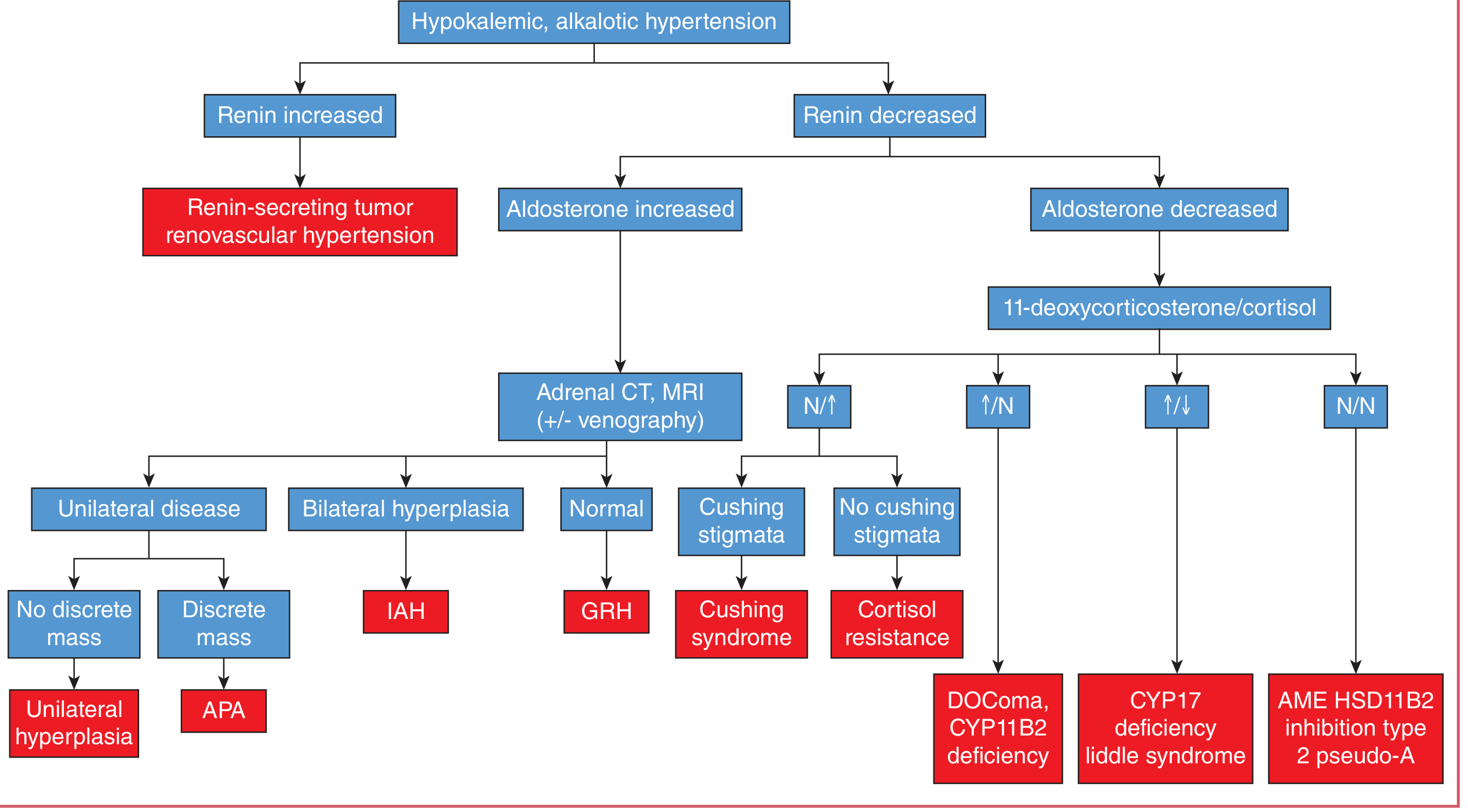
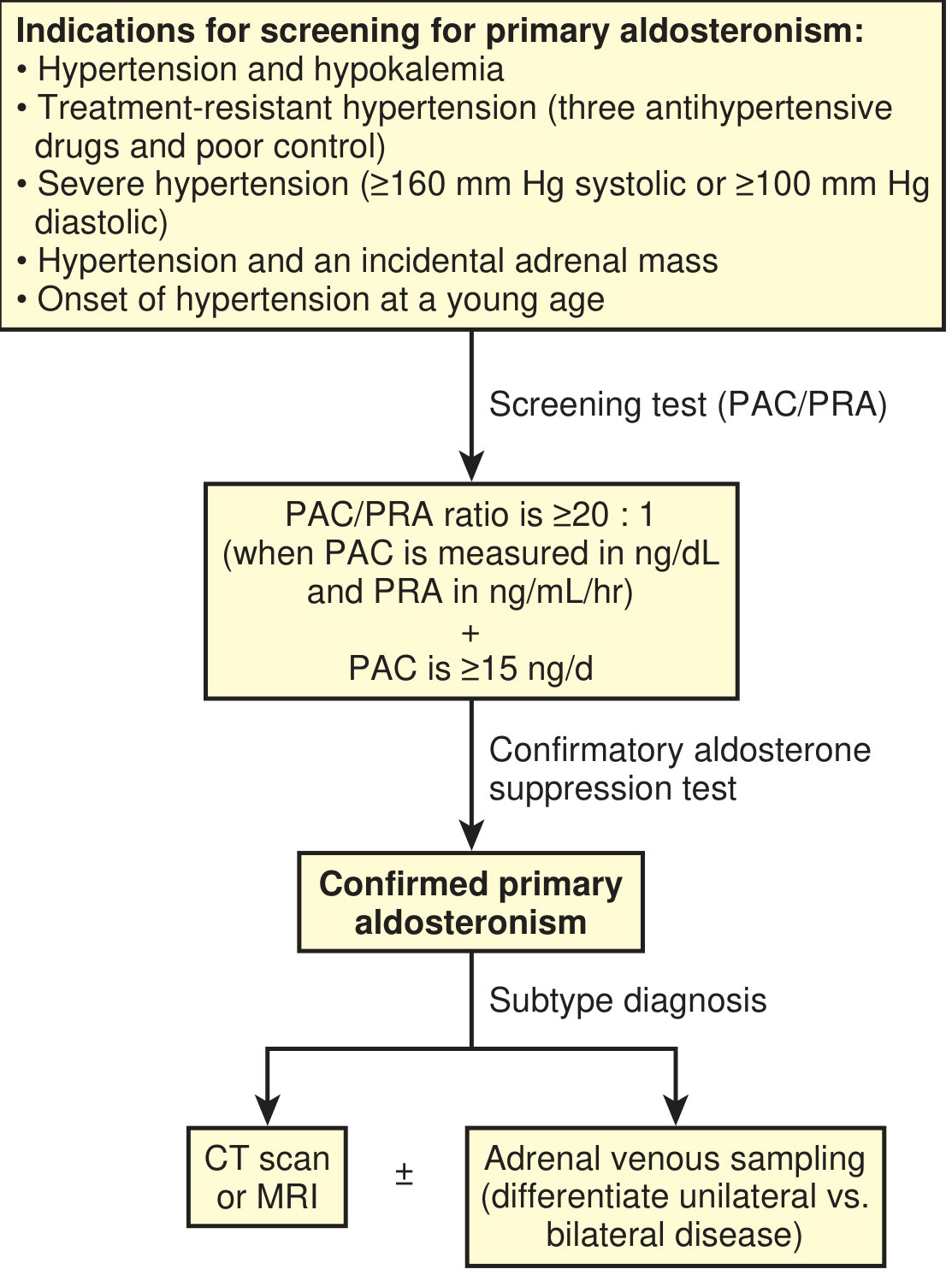
Additional / Special Investigations
| Situation | Test |
|---|---|
| Secondary hyperaldosteronism (elevated renin) | Renal Doppler/CTA for renal artery stenosis; renin-secreting tumour workup |
| Suspected familial hyperaldosteronism (age <20, family history) | Genetic testing (Southern blot or long PCR for CYP11B1/CYP11B2 chimeric gene — FH-I/GRA) |
| Suspected FH-I before genetic testing | Empiric dexamethasone suppression: aldosterone <4 ng/dL = positive |
| Distinguish APA from bilateral hyperplasia | PAC ≥100 ng/dL favours APA; <100 ng/dL favours IAH |
| Postural stimulation test (older/backup test) | Plasma aldosterone lying vs. standing: APA retains diurnal variation; IAH shows paradoxical rise with standing (accuracy ~85%) |
| Iodocholesterol scintigraphy | Limited utility (correlates with tumour size, poor for microadenomas) |
| 18-hydroxycorticosterone (8 AM recumbent) | >100 ng/dL suggests APA (less reliable) |
Subtypes & Prevalence Summary
| Subtype | Prevalence |
|---|---|
| Bilateral adrenal hyperplasia (IAH) | ~60% |
| Aldosterone-producing adenoma (Conn) | ~35% |
| Unilateral adrenal hyperplasia | ~2% |
| Familial hyperaldosteronism | <2% |
| Adrenal carcinoma | Rare |
| Ectopic aldosterone | <0.1% |
Sources: Brenner & Rector's The Kidney; Tietz Textbook of Laboratory Medicine 7e; Textbook of Family Medicine 9e; Current Surgical Therapy 14e
Recent evidence note: A 2025 Endocrine Society systematic review (PMID 40658500) supports the above stepwise approach, and a 2025 meta-analysis (PMID 40304781) highlights emerging CXCR4-targeted PET-CT as a potential localisation tool for PA, though it is not yet standard practice.
This is a shared conversation. Sign in to Orris to start your own chat.