

inbound8875195445846094580.jpg
What is this i not gei6paint is like rubber
Reading File
Looking at the image, I can see white/whitish patches on the inner lower lip mucosa with a rubbery texture. Let me search the medical library and look for similar clinical images.
Finding Sources
Finding Sources
Searching Images
white patch inner lip oral mucosa leukoplakia
Finding Sources
Finding Sources
Finding Sources
Searching Images
white sponge nevus leukoedema inner lip mucosa rubbery texture
Reading File
Loading Image
Based on my analysis, the image and the Harrison's table give a clear picture. Let me also check what that table said about white sponge nevus specifically.
The image in your photo shows whitish, thickened, irregular plaques on the inner lower lip (labial mucosa) that feel rubbery/spongy — and you say it's not painful. The most likely diagnoses, from most to least likely, are:
Most Likely: Leukoedema or White Sponge Nevus (Hereditary Mucosal Leukokeratosis)
Looking at your photo, the key features are:
- Diffuse whitish-gray, thickened, corrugated plaques on the inner lip mucosa
- Rubbery / spongy texture (you said "like rubber")
- No pain
- Bilateral appearance
This matches a condition called White Sponge Nevus (WSN) — a benign, hereditary condition caused by mutations in keratin genes (KRT4 or KRT13). The oral epithelium thickens and takes on a spongy, rubbery, wrinkled texture.
Comparison with a clinical reference image of White Sponge Nevus:
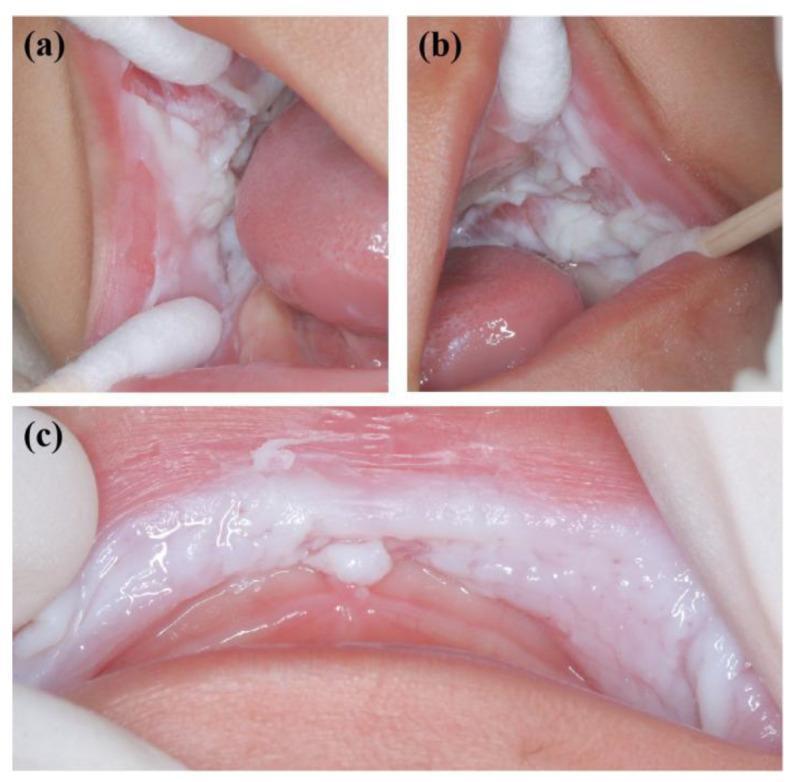
The resemblance to your photo is strong — note panel (c) which shows the inner upper lip with identical-looking whitish, spongy, thickened mucosa.
Other Possibilities to Consider
| Condition | Why it fits | Why it might not |
|---|---|---|
| Leukoedema | Diffuse, gray-white, folded mucosa; very common; benign | Usually disappears when stretched |
| Oral leukoplakia | White plaque that can't be wiped off | Usually has sharper borders; associated with tobacco/alcohol |
| Frictional keratosis | Thickened white area from chronic irritation | Usually more localized |
| Oral candidiasis (thrush) | White patches in mouth | These would scrape off with a tongue blade — rubbery patches that stay are NOT candida |
According to Harrison's Principles of Internal Medicine (2025): White sponge nevus is described as a "painless, whitish thickening of epithelium; adolescence/early adulthood onset; familial" — located on the oral mucosa and vagina, and is benign and permanent.
What You Should Do
- See a dentist or oral medicine specialist — this needs an in-person examination
- The doctor may do a biopsy to confirm the diagnosis, especially to rule out dysplasia or early leukoplakia
- Ask family members if they have similar patches inside their mouth (WSN is hereditary — autosomal dominant)
- Avoid tobacco, alcohol, and betel nut — these can cause similar-looking but more dangerous lesions (true leukoplakia, which carries cancer risk)
⚠️ Important: While this likely looks benign (especially if it has been present for years and runs in your family), any persistent white patch in the mouth that cannot be explained should be evaluated by a professional. A biopsy is the only way to definitively rule out dysplasia or malignancy.
It feels like my lip skin
That's actually a very helpful clue. If the tissue feels exactly like normal lip skin — not abnormally thick, hard, or rubbery in a pathological way — then this is most likely leukoedema, which is essentially a normal anatomical variant.
Most Likely: Leukoedema
Leukoedema is an extremely common, benign, and normal variation of oral mucosa. Here's why it fits:
- The inner lip/cheek mucosa looks grayish-white, slightly opaque, and wrinkled
- The texture feels soft and normal — just like regular lip tissue
- It is not a disease — it's simply how some people's mucosa looks
- It is more prominent in some ethnic groups and in people who smoke
- When you stretch the lip outward, the whitish appearance partially fades or disappears — this is the classic test
Key distinguishing point:
If you gently pull/stretch the lip further and the white color fades or becomes less obvious, that confirms leukoedema — not leukoplakia or WSN (which stay white when stretched).
Reassurance
- No treatment needed
- Not precancerous
- Not contagious
- Very common finding — dentists see it all the time
When to Still See a Dentist
Even if this is leukoedema, you should get it checked if:
- The patches have changed recently (grown, thickened, ulcerated)
- There is any pain, burning, or bleeding
- You use tobacco, betel nut (paan/gutka), or alcohol regularly — these change the risk profile significantly
- The white areas cannot be stretched away at all
A quick 2-minute dental exam can confirm this with certainty and give you peace of mind.
Ok
Glad that helps! To summarize:
- Most likely leukoedema — a harmless, normal variation of the mouth lining
- No treatment needed
- Just mention it at your next routine dental visit so they can confirm in person
Feel free to ask if anything else comes up! 😊
This is a shared conversation. Sign in to Orris to start your own chat.