
Reading File
This is a classic pediatric malnutrition case. Let me search the medical library for detailed content on this.
Quick Answer: This 18-month-old boy with weight 5.5 kg (severely underweight), weight-for-length Z-score <3, MUAC 108 mm, marked loss of subcutaneous fat, prominent ribs, loose skin, and "old-man" facies - without edema - has Severe Acute Malnutrition (SAM), specifically Marasmus. The mechanism is severe caloric (energy) deficiency, primarily from inadequate protein and calorie intake.
Searching sources...
Finding Sources
Finding Sources
Finding Sources
Finding Sources
Reading File
Reading File
Reading File
Finding Sources
Searching Images
marasmus child severe acute malnutrition emaciation
Loading Image
Finding Sources
Reading File
Reading File
I now have comprehensive information from the textbooks. Here is the full structured answer:
Clinical Case Analysis: 18-Month-Old Boy with Progressive Weight Loss
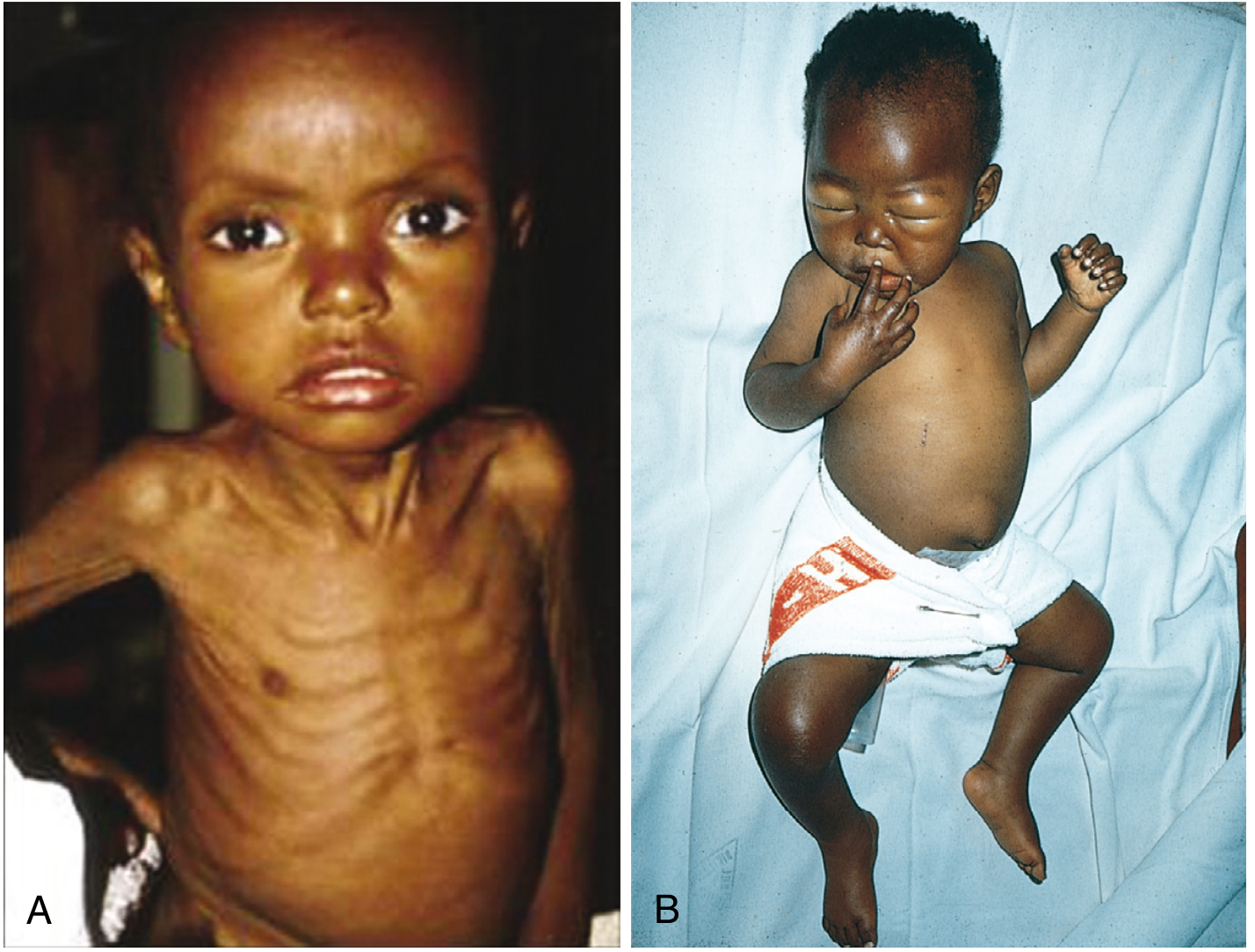
1. Most Likely Diagnosis
Severe Acute Malnutrition (SAM) - Marasmus
This is the non-edematous form of SAM, characterized by severe caloric (total energy) deficiency affecting both protein and non-protein calories.
2. Findings That Support the Diagnosis
| Finding | Significance |
|---|---|
| Weight 5.5 kg at 18 months | Expected ~11 kg; this is ~50% of expected - consistent with severe wasting (marasmus threshold is <60% expected weight) |
| Weight-for-length Z-score <-3 SD | Meets WHO criterion for SAM (threshold is <-3 SD) |
| MUAC 108 mm | Below 115 mm = SAM criterion (normal >125 mm) |
| No bilateral pitting edema | Key distinguishing feature from kwashiorkor - absence of edema points to marasmus |
| Marked loss of subcutaneous fat | Mobilization of fat stores as energy source |
| Prominent ribs, thin limbs | Severe muscle catabolism and fat depletion |
| Loose skin over buttocks | "Baggy pants" sign - loss of gluteal fat pad |
| "Old man" facial appearance | Loss of buccal fat pad (last fat pad to be depleted) |
| Alert and hungry | Preserved mentation - typical of marasmus (unlike kwashiorkor where apathy is common) |
| Diet history | Switched from breast milk to diluted cow's milk then watery cereal porridge - grossly calorie and protein deficient |
The absence of bilateral pitting edema is the single most important distinguishing feature from kwashiorkor.
3. Nutritional Mechanism
Marasmus = Adapted (total energy) starvation
When both caloric and protein intake are severely insufficient, the body mounts an adaptive metabolic response:
- Low insulin levels (due to inadequate carbohydrate intake) permit lipolysis and proteolysis
- Subcutaneous fat is mobilized as the primary fuel source - leading to emaciation
- Somatic (skeletal muscle) protein is catabolized via gluconeogenesis - providing amino acids as an energy source and preserving blood glucose
- Visceral protein compartment (albumin, etc.) is relatively spared - hence serum albumin is normal or near-normal, explaining the absence of edema
- Leptin falls, stimulating the hypothalamic-pituitary-adrenal axis to produce cortisol, which drives further lipolysis
- Growth hormone rises but its peripheral effects are blunted, so IGF-1 falls - contributing to growth failure
This is "adapted starvation" - the body efficiently preserves visceral proteins at the cost of somatic fat and muscle.
Compare with kwashiorkor (non-adapted malnutrition): protein is selectively deficient relative to carbohydrates, insulin remains elevated suppressing lipolysis, visceral proteins are depleted, albumin falls, and edema results.
4. How Should This Child Be Managed?
This child has complicated SAM (given the severity of wasting) and should be managed per the WHO 10-Step protocol, ideally as an inpatient:
Phase 1 - Stabilization (Days 1-7): Treat Life-Threatening Complications First
- Hypoglycemia: Give 10% dextrose or glucose water (50 mL) if blood glucose <3 mmol/L; feed every 2-3 hours
- Hypothermia: Warm the child; monitor temperature
- Dehydration: Use WHO-ReSoMal (Rehydration Solution for Malnourished) - NOT standard ORS (standard ORS has too much sodium and too little potassium). Give slowly (5-10 mL/kg/hr)
- Infections: Empiric broad-spectrum antibiotics even without obvious infection (common organisms missed due to impaired immune response). Amoxicillin is first-line for uncomplicated SAM
- Micronutrient deficiencies: Give daily supplements - multivitamins, folic acid, zinc, copper, potassium, magnesium
- Vitamin A: Single high-dose vitamin A on Day 1 (50,000 IU for children <6 months; 100,000 IU for 6-12 months; 200,000 IU for >12 months)
Phase 1 Feeding: F-75 formula (75 kcal/100 mL, low protein)
- Start cautiously to avoid refeeding syndrome (hypophosphatemia)
- ~100 kcal/kg/day, ~1-1.5 g protein/kg/day
- Small, frequent feeds every 2-3 hours
Phase 2 - Rehabilitation (Weeks 2-6): Nutritional Rebuilding
- Transition to F-100 formula (100 kcal/100 mL, higher protein) when appetite returns
- Then to Ready-to-Use Therapeutic Food (RUTF) - a fortified peanut-based paste (543 kcal/100 g)
- Target: 150-220 kcal/kg/day, 4-6 g protein/kg/day
- Sensory stimulation and play therapy for developmental catch-up
Phase 3 - Follow-Up
- Transition to local foods
- Nutritional counselling for family
- Treat underlying causes (poverty, poor feeding practices)
- Monitor for catch-up growth
- Immunizations (if not already given)
- Deworming
Warning - Refeeding Syndrome:
As noted in Lippincott Biochemistry, refeeding severely malnourished children can cause hypophosphatemia because available phosphate is rapidly used to phosphorylate carbohydrate intermediates during anabolism. Milk is beneficial because it is rich in phosphate.
Key Distinguishing Points: Marasmus vs Kwashiorkor
| Feature | Marasmus | Kwashiorkor |
|---|---|---|
| Weight for age | <60% expected | 60-80% expected |
| Edema | Absent | Present (bilateral pitting) |
| Serum albumin | Normal or slightly low | Markedly low |
| Subcutaneous fat | Markedly depleted | Relatively spared (masked by edema) |
| Liver | Normal | Enlarged, fatty |
| Skin/hair changes | Absent | Present ("flaky paint", depigmented hair) |
| Appetite | Hungry, alert | Anorexic, apathetic |
| Mechanism | Adapted starvation (↑ cortisol, lipolysis) | Non-adapted (↑ insulin, ↓ visceral protein) |
- Robbins, Cotran & Kumar Pathologic Basis of Disease, p. 412
- Lippincott Illustrated Reviews Biochemistry 8th ed, p. 1025-1027
- Park's Textbook of Preventive and Social Medicine (SAM definition, p. 4747)
- Goldman-Cecil Medicine, p. 2344-2348
This is a shared conversation. Sign in to Orris to start your own chat.