
Folate trap
The folate trap is a biochemical mechanism explaining how vitamin B12 deficiency causes functional folate deficiency, even when folate levels are normal.
Reading File
Searching sources...
Finding Sources
Finding Sources
Good results. Let me read the most detailed sections from Harper's and Basic Medical Biochemistry in parallel.
Reading File
Reading File
Let me read the detailed methyl-trap section and the Harper's folate trap explanation, plus fetch the key diagram.
Reading File
Reading File
Loading Image
I now have comprehensive information from multiple authoritative textbooks. Let me also fetch the one-carbon folate pathway diagram for context.
Loading Image
Reading File
I now have all the information needed for a comprehensive answer.
The Folate Trap (Methyl-Trap Hypothesis)
Core Concept
The folate trap (also called the methyl-trap hypothesis) describes how vitamin B12 deficiency produces a functional folate deficiency even when total body folate is normal. The folate pool becomes "trapped" in a metabolically useless form.
The Biochemical Mechanism
Normal state
Dietary folates enter cells and are converted to tetrahydrofolate (THF), the active form that carries one-carbon units for DNA synthesis (purines and thymidylate) and amino acid metabolism.
The folate cycle has a critical junction:
- Methylene-THF is irreversibly reduced by methylenetetrahydrofolate reductase (MTHFR) to N5-methyl-THF (5-methyltetrahydrofolate, or methyl-THF)
- This is the most thermodynamically stable form of folate in the cell
- The only reaction that can remove the methyl group from methyl-THF and release free THF is the methionine synthase reaction
The methionine synthase reaction (the exit door)
Methionine synthase uses methyl-THF as the methyl donor to convert homocysteine → methionine, with vitamin B12 (methylcobalamin) as the essential cofactor:
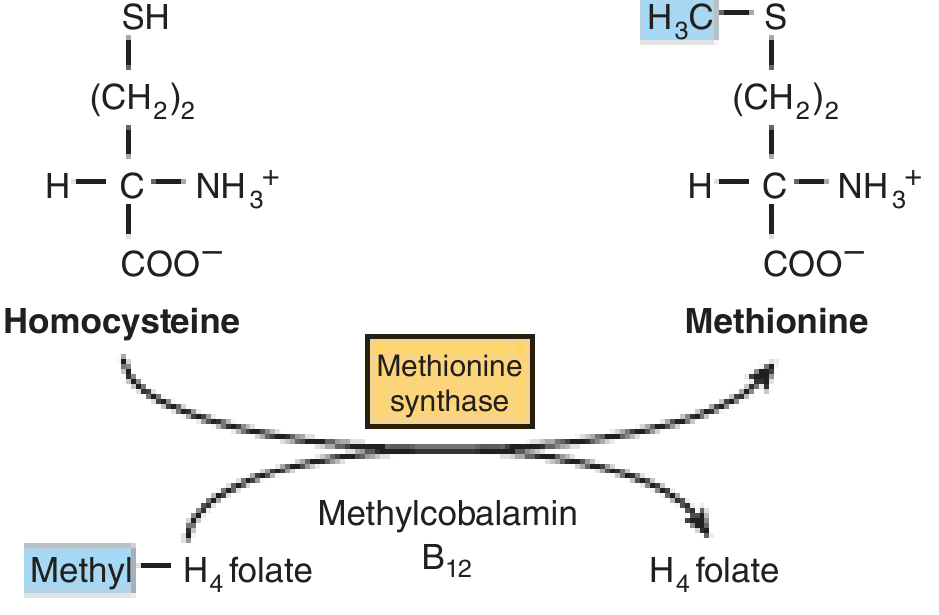
Fig: Methionine synthase converts homocysteine to methionine, transferring the methyl group from methyl-THF to release free THF. This requires vitamin B12 (methylcobalamin) as cofactor.
When B12 is deficient
- Methionine synthase activity is impaired (no B12 cofactor)
- Methyl-THF cannot donate its methyl group - it accumulates
- Over time, nearly the entire folate pool is sequestered as methyl-THF
- Free THF (and its other active derivatives - methylene-THF, formyl-THF, etc.) become unavailable
- Result: functional folate deficiency - folate is present in serum but cannot be used
This is the "trap": folate is locked in the methyl-THF form, which is a one-way street with a blocked exit.
Consequences of the Folate Trap
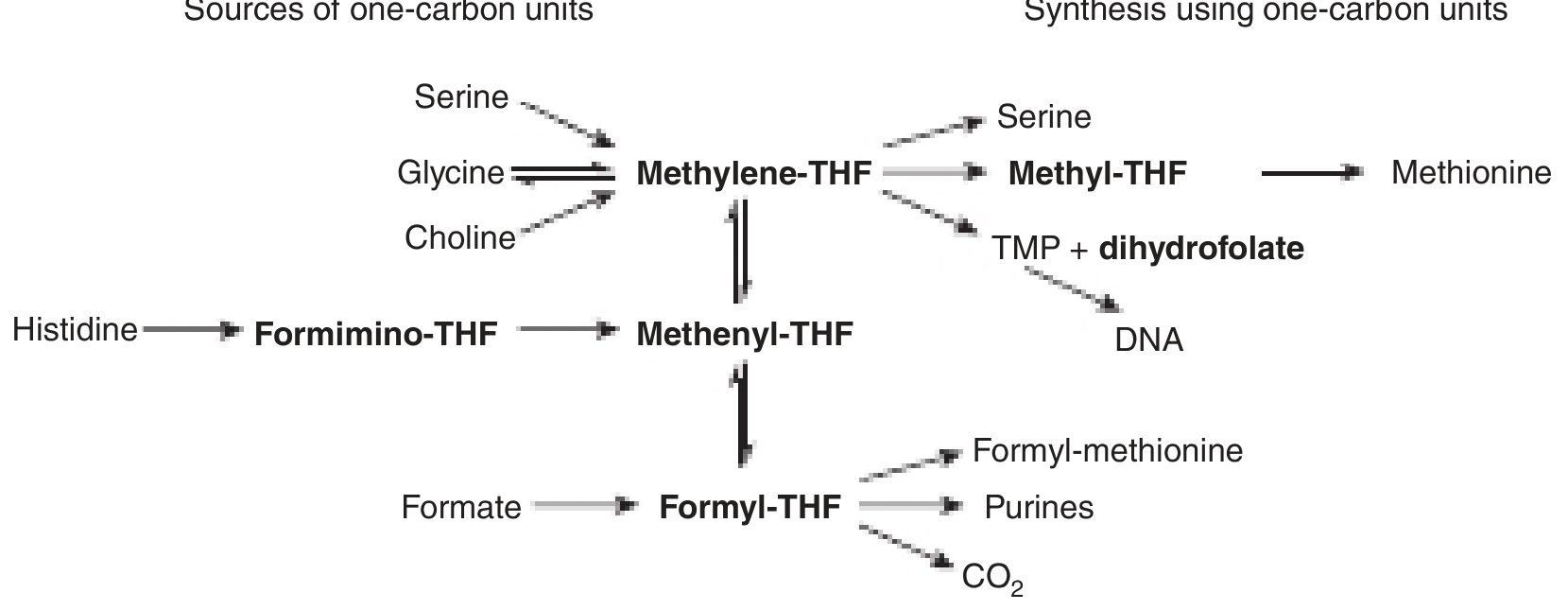
Fig: Sources and utilization of one-carbon substituted folates. In the folate trap, the entire pool is stuck as Methyl-THF and cannot feed into TMP synthesis or purine synthesis.
1. Megaloblastic anemia
- Methylene-THF is needed by thymidylate synthase to convert dUMP → dTMP (for DNA synthesis)
- Formyl-THF is needed for purine synthesis
- With the trap engaged, both pathways fail → impaired DNA synthesis → large, poorly dividing RBC precursors → megaloblastic anemia
- This is the same presentation as primary folate deficiency - the two are clinically indistinguishable on peripheral smear
2. Hyperhomocysteinemia
- The methionine synthase reaction is blocked → homocysteine accumulates
- Elevated homocysteine is a cardiovascular and neurological risk factor
3. SAM depletion (neurological effects)
- Methionine → S-adenosylmethionine (SAM) is the universal methyl donor in the CNS
- B12 deficiency → less methionine regenerated → reduced SAM → hypomethylation of DNA, histones, and myelin proteins
- The nervous system lacks the alternative betaine pathway for methionine regeneration, making it especially vulnerable
- Combined with methylmalonyl-CoA accumulation and branched-chain fatty acid incorporation into myelin → subacute combined degeneration of the spinal cord
The Dangerous Clinical Trap: Giving Folate Alone to a B12-Deficient Patient
This is the most important clinical implication of the folate trap:
| Action | Effect |
|---|---|
| Give folate alone to a B12-deficient patient | Partially corrects megaloblastic anemia (bypasses the trap by providing extra THF for dTMP/purine synthesis), but does NOT fix B12 deficiency |
| Neurological disease continues to progress silently while the anemia improves | Subacute combined degeneration can become irreversible |
| Why this happens | Extra folate bypasses the blocked step; the underlying B12 deficiency and SAM/methylmalonate pathway problems remain |
"If folate is given without cobalamin to a B12-deficient patient, the drug only partially corrects the megaloblastic anemia... However, the neurological syndrome may progress unless the physician realizes that B12 supplementation is required." - Basic Medical Biochemistry, 6e
This is why it is mandatory to rule out B12 deficiency before treating megaloblastic anemia with folate.
Key Enzymes and Cofactors
| Enzyme | Cofactor | Reaction | What fails in B12 deficiency |
|---|---|---|---|
| MTHFR (methylenetetrahydrofolate reductase) | NADPH | Methylene-THF → Methyl-THF (IRREVERSIBLE) | Works normally - continues trapping folate |
| Methionine synthase | Vitamin B12 (methylcobalamin) | Methyl-THF + Homocysteine → THF + Methionine | BLOCKED - this is the trap |
| Thymidylate synthase | Methylene-THF | dUMP → dTMP | Starved of substrate |
| Methylmalonyl-CoA mutase | Adenosylcobalamin (B12) | Methylmalonyl-CoA → Succinyl-CoA | Also fails - separate B12 pathway |
Summary
The folate trap = B12 deficiency → methionine synthase failure → methyl-THF accumulates → active THF pools depleted → functional folate deficiency → megaloblastic anemia + homocysteinemia
The neurological damage (subacute combined degeneration) is a separate B12-dependent mechanism (SAM depletion + methylmalonate accumulation) that giving folate alone will not address.
Sources: Harper's Illustrated Biochemistry 32e, p.556-557 | Basic Medical Biochemistry: A Clinical Approach 6e, pp.1393-1398 | Katzung's Basic and Clinical Pharmacology 16e | Quick Compendium of Clinical Pathology 5e
This is a shared conversation. Sign in to Orris to start your own chat.