
Stroke
Reading File
The query "Stroke" is broad. Let me clarify what aspect you need before diving deep.
Asking for Preferences
What aspect of stroke are you looking for?
Searching sources...
Finding Sources
Searching PubMed
"stroke" AND "warning signs" AND "recognition"
Searching the Web
stroke warning signs FAST symptoms 2025
Finding Sources
Finding Sources
Finding Sources
Finding Sources
Reading File
Finding Sources
Reading File
Reading File
Reading File
Loading Image
Here is a complete breakdown of stroke warning signs, drawn from authoritative medical textbooks.
Stroke Warning Signs
A stroke is a medical emergency. The core principle is: "TIME IS BRAIN" - every minute without treatment, approximately 1.9 million neurons die. Warning signs appear suddenly and without warning.
The BE-FAST Mnemonic
The American Heart Association endorses BE-FAST as the standard public-facing tool to recognize stroke:
| Letter | What to Check | Positive Sign |
|---|---|---|
| B | Balance | Sudden loss of balance or coordination |
| E | Eyes | Sudden blurred, double, or lost vision in one or both eyes |
| F | Face | Ask the person to smile - does one side droop or feel numb? |
| A | Arms | Ask them to raise both arms - does one drift downward? |
| S | Speech | Ask them to repeat a phrase - is it slurred, strange, or confused? |
| T | Time | Call emergency services immediately if you see any one of these signs |
The original FAST (Face, Arms, Speech, Time) is simpler and remains widely used. BE-FAST adds Balance and Eyes to capture posterior circulation strokes that FAST alone may miss.
Complete List of Sudden-Onset Warning Signs
According to Harrison's Principles of Internal Medicine (22nd ed.) and Park's Textbook of Preventive & Social Medicine, the warning signs of stroke include sudden onset of:
- Weakness or numbness of the face, arm, or leg - most often on ONE side of the body (about 85% of ischemic stroke patients have one-sided weakness/hemiparesis)
- Confusion or difficulty speaking or understanding speech (aphasia, dysarthria)
- Vision problems - blurred, double vision, or sudden loss of vision in one or both eyes
- Difficulty walking - sudden dizziness, loss of balance, or loss of coordination
- Severe headache with no known cause ("thunderclap" - especially in hemorrhagic stroke)
- Fainting or loss of consciousness
From Harrison's Principles of Internal Medicine, 22E: "patients and their family members should be counseled to call emergency medical services immediately if they experience or witness the sudden onset of any of the following: loss of sensory and/or motor function on one side of the body... change in vision, gait, or ability to speak or understand; or a sudden, severe headache."
Why "Sudden" Is the Key Word
The hallmark that distinguishes stroke from other neurological conditions is abrupt, sudden onset:
- Embolic or hemorrhagic strokes tend to produce maximum deficit at onset
- A "stuttering" or waxing-and-waning deficit may suggest thrombosis or a TIA (Transient Ischemic Attack)
- TIA produces the same warning signs but resolves within minutes to hours - it is still a medical emergency because it signals high short-term stroke risk
Stroke Mimics to Be Aware Of
Several conditions can look like a stroke but are not:
| Mimic | Distinguishing Feature |
|---|---|
| Seizure | May have convulsive activity before deficit |
| Migraine (acephalgic) | Sensory changes that migrate slowly over minutes across a limb |
| Brain tumor | Gradual onset; stroke-like only if there is hemorrhage or seizure |
| Metabolic encephalopathy | Fluctuating mental status, usually no focal deficit |
| Hypoglycemia | Clears rapidly with glucose correction |
What to Do If You Suspect a Stroke
- Call emergency services immediately - do not wait to see if symptoms resolve
- Note the exact time symptoms started - this determines eligibility for clot-busting treatment (tPA is given within 3-4.5 hours of onset)
- Do not give food, water, or medication by mouth - swallowing may be impaired
- Keep the person calm and lying down with head slightly elevated
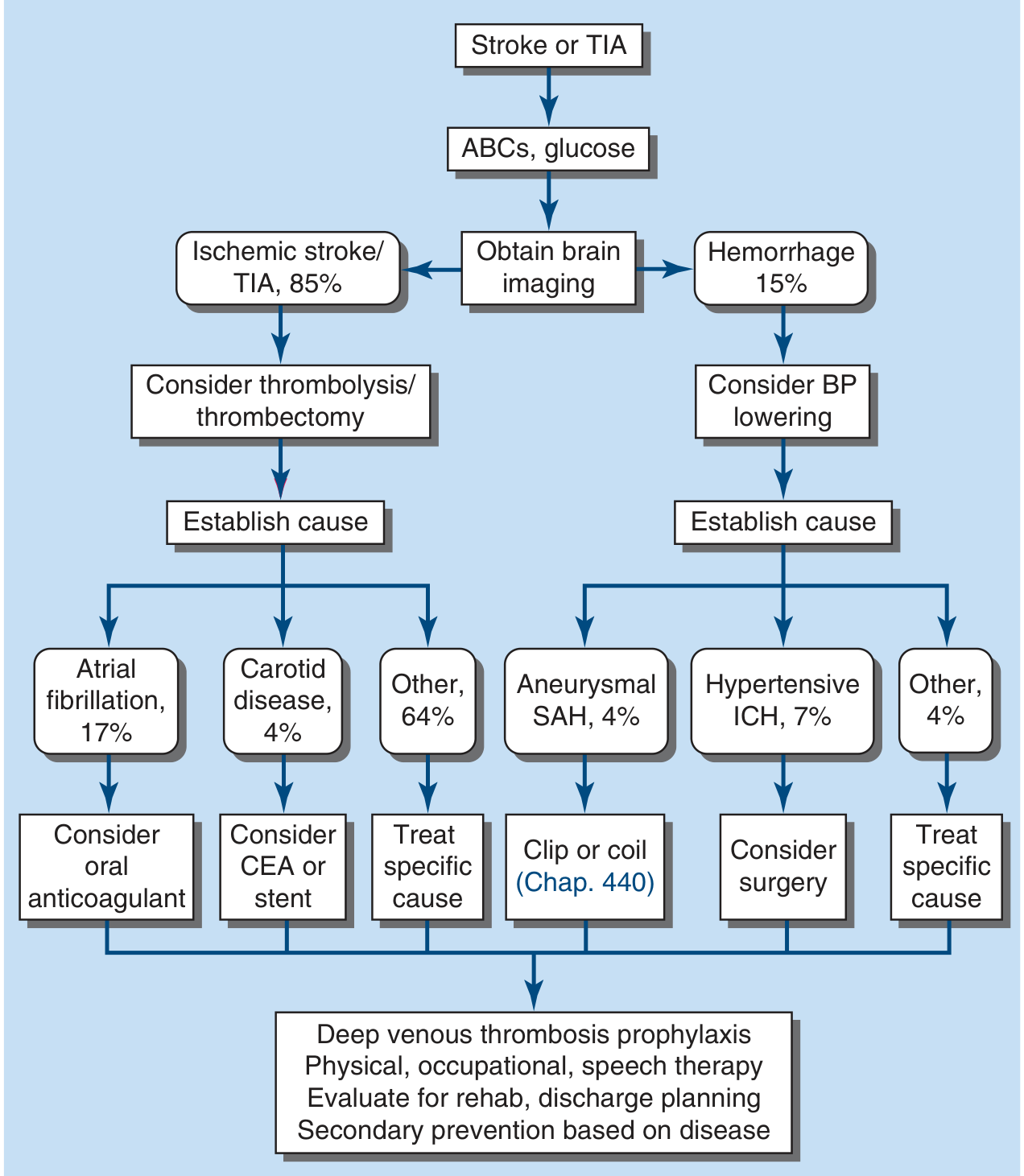
Stroke/TIA management pathway - Harrison's Principles of Internal Medicine, 22E
Here is a helpful explainer video on BE-FAST from a UC Davis neurologist:
Sources:
- Harrison's Principles of Internal Medicine, 22E (2025), Cerebrovascular Disease chapter
- Park's Textbook of Preventive and Social Medicine, p. 8239-8252
- The Washington Manual of Medical Therapeutics, p. 2452-2456
- AHA Journal: FAST mnemonic and stroke recognition
- Mayo Clinic: BE FAST stroke warning signs
Pathophysiology of stroke
Searching sources...
Finding Sources
Finding Sources
Searching the Web
pathophysiology of stroke ischemic hemorrhagic mechanisms 2024 2025
Good - Harrison's has a dedicated "Pathophysiology of Ischemic Stroke" section. Let me read it fully alongside the nephrology and neurology textbook content.
Reading File
Finding Sources
Reading File
Finding Sources
Finding Sources
Reading File
Loading Image
Excellent - I have the key ischemic cascade diagram. Now let me get the ICH pathophysiology and the penumbra details.
Reading File
Finding Sources
Finding Sources
Finding Sources
Reading File
Finding Sources
Reading File
This is a shared conversation. Sign in to Orris to start your own chat.