
Make a short on neurons
Asking for Preferences
What kind of 'short' do you mean? · Who is this for?
Reading File
Finding Sources
Finding Sources
Reading File
Reading File
Finding Sources
Finding Sources
Loading Image
Reading File
Finding Sources
I now have rich, well-sourced content. Here is the short explainer on neurons:
Neurons: The Cellular Basis of the Nervous System
What Is a Neuron?
A neuron is the fundamental signaling unit of the nervous system — electrically excitable cells specialized to receive, integrate, and transmit information. The human brain contains roughly 86 billion neurons, each forming thousands of connections with others.
Structure
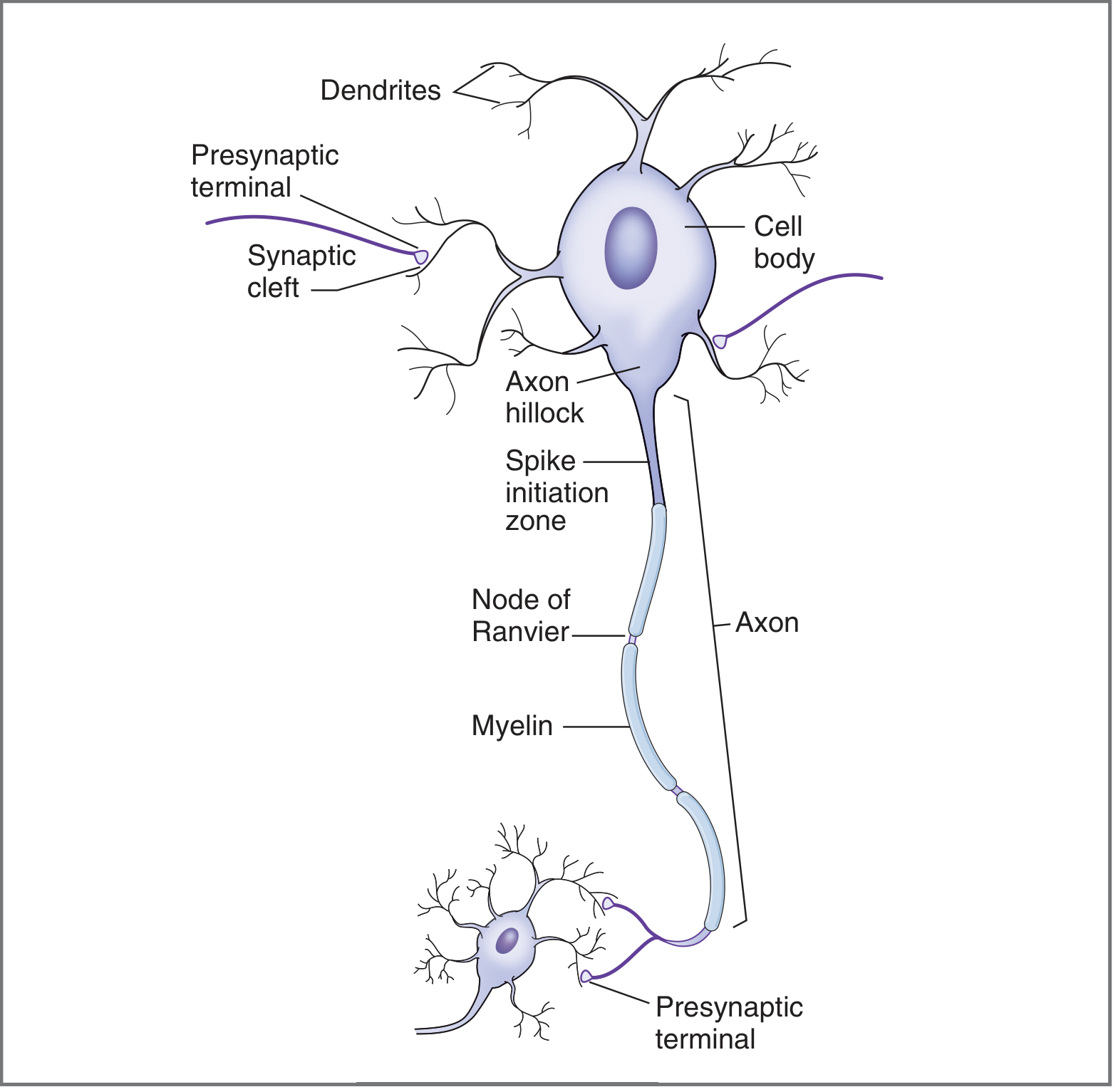
Every neuron has four main compartments:
| Part | Description |
|---|---|
| Soma (cell body) | The metabolic center — houses the nucleus, endoplasmic reticulum, and Golgi apparatus; responsible for protein synthesis |
| Dendrites | Short, tapering, branching processes that receive incoming signals and carry receptors for neurotransmitters |
| Axon | A single, long projection (up to 1 m) arising from the axon hillock; carries action potentials away from the soma toward target cells |
| Presynaptic terminals | Bulb-like endings of the axon that release neurotransmitter into the synapse when an action potential arrives |
The junction between two neurons is the synapse — composed of the presynaptic terminal, a ~20 nm synaptic cleft, and the postsynaptic membrane bearing receptors. Synapses can be axodendritic, axosomatic, or axoaxonic.
The Resting Membrane Potential
At rest, a neuron's membrane potential is approximately −70 mV — close to the K⁺ equilibrium potential. This negative charge is maintained by:
- Differential permeability of the membrane (K⁺ leaks out; Na⁺ is mostly excluded)
- The Na⁺/K⁺-ATPase pump (3 Na⁺ out : 2 K⁺ in per cycle)
Clinically, this matters: in hyperkalemia, the resting potential moves toward threshold → the neuron is more excitable. In hypokalemia, it hyperpolarizes → less excitable.
The Action Potential
An action potential (AP) is an all-or-none electrical impulse generated when the membrane depolarizes past threshold (~−55 mV). The sequence:
- Depolarization — voltage-gated Na⁺ channels open; Na⁺ rushes in → membrane rapidly swings positive (~+30 mV)
- Repolarization — Na⁺ channels inactivate; voltage-gated K⁺ channels open → K⁺ flows out, restoring negative potential
- After-hyperpolarization — slow closure of K⁺ channels briefly takes the membrane below resting potential before returning to −70 mV
The spike initiation zone (initial segment of the axon, just past the axon hillock) is where the threshold is lowest and APs are reliably triggered.
"The propensity of a neuron to generate and propagate action potentials from the cell body to its nerve terminals is called its excitability." — Barash's Clinical Anesthesia, 9e
Conduction & Myelination
Axons can be myelinated or unmyelinated:
- Myelinated axons: Wrapped in myelin (a protein-lipid insulator made by oligodendrocytes in the CNS, Schwann cells in the PNS). Gaps in the myelin — nodes of Ranvier — are the only sites where ion exchange occurs.
- Saltatory conduction: The AP "jumps" from node to node, dramatically increasing speed. Conduction velocity depends on both myelin thickness and axon diameter.
- Unmyelinated axons: Continuous conduction along the entire membrane surface — slower.
Fiber classification:
- A fibers (large, myelinated): fast conduction — motor, proprioception, touch
- B fibers (small, myelinated): autonomic preganglionic
- C fibers (unmyelinated): slow — pain, temperature
Demyelination (e.g., multiple sclerosis — CNS; Guillain-Barré syndrome — PNS) slows or blocks conduction, producing the characteristic deficits seen in these diseases.
Synaptic Transmission
When an AP reaches the presynaptic terminal:
- Voltage-gated Ca²⁺ channels open → Ca²⁺ influx
- Synaptic vesicles fuse with the membrane → neurotransmitter release into the cleft
- Transmitter diffuses across and binds postsynaptic receptors
- Binding generates either an EPSP (excitatory postsynaptic potential) or IPSP (inhibitory), depending on the ion channels opened
- The soma integrates all incoming EPSPs and IPSPs — if the net depolarization reaches threshold, a new AP fires
This is the basis for how all psychopharmacological drugs work — they target specific molecules involved in neurotransmission, modifying release, reuptake, or receptor binding.
Supporting Cells: Glia
Neurons do not work in isolation. Glial cells occupy >50% of brain volume:
| Cell | Function |
|---|---|
| Astrocytes | Supply metabolic fuel (lactate), modulate blood flow, buffer extracellular K⁺, secrete neurotrophic factors |
| Oligodendrocytes | Synthesize myelin in the CNS |
| Schwann cells | Synthesize myelin in the PNS |
| Microglia | CNS-resident immune cells; scavenge debris after injury |
Axonal Transport
The axon can be up to a meter long, so proteins synthesized in the soma must be actively transported:
- Anterograde (soma → terminal): via kinesin along microtubules; fast component (~400 mm/day), slow component (~0.5–10 mm/day)
- Retrograde (terminal → soma): via dynein (~200 mm/day) — also the route hijacked by neurotropic viruses (e.g., herpes simplex, rabies) and tetanus toxin
Sources: Costanzo Physiology 7th Ed. | Ganong's Review of Medical Physiology 26th Ed. | Stahl's Essential Psychopharmacology | Neuroscience: Exploring the Brain 5th Ed. | Guyton & Hall Textbook of Medical Physiology
This is a shared conversation. Sign in to Orris to start your own chat.