
mention the arterial supply of mid brain
Reading File
The midbrain receives its arterial supply primarily from branches of the basilar artery and posterior cerebral artery. Now let me consult the textbook library for a precise and complete answer.
Searching sources...
Finding Sources
Finding Sources
Finding Sources
Finding Sources
Excellent - found dedicated sections. Let me read these in parallel.
Reading File
Reading File
Reading File
Excellent - I now have detailed, authoritative content. Let me also fetch the brainstem blood supply diagram and get more detail on the midbrain-specific territories.
Reading File
Loading Image
I now have comprehensive information from multiple authoritative textbooks plus a high-quality anatomical diagram. Here is the full answer:
Arterial Supply of the Midbrain
The midbrain receives its blood supply entirely from the vertebrobasilar system, specifically from branches arising at the top of the basilar artery and the proximal posterior cerebral arteries (PCAs).
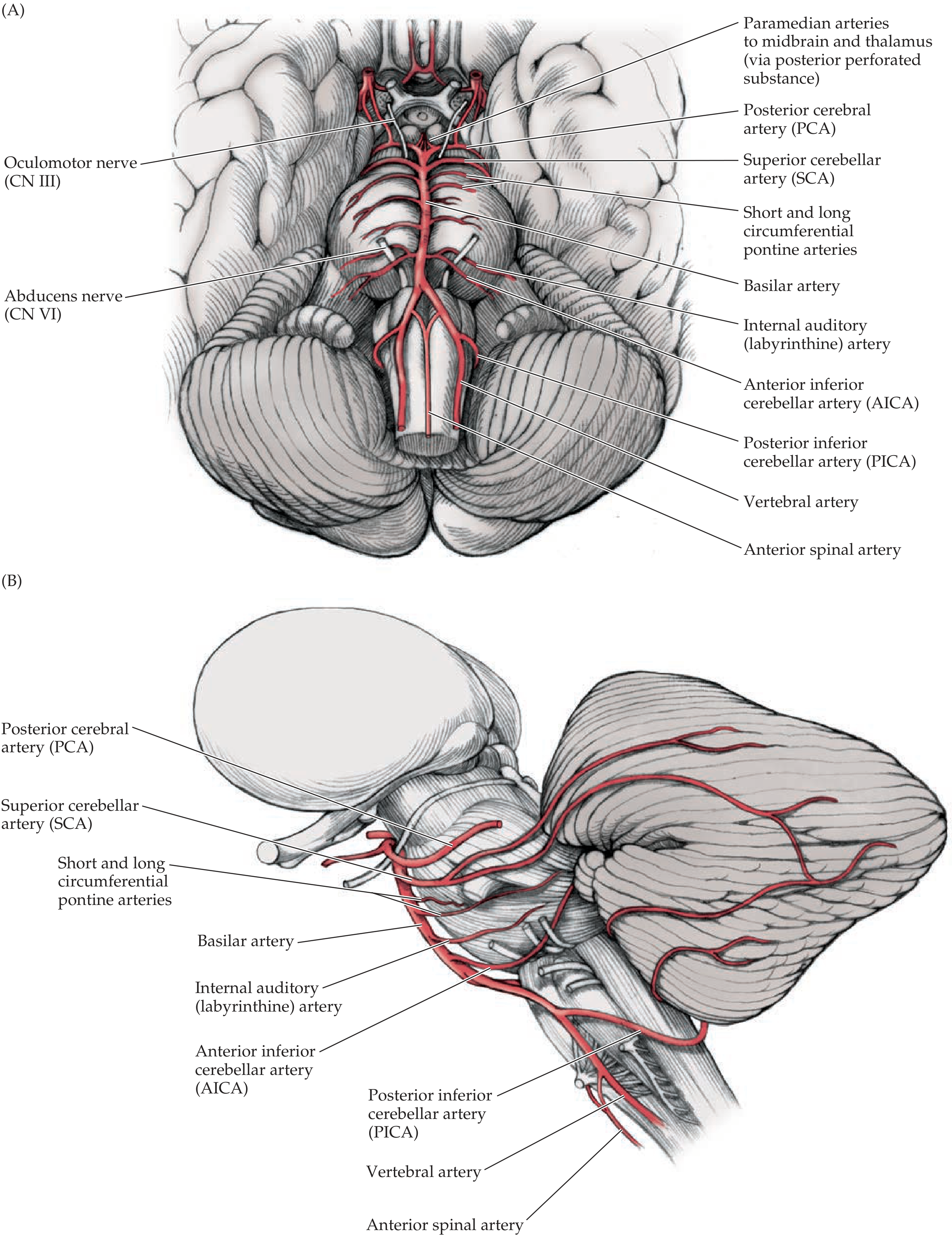
Main Arteries Supplying the Midbrain
1. Posterior Cerebral Artery (PCA) - Primary Supply
- Arises from the top of the basilar artery at the pontomesencephalic junction
- The P1 segment (also called the basilar communicating artery or mesencephalic artery) runs around the midbrain
- Supplies the lateral midbrain via circumferential branches
- The PCA wraps around the midbrain before continuing to supply the thalamus, medial occipital lobes, and inferior-medial temporal lobes
- Blood flow to the upper midbrain is predominantly via perforating branches of the PCA
2. Paramedian Branches from the Top of the Basilar Artery
- Short penetrating branches enter through the interpeduncular fossa (posterior perforated substance)
- Supply the medial midbrain and adjacent medial thalamus
- A notable variant: when these arteries bifurcate after origin, they form the artery of Percheron, a single trunk supplying bilateral paramedian midbrain and thalami - occlusion causes bilateral infarcts
3. Superior Cerebellar Artery (SCA)
- Arises just before the PCA at the top of the basilar artery, at the level of the rostral pons/pontomesencephalic junction
- Primarily supplies the superior cerebellum, but also contributes to the caudal aspect of the dorsal midbrain (superior dorsolateral region)
- The oculomotor nerve (CN III) passes characteristically between the SCA and PCA
Regional Territories of the Midbrain
| Region | Arterial Supply |
|---|---|
| Medial midbrain (cerebral peduncles, interpeduncular fossa) | Paramedian branches from top of basilar artery |
| Lateral midbrain (tegmentum, lateral surface) | Circumferential branches of PCA (proximal P1 segment) |
| Dorsal midbrain (superior colliculi, tectum) | PCA branches + small contribution from SCA |
| Bilateral medial midbrain (variant) | Artery of Percheron |
Summary Scheme
A simplified division splits midbrain territories into medial and lateral transverse regions:
- Medial territory - paramedian basilar perforators → contains the cerebral peduncles, substantia nigra, red nucleus, oculomotor fascicles. Infarction here causes ipsilateral CN III palsy + contralateral hemiparesis (Weber's syndrome)
- Lateral territory - PCA circumferential branches → contains the lateral tegmentum, spinothalamic tract, oculosympathetic fibres. Infarction here causes contralateral pain/temperature loss, ipsilateral Horner syndrome (Claude's or Benedict's syndrome depending on exact territory)
Sources:
- Neuroanatomy through Clinical Cases, 3rd Ed. - "Brainstem Vascular Supply" (Figures 14.18-14.21)
- Gray's Anatomy for Students - "Vascular Supply to the Brainstem"
- Bradley and Daroff's Neurology in Clinical Practice - "Midbrain Stroke Syndromes"
This is a shared conversation. Sign in to Orris to start your own chat.