
Mi
It looks like your message got cut off! Could you finish your thought? What would you like help with?
Myocardial infaction
That's a broad topic. Let me clarify what you need before diving in.
Asking for Preferences
What aspect of myocardial infarction do you want to focus on? · What is your background?
Reading the medical library skill first, then pulling content in parallel.
Reading File
Now searching the library and PubMed in parallel:
Finding Sources
Searching PubMed
"myocardial infarction"[MeSH Terms] AND "diagnosis"[MeSH Terms]
Finding Sources
Finding Sources
Excellent. Now reading the key sections from Braunwald's, Goldman-Cecil, and Tietz in parallel:
Reading File
Reading File
Reading File
The Goldman-Cecil offset was off. Let me get the right sections — Braunwald's MI chapter and Goldman-Cecil MI section:
Finding Sources
Finding Sources
Harrison's has the key "CLINICAL PRESENTATION" section. Reading it plus the Goldman-Cecil TIMI section:
Reading File
Reading File
Excellent data from Harrison's and Goldman-Cecil. Let me fetch the ACS spectrum diagram and get STEMI-specific ECG/diagnosis content:
Loading Image
Finding Sources
Now reading the Harrison's STEMI chapter and Goldman-Cecil's STEMI diagnosis section:
Reading File
Reading File
I now have comprehensive, authoritative content. Let me compile the full answer.
Myocardial Infarction: Clinical Presentation & Diagnosis
The ACS Spectrum
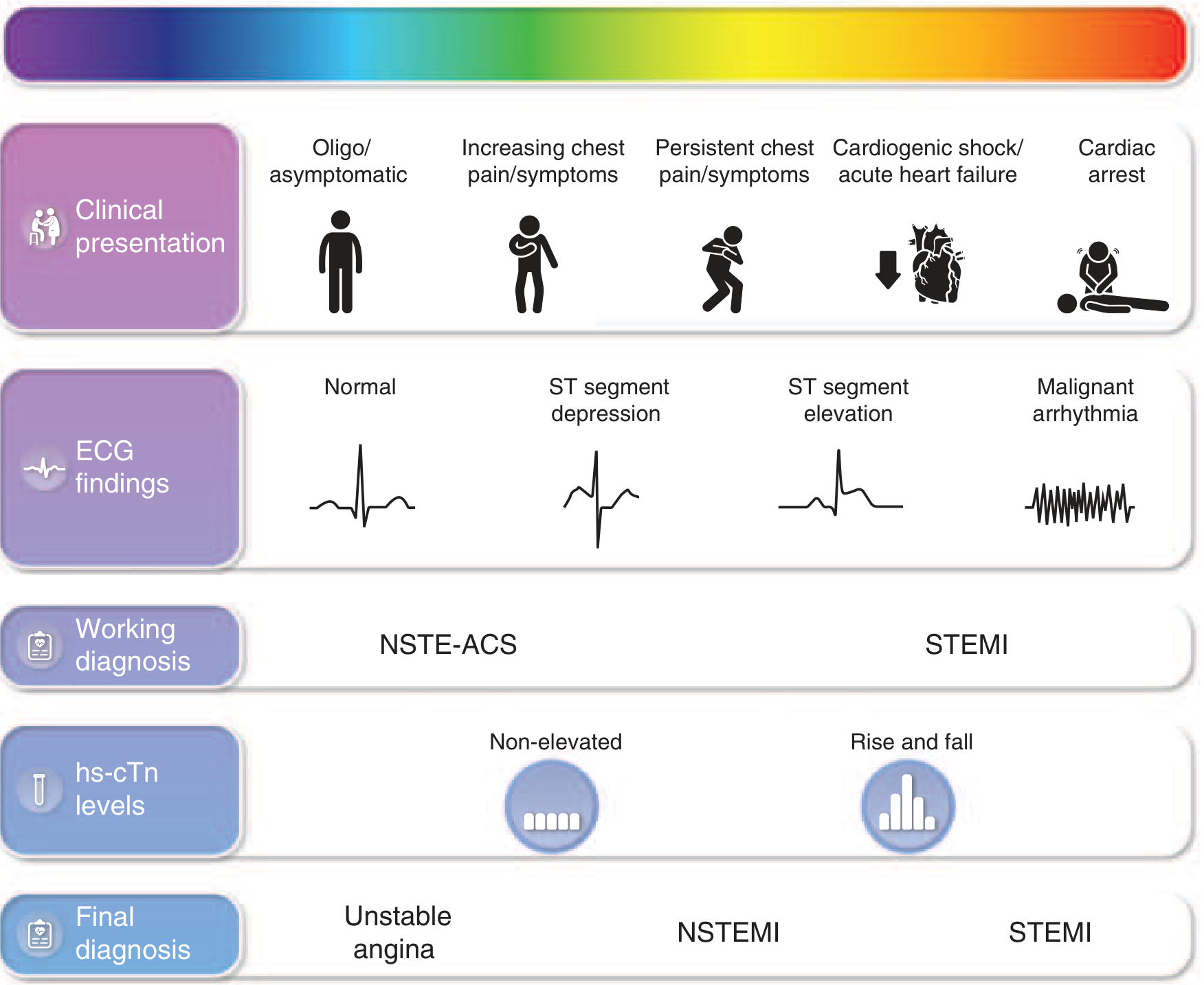
MI exists along a continuum with unstable angina (UA). The key distinction:
- UA: ischemic chest pain at rest/minimal exertion, no biomarker elevation
- NSTEMI: same presentation + elevated troponin, no ST elevation on ECG
- STEMI: ischemic symptoms + persistent ST elevation on ECG → total coronary occlusion by fresh thrombus
Clinical Presentation
Symptoms
Chest discomfort is typically substernal, and must have ≥1 of:
- Occurs at rest or with minimal exertion, lasting >10 minutes
- New onset within the prior 2 weeks
- Crescendo pattern — more severe, prolonged, or frequent than prior episodes
Radiation: left arm, left shoulder, neck, jaw.
Anginal equivalents (more common in women, elderly, diabetics):
- Dyspnea
- Epigastric discomfort / nausea
- Diaphoresis
- Generalized weakness or fatigue
Up to 20–30% of MIs are "silent" or atypical — women, diabetics, and the elderly most at risk for atypical presentation.
Physical Examination
The exam may be unremarkable in many patients. Signs of large infarction include:
- Diaphoresis, pale cool skin
- Sinus tachycardia
- S3 and/or S4 heart sound
- Basilar rales (pulmonary edema)
- Hypotension or cardiogenic shock (most severe)
Critical exam goal: exclude life-threatening mimics — aortic dissection, pulmonary embolism, cardiac tamponade.
ECG Diagnosis
STEMI Criteria
Transmural ischemia → ST elevation (current of injury):
- ≥2 contiguous leads:
- ≥2 mm in V2–V3 (men ≥40 yr), ≥2.5 mm (men <40 yr), ≥1.5 mm (women)
- ≥1 mm in all other leads
- New LBBB in the right clinical context is treated as STEMI-equivalent
- Posterior MI: ST depression V1–V3 + tall R waves (mirror image); confirm with V7–V9
Hyperacute T waves may precede ST elevation in the earliest minutes.
Evolutionary changes: ST elevation → Q waves → T-wave inversion → resolution (or permanent Q waves)
NSTEMI / UA (NSTE-ACS) Criteria
- ST depression ≥0.5 mm (subendocardial ischemia)
- T-wave inversions (especially ≥1 mm in multiple leads)
- ECG may be normal (does not exclude NSTEMI)
- Differentiated from UA by troponin elevation
Biomarker Diagnosis — Cardiac Troponin
High-Sensitivity Cardiac Troponin (hs-cTn)
Current standard. Key principles per Tietz Textbook of Laboratory Medicine:
| Strategy | Criteria | Performance |
|---|---|---|
| Single hs-cTnI <LOD (2 ng/L, Abbott) at presentation | Rule-out MI | NPV 99.8%, sensitivity 100% |
| Single hs-cTnT <LOD (5 ng/L, Roche) + non-ischemic ECG | Rule-out MI (~31% classified low risk) | Sensitivity 98.7%, NPV 99.3% |
| hs-cTn 0h/1h algorithm | Δhs-cTn within 1 hour determines rule-in or rule-out | ESC-validated pathway |
Rule-in: moderately elevated hs-cTn at baseline or significant rise (Δ) within 1 hour → high likelihood of NSTEMI → admit to CCU.
Important caveat: Elevated troponin ≠ MI. Causes of Type 2 MI / myocardial injury include PE, decompensated HF, severe hypertension, tachycardia, anemia, sepsis. Clinical context is mandatory.
Older Markers (now largely replaced by hs-cTn)
- CK-MB: rises 4–6h, peaks 12–24h, normalizes by 48–72h (useful for reinfarction detection)
- Myoglobin: earliest but non-cardiac-specific
Risk Stratification
TIMI Score (NSTE-ACS) — 1 point each:
| Risk Factor |
|---|
| Age ≥65 years |
| ≥3 CAD risk factors |
| Known CAD (≥50% stenosis) |
| ST deviation >0.5 mm on presenting ECG |
| ≥2 anginal episodes in prior 24 hours |
| Aspirin use in prior 7 days |
| Elevated cardiac markers (troponin or CK-MB) |
Score 0–2: low risk; 3–4: intermediate; 5–7: high risk for death/MI/urgent revascularization at 14 days.
GRACE Score
Incorporates: age, HR, systolic BP, creatinine, Killip class, ST deviation, cardiac arrest at admission, elevated markers. More continuously calibrated than TIMI.
Diagnostic Mimics to Exclude
| Condition | Distinguishing Feature |
|---|---|
| Aortic dissection | Tearing pain radiating to back, pulse differentials, widened mediastinum |
| Pulmonary embolism | Pleuritic component, hypoxia, S1Q3T3 ECG, D-dimer, CT-PA |
| Acute pericarditis | Diffuse ST elevation (saddle-shaped) in all leads except aVR, pleuritic quality, friction rub |
| Myocarditis | Chest pain + troponin + ECG changes → coronary imaging first; CMR for definitive diagnosis |
| Takotsubo syndrome | Post-stress, apical ballooning, usually post-menopausal women |
| Vasospastic angina (Prinzmetal) | ST elevation during pain, resolves spontaneously or with nitrates |
Summary: Diagnostic Algorithm
Ischemic symptoms?
      ↓
12-lead ECG within 10 min
      ├── Persistent STE or new LBBB → STEMI → Activate cath lab
      └── No STE → hs-cTn at 0h (±1h)
                    ├── <LOD + non-ischemic ECG → Low risk (rule-out)
                    ├── Intermediate → Serial troponin at 3h; risk score
                    └── Elevated or rising → NSTEMI → Admit, anticoagulate, risk-stratify
Sources:
- Harrison's Principles of Internal Medicine 22E (2025), Chapter 285
- Goldman-Cecil Medicine International Edition, Chapter 57
- Tietz Textbook of Laboratory Medicine 7th Ed., Chapter on AMI biomarkers
This is a shared conversation. Sign in to Orris to start your own chat.