
B.p = co x TPR Can you explain this to me in simplest Way and language
- Blood Pressure (BP) = the pressure inside your blood vessels (like water pressure in the hose)
- Cardiac Output (CO) = how much blood your heart pumps per minute (like how fast the tap is turned on)
- Total Peripheral Resistance (TPR) = how narrow or wide your blood vessels are (like how narrow the hose is)
BP = CO × TPR
| Term | What it means | Real-life analogy |
|---|---|---|
| CO (Cardiac Output) | Heart rate × stroke volume (how hard & fast the heart pumps) | How open the water tap is |
| TPR (Total Peripheral Resistance) | Resistance from small blood vessels (arterioles) | How narrow the hose is |
| BP (Blood Pressure) | The resulting pressure | Water pressure at the end |
- CO goes up (heart pumps more) → BP rises
- TPR goes up (vessels get narrower) → BP rises
- CO goes down (heart pumps less) → BP falls
- TPR goes down (vessels relax/widen) → BP falls
- Your heart pumps faster → CO increases
- Your muscles need more blood → vessels dilate → TPR decreases
- The net effect on BP is relatively balanced (though systolic BP does rise slightly)
- Adrenaline makes the heart pump harder → CO up
- Adrenaline also constricts vessels → TPR up
- Result: BP shoots up
- Beta-blockers reduce CO (slow the heart)
- Vasodilators / ACE inhibitors / Calcium channel blockers reduce TPR (relax vessel walls)
Create a visual diagram explaining this equation
A clean medical education diagram explaining the equation: Blood Pressure = Cardiac Output x Total Peripheral Resistance. The diagram should include: - A large central equation at the top: BP = CO × TPR - Three labeled sections side by side connected by arrows and multiplication symbol - Left box: "Cardiac Output (CO)" with a heart icon, showing Heart Rate × Stroke Volume, with upward and downward arrows showing what increases/decreases it (exercise, adrenaline increase it; beta-blockers decrease it) - Middle: a large multiplication symbol (×) - Right box: "Total Peripheral Resistance (TPR)" with a blood vessel cross-section diagram, showing narrow vs wide vessels, with labels (vasoconstriction increases it, vasodilation decreases it) - Equals sign (=) pointing to bottom center box: "Blood Pressure (BP)" with a blood pressure cuff icon, showing normal range 120/80 mmHg - A garden hose analogy illustration at the bottom: tap (CO) and hose width (TPR) producing water pressure (BP) - Color coding: CO in blue, TPR in orange/red, BP in purple - Clean white background, medical textbook style, clear fonts, professional layout
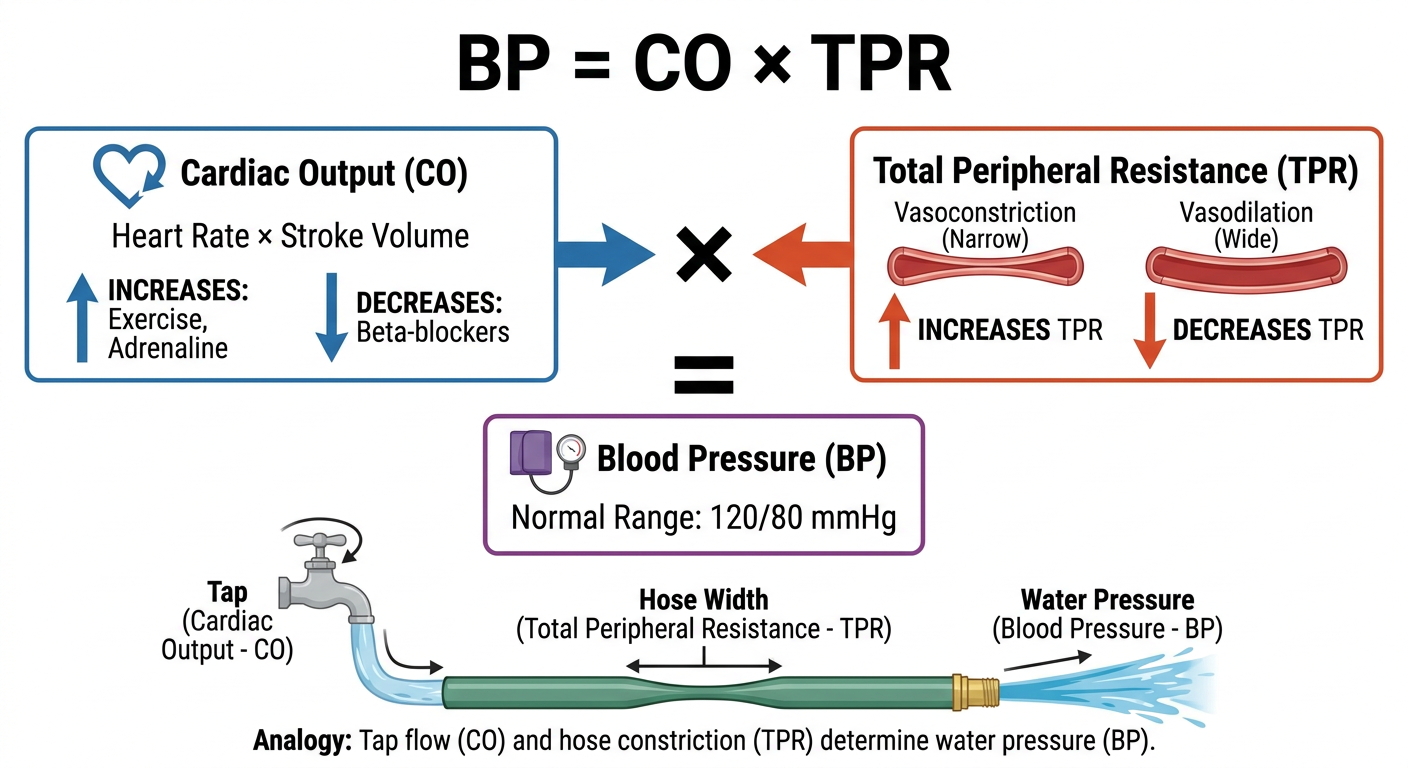
- Blue (left) - Cardiac Output: driven by heart rate and stroke volume
- Orange/Red (right) - Total Peripheral Resistance: determined by vessel width
- Purple (bottom) - Blood Pressure: the resulting pressure from multiplying the two