
Use of disulfiram in alcohol dependence
I'll start by reading the medical library skill, then search for comprehensive information on disulfiram in alcohol dependence.
Quick answer: Disulfiram (Antabuse) is an aversion therapy agent used in alcohol dependence. It works by inhibiting aldehyde dehydrogenase, causing acetaldehyde accumulation when alcohol is consumed, producing an unpleasant reaction (flushing, nausea, palpitations). It is used as a deterrent in motivated, abstinent patients and requires close monitoring for hepatotoxicity and other adverse effects.
Searching sources...
Reading File
Now I'll run parallel searches across the medical library and PubMed simultaneously.
Finding Sources
Finding Sources
Searching PubMed
disulfiram alcohol dependence treatment
Excellent results. Now I'll read the key textbook sections in parallel - the Maudsley Guidelines (most clinically comprehensive), Goodman & Gilman (pharmacology), and Kaplan & Sadock's Synopsis (psychiatry perspective).
Reading File
Reading File
Reading File
Excellent content. Let me now read the remaining Kaplan & Sadock sections on precautions/adverse reactions and Lippincott pharmacology, plus the Maudsley monitoring sections.
Reading File
Reading File
Reading File
I have very comprehensive content. There's also a metabolism diagram available. Let me fetch that image and also check the Goldman-Cecil section for the comparison table.
Loading Image
Reading File
I now have comprehensive data from multiple authoritative sources. Let me compile the full answer.
Disulfiram in Alcohol Dependence
Overview
Disulfiram (brand name: Antabuse) is an aversion therapy agent - the first drug approved to treat alcohol use disorder (AUD). It is currently classified as a second-line treatment, indicated for patients with moderate-to-severe alcohol dependence who have completed withdrawal and are motivated to maintain abstinence. It does not reduce craving; its effect is purely deterrent.
- Goldman-Cecil Medicine, p. 3802
- Maudsley Prescribing Guidelines in Psychiatry, 15e, p. 516
Mechanism of Action
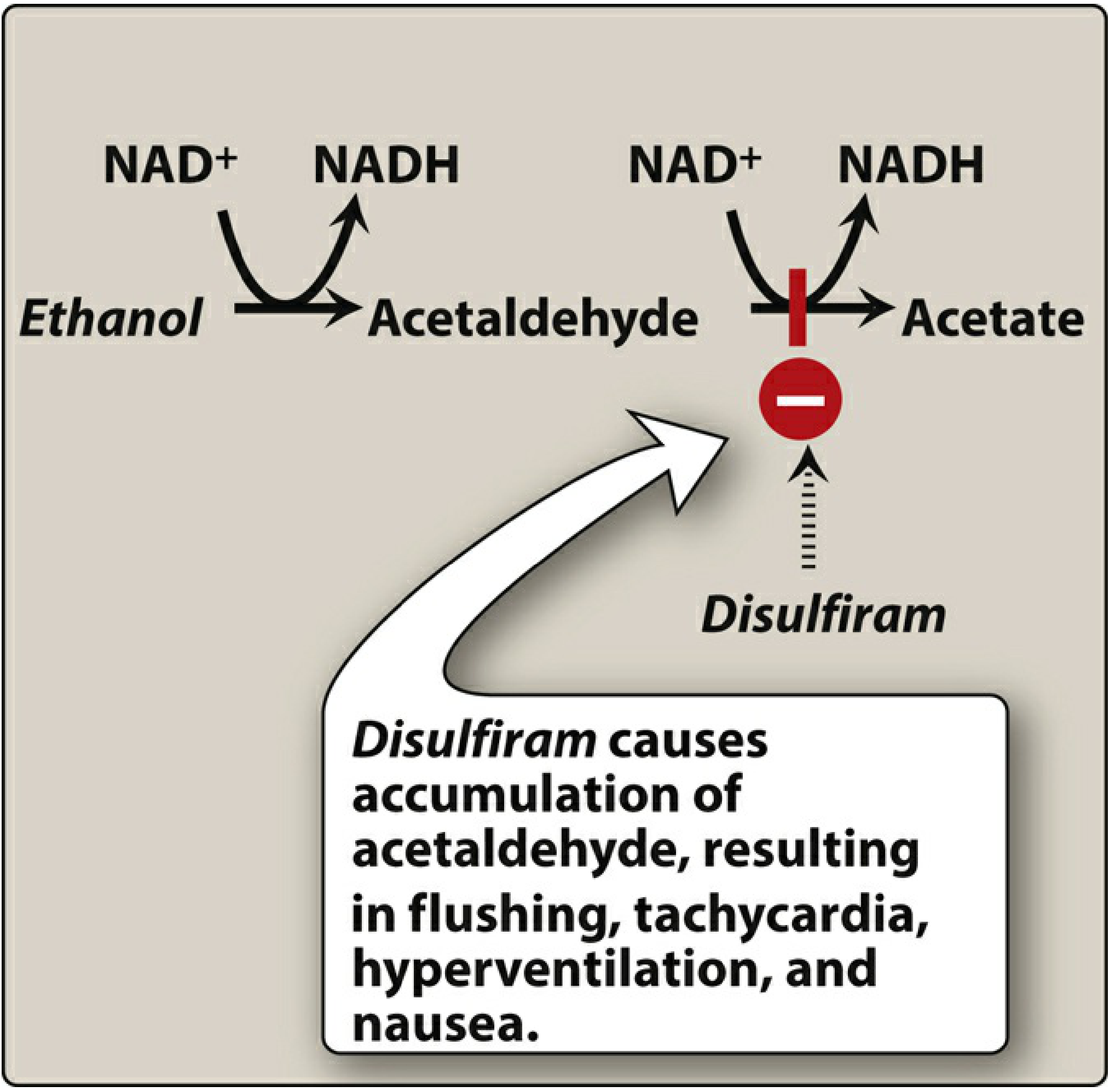
Normal ethanol metabolism proceeds:
Ethanol → Acetaldehyde (via alcohol dehydrogenase) → Acetate/Acetyl-CoA (via aldehyde dehydrogenase, ALDH)
Disulfiram irreversibly inhibits ALDH (both cytosolic and mitochondrial isoforms), causing toxic acetaldehyde to accumulate to levels 5-10 times higher than normal. This triggers the disulfiram-alcohol reaction.
-
The active inhibiting metabolite is diethylthiomethylcarbamate, a suicide-substrate inhibitor of ALDH
-
Disulfiram also inhibits dopamine-β-hydroxylase, reducing conversion of dopamine to norepinephrine - this is relevant to its side effects and may contribute to its effect on monoamine metabolism
-
ALDH inhibition is long-lasting: sensitization to alcohol persists for up to 14 days after the last dose
-
Goodman & Gilman's Pharmacological Basis of Therapeutics, p. 547
-
Lippincott Illustrated Reviews Pharmacology
The Disulfiram-Alcohol Reaction
The reaction begins within 5-10 minutes of alcohol ingestion and typically lasts 30 minutes to 2 hours.
| Mild Reaction | Severe Reaction |
|---|---|
| Facial flushing | Acute heart failure |
| Sweating | Myocardial infarction |
| Nausea and vomiting | Arrhythmias / bradycardia |
| Hyperventilation / dyspnea | Severe hypotension / shock |
| Tachycardia | Respiratory depression |
| Throbbing headache | Loss of consciousness |
| Blurred vision, vertigo | Death (rare) |
Severity is dose-dependent - related to both the disulfiram dose and the amount of alcohol consumed:
- Blood ethanol 5-10 mg/100 mL: mild symptoms
- Blood ethanol ~50 mg/100 mL: fully developed reaction
- Blood ethanol 125-150 mg/100 mL: loss of consciousness/coma
- Fatal reactions most often occur with disulfiram >500 mg/day combined with >3 oz of alcohol
Much of the therapeutic effect is actually mediated by the mental anticipation of the aversive reaction, not just the pharmacological action itself.
- Kaplan & Sadock's Synopsis of Psychiatry, pp. 2108-2109
- Maudsley Prescribing Guidelines, p. 516
Pharmacokinetics
| Parameter | Detail |
|---|---|
| Absorption | Almost complete from GI tract after oral dosing |
| Half-life | 60-120 hours |
| Duration of effect | Up to 14 days after last dose (slow ALDH restoration) |
| Metabolism | Hepatic; active metabolites inhibit ALDH |
| Drug interactions | Inhibits CYP enzymes - raises levels of phenytoin, diazepam, barbiturates, warfarin, isoniazid, tricyclics, caffeine, paraldehyde |
- Kaplan & Sadock's Synopsis of Psychiatry, p. 2108
- Goodman & Gilman, p. 547
Dosage and Administration
| Phase | Dose |
|---|---|
| Loading (first 1-2 weeks) | 500 mg/day orally (Maudsley: initial 800 mg) |
| Maintenance | 250 mg/day (range 125-500 mg/day) |
| Maximum recommended | 500 mg/day |
| Special case (comorbid cocaine dependence) | Up to 500 mg/day has been used |
Key administration rules:
-
Do not start until the patient has been abstinent for at least 12-24 hours
-
Take the morning dose when resolve not to drink is strongest
-
Patients must avoid all hidden alcohol sources: cough syrups, food sauces, fermented vinegar, aftershave lotions, alcohol-based topical preparations, and perfumes
-
Patients should carry an identification card describing the reaction and emergency contact details
-
Kaplan & Sadock's Synopsis, p. 2110
-
Goodman & Gilman, p. 547
-
Maudsley Prescribing Guidelines, p. 516
Clinical Indications and Position in Treatment
"Disulfiram should be considered in combination with a psychological intervention for patients who wish to achieve abstinence but for whom acamprosate or naltrexone are not suitable."
Ideal candidate: Highly motivated patient, completed alcohol withdrawal, aiming for total abstinence, preferably with supervised administration (e.g., by a family member or healthcare worker).
Supervised disulfiram greatly improves compliance and effectiveness - evidence supports superiority over unsupervised use.
The evidence base for disulfiram is weaker than for acamprosate and naltrexone in formal RCTs (partly due to inherent difficulties in blinding), although its effect size may be greater in supervised settings.
- Maudsley Prescribing Guidelines, p. 516
- Goldman-Cecil Medicine, p. 3802
Contraindications
| Category | Examples |
|---|---|
| Cardiovascular | Cardiac failure, coronary artery disease, hypertension |
| Neurological | Cerebrovascular disease, seizure disorder, abnormal EEG, brain damage |
| Hepatic | Significant liver disease (hepatic disease - use with caution or avoid) |
| Psychiatric | Severe mental illness (psychosis - worsens due to dopamine-β-hydroxylase inhibition) |
| Other metabolic | Diabetes, hypothyroidism, nephritis |
| Substance | Polydrug dependence, paraldehyde use (metabolizes to acetaldehyde) |
| Physiological states | Pregnancy, breastfeeding |
| Alcohol exposure | Ingestion of alcohol within previous 24 hours |
| Peripheral | Peripheral neuropathy |
- Maudsley Prescribing Guidelines, Table 4.8
- Kaplan & Sadock's Synopsis, p. 2601
Adverse Effects (Without Alcohol)
- Common: Fatigue, halitosis, dermatitis, impotence
- Neurological: Optic neuritis, peripheral neuropathy, mental/personality changes
- Hepatic: Rare but serious - hepatotoxicity (monitor for sudden-onset jaundice; stop drug immediately if it occurs)
- Psychiatric: May exacerbate psychosis (via dopamine-β-hydroxylase inhibition raising dopamine levels); catatonic reactions reported
- Most common general side effect: Sedation
Monitoring Protocol (NICE CG115)
| Time Period | Frequency |
|---|---|
| First 2 months | Every 2 weeks |
| Months 3-6 | Monthly |
| After 6 months | Every 6 months |
Liver function tests should be checked before starting and periodically during treatment given the risk of hepatotoxicity.
Drug Interactions
Disulfiram inhibits hepatic CYPs (cytochrome P450 enzymes), raising plasma levels of:
- Phenytoin
- Diazepam and other benzodiazepines
- Barbiturates
- Warfarin (increased bleeding risk)
- Isoniazid (potentiates neurotoxicity)
- Tricyclic antidepressants
- Theophylline and caffeine
Paraldehyde is absolutely contraindicated - it is metabolized to acetaldehyde and will precipitate a severe reaction.
- Goodman & Gilman, p. 547
- Kaplan & Sadock's Synopsis, p. 2611
Treatment of a Severe Disulfiram-Alcohol Reaction
Management is primarily supportive (prevent shock):
- Oxygen supplementation
- IV fluids
- IV vitamin C
- Ephedrine (vasopressor support)
- Antihistamines
Comparison With Other FDA-Approved AUD Medications
| Feature | Disulfiram | Naltrexone | Acamprosate |
|---|---|---|---|
| Mechanism | ALDH inhibition (aversion) | Opioid receptor antagonism (anti-craving) | NMDA/GABA modulation (anti-craving) |
| Goal | Abstinence via deterrence | Reduce relapse/craving | Maintain abstinence |
| Line of treatment | Second-line | First-line | First-line |
| Reduces craving | No | Yes | Yes |
| Alcohol-free required to start | Yes (12-24 hrs) | Yes (abstinent first) | No (start after withdrawal) |
| Hepatotoxicity risk | Yes (mild) | Yes (dose-dependent) | No |
| Renal consideration | No | No | Yes (reduce dose if CrCl 30-50; avoid if <30) |
| Evidence strength in RCTs | Weaker (hard to blind) | Strong | Strong |
- Goldman-Cecil Medicine, p. 3802-3815
- Katzung's Basic and Clinical Pharmacology, 16e
Special Populations
- Pregnancy/Breastfeeding: Contraindicated
- Adolescents (16-19 yrs): Not licensed; naltrexone is best-supported in this age group
- Older adults: Use with caution; lower threshold for hepatic monitoring
- Comorbid psychosis: Avoid - risk of worsening psychosis via dopamine accumulation
- Comorbid PTSD + AUD: Either naltrexone or disulfiram (alone or combined) improves drinking outcomes vs placebo
- Comorbid cocaine + AUD: Disulfiram 500 mg/day has been used - also inhibits dopamine-β-hydroxylase, which may reduce cocaine reinforcement
Recent Evidence (PubMed 2023-2026)
A 2025 Cochrane meta-analysis (PMID 40110869) on combined pharmacological and psychosocial interventions for AUD found that combined approaches are superior to either alone, supporting the NICE recommendation that disulfiram should always be paired with a psychological intervention. A 2024 systematic review on pharmacotherapy in AUD with psychotic disorders (PMID 36582063) reinforces caution with disulfiram in that population given its dopaminergic effects.
Summary: Disulfiram remains a useful second-line tool for highly motivated, abstinence-oriented patients in supervised settings. Its aversion mechanism is unique, compliance-dependent, and should always be combined with structured psychological support. First-line agents (naltrexone, acamprosate) are preferred when suitable, but supervised disulfiram can achieve strong real-world outcomes where adherence can be assured.
This is a shared conversation. Sign in to Orris to start your own chat.