
Gross and microscopic features of cholesterol and pigment stones 2nd mbbs pathology
Reading File
Finding Sources
Finding Sources
Searching PubMed
gallstones AND pathology
Searching the Web
cholesterol pigment gallstones gross microscopic morphology pathology
Reading File
Reading File
Cholesterol and pigment gallstones: gross and microscopic features
1. Cholesterol stones
Gross features
- Form only in the gallbladder.
- Usually multiple, though occasionally a single large stone may fill the fundus.
- Typically round or ovoid.
- Pure cholesterol stones are:
- Pale yellow
- Hard
- Finely granular externally
- On cut section, show a glistening radiating crystalline pattern.
- Stones containing more calcium salts and bilirubin become grey-white, greenish, brown, or black, and may be laminated.
- Multiple stones may become faceted because they press against one another.
- Usually radiolucent, but 10% to 20% contain enough calcium carbonate to be radiopaque.
Microscopic features
- Composed predominantly of cholesterol monohydrate crystals, constituting more than 50% of the stone.
- Crystals are typically flat, rectangular plates with notched corners.
- On polarised light, cholesterol crystals are birefringent.
- The crystals are embedded in a matrix of mucin glycoprotein, with variable calcium salts and bilirubin pigment.
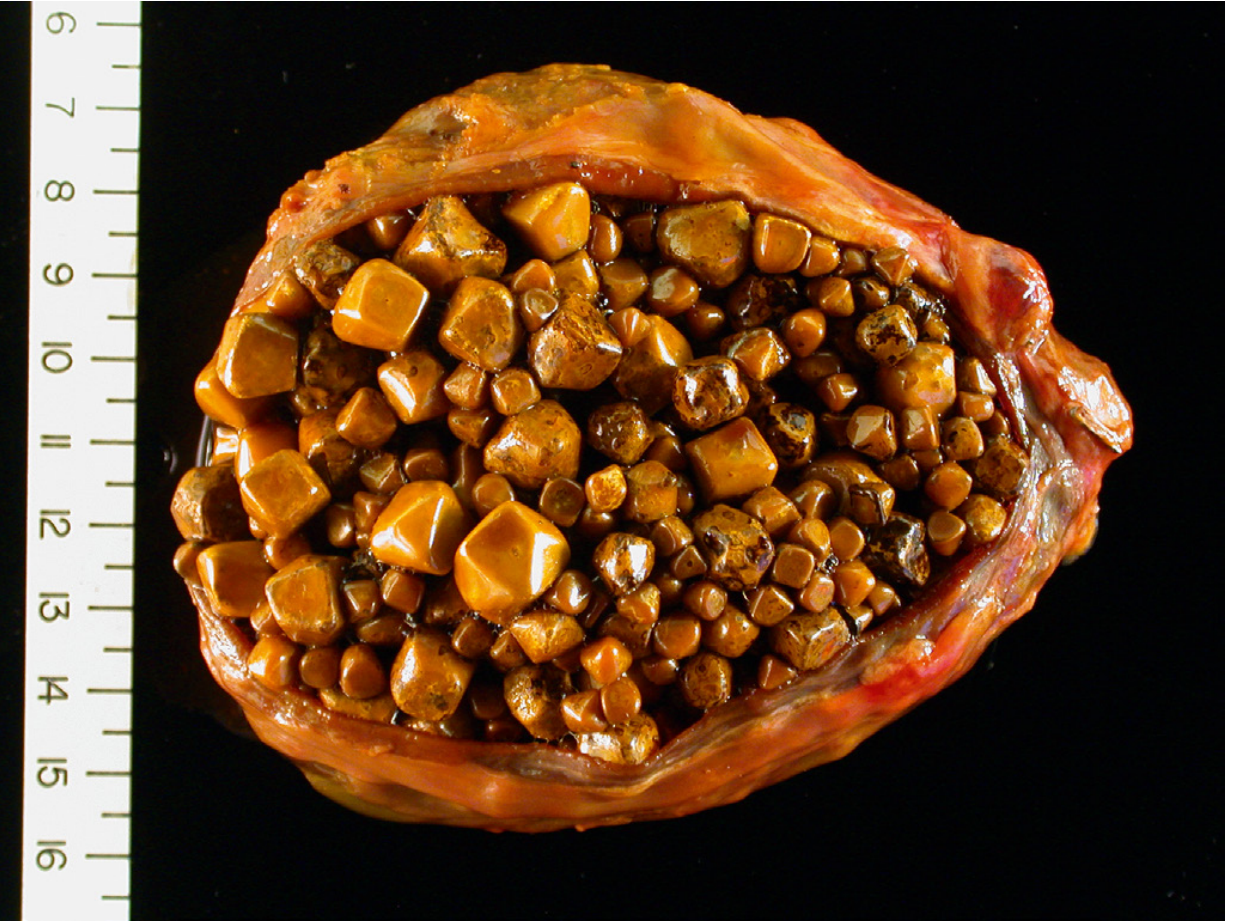
Source: Robbins, Cotran & Kumar Pathologic Basis of Disease, Cholelithiasis morphology.
2. Pigment stones
These are composed mainly of calcium salts of unconjugated bilirubin. They are of two types: black and brown.
| Feature | Black pigment stones | Brown pigment stones |
|---|---|---|
| Usual location | Gallbladder, with sterile bile | Large intrahepatic or extrahepatic bile ducts |
| Association | Chronic hemolysis, cirrhosis, ineffective erythropoiesis | Biliary infection and stasis, often with parasites |
| Gross appearance | Black, small, brittle/friable, often numerous | Brown, soft, greasy or soap-like |
| Shape | Spiculated, irregular, molded | Usually rounded and laminated |
| Radiology | Often radiopaque due to calcium salts | Usually radiolucent |
Gross features
- Colour ranges from brown to black.
- Black stones:
- Small, usually less than 1.5 cm
- Numerous
- Brittle and friable
- Irregular, spiculated, or molded contours
- Often radiopaque.
- Brown stones:
- Soft and laminated
- Greasy or soap-like consistency
- Usually form within infected bile ducts
- Usually radiolucent.
Microscopic features
- Predominantly contain calcium bilirubinate, that is, insoluble calcium salts of unconjugated bilirubin.
- Black pigment stones contain oxidised polymerised calcium bilirubinate, with calcium carbonate/phosphate, mucin, and small amounts of cholesterol.
- Brown pigment stones contain calcium bilirubinate plus calcium soaps, especially calcium palmitate and calcium stearate, cholesterol, and mucin.
- Mucin glycoproteins form the scaffold and cementing matrix in both cholesterol and pigment stones.
One-line viva distinction
- Cholesterol stone: pale-yellow, hard, radiating crystalline cut surface, cholesterol crystals with notched corners.
- Black pigment stone: black, small, multiple, friable, calcium bilirubinate.
- Brown pigment stone: brown, soft, greasy, laminated, infected bile ducts.
This is a shared conversation. Sign in to Orris to start your own chat.