
Compare and contrast the microscopeic anantomy if white fibro cartilage and hayaline cartilage
Reading File
This is a visual/histology question. Now I'll search both headings and paragraphs in parallel for white fibrocartilage and hyaline cartilage microscopic anatomy.
Finding Sources
Finding Sources
Good results. Now let me read the detailed histology sections from the best sources - Junqueira's and the Histology Text and Atlas - in parallel, plus look for images.
Reading File
Reading File
Excellent content. I have rich detail from both Junqueira's and the Histology Text and Atlas. I also found image URLs. Let me fetch the key comparison image and read the detailed fibrocartilage section from Junqueira's, in parallel.
Loading Image
Reading File
Reading File
Excellent - I have the key comparison image and rich detailed content from both textbooks. Let me now read the fibrocartilage-specific sections and fetch the fibrocartilage microscopy image.
Reading File
Reading File
I now have comprehensive detail from both Junqueira's Basic Histology and the Histology Text and Atlas. Let me also fetch the fibrocartilage photomicrograph image to include in the answer.
Loading Image
Loading Image
I now have all the information and images needed for a thorough, well-illustrated comparison. Here is the full answer:
Microscopic Anatomy: Hyaline Cartilage vs. White Fibrocartilage
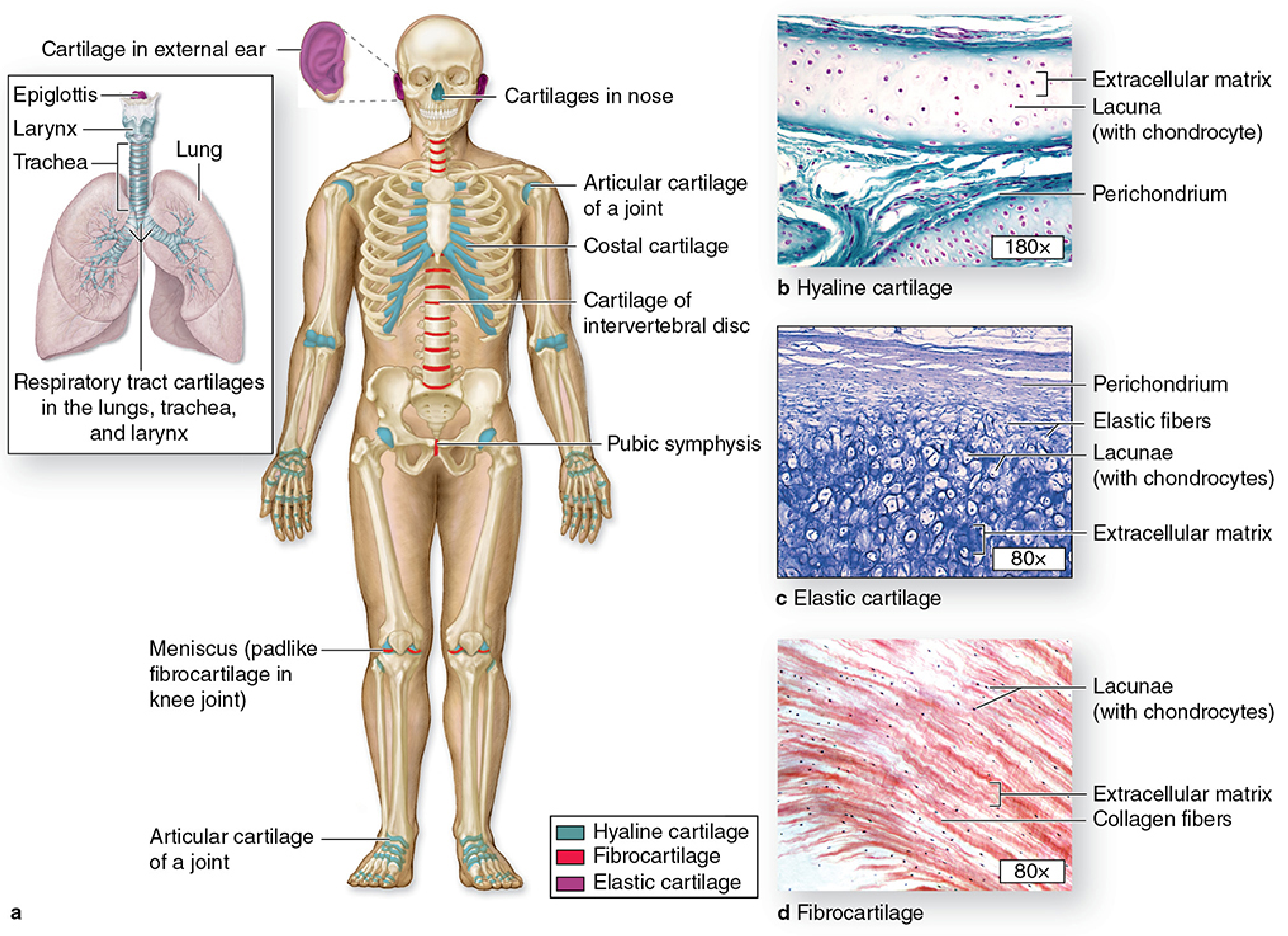
1. Hyaline Cartilage
General Appearance
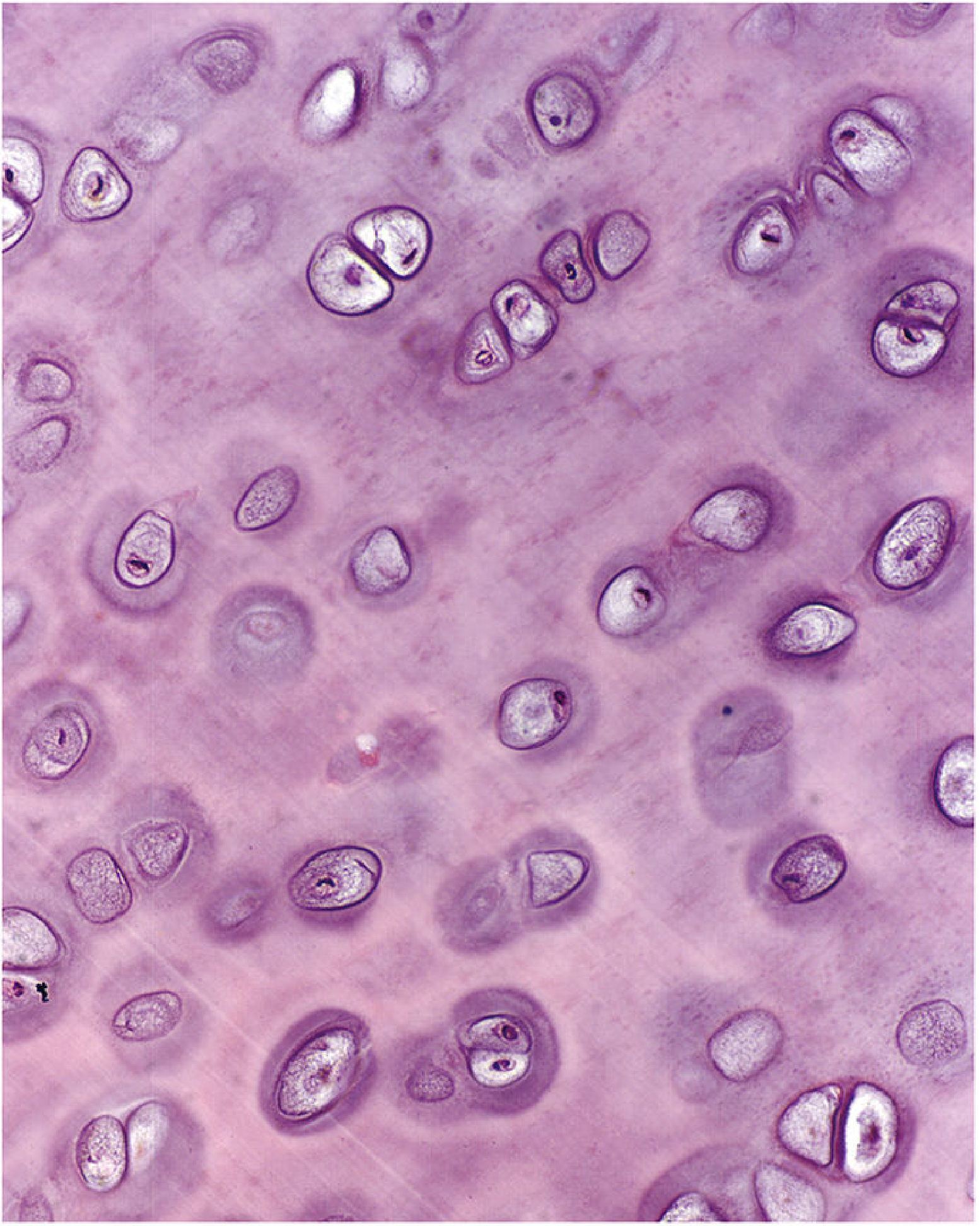
Under H&E, hyaline cartilage has a characteristic glassy, homogeneous, pale basophilic (blue-purple) matrix that appears almost structureless at low power. The name "hyaline" comes from the Greek hyalos (glass), reflecting this translucent quality.
Cells
- Chondrocytes are the sole cell type. They are round-to-oval cells with a large pale nucleus and moderate cytoplasm, housed in spaces called lacunae.
- Near the perichondrium, chondrocytes are smaller and flattened (younger chondroblasts). Deeper in, they are larger and rounded.
- After cell division, daughter cells remain together in groups of 2-8, sharing a common lacuna - these are called isogenous groups (or cell nests).
- Cytoplasm is rich in rough ER and Golgi, consistent with active matrix secretion.
Extracellular Matrix (ECM)
The matrix makes up >95% of total volume and has three recognizable zones:
| Zone | Location | Composition | Staining |
|---|---|---|---|
| Capsular (pericellular) matrix | Immediately around each lacuna | Highest concentration of sulfated proteoglycans, type VI collagen, hyaluronan, fibronectin, laminin | Intensely basophilic |
| Territorial matrix | Surrounds the isogenous group | Type II collagen network, lower proteoglycan content | Moderately basophilic |
| Interterritorial matrix | Between cell groups | Most abundant; more collagen, least proteoglycans | Least basophilic / pale |
- Collagen type: Predominantly type II collagen (thin fibrils ~10-20 nm), which are not individually visible by light microscopy - they are masked by the abundant proteoglycans. This is why the matrix looks homogeneous.
- Ground substance: Abundant proteoglycan aggregates (aggrecan linked to hyaluronan via link proteins). The sulfated GAGs (chondroitin sulfate, keratan sulfate) give strong basophilia and metachromasia with toluidine blue.
- Water content: ~75% of wet weight, critical for shock absorption by diffusion.
Perichondrium
- A well-defined double-layered perichondrium surrounds hyaline cartilage (except articular cartilage):
- Outer fibrous layer: dense connective tissue with fibroblasts
- Inner chondrogenic layer: contains chondroprogenitor cells (perichondrial stem cells) that can differentiate into chondroblasts
- Articular cartilage is the exception - it lacks perichondrium and receives nutrition from synovial fluid.
Aging Changes
Hyaline cartilage calcifies with age - calcium phosphate crystals deposit in the matrix, making it brittle. This is a normal aging phenomenon, distinct from pathological ossification.
2. White Fibrocartilage (Fibrocartilage)
General Appearance
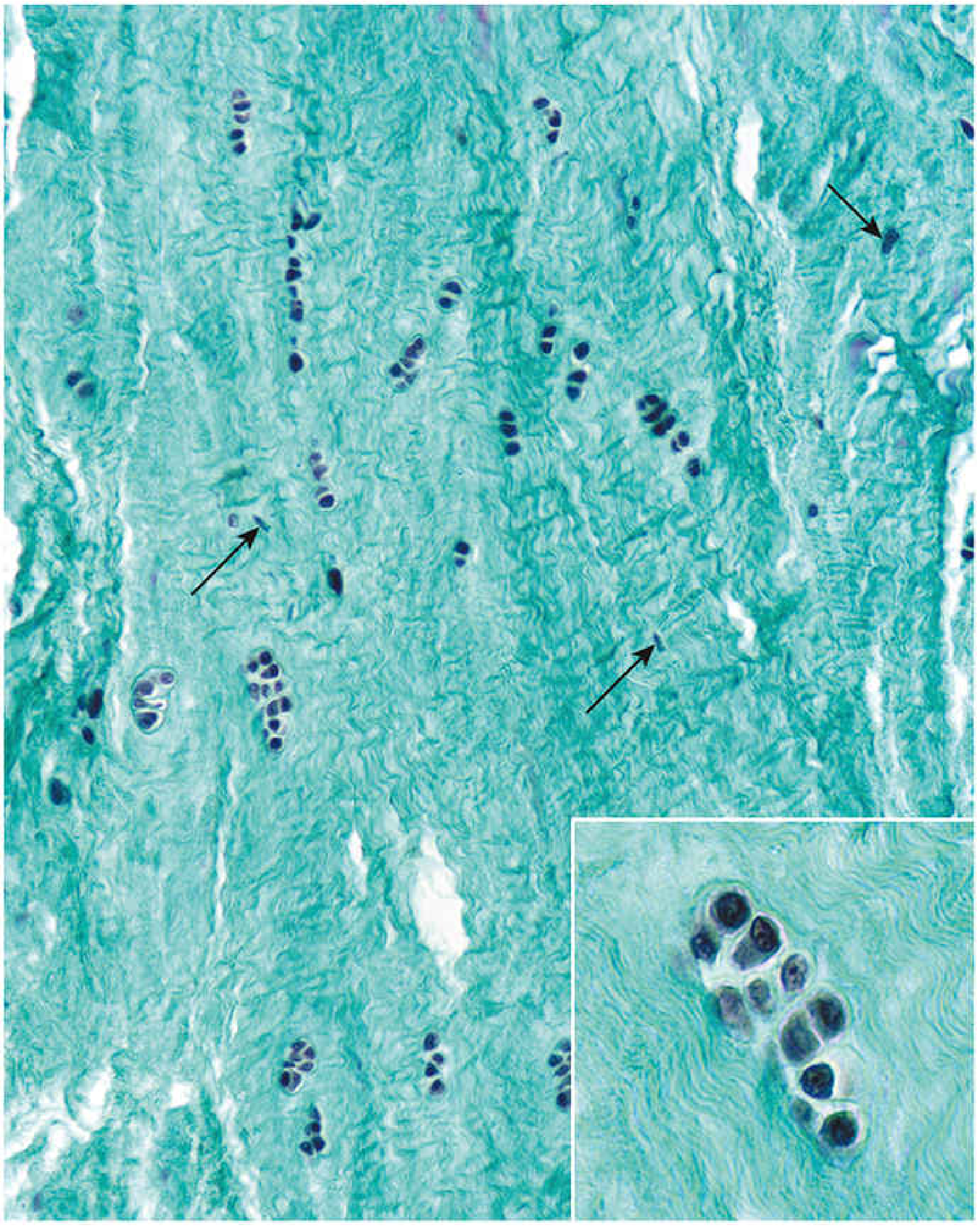
Fibrocartilage is histologically a hybrid tissue - it combines features of both hyaline cartilage and dense regular connective tissue. At low power it has a distinctly fibrous, striated appearance with thick collagen bundles running in parallel arrays. The matrix is far less abundant than in hyaline cartilage, giving it a more acidophilic (eosinophilic/pink) quality on H&E.
Cells
- Two cell populations are present, which is the key distinguishing feature:
- Chondrocytes - round cells with dark, rounded nuclei sitting in small lacunae. They are identical in morphology to hyaline cartilage chondrocytes, but are surrounded by much less matrix. They occur singly, in rows, or in small isogenous groups aligned between collagen bundles.
- Fibroblasts - elongated, spindle-shaped cells with flattened nuclei, scattered throughout the dense collagen bundles. They actively produce type I collagen.
- The presence of both chondrocytes and fibroblasts is a hallmark feature not found in hyaline cartilage.
Extracellular Matrix
- Collagen type: Predominantly type I collagen (thick, densely packed bundles visible by light microscopy), with small amounts of type II collagen around the chondrocyte lacunae.
- The thick type I collagen bundles are the dominant feature, arranged in parallel layers in most locations (e.g., annulus fibrosus of intervertebral disc).
- Ground substance: Far fewer proteoglycans than hyaline cartilage. This is why the matrix is more acidophilic (less basophilic/metachromatic). The territorial matrix around chondrocytes retains some basophilia from residual type II collagen and proteoglycans, but the bulk of the tissue stains pink.
Perichondrium
- Fibrocartilage has no surrounding perichondrium. This is a defining difference from both hyaline and elastic cartilage.
- There is no clear boundary between fibrocartilage and the surrounding dense connective tissue - they blend seamlessly.
Aging Changes
Unlike hyaline cartilage, fibrocartilage does not calcify with normal aging.
Side-by-Side Comparison
| Feature | Hyaline Cartilage | White Fibrocartilage |
|---|---|---|
| Appearance (LM) | Glassy, homogeneous, basophilic matrix | Fibrous, striated, predominantly acidophilic |
| Cell types | Chondrocytes only | Chondrocytes + fibroblasts |
| Chondrocyte arrangement | Singly + isogenous groups, scattered throughout | In rows or small groups, aligned along collagen bundles |
| Dominant collagen | Type II (invisible by LM) | Type I (thick bundles, visible by LM) |
| Ground substance | Very abundant; rich in sulfated proteoglycans | Sparse; few proteoglycans |
| Matrix staining | Strongly basophilic, metachromatic | Weakly basophilic/acidophilic |
| Matrix around cells | Abundant; 3 distinct zones (capsular, territorial, interterritorial) | Scant; only a small rim around chondrocytes |
| Perichondrium | Present (except articular cartilage) | Absent |
| Lacunae | Well-defined, large | Smaller, less distinct |
| Vascularity | Avascular | Avascular |
| Aging | Calcifies | Does not calcify |
| Locations | Articular surfaces, costal cartilages, trachea, bronchi, nose, epiphyseal plates | Intervertebral discs, pubic symphysis, menisci, TMJ disc, tendon-bone insertions |
| Function | Smooth joint movement, skeletal support, growth template | Resistance to both compressive and shear forces; shock absorption in high-stress sites |
Key Histological "Hook" for Identification
- Hyaline: Look for a uniform, pale-blue, glassy matrix with rounded chondrocytes in prominent lacunae forming isogenous nests. Perichondrium is present. No visible collagen fibers.
- Fibrocartilage: Look for thick parallel collagen bundles dominating the field (pink on H&E, green on Masson/Gomori trichrome), with two cell types - rounded chondrocytes in rows and spindly fibroblasts between bundles. No perichondrium. Far less matrix around cells.
Sources: Junqueira's Basic Histology, 17e, Chapter 7; Histology: A Text and Atlas with Correlated Cell and Molecular Biology, Chapter 7.
This is a shared conversation. Sign in to Orris to start your own chat.