
Blocked punctum
Reading File
Finding Sources
Finding Sources
Searching PubMed
"punctal stenosis" OR "blocked punctum" treatment
Finding Sources
Reading File
Reading File
Reading File
Reading File
Finding Sources
Reading File
Reading File
I now have enough material from Kanski's Clinical Ophthalmology to give a complete, well-structured answer. Let me also fetch the clinical photo of punctal stenosis for visual clarity.
Loading Image
Blocked Punctum (Punctal Stenosis/Obstruction)
Anatomy Recap
The punctum sits at the posterior edge of the lid margin, at the junction of the lash-bearing lateral five-sixths and the medial non-ciliated one-sixth. Each punctum opens into a 2 mm vertical ampulla, then an 8 mm horizontal canaliculus, leading to the lacrimal sac. The punctum and vertical canaliculus are embedded in the tarsal plate.
Definition
A blocked or stenosed punctum is narrowing or complete occlusion of the lacrimal punctal opening, causing failure of tear entry into the drainage system and resulting in epiphora (watering eye). Punctal abnormality is the most common cause of lacrimal drainage failure.
Epidemiology
Punctal stenosis is extremely common - reported in up to ~50% of the general population. Over half of those with evident stenosis are asymptomatic, often because of insufficient tear production or increased evaporation that compensates.
Classification
Primary Punctal Stenosis
Stenosis occurs without punctal eversion. Common causes:
- Chronic blepharitis (most common)
- Idiopathic stenosis
- Herpes simplex or herpes zoster lid infection
- Local radiotherapy
- Cicatrizing conjunctivitis (e.g., mucous membrane pemphigoid, Stevens-Johnson)
- Chronic topical glaucoma medications (especially long-term drops)
- Systemic cytotoxic drugs - particularly 5-fluorouracil (well-recognised cause)
- Rare: porphyria cutanea tarda
Secondary Punctal Stenosis
Stenosis follows punctal eversion leading to chronic failure of tear entry. Often seen with:
- Medial ectropion
- Lid laxity
- Conjunctivochalasis (redundant bulbar conjunctiva overriding the punctum - common but underdiagnosed)
Other Causes of Punctal Obstruction
- Eyelash lodged in the ampulla
- Large caruncle displacing the punctum away from the globe
- Centurion syndrome (medial lid displacement due to prominent nasal bridge)
- Congenital: failure of the proximal lacrimal system to canalize (punctal atresia)
Clinical Features
- Epiphora - watering eye, medial or lateral canthal overflow
- High marginal tear strip (>0.6 mm vs. normal 0.2-0.4 mm)
- Pouting punctum suggests canaliculitis rather than simple stenosis
- Mucopurulent discharge is more typical of distal (nasolacrimal duct) obstruction than punctal blockage
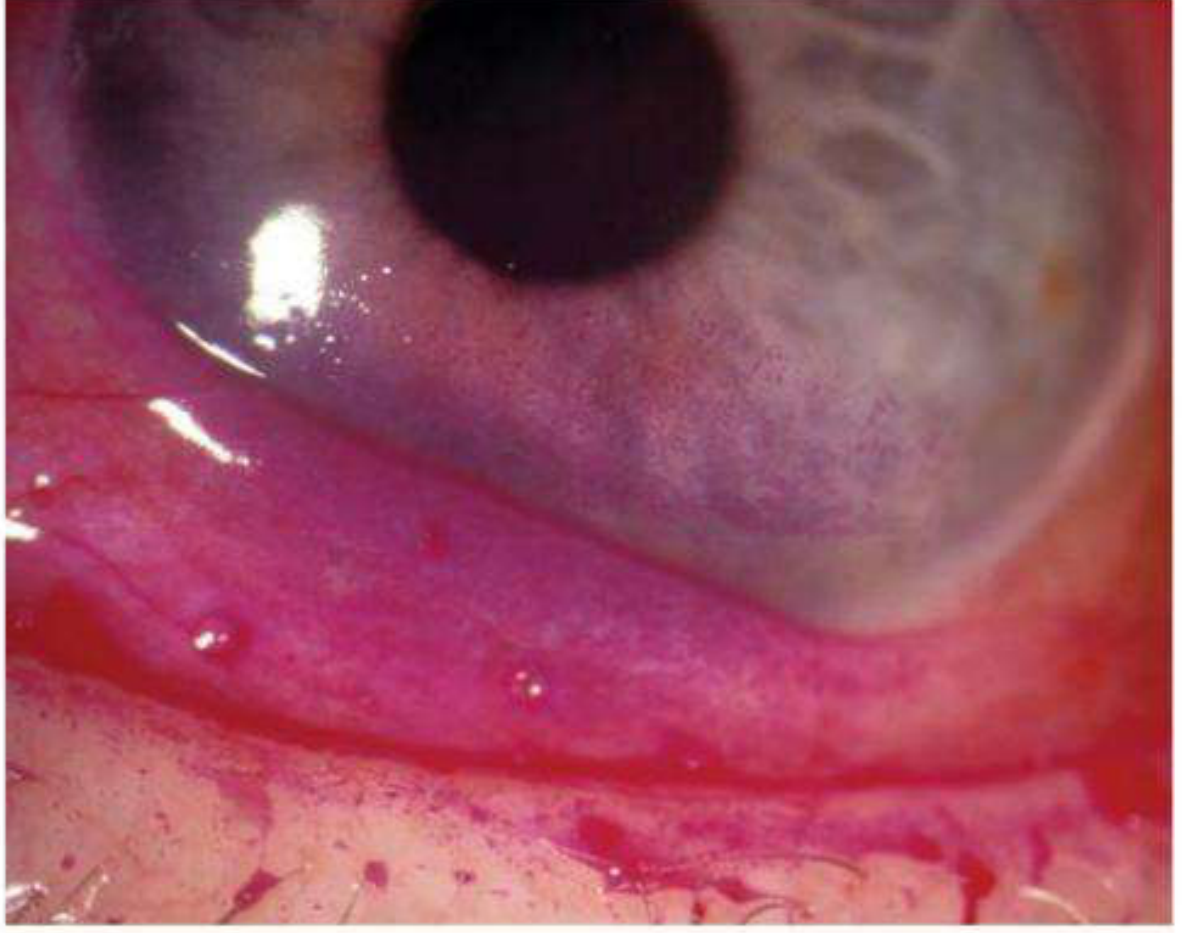
Examination
- Always examine puncta before cannulation - irrigation temporarily dilates the opening and will mask stenosis.
- Slit-lamp examination of puncta and eyelids.
- Fluorescein disappearance test: instill 1-2% fluorescein bilaterally; prolonged retention after 5-10 minutes = inadequate drainage.
- Lacrimal irrigation: contraindicated if absent/severely stenosed punctum; surgical enlargement required first.
- Probing: hard stop = bone contact (patent system with NLD obstruction); soft stop = mucosal blockage.
- Jones dye tests for physiological vs. anatomical obstruction.
Management
Primary Stenosis
- Dilation alone - can be tried but rarely gives sustained benefit.
- Dilation + mini-Monoka stent (FCI Ophthalmic) - significantly better results than dilation alone; stent removed after 1 month.
- Punctoplasty - when the above fails. Multiple techniques described:
- One-, two-, or three-snip enlargement with removal of the posterior ampulla wall
- Mechanical punch (e.g., Kelly punch)
- Laser punctoplasty
- Microsurgical techniques
- A temporary stent can be used post-operatively to maintain patency
Important caveat: surgical intervention has the potential to disrupt normal anatomical and physiological punctal tear-drainage function.
Secondary Stenosis
Punctoplasty is usually performed in conjunction with correction of the eversion:
- Retropunctal (Ziegler) cautery - for pure punctal eversion; burns placed ~5 mm below the punctum on the palpebral conjunctiva cause tissue shrinkage to invert the punctum.
- Medial conjunctivoplasty - for larger medial ectropion without horizontal laxity; a diamond-shaped piece of tarsoconjunctiva (~4 mm high × 8 mm wide) is excised inferolateral to the canaliculus.
- Lower lid tightening (tarsal strip) - for horizontal lid laxity, often combined with medial conjunctivoplasty.
Conjunctivochalasis
Excess bulbar conjunctiva can be secured to the sclera with absorbable sutures (6-0 polyglactin placed 6-8 mm from the limbus) or a crescent of excess conjunctiva excised.
Key Points Summary
| Aspect | Detail |
|---|---|
| Most common cause | Chronic blepharitis; idiopathic |
| Drug causes | 5-fluorouracil, long-term topical glaucoma drops |
| First-line Rx | Dilation ± mini-Monoka stent |
| Surgical Rx | Punctoplasty (1/2/3-snip, Kelly punch, laser) |
| Secondary stenosis Rx | Punctoplasty + ectropion correction |
| Key examination rule | Examine puncta BEFORE any irrigation |
- Kanski's Clinical Ophthalmology: A Systematic Approach, 10th ed., pp. 103-119
- Scott-Brown's Otorhinolaryngology, Head & Neck Surgery Vol. 2, p. 326
This is a shared conversation. Sign in to Orris to start your own chat.