
Method of procure criminal abortion and their complications
Reading File
Now let me search the medical library for content on criminal abortion methods and complications.
Finding Sources
Finding Sources
Excellent - found dedicated sections in three forensic medicine textbooks. Let me read all key sections in parallel.
Reading File
Reading File
Reading File
The Dikshit textbook section is truncated. Let me continue reading the comprehensive content from that block, including complications and postmortem evidence.
Reading File
Reading File
Excellent content. Let me continue reading the Dikshit book for complications and causes of death, and the Parikh book for mechanical methods:
Reading File
Reading File
I have comprehensive content. Let me read the final sections - the Parikh book on instrumental methods + complications, and the Dikshit postmortem evidence section:
Reading File
Reading File
I now have comprehensive information from both textbooks. Let me also read the Parikh book's section on complications (which is truncated) and get the instrumental methods part:
Reading File
Reading File
I now have all the comprehensive information needed. Let me read the Dikshit complications section to complete the picture:
Reading File
I now have comprehensive information. Let me fetch the anatomical diagram image of complications that was referenced:
Loading Image
Loading Image
I now have all the information needed to write a comprehensive answer. Here is the complete, well-structured response from authoritative forensic medicine textbooks:
Criminal Abortion: Methods of Procurement and Complications
Criminal abortion is the induced destruction or expulsion of the foetus from the womb unlawfully, where there is no therapeutic indication for the termination. It is governed under Sections 312-316 of the Indian Penal Code, with punishment ranging from 3 to 10 years imprisonment.
Types of Abortionists
- Expert / medically qualified professionals
- Semi-skilled - midwives, nurses, chemists
- Unskilled - persons with no training
Methods Used to Procure Criminal Abortion
The methods fall into three broad categories:
A. Mechanical Violence
1. General Mechanical Violence
These act directly on the uterus or indirectly by promoting pelvic congestion and haemorrhage between the uterus and membranes.
- Severe pressure over the abdomen: blows, kicks, tight lacing, jumping
- Violent exercise: riding, cycling, jumping from height, jolting, driving on rough roads, lifting heavy weights
- Cupping: A coin is placed on the hypogastrium, a piece of camphor lighted on it, and a cup/mug placed over it mouth-downward. The partial vacuum created pulls the abdominal wall, causing partial separation of the placenta. Used mainly in advanced pregnancy
- Application of leeches to the pudenda, perineum, and inner thighs
- Very hot and cold baths alternately
- Massaging the uterus through the abdominal wall
General violence generally fails except in women already predisposed to abort.
2. Local Mechanical Violence
Bimanual correction of a retroverted uterus may incidentally result in abortion. Skilled local interference is classified as follows:
- Unskilled interference: Self-instrumentation using whatever is at hand - pencil, knitting needle, hairpin, nail, etc. No attempt at asepsis; major risk of sepsis.
- Semi-skilled interference: Use of syringes to inject fluids (soap solution, potassium permanganate, Lysol, mercuric perchloride, glycerine) into the uterine cavity under pressure; insertion of a laminaria (sea tangle) tent into the cervix to cause swelling and dilatation, followed by passage of a soft rubber catheter as an irritating foreign body
- Skilled interference: Vacuum aspiration or D&C under anaesthesia (first trimester); prostaglandins F2α via amniocentesis or cervical route (second trimester); amniotic fluid replacement with 20% saline or 50% glucose (third trimester)
B. Instruments
Instruments are used for:
- Rupture of membranes using a uterine sound, catheter, pencil, knitting needle, hairpin, or fingers
- Abortion stick: A thin wooden or bamboo stick, 12-18 cm long, with one end wrapped in cotton wool soaked in juice of Marking nut (Semecarpus anacardium), Calotropis, or a paste of arsenic oxide, arsenic sulphide, or red lead. Instead of a stick, a twig of an irritant plant may be used - Calotropis gigantea (madar), Plumbago rosea (lal chitra), or Nerium odorum (kaner). It is introduced into the os uteri, causing local excoriation, bruising, perforation, and often sepsis
- Dilatation of the cervix: Using slippery elm bark (a flat piece about 3 mm thick inserted into the cervical canal), which absorbs vaginal secretions, swells, and dilates the canal. Compressed sponge is used similarly
- Air insufflation: Air instilled into the vagina via syringe or pump
- Electricity: Negative electrode applied to the cervix, positive electrode over the sacrum or lumbar vessels; current causes uterine contractions
- Paste (Utus paste): Contains iodine (or a salt such as potassium iodide), thymol, or mercury, injected from a collapsible tube with a uterine applicator. The main active component is iodine
- Syringing: An enema syringe (Higginson's syringe) with a hard nozzle inserted into the cervix. Fluids used include soapy water, inorganic and organic acids, lead solutions, arsenic, Lysol, cresol, formalin, potassium permanganate. The fluid detaches the amniotic sac and placenta from the uterine walls, causing uterine contractions and haemorrhage
C. Abortifacient Drugs
Many drugs used as abortifacients have no real effect on the uterus or foetus unless given in toxic doses - meaning death may occur from the drug's toxicity without any abortion.
i. Drugs acting directly on the uterus
Ecbolics (increase uterine contractions):
- Ergot (Ergometrine) - the most commonly used
- Quinine
- Cotton root bark
- Posterior pituitary extract (oxytocin)
- Potassium permanganate tablets (placed locally in vagina - cause ulceration and bleeding)
- Lead oleate pills (cause tonic uterine contraction)
- Nitrobenzol
- Strychnine
Emmenagogues (increase menstrual flow; used in large doses):
- Savin (oil of Juniperus sabina)
- Borax
- Apiol (toxic effects due to tricresyl phosphate)
- Synthetic oestrogens
- Prostaglandins
ii. Drugs acting indirectly on the uterus
Irritants of the genito-urinary tract (produce reflex uterine contraction):
- Oil of tansy
- Oil of turpentine
- Cantharides (in large doses: renal inflammation, albuminuria)
- Potassium permanganate (120-300 ml via vaginal route: erosion of vessels, haemorrhage)
Irritants of the gastrointestinal tract (excite the uterus "in sympathy"):
- Emetics (tartaric acid)
- Purgatives (Colocynth, Castor oil, Croton oil)
- Magnesium sulphate
Drugs with general poisonous effects on the body:
- Inorganic irritants: Lead, copper, antimony, mercury, arsenic. Lead (as diachylon pills) was extensively used - it causes tonic uterine contraction and has a direct toxic effect on trophoblastic epithelium, resulting in abortion or fetal death. Symptoms of lead poisoning often appear
- Organic irritants used in India: Unripe fruits of papaya (Carica papaya) and pineapple, seeds of Gajar (Daucus carota), milky juice of Madar (Calotropis gigantea), bark of Lal chitra (Plumbago rosea), Karela (bitter gourd), Sanguinaria
Complications of Procuring Abortion
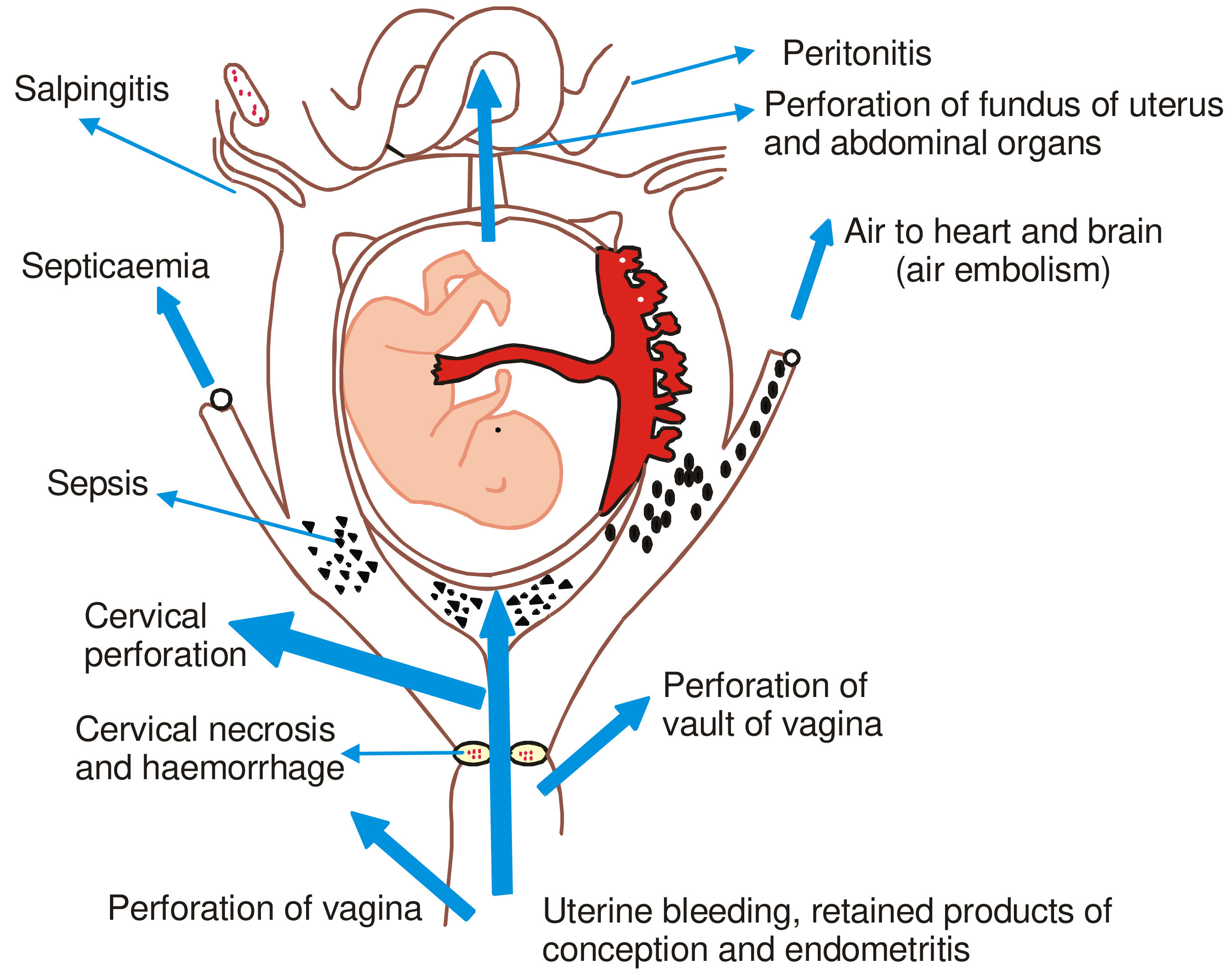
Immediate Complications
| Complication | Mechanism |
|---|---|
| Shock and haemorrhage | Uterine perforation from instrument use |
| Air embolism | ~100 ml of air entering uterine veins (when soapy solution mixed with air is injected under pressure); patient collapses within 10 minutes |
| Reflex vagal inhibition | Touching the cervix or lower uterine segment by an instrument or irritant fluid, especially during anaesthesia |
| Fat embolism | Injection of soapy water or corrosives such as Lysol |
Delayed Complications
- Septicaemia and pyaemia: due to dirty surroundings, dirty instruments, or uterine injury - organisms commonly involved are Clostridium welchii and Clostridium tetani
- General peritonitis
- Toxaemia (absorption of toxic substances through uterine/vaginal mucosa)
- Tetanus
- Necrosis of cervix
- Fatal haemorrhage from retained products of conception, perforation of cervix, vaginal vault, or fundus of uterus
- Delayed air embolism: air held in the uterus until placental separation opens vessels; mucus plug may prevent escape via cervix. Minimum lethal dose is ~100 ml
Remote Complications
- Jaundice and renal suppression
- Bacterial endocarditis
- Pulmonary embolism
- Pneumonia
- Empyema and meningitis
- Poisonous effects of the drug itself (especially lead, arsenic)
- Salpingitis leading to tubal factor infertility
Causes of Death (Forensic Classification)
| Timing | Cause |
|---|---|
| Immediate | Shock + haemorrhage, air embolism, reflex vagal inhibition, fat embolism |
| Delayed | Septicaemia/pyaemia, peritonitis, toxaemia, tetanus |
| Remote | Jaundice, renal failure, bacterial endocarditis, pulmonary embolism, pneumonia, empyema, meningitis, drug toxicity |
Postmortem Evidence of Criminal Abortion
Sudden death of a woman of childbearing age raises suspicion when:
- The deceased is pregnant and deeply cyanosed
- Instruments or drugs are found at the scene
- Underclothing is apparently disturbed
- Fluid, soapy water, or blood-stained discharge is coming from the vagina
To convict an abortionist, it must be established that: (1) the dead woman was pregnant, (2) the accused was responsible for the act interrupting pregnancy, (3) the accused acted with intention of producing an illegal abortion, and (4) death occurred as a result.
Sources: P.C. Dikshit Textbook of Forensic Medicine and Toxicology, pp. 365-368; Parikh's Textbook of Medical Jurisprudence, Forensic Medicine and Toxicology, pp. 455-459; KS Narayan Reddy's The Essentials of Forensic Medicine and Toxicology, 36th ed.
This is a shared conversation. Sign in to Orris to start your own chat.