
difference between submandibular & sublingual gland
Reading File
Searching sources...
Finding Sources
Finding Sources
Reading File
Reading File
Finding Sources
Reading File
Reading File
Reading File
Reading File
Loading Image
I now have comprehensive information from multiple textbooks. Here is a detailed comparison:
Submandibular vs. Sublingual Gland
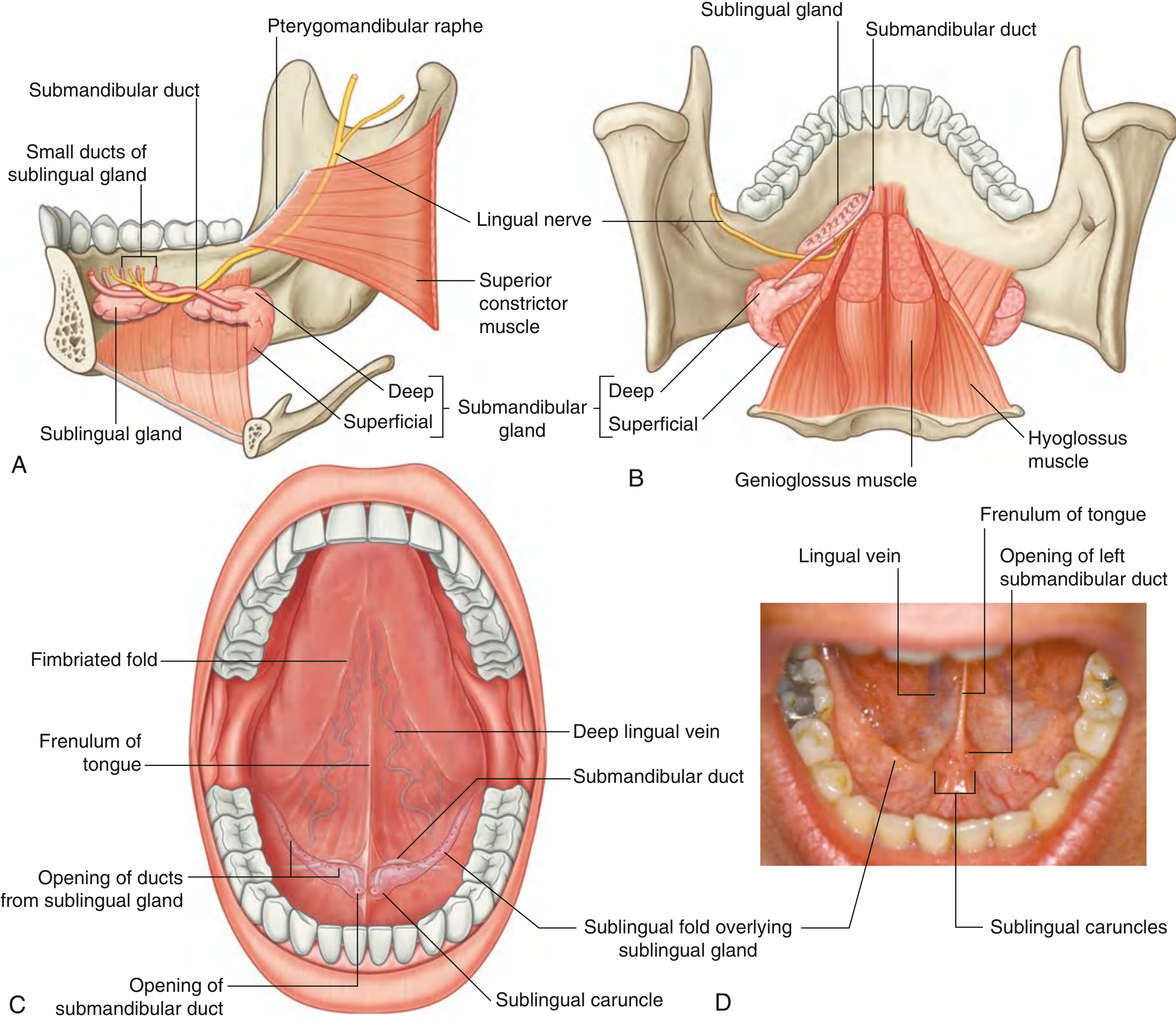
Overview
| Feature | Submandibular Gland | Sublingual Gland |
|---|---|---|
| Size/Rank | 2nd largest major salivary gland | Smallest of the 3 major salivary glands |
| Weight | ~8-15 g | ~3-4 g |
| Shape | Hook-shaped (bi-lobed) | Almond/elongated flat shape |
Location
| Feature | Submandibular Gland | Sublingual Gland |
|---|---|---|
| Primary position | Submandibular triangle, below floor of mouth | Beneath oral mucosa, in floor of oral cavity |
| Fossa | Submandibular fossa on medial mandible (below mylohyoid line) | Sublingual fossa on medial mandible (above anterior 1/3 of mylohyoid line) |
| Relation to mylohyoid | Superficial part lies BELOW (outside oral cavity); deep part loops ABOVE into the floor of mouth | Entirely ABOVE mylohyoid (within oral cavity) |
| Lateral relation | Medial surface of mandibular body | Medial surface of mandible |
| Medial relation | Hyoglossus and styloglossus muscles | Genioglossus muscle (separated by lingual nerve and submandibular duct) |
| Notable | Deep part extends forward to the posterior end of sublingual gland | Lies lateral to the submandibular duct; behind it lies the deep part of submandibular gland |
Duct
| Feature | Submandibular Gland | Sublingual Gland |
|---|---|---|
| Duct name | Submandibular duct (Wharton's duct) | Multiple minor sublingual ducts; sometimes a major sublingual duct (Bartholin's duct) |
| Duct length | ~5 cm | Very short |
| Number of ducts | One main duct | 8-20 excretory ducts |
| Opening | Single opening on sublingual papilla/caruncle at side of frenulum | Minor ducts open along the crest of the sublingual fold; major duct (when present) opens with or near the submandibular duct |
| Relation | Crossed laterally by the lingual nerve (loops under the duct) | Opens alongside or near the submandibular duct |
Secretion (Histology)
| Feature | Submandibular Gland | Sublingual Gland |
|---|---|---|
| Type | Mixed: predominantly serous (seromucous) | Mixed: predominantly mucous (seromucous) |
| Serous demilunes | Present | Present but fewer |
Nerve Supply
Both glands share the same parasympathetic pathway, which is a key fact:
| Feature | Submandibular Gland | Sublingual Gland |
|---|---|---|
| Parasympathetic preganglionic | Chorda tympani (branch of CN VII facial nerve) | Same - chorda tympani (CN VII) |
| Pathway | Chorda tympani → lingual nerve → submandibular ganglion | Chorda tympani → lingual nerve → submandibular ganglion |
| Ganglion | Submandibular ganglion (hangs off the lingual nerve, on hyoglossus muscle) | Same - submandibular ganglion |
| Postganglionic | Directly to submandibular gland | Some fibers return to lingual nerve then reach the sublingual gland |
| Sympathetic | Preganglionic from T1 → superior cervical ganglion → follow blood vessels | Same pathway |
Blood Supply & Lymphatics
| Feature | Submandibular Gland | Sublingual Gland |
|---|---|---|
| Arterial supply | Branches of facial and lingual arteries | Branches of facial and lingual arteries |
| Venous drainage | Lingual and facial veins | Lingual and facial veins |
| Lymphatics | Submandibular nodes → deep cervical nodes (jugulo-omohyoid node) | Submandibular nodes → deep cervical nodes |
Key Clinical Points
- The submandibular gland accounts for ~65-70% of total resting saliva output - it is the dominant contributor despite not being the largest gland.
- Sialolithiasis (salivary stones) most commonly affect the submandibular duct (~80% of cases) because Wharton's duct is long, runs upward, and the saliva is more viscous/mucous.
- The sublingual gland is rarely affected by stones but can form ranulas - mucus retention cysts in the floor of the mouth when ducts are obstructed.
- The lingual nerve has a characteristic winding relationship to the submandibular duct: it crosses lateral, then medial, then lateral again as it descends. This is surgically important.
- Both glands are in the path of the submandibular ganglion and share parasympathetic innervation from the chorda tympani - distinguishing them from the parotid (CN IX via otic ganglion).
Sources: Gray's Anatomy for Students (pp. 1242-1245); Scott-Brown's Otorhinolaryngology Head & Neck Surgery (pp. 692-693); Color Atlas of Human Anatomy Vol. 2 (pp. 260-261)
allover differences in one chart
Here is a single consolidated comparison chart:
| Feature | Submandibular Gland | Sublingual Gland |
|---|---|---|
| Size | 2nd largest major salivary gland | Smallest major salivary gland |
| Weight | ~8–15 g | ~3–4 g |
| Shape | Hook-shaped (bi-lobed) | Almond-shaped, flat |
| Position | Submandibular triangle, below floor of mouth | Floor of oral cavity, beneath oral mucosa |
| Fossa | Submandibular fossa (below mylohyoid line) | Sublingual fossa (above anterior 1/3 of mylohyoid line) |
| Relation to mylohyoid | Superficial part BELOW (outside oral cavity); deep part loops above into floor of mouth | Entirely ABOVE mylohyoid (inside oral cavity) |
| Lateral relation | Medial surface of mandible body | Medial surface of mandible |
| Medial relation | Hyoglossus & styloglossus muscles | Genioglossus muscle |
| Secretion type | Mixed - predominantly SEROUS | Mixed - predominantly MUCOUS |
| Duct name | Wharton's duct | Minor sublingual ducts; Bartholin's duct (major, when present) |
| No. of ducts | 1 main duct | 8–20 ducts |
| Duct length | ~5 cm (long) | Very short |
| Duct opening | Sublingual caruncle/papilla beside frenulum | Along sublingual fold crest; major duct opens near submandibular duct |
| Parasympathetic ganglion | Submandibular ganglion | Submandibular ganglion (same) |
| Preganglionic nerve | Chorda tympani (CN VII) | Chorda tympani (CN VII) (same) |
| Postganglionic fibers | Directly from submandibular ganglion to gland | Via lingual nerve branches from submandibular ganglion |
| Arterial supply | Facial & lingual arteries | Facial & lingual arteries |
| Venous drainage | Facial & lingual veins | Facial & lingual veins |
| Lymphatic drainage | Submandibular nodes → deep cervical nodes | Submandibular nodes → deep cervical nodes |
| % of resting saliva | ~65–70% | ~5% |
| Common pathology | Sialolithiasis (stones) - most common site (~80% of all stones) | Ranula (mucus retention cyst) |
| Stone predisposition | High - long upward duct, viscous mucous secretion | Low |
| Clinical importance | Lingual nerve loops around Wharton's duct (surgical landmark) | Ranulas; rarely tumors |
Memory tip: "SubMandibular = More serous, More saliva, More stones" | "SubLingual = Lots of ducts, Less serous, Less common pathology"
This is a shared conversation. Sign in to Orris to start your own chat.