
Type if nystagmus, mechanisms, physiology of nystagmus, how it’s generate , different type, peripheral vs central , Patho physiology in disease, with example using standard article and book
nystagmus types mechanisms classification
nystagmus peripheral central differentiation vestibular
nystagmus pathophysiology vestibular ocular motor
Nystagmus: Comprehensive Review
1. Definition
"Nystagmus reflects an imbalance in one or more of the systems that maintain stability of gaze." — Adams and Victor's Principles of Neurology, 12th Ed.
- Oscillopsia — the environment appears to oscillate
- Poor foveation — blurred vision due to inability to hold the target on the fovea
2. Physiology of Gaze Stabilization (Why Nystagmus Occurs)
2.1 Fixation / Visual Feedback System
2.2 Neural Integrator (NI)
2.3 Vestibulo-Ocular Reflex (VOR)
"The causes may be viewed as originating in (1) structures that maintain steadiness of gaze in the primary position; (2) the system for holding eccentric gaze—the neural integrator; or (3) the VOR system." — Adams and Victor's Principles of Neurology, 12th Ed.
2.4 The VOR Arc (Generation of Slow Phase)
- Ampullopetal flow in horizontal canal → increased firing of ipsilateral vestibular nerve → excitation of contralateral horizontal gaze center → eyes deviate slowly ipsilateral
- Ewald's Laws govern canal-specific behavior:
- Eye/head movements occur in the plane of the stimulated canal and in the direction of endolymph flow
- Ampullopetal flow > ampullofugal in the lateral canal
- The reverse is true for the posterior and superior canals
- The fast (saccadic) phase is triggered by a brainstem center as a centrally generated corrective movement
"The slow phase of the nystagmus = direction of the flow of endolymph; the quick phase (centrally generated) = compensatory mechanism." — K.J. Lee's Essential Otolaryngology
2.5 Caloric Testing (COWS Mnemonic)
— Ganong's Review of Medical Physiology, 26th Ed.
3. Classification of Nystagmus
3.1 By Waveform (Most Fundamental Division)
| Type | Slow Phase | Fast Phase | Velocity Profile |
|---|---|---|---|
| Pendular | Slow | Slow (equal velocity both ways) | Sinusoidal |
| Jerk — Linear | Slow constant velocity | Fast saccadic | Vestibular origin (peripheral or central) |
| Jerk — Decreasing velocity (exponential) | Slow, decelerating | Fast saccadic | "Leaky" NI → gaze-paretic nystagmus |
| Jerk — Increasing velocity (exponential) | Slow, accelerating | Fast saccadic | High-gain instability; typical of infantile nystagmus syndrome (INS) / congenital nystagmus |
The direction of nystagmus is named by the fast phase (e.g., "beats right" = fast phase to the right). — Bradley and Daroff's Neurology in Clinical Practice
3.2 By Plane
- Horizontal — most common
- Vertical (upbeat or downbeat)
- Torsional (rotatory)
- Mixed / Oblique (e.g., see-saw)
3.3 By Conjugacy
- Conjugate — both eyes move together (most common)
- Disconjugate (dissociated) — eyes oscillate out of phase or in different directions; seen with brainstem lesions (e.g., INO → ataxic nystagmus) and spasmus nutans
4. Types of Nystagmus
4.1 Physiological Nystagmus (Normal)
| Type | Mechanism |
|---|---|
| End-point nystagmus | Fine jerk nystagmus at extremes of gaze (>30°); fast phase in direction of gaze; normal finding |
| Optokinetic nystagmus (OKN) | Moving target traverses visual field → slow pursuit phase follows target; fast saccadic phase resets to next target. Controlled by: slow phase → parieto-occipito-temporal cortex; fast phase → frontal lobe |
| Post-rotatory nystagmus | Follows rotation; slow phase away from rotation, fast phase same as rotation direction; postrotatory beats opposite |
4.2 Pathological Nystagmus — Complete Catalogue
A. Vestibular (Peripheral Origin)
- Spontaneous vestibular nystagmus — horizontal with torsional component; beats away from the lesion; obeys Alexander's law; suppressed by fixation; associated with vertigo, nausea, tinnitus, hearing loss
B. Gaze-Evoked Nystagmus
- Caused by leaky NI; beats in direction of gaze; both eyes affected; most common nystagmus overall (drugs — alcohol, barbiturates, phenytoin are the most frequent cause)
C. Downbeat Nystagmus
- Fast phase beating downward; most common acquired primary positional nystagmus; worst in lateral gaze and downgaze
- Localization: bilateral flocculus / cervicomedullary junction
- Causes: Chiari malformation, Arnold-Chiari, syringobulbia, foramen magnum tumors, lithium, phenytoin, anticonvulsants, alcoholic cerebellar degeneration, Wernicke encephalopathy, demyelination, SCA-6, paraneoplastic, vertebrobasilar ischemia
D. Upbeat Nystagmus
- Fast phase beating upward in all positions
- Localization: bilateral pontomesencephalic junction / cerebellar vermis
- Causes: posterior fossa lesions, Wernicke encephalopathy, drugs
E. Periodic Alternating Nystagmus (PAN)
- Conjugate horizontal jerk nystagmus that periodically reverses direction (cycle 1–3 minutes with ~15 s null period)
- Localization: floor of fourth ventricle (nodulus/uvula)
- Mechanism: loss of GABA-ergic inhibition of the velocity storage mechanism in the nodulus
- Congenital or acquired (cerebellar disease, ataxia telangiectasia, phenytoin)
F. See-Saw Nystagmus
- Pendular nystagmus: one eye elevates and intorts while the other depresses and extorts, alternating
- Causes: parasellar tumors (often with bitemporal hemianopia), syringobulbia, brainstem stroke, diencephalic lesions
G. Convergence-Retraction Nystagmus
- Co-contraction of extraocular muscles (especially medial recti); globe retracts on attempted upgaze saccades; induced by downward OKN drum
- Localization: pretectal area (dorsal midbrain)
- Causes: Parinaud syndrome — pinealoma, vascular accidents, hydrocephalus
H. Ataxic Nystagmus (INO-associated)
- Horizontal jerk nystagmus in the abducting eye with limited adduction of the other eye
- Caused by internuclear ophthalmoplegia (INO) — lesion in the MLF
- Hallmark of MS (bilateral INO) or brainstem vascular disease
I. Bruns Nystagmus
- Coarse, slow-frequency cerebellar nystagmus in gaze toward the lesion + fine, high-frequency vestibular nystagmus in gaze away
- Caused by cerebellopontine angle tumors (e.g., vestibular schwannoma)
J. Acquired Pendular Nystagmus (APN)
- Horizontal ± vertical ± torsional, frequency 3–5 Hz
- Most common cause: multiple sclerosis; also brainstem vascular disease, Cockayne syndrome, Pelizaeus-Merzbacher disease, Whipple disease
- Mechanism: disruption of cerebellar feedback to NIs; deafferentation of inferior olive via lesions of the central tegmental tract → oscillatory instability
K. Latent Nystagmus
- No nystagmus with both eyes open; horizontal jerk nystagmus appears when one eye is covered — fast phase toward the uncovered fixating eye
- Associated with infantile esotropia and dissociated vertical deviation (DVD)
L. Infantile Nystagmus Syndrome (INS) / Congenital Nystagmus
- Present from birth or first few months of life; predominantly horizontal even in vertical gaze
- Increasing velocity (accelerating) slow phase — pathognomonic but not exclusive
- Null zone: position of gaze where nystagmus is minimal
- Associated with: afferent visual pathway disorders (albinism, retinal dystrophies, optic nerve hypoplasia), or idiopathic motor form
M. Spasmus Nutans
- Triad: high-frequency small-amplitude nystagmus ("shimmering"), head nodding, abnormal head posture
- Onset in first year of life; usually remits by age 3–8 years
- Warning: must rule out optic nerve/chiasmal glioma by MRI
All of above: — Bradley and Daroff's Neurology in Clinical Practice; Kanski's Clinical Ophthalmology 10th Ed.
5. Peripheral vs. Central Nystagmus
| Feature | Peripheral (vestibular end-organ / nerve) | Central (brainstem / cerebellum) |
|---|---|---|
| Direction | Unidirectional; beats away from lesion | May be direction-changing with gaze |
| Plane | Horizontal ± torsional | Any plane; pure vertical or torsional highly suggests central |
| Alexander's law | Follows it (amplitude increases in fast-phase direction) | Often does not follow |
| Slow phase velocity profile | Linear (constant velocity) | Variable; may be increasing or decreasing exponential |
| Fixation effect | Suppressed by visual fixation (use Frenzel lenses to unmask) | Not suppressed (or worsened) by fixation |
| HINTS test — head impulse | Positive (abnormal — eye corrective saccade) = peripheral | Negative (normal head impulse) = central danger sign |
| HINTS test — nystagmus | Unidirectional | Direction-changing = central |
| HINTS test — skew deviation | Absent | Present = central |
| Vertigo severity | Severe, disabling | Moderate to mild |
| Nausea/vomiting | Prominent | Less prominent |
| Hearing loss / tinnitus | Common (labyrinthine disease) | Rare (unless AICA territory) |
| Associated neuro signs | Absent | Headache, ataxia, diplopia, dysarthria, pyramidal signs |
| Oscillopsia | May be present during motion only | Often present |
| Course | Resolves over days–weeks (compensation) | Persists; may progress |
| Examples | BPPV, vestibular neuritis, Ménière's disease | Posterior fossa stroke, MS, cerebellar degeneration |
"Peripheral vestibular nystagmus is usually associated with vertigo, nausea, vomiting, perspiration, diarrhea, hearing loss, and tinnitus… With central vestibular nystagmus, symptoms such as nausea are less severe, but other neurological features may be present, such as headache, ataxia, diplopia, and pyramidal tract signs." — Bradley and Daroff's Neurology in Clinical Practice
6. Alexander's Law
- 1st degree: nystagmus only in the direction of the fast component
- 2nd degree: nystagmus in fast-phase direction AND in primary gaze
- 3rd degree: nystagmus in all three directions (including gaze opposite fast phase)
— K.J. Lee's Essential Otolaryngology
7. Pathophysiology in Specific Diseases
7.1 Benign Paroxysmal Positional Vertigo (BPPV)
- Latency (1–5 seconds) — time for canalith to settle and begin flowing
- Short duration (<1 minute)
- Fatigability on repeated testing
- Reversal on returning to upright
— Cummings Otolaryngology Head and Neck Surgery; Localization in Clinical Neurology 8th Ed.
7.2 Vestibular Neuritis (Peripheral)
7.3 Ménière's Disease
7.4 Multiple Sclerosis (Central)
— Bradley and Daroff's; Kanski's Clinical Ophthalmology 10th Ed.
7.5 Chiari Malformation Type I
7.6 Wernicke Encephalopathy (Thiamine Deficiency)
— Bradley and Daroff's Neurology; Kanski's
7.7 Parinaud / Dorsal Midbrain Syndrome (e.g., Pinealoma)
7.8 Drug-Induced Nystagmus
— Adams and Victor's Principles of Neurology, 12th Ed.; Ganong's Review of Medical Physiology, 26th Ed.
7.9 Posterior Fossa Stroke (AICA/PICA)
- AICA: involves labyrinthine artery → hearing loss + peripheral-pattern nystagmus + ipsilateral facial numbness (mimics vestibular neuritis) — this "central mimic" is why HINTS exam is critical
- PICA: lateral medullary (Wallenberg) syndrome — nystagmus with ocular tilt reaction, skew deviation, Horner syndrome, crossed sensory loss
7.10 Vestibular Schwannoma
— Kanski's Clinical Ophthalmology 10th Ed.
8. Localizing Value Summary Table
| Nystagmus Syndrome | Localization |
|---|---|
| Downbeat nystagmus | Bilateral cervicomedullary junction / flocculus |
| Periodic alternating nystagmus | Floor of 4th ventricle (nodulus) |
| Upbeat nystagmus | Bilateral pontomesencephalic junction; cerebellar vermis |
| Pendular nystagmus | Medial medulla; paramedian pons; deep cerebellum (fastigial); myelin disorders |
| See-saw nystagmus | Parasellar (3rd ventricle), brainstem, diencephalic |
| Convergence-retraction nystagmus | Pretectum (dorsal midbrain) |
| Ataxic nystagmus (INO) | MLF (medial longitudinal fasciculus) |
| Bruns nystagmus | Cerebellopontine angle |
| Gaze-evoked / gaze-paretic | NI dysfunction (drugs, posterior fossa lesions) |
9. Recent Evidence
| Source | Key Point |
|---|---|
| Shah et al., Acad Emerg Med 2023 (PMID: 36453134) — Systematic review & meta-analysis (GRACE-3) | HINTS exam (especially direction-changing nystagmus + normal head impulse + skew deviation) has high sensitivity for posterior fossa stroke; superior to early MRI in acute vestibular syndrome |
| Lemos & Strupp, J Neurol 2022 (PMID: 34669008) | Updated classification of central positional nystagmus — including patterns that may mimic BPPV (e.g., persistent downbeat positional nystagmus in cerebellar disease) |
| Gold D, Continuum 2025 (PMID: 40179406) | Comprehensive review of nystagmus and saccadic intrusions — updated clinical framework for acquired nystagmus management |
| Helmchen et al., Laryngorhinootologie 2024 (PMID: 38195848) | Update on central oculomotor disorders and nystagmus — therapeutic advances including 4-aminopyridine for downbeat nystagmus and memantine for pendular nystagmus |
Key Textbook Sources
- Bradley and Daroff's Neurology in Clinical Practice — Chapters 18 & 22
- Adams and Victor's Principles of Neurology, 12th Ed. — Chapter on Eye Movements
- Kanski's Clinical Ophthalmology: A Systematic Approach, 10th Ed. — Chapter 19
- Ganong's Review of Medical Physiology, 26th Ed. — Chapter on Vestibular Physiology
- K.J. Lee's Essential Otolaryngology — Nystagmus & Vestibular Testing
- Localization in Clinical Neurology, 8th Ed. — Gaze-Holding Nystagmus; BPPV
- Cummings Otolaryngology Head and Neck Surgery — Vestibular Disorders
What Was Covered
Physiology & Generation
Types
Peripheral vs. Central
Disease Pathophysiology
Vestibolo ocular response and its physiology and Patho physiology and disease with examination. Use standard article and textbook
vestibulo-ocular reflex physiology pathophysiology
video head impulse test vHIT vestibular function
HINTS exam head impulse nystagmus skew stroke
HINTS bedside examination acute vestibular syndrome
The Vestibulo-Ocular Reflex (VOR): Comprehensive Review
1. Definition and Teleological Purpose
"If you shake your head back and forth while reading, you can still discern words because of the VOR. If instead you move the book at a similar speed while holding your head steady, you can no longer read the words." — Kandel, Principles of Neural Science, 6th Ed.
2. Peripheral Apparatus: The Receptor Organs
2.1 Semicircular Canals (Angular Acceleration → Rotational VOR)
- Horizontal canals — paired bilaterally
- Left anterior + Right posterior (LARP plane)
- Right anterior + Left posterior (RALP plane)
- Ampullopetal flow in horizontal canal → utricle direction → stereocilia toward kinocilium → depolarization → increased firing
- Ampullofugal flow → stereocilia away from kinocilium → hyperpolarization → decreased firing
2.2 Otolith Organs (Linear Acceleration → Translational VOR)
3. The Neural Arc: From Canal to Eye Muscle
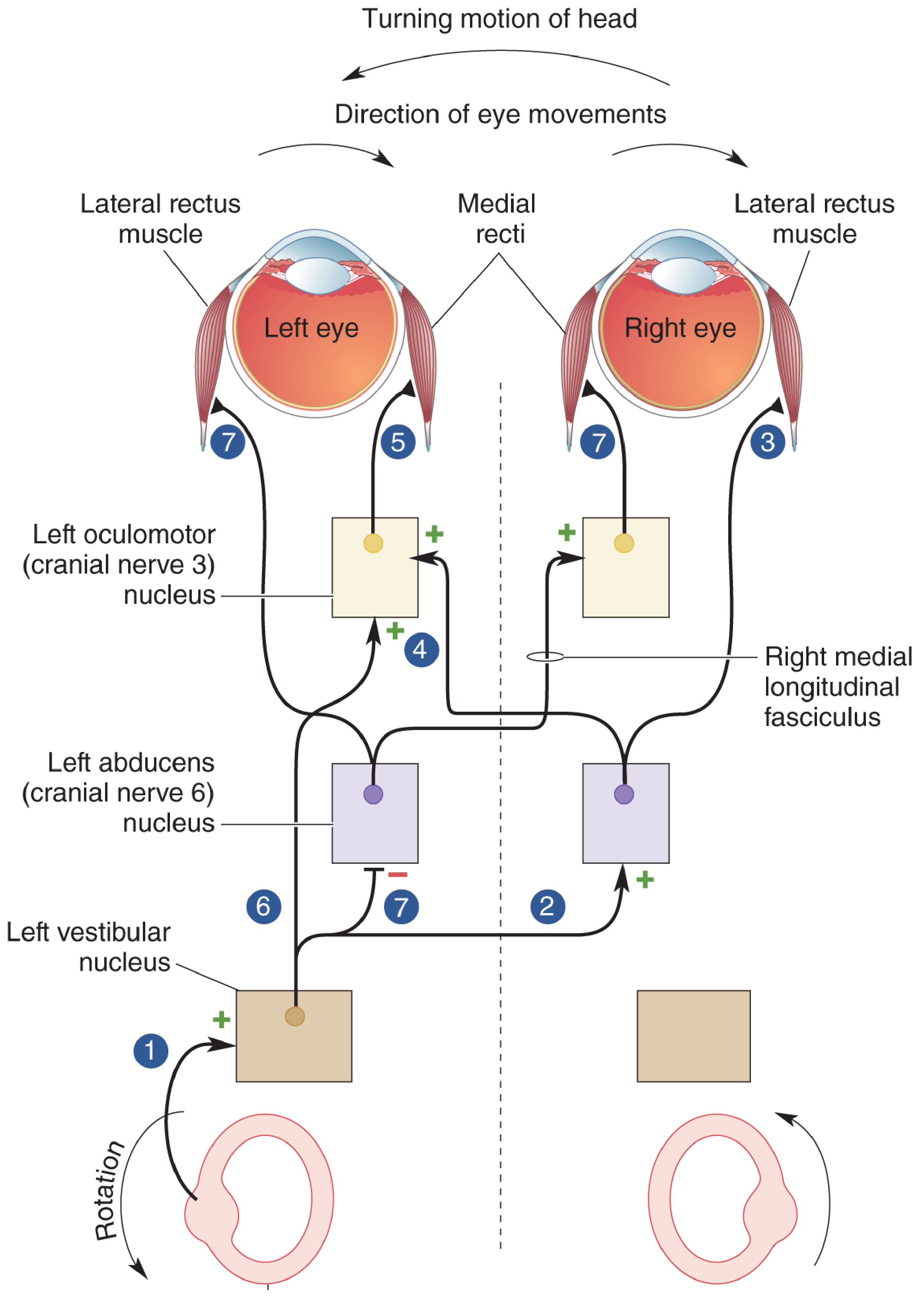
3.1 The Three-Neuron Arc (Rotational VOR)
- Neuron 1 (Afferent): Left horizontal semicircular canal hair cells depolarize → increase firing of left CN VIII afferents → excite ipsilateral (left) vestibular nucleus (medial vestibular nucleus, MVN)
- Neuron 2 (Interneuron): Left MVN sends excitatory axons (via the medial longitudinal fasciculus, MLF) to:
- Contralateral (right) abducens nucleus (CN VI) — excites right lateral rectus
- Simultaneously, right abducens interneurons send excitatory signals back across midline via the MLF to the left oculomotor nucleus (CN III) — excites left medial rectus
- Neuron 3 (Motor): Motor neurons in CN III and CN VI nuclei → extraocular muscles
- Right lateral rectus contracts → right eye abducts
- Left medial rectus contracts → left eye adducts
- Both eyes move conjugately to the right — perfectly compensating leftward head rotation
3.2 The Two Parallel Processes Within the VOR
"All types of conjugate eye movement — the VOR, optokinetic nystagmus, saccades, and pursuit — are initiated as velocity commands passed both directly to the oculomotor neurons and indirectly through this shared neural integrator." — Cummings Otolaryngology Head and Neck Surgery
3.3 Velocity Storage Mechanism
4. Types of VOR
4.1 Rotational VOR (rVOR)
4.2 Translational VOR (tVOR / linear VOR)
4.3 Ocular Counter-Rolling (OCR)
4.4 VOR Suppression (Voluntary Cancellation)
4.5 Visually Enhanced VOR (VVOR)
— K.J. Lee's Essential Otolaryngology
5. VOR Gain and Its Significance
- Gain < 1 (hypometric VOR): insufficient compensatory eye movement; head moves but eyes don't keep up → catch-up saccade follows → image unstable during movement → oscillopsia
- Gain > 1 (hypermetric VOR): eyes overshoot; rare
- Gain ~0 (areflexic VOR): bilateral vestibular failure
6. Cerebellar Modulation and VOR Adaptation
- Mossy fibers carry vestibular, visual, and motor signals from pontine/vestibular nuclei to the cerebellar cortex → granule cells → parallel fibers → Purkinje cells
- Climbing fibers (from inferior olive) carry retinal slip error signals — whenever the VOR is inaccurate, there is motion of the visual image on the retina (retinal slip), which serves as a teaching signal
- Concurrent activation of parallel fibers and climbing fibers at a Purkinje cell induces long-term depression (LTD) at the parallel fiber synapse → calibrates the gain of the VOR
- Additionally, flocculus target neurons in the vestibular nuclei (which receive GABAergic input from Purkinje cells and direct vestibular afferent input) undergo plasticity and can maintain calibration changes without further cerebellar input
"Anyone who wears eyeglasses depends on this plasticity of the VOR." — Kandel, Principles of Neural Science, 6th Ed.
7. VOR and Optokinetic Reflex (OKR) Supplementation
8. Caloric Test — Physiology of VOR Testing
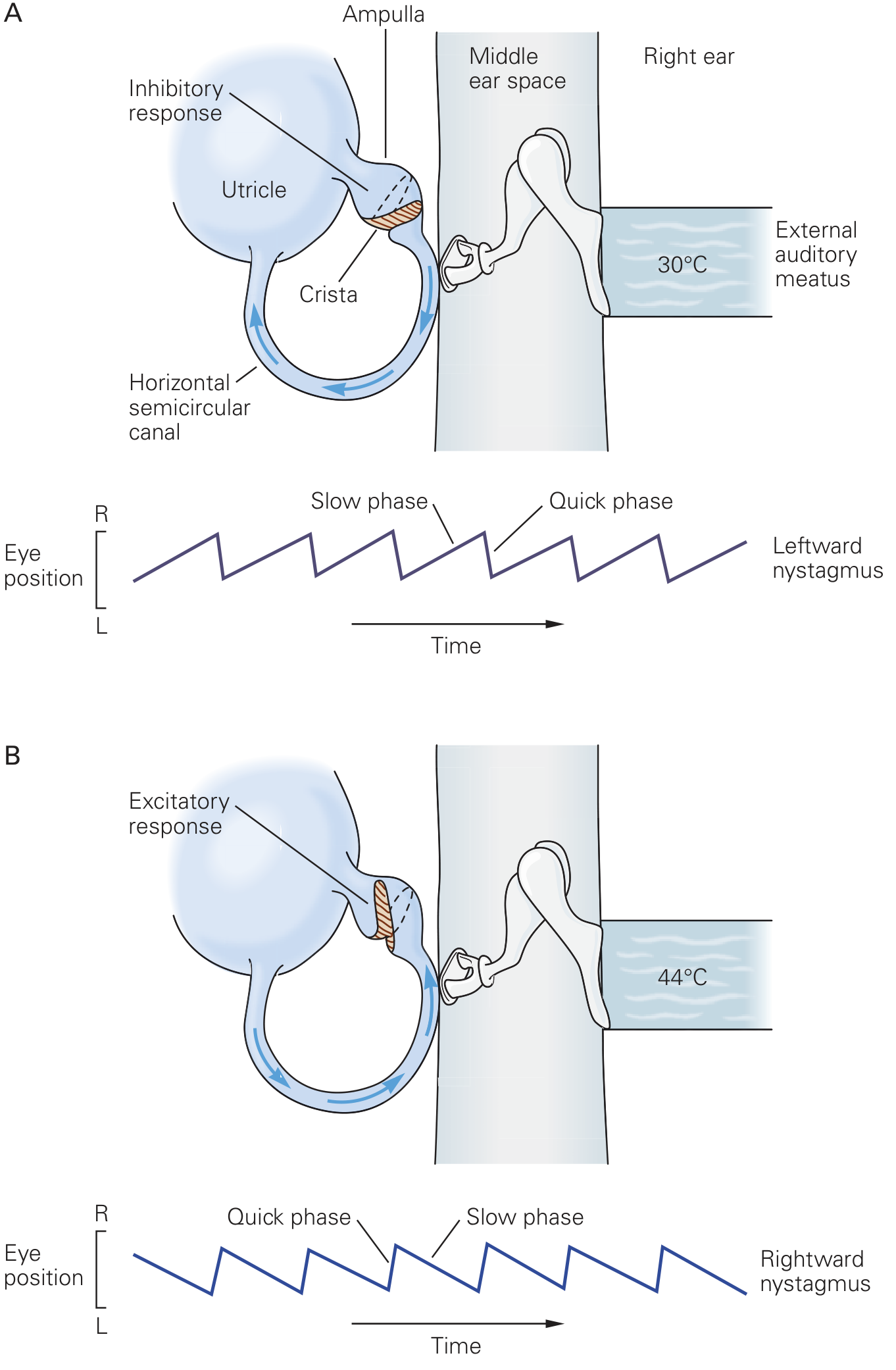
- Warm (44°C) → endolymph rises → ampullopetal flow in horizontal canal → excitation → nystagmus beats toward irrigated ear (SAME)
- Cold (30°C) → endolymph descends → ampullofugal flow → inhibition → nystagmus beats away from irrigated ear (OPPOSITE)
- Normal: Equal nystagmus responses from both ears (20–50 seconds duration)
- Canal paresis: Reduced or absent response from one ear → unilateral lesion
- Directional preponderance: Stronger nystagmus in one direction → reflects spontaneous vestibular imbalance
- Bilateral absent caloric responses: Bilateral vestibular hypofunction (e.g., ototoxicity)
9. Pathophysiology of VOR in Disease
9.1 Unilateral Vestibular Hypofunction (e.g., Vestibular Neuritis)
- Spontaneous horizontal-torsional jerk nystagmus (slow phase toward lesion, fast phase away)
- Severely impaired VOR: during rapid head turn toward the lesioned side, the intact side is simultaneously inhibited by the movement, and the lesioned side provides no excitatory signal → VOR gain ↓ on the lesioned side (catch-up saccade visible on head impulse test)
- Head shaking nystagmus: after 20 cycles of 2 Hz horizontal head shaking, post-shaking nystagmus beats toward the intact side (velocity storage asymmetry)
- Symptoms: severe vertigo, nausea, vomiting, oscillopsia; no hearing loss (differentiates from labyrinthitis)
- Recovery: central vestibular compensation over days–weeks; spontaneous nystagmus resolves even without peripheral recovery
"The vertigo and nystagmus resulting from an acute vestibular lesion typically subside over several days, even if peripheral function does not recover. This is because central compensatory mechanisms restore the balance in vestibular signals in the brainstem." — Kandel, Principles of Neural Science, 6th Ed.
9.2 Bilateral Vestibular Hypofunction (BVH)
- No spontaneous nystagmus (no imbalance)
- No vertigo at rest
- Profoundly impaired VOR bilaterally — gain approaches 0
- Oscillopsia during all head movement — the patient cannot read street signs while walking; faces blur while walking
- Some patients perceive their own heartbeat as visual oscillations (VOR fails to compensate for minuscule head movements from cardiac pulse)
- Romberg test positive (eyes closed): falls because vestibular and visual inputs are both absent; only proprioception remains
- Dynamic visual acuity (DVA): loss of ≥5 lines on Snellen chart during head shaking at >2 Hz is diagnostic
9.3 Benign Paroxysmal Positional Vertigo (BPPV)
9.4 Ménière's Disease
9.5 Multiple Sclerosis — MLF Lesion (INO)
- Bilateral INO is virtually pathognomonic of MS
- Associated convergence-retraction nystagmus with midbrain demyelination
- VOR gain may be abnormal (hypermetric or hypo-metric depending on level of cerebellar involvement)
9.6 Cerebellar Disease (Flocculus/Nodulus)
- Flocculus lesion: Loss of VOR suppression (cannot suppress VOR during smooth pursuit), impaired VOR adaptation (gain cannot be recalibrated), gaze-evoked nystagmus
- Nodulus/uvula lesion: Loss of velocity storage inhibition → PAN (periodic alternating nystagmus), loss of suppression of post-rotatory nystagmus, ocular tilt reaction
- Fastigial nucleus lesion: Hypermetric saccades, impaired VOR suppression
"Patients with cerebellar disease are often characterized by a VOR response of abnormal amplitude or direction." — Kandel, Principles of Neural Science, 6th Ed.
9.7 Posterior Fossa Stroke (AICA/PICA)
9.8 Drug-Induced VOR Impairment
9.9 Traumatic Brain Injury (mTBI/Concussion)
- Impaired VOR gain and smooth pursuit
- Increased saccadic latency
- Convergence insufficiency
10. Clinical Examination of the VOR
10.1 Head Impulse Test (HIT) / Halmagyi-Curthoys Test
- Patient fixates on examiner's nose
- Examiner delivers a brief, unpredictable, high-velocity (100–200°/sec), small amplitude (10–15°) head rotation in the horizontal plane
- Observe eyes — do they stay fixed on target throughout, or does a catch-up saccade occur after the movement?
- Normal (negative HIT): Eyes remain on target throughout — VOR gain is intact. In an acutely dizzy patient with normal head impulse, the cause may be central (stroke) — this is the critical HINTS finding
- Abnormal (positive HIT): Catch-up saccade after head impulse toward the affected side → VOR gain reduced → peripheral vestibular lesion on that side
- Must be done for all 3 canal planes (horizontal, LARP, RALP) for complete assessment
"Acute dizziness in the context of a normal head impulse testing may indicate cerebellar ischemia rather than vestibular neuritis." — Cummings Otolaryngology Head and Neck Surgery
10.2 Video Head Impulse Test (vHIT)
10.3 Caloric Testing (Bithermal Caloric Test)
- Warm 44°C and cold 30°C, 250 mL each, 30 seconds
- Head at 30° reclined (supine) to align horizontal canal vertically
- Measure duration or peak slow-phase velocity of nystagmus
- Canal paresis (CP) formula: (RC+RW) − (LC+LW) / (RC+RW+LC+LW) × 100%
- CP >25% = unilateral canal hypofunction
- Directional preponderance (DP): (RW+LC) − (RC+LW) / total × 100%
- DP >30% = vestibular asymmetry
10.4 Rotary Chair (Sinusoidal Harmonic Acceleration)
- Bilateral vestibular hypofunction (caloric testing may be normal; rotary chair shows reduced gain across frequencies)
- Monitoring ototoxic drug exposure
- Assessing compensation after unilateral loss
10.5 Dynamic Visual Acuity (DVA) Test
10.6 VOR Suppression Test
- Normal: smooth tracking; gaze stays on finger during rotation
- Abnormal: VOR cannot be suppressed → nystagmus develops during tracking → cerebellar (floccular) pathology
10.7 Head-Shaking Nystagmus (HSN) Test
- Normal: No post-shaking nystagmus (velocity storage symmetrically discharged)
- Abnormal: Post-shaking nystagmus beats toward the intact side → asymmetric velocity storage from unilateral peripheral lesion
- Tests VOR at 1–2 Hz (complementary to caloric and HIT)
10.8 VEMP (Vestibular Evoked Myogenic Potentials)
- cVEMP (cervical): Sound stimulus → saccular activation → ipsilateral sternocleidomastoid EMG response. Tests saccular and inferior vestibular nerve function
- oVEMP (ocular): Sound or vibration → utricular activation → contralateral inferior oblique muscle response. Tests utricular and superior vestibular nerve function
10.9 HINTS Exam (Bedside Acute Vestibular Syndrome)
| Component | Peripheral (Safe) | Central (Dangerous) |
|---|---|---|
| Head Impulse | Abnormal (positive — catch-up saccade) | Normal (negative) |
| Nystagmus type | Unidirectional, horizontal-torsional | Direction-changing with gaze |
| Test of Skew (cover-uncover) | No skew deviation | Vertical skew (hypertropia) |
- Xu et al., Am J Emerg Med 2026 (PMID 41045791): HINTS meta-analysis — high sensitivity/specificity for stroke in AVS
- Anburajan et al., J Neurol 2026 (PMID 41665728): HINTS+ for AICA stroke diagnosis
- Tarnutzer et al., Ann Neurol 2023 (PMID 37038843): Clinician training significantly affects HINTS diagnostic accuracy — neuro-otologists perform better than general physicians
10.10 Otoneurological Examination Summary Table
| Test | What It Tests | Frequency Range |
|---|---|---|
| Head impulse test (bedside) | Horizontal VOR gain | High (~3–5 Hz) |
| vHIT | All 6 semicircular canals, VOR gain | High (~3–5 Hz) |
| Caloric testing | Horizontal VOR, each labyrinth separately | Very low (~0.003 Hz) |
| Rotary chair | VOR gain/phase | Low-to-mid (0.01–1 Hz) |
| Head-shaking nystagmus | Velocity storage asymmetry | Mid (~1–2 Hz) |
| DVA | Functional VOR (bilateral loss) | Mid-high (>2 Hz) |
| VEMP | Otolith organs (saccule/utricle) | N/A (sound/vibration) |
| VOR suppression | Cerebellar (floccular) function | Low |
11. Summary of VOR Pathophysiology by Disease
| Disease | Mechanism | VOR Finding |
|---|---|---|
| Vestibular neuritis | Unilateral deafferentation | Reduced gain toward lesion; positive HIT; caloric paresis |
| BVH (aminoglycoside) | Bilateral hair cell destruction | Bilateral VOR gain ~0; bilateral caloric failure; oscillopsia |
| BPPV | Aberrant canalith hydrodynamics | Transient anomalous canal VOR drive; resolves with repositioning |
| Ménière's disease | Endolymphatic hydrops | Episodic VOR fluctuation; evolving caloric hypofunction |
| Posterior fossa stroke (PICA/AICA) | Vestibular nucleus / labyrinthine artery ischemia | AICA: positive HIT + hearing loss; PICA: normal HIT (central) |
| MLF lesion (INO) in MS | Interrupted VOR interneuron | INO pattern — impaired adduction + abducting nystagmus |
| Cerebellar (flocculus) | Loss of VOR calibration/suppression | Impaired VOR suppression; gaze-evoked nystagmus |
| mTBI/Concussion | Diffuse axonal injury to VOR pathways | Reduced VOR gain; impaired suppression; convergence deficit |
| CANVAS (RFC1) | Bilateral vestibulopathy + neuropathy | Bilateral VOR failure; absent cVEMP; bilateral caloric loss |
Key Sources
- Kandel — Principles of Neural Science, 6th Ed. — Chapters 27 & 35 (definitive cellular/circuit physiology)
- Neuroscience: Exploring the Brain, 5th Ed. — Chapter 11 (VOR circuit diagram)
- Cummings Otolaryngology HNS — Chapter 165 (velocity storage, clinical implications) and Chapter 166 (head impulse test)
- Costanzo Physiology, 7th Ed. — Vestibulo-ocular reflexes and caloric testing
- K.J. Lee's Essential Otolaryngology — VOR examination battery
- Bradley and Daroff's Neurology in Clinical Practice — VOR and ocular motor control
- Xu et al., Am J Emerg Med 2026 (PMID 41045791) — HINTS systematic review & meta-analysis
- Anburajan et al., J Neurol 2026 (PMID 41665728) — HINTS+ for AICA stroke
- Tarnutzer et al., Ann Neurol 2023 (PMID 37038843) — Clinician training and HINTS accuracy meta-analysis
- Garces et al., Cerebellum 2024 (PMID 37117990) — VOR/oculomotor biomarkers in hereditary ataxia
- Crampton et al., Neurochirurgie 2021 (PMID 33482235) — VOR dysfunction in mTBI
- Dupré et al., Cerebellum 2021 (PMID 33011895) — CANVAS bilateral vestibular areflexiaThis is a full synthesis drawn from 6 authoritative textbooks and 6 peer-reviewed articles, including two 2026 systematic reviews. Here is a concise roadmap of what was covered:
What Was Covered
Physiology
Types of VOR
Cerebellar Adaptation
Velocity Storage
Clinical Examination (10 tests detailed)
Pathophysiology in 10 diseases
Different between giddiness, dizziness and vertigo , peripheral vs central vertigo , Patho physiology, test and treatment, explain all this in detail using standard article and textbook
Different between giddiness, dizziness and vertigo , peripheral vs central vertigo , Patho physiology, test and treatment, explain all this in detail using standard article and textbook
dizziness vertigo diagnosis classification management
BPPV Epley maneuver treatment vertigo
vestibular neuritis treatment corticosteroids vertigo
Meniere disease diagnosis treatment guidelines
vestibular rehabilitation exercise vertigo balance
persistent postural perceptual dizziness PPPD treatment
Giddiness, Dizziness, and Vertigo: A Comprehensive Clinical Review
1. Definitions and Distinctions
"The term dizziness is applied by the patient to a number of different sensory and psychic experiences — a feeling of rotation or whirling as well as non-rotatory swaying, weakness, faintness, light-headedness, or unsteadiness." — Adams and Victor's Principles of Neurology, 12th Ed.
1.1 Vertigo
- Implies an acute asymmetry of vestibular inputs from the two labyrinths or their central pathways
- The most specific form of dizziness for vestibular disease
- Can be peripheral (labyrinth/vestibular nerve) or central (brainstem/cerebellum)
- Almost always accompanied by nausea and the need to hold still
- Symptom is made worse by head movement (any cause) and eye opening (peripheral)
"Vertigo — an illusion of self or environmental motion — implies an acute asymmetry of vestibular inputs from the two labyrinths or in their central pathways." — Harrison's Principles of Internal Medicine, 22nd Ed. (2025)
1.2 Dizziness (Non-Vertiginous)
| Subtype | Core Sensation | Mechanism |
|---|---|---|
| Presyncope / near-syncope | Faintness, "blacking out," light-headedness about to faint | Brain hypoperfusion — cardiac arrhythmia, orthostatic hypotension, aortic stenosis, vasovagal |
| Disequilibrium | Unsteadiness on standing/walking, off-balance (no spinning), worst when walking | Balance system failure — multisensory deficits, cerebellar ataxia, proprioceptive loss, parkinsonism, vestibulospinal dysfunction |
| Non-specific light-headedness | Floating, swimming sensation, not clearly spinning or fainting | Anxiety, hyperventilation, hypoglycemia, medications, anaemia |
"Dizziness is an imprecise symptom used to describe a variety of common sensations that include vertigo, light-headedness, faintness, and imbalance." — Harrison's Principles of Internal Medicine, 22nd Ed.
- Dizziness exclusively when walking, not when sitting or lying still
- Worse in the dark (removes visual compensation)
- Common in the elderly — multiple sensory deficits (reduced proprioception + vestibular hypofunction + visual impairment = multisensory dizziness)
1.3 Giddiness
- Not a true rotational vertigo
- Not a frank presyncope
- The sensation is fuzzy, "swimming," unreal, floaty
- Strongly associated with anxiety disorders, panic attacks, and somatoform disorders
- Hyperventilation → ↓ PaCO₂ → cerebral vasoconstriction → lightheadedness + perioral/digital paresthesias
"Ill-defined light-headedness, or 'giddiness,' a symptom that often accompanies anxiety." — Adams and Victor's Principles of Neurology, 12th Ed.
1.4 How to Distinguish at Bedside — The Critical History Questions
| Question | Vertigo | Presyncope | Disequilibrium | Giddiness |
|---|---|---|---|---|
| "Is the room spinning?" | YES | No | No | No |
| "Do you feel like you're going to faint/black out?" | No | YES | No | Variable |
| "Only when walking/standing — better sitting?" | No | Sometimes | YES | Variable |
| Positional trigger (lying down, head turn) | YES (BPPV) | No | No | No |
| Duration | Seconds (BPPV) / Hours (Ménière) / Days (neuritis) | Seconds | Chronic | Variable |
| Orthostatic BP measurement | Normal | May show drop | Normal | Normal |
2. Physiological Basis of Balance
- Vestibular system — semicircular canals (angular acceleration), otoliths (linear acceleration + gravity). The dominant system for rapid head movement signals.
- Visual system — retinal slip, visual flow, horizon reference
- Somatosensory/Proprioceptive system — joint position, muscle spindles, plantar mechanoreceptors (especially from the cervical spine and ankles)
"Any disease that disrupts these neural mechanisms may give rise to vertigo and disequilibrium. The interdependence of the two schemata (self and environment) is ascribed to the fact that the various sense organs — retinal, labyrinthine, and proprioceptive — are usually activated simultaneously." — Adams and Victor's Principles of Neurology, 12th Ed.
3. Peripheral vs. Central Vertigo
3.1 Comparison Table
| Feature | Peripheral | Central |
|---|---|---|
| Site of lesion | Labyrinth, vestibular nerve (CN VIII) | Brainstem, cerebellum, vestibular cortex |
| Onset | Sudden | Gradual or sudden |
| Severity | Often severe initially | Usually mild–moderate (but can be severe in stroke) |
| Duration | Seconds (BPPV) / Hours (Ménière) / Days (neuritis) | Usually weeks–months (continuous); seconds–minutes (TIA) |
| Nystagmus direction | Unidirectional, horizontal ± torsional | Direction-changing on lateral gaze; purely vertical; purely torsional |
| Nystagmus type | Horizontal-torsional (neuritis); torsional-upbeat (BPPV) | Pure vertical, downbeat, or direction-changing |
| Fixation effect on nystagmus | Suppressed by fixation | Not suppressed (may worsen) |
| Head impulse test (HIT) | Positive (catch-up saccade toward lesion) | Negative (normal — alarming sign of central cause) |
| Skew deviation | Absent | May be present |
| Hearing loss / tinnitus | Common (labyrinthitis, Ménière's) | Uncommon (unless AICA territory) |
| Associated neurological signs | None | Diplopia, dysarthria, dysmetria, facial numbness, Horner, hemiplegia, limb ataxia |
| Postural instability | Can stand, though uncomfortable | May be unable to stand at all (suggests cerebellar lesion) |
| Romberg test | Falls to side of lesion | Variable; may fall in any direction |
| Examples | BPPV, vestibular neuritis, Ménière's, labyrinthitis | Posterior fossa stroke/hemorrhage, MS, cerebellar degeneration, tumor, Wallenberg syndrome |
| Urgency | Usually not emergency (except for AICA mimics) | EMERGENCY if stroke suspected |
- Pure vertical nystagmus — always central
- Direction-changing nystagmus with gaze changes — always central
- Normal head impulse test in a patient with acute constant vertigo — red flag for posterior fossa stroke
- Inability to stand unaided — suggests central cause
- Prominent neurological deficits + vertigo — treat as posterior fossa emergency until proven otherwise
"Patients with any abnormalities accompanying vertigo should be considered to have posterior fossa disease until proven otherwise and should be treated on an urgent basis." — Neuroanatomy through Clinical Cases, 3rd Ed.
4. Pathophysiology of Major Conditions
4.1 Benign Paroxysmal Positional Vertigo (BPPV)
- Otoconia (calcium carbonate crystals) detach from utricular macula (by head trauma, aging, osteoporosis, viral infection, or idiopathic)
- Migrate into a semicircular canal — posterior canal in ~90%, horizontal canal ~8%, anterior canal rare
- Head repositioning → gravity moves free-floating canalith plug → hydrodynamic pressure on cupula → abnormal neural signal → VOR mismatch with actual head position → brief intense vertigo + characteristic nystagmus
- Cupulolithiasis variant: debris adheres to cupula itself → making it heavy (gravity-sensitive); produces nystagmus with no latency and longer duration
4.2 Vestibular Neuritis (Acute Unilateral Vestibulopathy)
- Presumed HSV-1 reactivation (detected in vestibular ganglia post-mortem) → inflammation/demyelination of the superior division of vestibular nerve (supplies anterior + horizontal SCCs and utricle) → sudden complete or partial unilateral vestibular deafferentation
- Acute imbalance: intact side continues firing at 90 spikes/sec; affected side fires less → brain interprets this as continuous rotation away from the lesion → spontaneous horizontal-torsional nystagmus (fast phase toward intact side), vertigo, nausea, oscillopsia
- No cochlear involvement = no hearing loss (differentiates from labyrinthitis)
- Recovery: central compensation over days–weeks via vestibular plasticity; clinical nystagmus resolves even without peripheral recovery
4.3 Labyrinthitis
4.4 Ménière's Disease (Endolymphatic Hydrops)
- Excess endolymph accumulation → distension of the membranous labyrinth (endolymphatic hydrops)
- Periodic ruptures of Reissner's membrane → K⁺-rich endolymph enters perilymph space → potassium intoxication of vestibular/cochlear hair cells and CN VIII afferents
- Initial burst of excitation (irritative phase: nystagmus toward affected ear) → followed by inhibitory block (paretic phase: nystagmus away)
- The attack self-terminates as K⁺ is reabsorbed and Reissner's membrane re-heals
- Two or more spontaneous episodes of vertigo, each lasting 20 min–12 hours
- Audiometrically documented low-to-mid frequency sensorineural hearing loss in the affected ear on at least one occasion
- Fluctuating aural symptoms in the affected ear (hearing loss, tinnitus, or fullness)
- Not better explained by another vestibular diagnosis
4.5 Vestibular Migraine
4.6 Posterior Circulation Stroke / TIA
- Vestibular nuclei + inferior cerebellar peduncle affected
- Vertigo, vomiting, severe dysphagia, hoarseness (CN IX, X)
- Ipsilateral facial pain and temperature loss (CN V descending tract)
- Contralateral body pain and temperature loss
- Ipsilateral Horner syndrome (ptosis, miosis, anhidrosis)
- Ipsilateral limb ataxia
- Nystagmus: horizontal-torsional, ocular tilt reaction, skew deviation
- HIT: often negative (normal) — central pattern
- Labyrinthine artery arises from AICA → peripheral pattern (positive HIT) + ipsilateral hearing loss
- This is the "central mimic" of vestibular neuritis — distinguishing feature is unilateral hearing loss and eventual neurological signs (facial palsy, CN VI palsy)
- Sudden severe vertigo + headache + inability to stand
- Ipsilateral CN VI palsy (brainstem compression)
- Requires urgent neurosurgical evaluation — can cause tonsillar herniation
- Episodic vertigo lasting minutes, usually with other posterior fossa symptoms (diplopia, dysarthria, dysphagia)
- Risk factors: age >60, hypertension, atherosclerosis, diabetes, anticoagulants
4.7 Persistent Postural-Perceptual Dizziness (PPPD)
4.8 Perilymph Fistula
5. Clinical Examination
5.1 General Approach (History First)
- Is it dangerous? (arrhythmia, stroke)
- Is it vestibular? (spinning vs fainting vs imbalance)
- If vestibular — peripheral or central?
- Timing: episodic seconds / episodic hours / constant (days)
- Triggers: position change, head movement, upright posture
- Associated symptoms: hearing loss, tinnitus, aural fullness, diplopia, dysarthria, dysphagia, facial numbness, limb weakness
- Medications, cardiovascular risk factors
5.2 Orthostatic Blood Pressure Measurement
- Supine → standing or sitting with legs dangling
- Normal: systolic drops ≤10 mmHg, pulse rises ≤10 bpm
- Abnormal: systolic drop >20 mmHg or diastolic drop >10 mmHg = orthostatic hypotension → presyncope/disequilibrium cause
5.3 Otoscopy
- Perforation, scarred TM → perilymph fistula
- Fluid, cholesteatoma → labyrinthitis source
- Vesicles in EAC → Ramsay Hunt syndrome
5.4 Dix-Hallpike Test (Nylén-Bárány Maneuver)
- Patient sits upright on examination table
- Turn head 45° toward the ear to be tested
- Quickly lower patient to supine with head extended 20–30° below horizontal (over edge of table)
- Patient keeps eyes open; examiner observes for nystagmus and asks about vertigo
- Hold 30–60 seconds, then return to seated; repeat opposite side
| Feature | Peripheral (BPPV) | Central |
|---|---|---|
| Latency to nystagmus | 2–5 seconds | Immediate or none |
| Direction | Upbeat + torsional (toward down ear) | Any, including pure vertical |
| Duration | <30 seconds | Prolonged or persistent |
| Adaptation/habituation | Yes — fatigues with repetition | No — non-fatigable |
| Vertigo | Always accompanies nystagmus | Nystagmus can appear without vertigo |
- Patient supine, head turned 90° to each side in turn
- Positive: horizontal geotropic nystagmus (beating toward the down ear = canalithiasis) or apogeotropic nystagmus (away from down ear = cupulolithiasis)
- The direction-changing nature here is due to head position change (not gaze direction) and is NOT a central sign
5.5 Head Impulse Test (HIT) / Halmagyi-Curthoys Test
- Positive (catch-up saccade visible): VOR gain reduced on that side → peripheral vestibular lesion
- Negative (eyes remain fixed): VOR intact → in an acutely dizzy patient with constant vertigo, raises concern for posterior fossa stroke
5.6 HINTS Exam (Head Impulse, Nystagmus type, Test of Skew)
| Component | Peripheral (Safe) | Central (Dangerous) |
|---|---|---|
| H — Head Impulse | Positive (catch-up saccade) | Negative (normal VOR) |
| N — Nystagmus | Unidirectional, horizontal | Direction-changing with gaze |
| T — Test of Skew (cover-uncover) | No skew | Vertical skew deviation present |
- Xu et al., Am J Emerg Med 2026 (PMID 41045791) — HINTS family meta-analysis: high sensitivity for stroke in AVS
- Anburajan et al., J Neurol 2026 (PMID 41665728) — HINTS+ (adding acute unilateral hearing loss) specifically improves AICA stroke detection
Important caveat (Rosen's Emergency Medicine): HINTS requires experience and should only be applied in patients with acute vestibular syndrome (first episode of constant vertigo). Applying it in BPPV (episodic) or presyncope is inappropriate and misleading.
5.7 Romberg Test
- Patient stands feet together, arms at sides
- First eyes open, then eyes closed
- Positive Romberg: able to stand with eyes open but sways/falls with eyes closed → implicates proprioceptive or vestibular dysfunction (visual compensation is present)
- Cannot stand even with eyes open: cerebellar lesion or very severe bilateral vestibular failure
- In peripheral vestibular lesions: falls toward the side of the lesion
5.8 Fukuda (Unterberger) Stepping Test
- Patient marches in place with eyes closed and arms extended for 60 steps
- Normal: moves <0.5 m and rotates <30°
- With unilateral vestibular hypofunction: rotates/deviates toward the side of the lesion (the intact side has relatively stronger vestibulospinal output)
- Low sensitivity; useful as adjunct
5.9 Caloric Testing (Bithermal Caloric Test)
- Tests each horizontal SCC individually at very low frequency
- Warm water (44°C) → nystagmus same side (COWS mnemonic)
- Canal paresis (CP) formula: [(RC + RW) − (LC + LW)] / (RC + RW + LC + LW) × 100%; CP >25% = unilateral hypofunction
- Critical for: confirming site-of-lesion in vestibular neuritis, pre-surgical ablation assessment, ototoxicity monitoring
5.10 Pure Tone Audiometry (PTA) + Tympanometry
- Fluctuating low-frequency sensorineural hearing loss at 250–1000 Hz → Ménière's disease
- Sudden unilateral high-frequency SNHL → labyrinthitis, AICA stroke
- Conductive loss → otitis media, cholesteatoma, otosclerosis
- Tympanometry: type B flat curve → effusion; type C → negative middle ear pressure
5.11 Neuroimaging
- MRI brain with posterior fossa sequences (DWI, FLAIR): mandatory if central cause suspected
- CRITICAL: MRI DWI may be falsely negative in first 24–48 hours of posterior fossa infarct (sensitivity ~50%). HINTS exam by experienced neuro-otologist outperforms early MRI DWI in this window
- CT head: emergent if cerebellar hemorrhage suspected (sudden severe headache + vertigo + inability to stand)
- MRI internal auditory meatus with gadolinium: if vestibular schwannoma suspected (progressive unilateral SNHL, no vertigo usually)
6. Treatment
6.1 BPPV — Canalith Repositioning Maneuvers
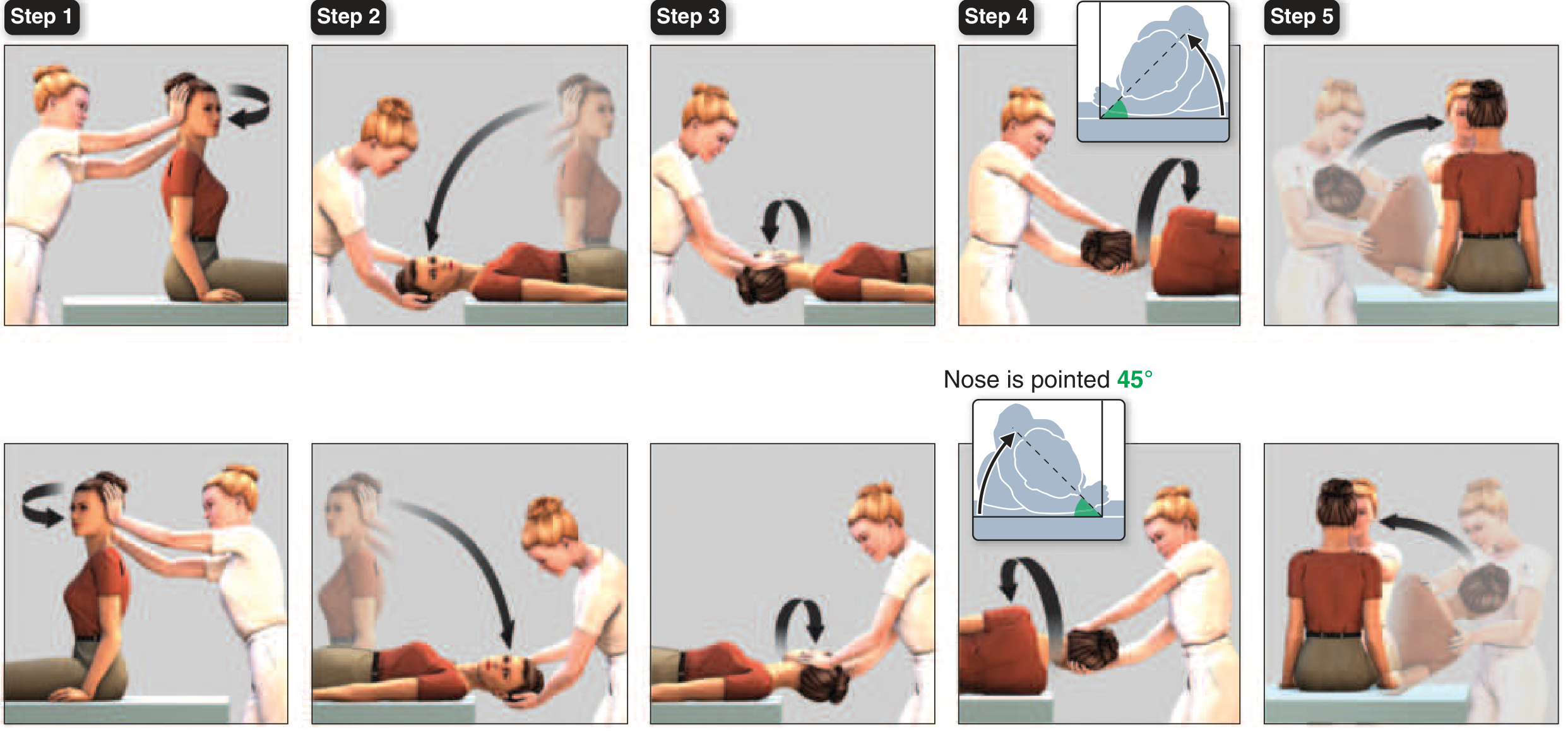
- Seated, head 45° to right. Quickly lie back, head hanging 30° below horizontal. Hold 30 sec.
- Turn head 90° to left (now 45° to left side). Hold 30 sec.
- Turn body and head 90° further left (face down 45°). Hold 30 sec.
- Sit up on the left side.
- Repeat to confirm resolution.
6.2 Vestibular Neuritis
- Vestibular suppressants for severe nausea/vomiting:
- Prochlorperazine (Stemetil) 5–10 mg IM/IV/oral
- Meclizine (antihistamine) 25–50 mg TDS
- Dimenhydrinate (Dramamine)
- Ondansetron for refractory vomiting
- Limit to first 3–5 days only — prolonged use impairs central compensation and recovery
- Evidence for benefit in short-term VOR recovery but not significantly in long-term functional outcomes
- Leong et al., Otolaryngol Head Neck Surg 2021 (PMID 33525978) — systematic review + meta-analysis: steroids improve caloric testing recovery but evidence for clinical benefit is mixed
- Oliveira et al., Acad Emerg Med 2023 (PMID 35975654) — GRACE systematic review: no definitive evidence steroids improve patient-reported outcomes; decision should be individualized
- Prednisolone 60–100 mg/day for 3 days, tapered over 3 weeks, if given
- Antivirals (acyclovir): no proven benefit unless Ramsay Hunt syndrome (vesicles in EAC, facial palsy, CN VIII dysfunction from VZV)
- Gaze stabilization exercises, balance training, habituation exercises
- Hidayati et al., Medicina 2022 (PMID 36143898) — systematic review + meta-analysis: vestibular rehabilitation + steroids superior to either alone for compensation
- Encourage early mobilization — immobility delays central compensation
6.3 Ménière's Disease
- Low-sodium diet (<1500 mg/day) — reduces endolymph volume fluctuations
- Diuretics: hydrochlorothiazide 25 mg + triamterene 37.5 mg (or acetazolamide) — no robust RCT evidence but widely used
- Avoid caffeine, alcohol, tobacco, stress
- Increases cochlear blood flow, reduces endolymphatic hydrops
- Widely used in Europe and Asia; not approved in the US
- BEMED trial (large European RCT) showed no superiority over placebo for attack frequency — evidence mixed; most guidelines still include it as an option
- For refractory cases; preserves hearing; can be repeated
- First-line in patients wishing to preserve hearing
- Ablative; selectively destroys vestibular hair cells while sparing cochlear function (relatively)
- Very effective for controlling vertigo attacks (>90%) but carries risk of hearing loss
- Used when hearing is already severely compromised
- Endolymphatic sac decompression/shunting: non-ablative; modest evidence
- Vestibular nerve section: ablative, preserves hearing; highly effective but major surgery
- Labyrinthectomy: removes labyrinth entirely; only if hearing already lost; definitive
6.4 Posterior Circulation Stroke — Emergency Management
- Immediate CT brain to exclude hemorrhage
- IV thrombolysis (tPA) within 4.5 hours if ischemic and eligible
- Endovascular thrombectomy for large vessel occlusion within 24 hours
- Admit to stroke unit; dual antiplatelet (aspirin + clopidogrel) for non-cardioembolic TIA/minor stroke for 21 days, then single agent
- Statin therapy; control vascular risk factors
- Cerebellar hemorrhage >3 cm or with brainstem compression: emergency suboccipital craniectomy
6.5 Vestibular Migraine
- Triptans (sumatriptan), antiemetics (prochlorperazine), NSAIDs during attacks
- Benzodiazepines for severe brief attacks
- Tricyclic antidepressants (amitriptyline 10–50 mg), topiramate, propranolol, valproate, venlafaxine
- Lifestyle: trigger avoidance (sleep, stress, dietary triggers), regular exercise
6.6 PPPD — Persistent Postural-Perceptual Dizziness
- Sertraline, escitalopram, venlafaxine — Cochrane review (Webster et al., PMID 36906836) confirms SSRI/SNRI benefit
- Response typically takes 4–8 weeks
- Highly effective — Cochrane review (Webster et al., PMID 36912784): VRT significantly reduces dizziness handicap
- Includes habituation, gaze stabilization, balance retraining, and gradual exposure to provocative environments
- Zang et al. meta-analysis (Braz J Otorhinolaryngol 2024, PMID 38350404): CBT + VRT superior to VRT alone
- Addresses fear-avoidance behaviors and hypervigilance to balance signals
6.7 Orthostatic Hypotension / Presyncope
- Non-pharmacological: increase fluid and salt intake, compression stockings, physical counter-maneuvers (leg crossing, squatting), slow rising
- Treat underlying cause (medication review, treat cardiac arrhythmia)
- Pharmacological: fludrocortisone 0.1–0.3 mg/day; midodrine 2.5–10 mg TDS; pyridostigmine; droxidopa (neurogenic OH)
7. Drug Summary for Symptomatic Vertigo Relief
| Drug class | Example | Mechanism | Use |
|---|---|---|---|
| Antihistamines | Meclizine, cinnarizine, dimenhydrinate | H₁ block → reduces vestibular input | Short-term acute vertigo |
| Anticholinergics | Scopolamine patch | Muscarinic block → reduces vestibular input | Motion sickness, acute vertigo |
| Phenothiazines | Prochlorperazine | D₂ block + antiemetic | Acute vomiting with vertigo |
| Benzodiazepines | Diazepam, lorazepam | GABA-A potentiation → vestibular sedation | Short-term severe acute vertigo |
| Betahistine | Betahistine 16–24 mg TDS | H₁ agonist / H₃ antagonist | Ménière's prophylaxis |
| Corticosteroids | Prednisolone | Anti-inflammatory | Vestibular neuritis (controversial) |
| Diuretics | HCTZ + triamterene | Reduce endolymph | Ménière's management |
| SSRIs/SNRIs | Sertraline, venlafaxine | Reduce cortical vestibular hypervigilance | PPPD |
| 4-Aminopyridine | Dalfampridine | K⁺ channel blocker → improves cerebellar firing | Downbeat nystagmus, episodic ataxia type 2 |
8. Red Flag Symptoms — "Dangerous Dizziness"
- Sudden severe headache ("worst of life") — cerebellar hemorrhage, SAH
- Inability to walk or stand — cerebellar infarct or hemorrhage
- Diplopia, dysarthria, dysphagia, facial numbness — posterior fossa stroke
- New headache in elderly with neck pain — vertebral artery dissection
- Acute unilateral hearing loss + vertigo — AICA infarct (not just neuritis)
- First episode of vertigo in patient >60 with vascular risk factors — TIA until proven otherwise
- Normal head impulse test in a patient with constant vertigo — central cause
Key Textbook Sources
- Harrison's Principles of Internal Medicine, 22nd Ed. (2025) — Chapter 24 (Dizziness and Vertigo)
- Adams and Victor's Principles of Neurology, 12th Ed. — Dizziness and Vertigo chapter
- Rosen's Emergency Medicine — Chapter 15 (Dizziness and Vertigo, Table 15.2 & 15.3)
- Neuroanatomy through Clinical Cases, 3rd Ed. — Chapter 12.6
- Localization in Clinical Neurology, 8th Ed. — Systemic causes of vertigo
Key Articles
| PMID | Study | Finding |
|---|---|---|
| 41045791 | Xu et al., Am J Emerg Med 2026 | HINTS family meta-analysis — high sensitivity for stroke in AVS |
| 41665728 | Anburajan et al., J Neurol 2026 | HINTS+ improves AICA stroke diagnosis |
| 38900988 | Valsted et al., Am J Audiol 2024 | Epley maneuver most effective among 4 BPPV repositioning maneuvers |
| 40098079 | Si et al., BMC Neurol 2025 | Network meta-analysis confirms Epley maneuver as first choice for posterior canal BPPV |
| 33525978 | Leong et al., Otolaryngol HNS 2021 | Steroids improve VOR recovery in vestibular neuritis but clinical benefit mixed |
| 35975654 | Oliveira et al., Acad Emerg Med 2023 | GRACE review: no definitive evidence for steroids in vestibular neuritis |
| 36143898 | Hidayati et al., Medicina 2022 | VRT + steroids superior to either alone in vestibular neuritis |
| 36912784 | Webster et al., Cochrane 2023 | VRT significantly reduces dizziness handicap in PPPD |
| 36906836 | Webster et al., Cochrane 2023 | SSRIs/SNRIs effective pharmacological treatment for PPPD |
| 38350404 | Zang et al., BJORL 2024 | CBT + VRT superior to VRT alone in PPPD |
| 40210232 | Hudson et al., Otol Neurotol 2025 | 15–40% bilateral progression in Ménière's over 10–20 years |
| 41147266 | Moreno-Ajona, Headache 2026 | PPPD vs vestibular migraine — narrative review of differentiation |
Summary of What Was Covered
1. Definitions Distinguished
2. Peripheral vs Central (Full Comparison Table)
3. Pathophysiology
4. Examination (10 Tests)
5. Treatment
Please provide answer
- A follow-up on the previous topics (nystagmus, VOR, vertigo)?
- A new medical topic?
- A specific disease, mechanism, or clinical scenario?
Different between giddiness, dizziness and vertigo , peripheral vs central vertigo , Patho physiology, test and treatment, explain all this in detail using standard article and textbook
- Definitions — Giddiness vs Dizziness vs Vertigo (with the 4-subtype classification from Adams & Victor)
- Peripheral vs Central Vertigo — full 12-feature comparison table from Harrison's, Rosen's, and Neuroanatomy through Clinical Cases
- Pathophysiology — BPPV (canalithiasis), Vestibular Neuritis (HSV-1 deafferentation), Ménière's (endolymphatic hydrops + K⁺ toxicity), Posterior Circulation Stroke (PICA/Wallenberg, AICA), Vestibular Migraine, PPPD, and more
- Examination — 10 clinical tests with full technique and interpretation: Dix-Hallpike, Head Impulse Test, HINTS exam (with 2026 meta-analysis evidence), Romberg, Fukuda, caloric testing, audiometry, and neuroimaging
- Treatment — Epley maneuver (with diagram), vestibular neuritis management (3 systematic reviews on steroids + VRT), Ménière's stepwise treatment, PPPD (Cochrane-level evidence for SSRIs + CBT + VRT), posterior fossa stroke emergency management, and a complete drug summary table
Can please provide it again
Giddiness, Dizziness, and Vertigo: A Complete Clinical Review
PART 1 — DEFINITIONS AND DISTINCTIONS
"The term dizziness is applied by the patient to a number of different sensory and psychic experiences — a feeling of rotation or whirling as well as non-rotatory swaying, weakness, faintness, light-headedness, or unsteadiness… These experiences fall into four categories: (1) vertigo; (2) near syncope; (3) disequilibrium; and (4) ill-defined light-headedness, or 'giddiness.'" — Adams and Victor's Principles of Neurology, 12th Ed.
1.1 Vertigo
- Implies an acute asymmetry of vestibular inputs from the two labyrinths or their central pathways
- Most specific form of dizziness for vestibular disease
- Accompanied by nausea, vomiting, tendency to fall
- Worsened by head movement and (in peripheral causes) by eye opening
- Can be peripheral (labyrinth / vestibular nerve) or central (brainstem / cerebellum)
"Vertigo — an illusion of self or environmental motion — implies an acute asymmetry of vestibular inputs from the two labyrinths or in their central pathways." — Harrison's Principles of Internal Medicine, 22nd Ed. (2025)
1.2 Dizziness (Non-Vertiginous Subtypes)
| Subtype | Core Sensation | Primary Mechanism |
|---|---|---|
| Presyncope / near-syncope | Faintness, blackout feeling, about to faint | Brain hypoperfusion — cardiac arrhythmia, orthostatic hypotension, vasovagal, aortic stenosis |
| Disequilibrium | Off-balance, unsteadiness when walking (no spinning), better when sitting | Balance system failure — multisensory deficits, cerebellar ataxia, proprioceptive loss, parkinsonism |
| Non-specific light-headedness | Floating, swimming, fuzzy, unreal | Anxiety, hyperventilation, hypoglycaemia, anaemia, medications |
1.3 Giddiness
- Not a rotational vertigo
- Not presyncope
- Fuzzy, floating, unreal sensation
- Mechanism: hyperventilation → ↓PaCO₂ → cerebral vasoconstriction → light-headedness + perioral/digital paraesthesiae
- Associated: anxiety disorders, panic attacks, somatoform disorders
- Diagnosis of exclusion after organic causes are ruled out
"Ill-defined light-headedness, or 'giddiness,' a symptom that often accompanies anxiety." — Adams and Victor's Principles of Neurology, 12th Ed.
1.4 Bedside Differentiation: Key History Questions
| Question | Vertigo | Presyncope | Disequilibrium | Giddiness |
|---|---|---|---|---|
| "Is the room spinning?" | YES | No | No | No |
| "Feel like you'll faint/black out?" | No | YES | No | Sometimes |
| "Only when walking, better sitting?" | No | Sometimes | YES | No |
| Positional head-change trigger | YES (BPPV) | No | No | No |
| Duration | Seconds (BPPV) / Hours (Ménière) / Days (neuritis) | Seconds | Chronic | Variable |
| Nausea | Prominent | Mild | Absent | Absent |
| Orthostatic BP drop | No | Yes | No | No |
PART 2 — PHYSIOLOGY OF BALANCE
- Vestibular system — semicircular canals (angular acceleration), otoliths/maculae (linear acceleration + gravity). Dominant for rapid head signals.
- Visual system — retinal slip, optic flow, horizon reference
- Somatosensory/Proprioceptive system — joint position sensors, muscle spindles, plantar mechanoreceptors, cervical spine afferents
"Any disease that disrupts these neural mechanisms may give rise to vertigo and disequilibrium. The interdependence of the two schemata (self and environment) is ascribed to the fact that the various sense organs are usually activated simultaneously by any body movement." — Adams and Victor's Principles of Neurology, 12th Ed.
PART 3 — PERIPHERAL vs. CENTRAL VERTIGO
3.1 Full Comparison Table
| Feature | Peripheral | Central |
|---|---|---|
| Site of lesion | Labyrinth, vestibular nerve (CN VIII) | Brainstem, cerebellum, vestibular cortex |
| Onset | Sudden | Gradual or sudden |
| Severity of vertigo | Often severe initially | Usually mild–moderate (but can be severe in stroke/haemorrhage) |
| Duration | Seconds (BPPV); hours (Ménière); days (neuritis) | Weeks–months continuous; seconds–minutes (TIA) |
| Nystagmus direction | Unidirectional, horizontal ± torsional | Direction-changing on lateral gaze; purely vertical; purely torsional |
| Fixation effect on nystagmus | Suppressed by visual fixation | Not suppressed (may worsen) — use Frenzel lenses |
| Head Impulse Test (HIT) | Positive (catch-up saccade toward lesion) | Negative (normal VOR — alarming central sign) |
| Skew deviation | Absent | May be present — vertical ocular misalignment on cover test |
| Hearing loss / tinnitus | Common (labyrinthitis, Ménière's) | Rare (unless AICA territory stroke) |
| Associated neurological signs | Absent | Diplopia, dysarthria, dysphagia, facial numbness, Horner syndrome, hemiplegia, limb ataxia |
| Postural instability | Can stand (uncomfortable) | May be unable to stand at all (cerebellar lesion) |
| Alexander's law | Follows it | Often does not follow |
| Examples | BPPV, vestibular neuritis, Ménière's, labyrinthitis | Posterior fossa stroke/haemorrhage, MS (INO), cerebellar degeneration, Wallenberg syndrome, tumour |
3.2 Critical Pearls for Peripheral vs Central
- Pure vertical nystagmus → always central
- Direction-changing nystagmus with change of gaze → always central
- Normal head impulse test in acute constant vertigo → red flag for posterior fossa stroke
- Inability to stand unaided → suggests central cause
- Neurological deficits + vertigo → treat as posterior fossa emergency
- "Acute dizziness with normal head impulse testing may indicate cerebellar ischemia rather than vestibular neuritis." — Cummings Otolaryngology HNS
PART 4 — PATHOPHYSIOLOGY IN MAJOR CONDITIONS
4.1 Benign Paroxysmal Positional Vertigo (BPPV)
- Otoconia (CaCO₃ crystals) detach from utricular macula (due to head trauma, aging, osteoporosis, viral infection, or idiopathic)
- Migrate into a semicircular canal — posterior canal ~90%, horizontal canal ~8%, anterior canal rare
- Head repositioning → gravity moves the free-floating canalith plug → hydrodynamic pressure on cupula → anomalous vestibular signal → VOR mismatch → brief intense vertigo + nystagmus
- Cupulolithiasis variant: debris adheres to cupula → making it gravity-sensitive; no latency, longer duration, less fatigable
- Posterior canal → upbeat + torsional (upper poles beating toward the down-ear)
- Horizontal canal → horizontal geotropic (canalithiasis) or apogeotropic (cupulolithiasis)
4.2 Vestibular Neuritis (Acute Unilateral Vestibulopathy)
- Presumed HSV-1 reactivation in vestibular ganglia → inflammation/demyelination of the superior division of the vestibular nerve
- Sudden complete/partial unilateral vestibular deafferentation
- Intact side fires at ~90 spikes/sec; affected side fires less → brain interprets this as continuous head rotation away from the lesion
- Spontaneous horizontal-torsional nystagmus (fast phase toward intact side), severe vertigo, nausea, oscillopsia
- No cochlear involvement = no hearing loss (key differentiator from labyrinthitis)
- Recovery: central vestibular compensation over days–weeks via brainstem/cerebellar plasticity; nystagmus resolves even without peripheral recovery
4.3 Labyrinthitis
4.4 Ménière's Disease (Endolymphatic Hydrops)
- Excess endolymph → distension of the membranous labyrinth (endolymphatic hydrops)
- Periodic ruptures of Reissner's membrane → K⁺-rich endolymph enters perilymph space → K⁺ intoxication of hair cells and CN VIII afferents
- Irritative phase: burst of excitation → nystagmus toward affected ear
- Paretic phase: inhibitory block → nystagmus away from affected ear
- Attack self-terminates as K⁺ is reabsorbed and Reissner's membrane re-heals
- ≥2 spontaneous vertigo episodes, each lasting 20 min–12 hours
- Audiometrically documented low-to-mid frequency SNHL in affected ear (at least once)
- Fluctuating aural symptoms (hearing loss, tinnitus, or fullness) in affected ear
- Not better explained by another vestibular diagnosis
4.5 Vestibular Migraine
4.6 Posterior Circulation Stroke / TIA
- Vestibular nuclei + inferior cerebellar peduncle involved
- Features: severe vertigo, vomiting, dysphagia, hoarseness (CN IX, X), ipsilateral facial pain/temperature loss (CN V), contralateral body pain/temperature loss, ipsilateral Horner syndrome, ipsilateral limb ataxia
- Nystagmus: horizontal-torsional + skew deviation + ocular tilt reaction
- HIT: often negative (central pattern — no catch-up saccade)
- Labyrinthine artery arises from AICA → sudden unilateral end-organ failure + ipsilateral hearing loss
- "Central mimic" of vestibular neuritis — acute hearing loss + positive HIT (peripheral pattern but central cause)
- HINTS+ (adding hearing loss) specifically improves AICA stroke detection
- Sudden severe vertigo + severe headache + inability to stand
- Ipsilateral CN VI palsy (brainstem compression by expanding hematoma)
- Neurosurgical emergency — can cause tonsillar herniation
- Episodic vertigo lasting minutes + other posterior fossa symptoms (diplopia, dysarthria, dysphagia)
- Risk factors: age >60, hypertension, atherosclerosis, diabetes
4.7 Persistent Postural-Perceptual Dizziness (PPPD)
4.8 Perilymph Fistula
PART 5 — CLINICAL EXAMINATION
5.1 Approach (Three Core Questions)
- Is it dangerous? → arrhythmia? stroke? cerebellar haemorrhage?
- Is it vestibular? → spinning (vertigo) vs fainting vs imbalance
- If vestibular — peripheral or central?
5.2 Orthostatic Blood Pressure
- Measure supine → standing at 1 and 3 minutes
- Normal: systolic drops ≤10 mmHg, pulse rises ≤10 bpm
- Orthostatic hypotension: systolic drop >20 mmHg or diastolic >10 mmHg → presyncope mechanism confirmed
5.3 Otoscopy
- Perforated/scarred TM → perilymph fistula
- Cholesteatoma, fluid → labyrinthitis source
- Vesicles in EAC (herpes zoster) → Ramsay Hunt syndrome (VZV)
5.4 Dix-Hallpike Test (Gold Standard for BPPV)
- Patient sits upright; head turned 45° toward the ear being tested
- Rapidly lower patient to supine with head extended 20–30° below horizontal (over table edge)
- Patient keeps eyes open; examiner observes nystagmus and asks about vertigo
- Hold 30–60 seconds; return to seated; repeat other side
| Feature | Peripheral (BPPV) | Central |
|---|---|---|
| Latency to nystagmus | 2–5 seconds | Immediate or none |
| Nystagmus direction | Upbeat + torsional (toward down-ear) | Any; pure vertical is always central |
| Duration | <30 seconds | Prolonged / persistent |
| Fatigability with repetition | Yes (habituates) | No |
| Vertigo accompanying nystagmus | Always present | Nystagmus can occur without vertigo |
5.5 Head Impulse Test (Halmagyi-Curthoys)
- Positive (catch-up saccade after impulse): VOR gain reduced → peripheral vestibular lesion on that side → reassuring in acute vertigo
- Negative (eyes remain locked on target): VOR intact → in patient with acute constant vertigo → central cause must be excluded
5.6 HINTS Exam
| Component | Peripheral (Safe) | Central (Dangerous — stroke) |
|---|---|---|
| H — Head Impulse Test | Positive (catch-up saccade) | Negative (normal VOR) |
| N — Nystagmus type | Unidirectional horizontal ± torsional | Direction-changing with gaze |
| T — Test of Skew (cover-uncover) | No skew deviation | Vertical skew (hypertropia) present |
- Xu et al., Am J Emerg Med 2026 (PMID 41045791) — HINTS family meta-analysis: high sensitivity/specificity for stroke in AVS
- Anburajan et al., J Neurol 2026 (PMID 41665728) — HINTS+ systematic review: acute hearing loss component critical for AICA infarct detection
5.7 Romberg Test
- Patient stands feet together, arms at sides
- Test 1: eyes open; Test 2: eyes closed
- Positive Romberg: can stand eyes open but sways/falls eyes closed → vestibular or proprioceptive dysfunction (visual compensation present when eyes open)
- Cannot stand even with eyes open → cerebellar lesion or severe bilateral vestibular failure
- Falls toward the side of the lesion in peripheral vestibular disease
5.8 Fukuda (Unterberger) Stepping Test
- Patient marches in place 60 steps with eyes closed, arms extended
- Normal: moves <0.5 m, rotates <30°
- Unilateral vestibular hypofunction: rotates/deviates toward side of lesion
- Low sensitivity but useful as adjunct
5.9 Head-Shaking Nystagmus Test
- Frenzel lenses applied; examiner shakes head horizontally at 2 Hz for 20 cycles; observe on stopping
- Normal: no post-shaking nystagmus
- Unilateral vestibular hypofunction: post-shaking nystagmus beating toward intact side (velocity storage asymmetry)
- Tests VOR at 1–2 Hz (complementary to HIT and caloric testing)
5.10 Caloric Testing (Bithermal)
- Head tilted back 30° (supine) to align horizontal canal vertically
- Warm (44°C) → convection mimics ampullopetal flow → nystagmus same side (WARM = SAME)
- Cold (30°C) → convection mimics ampullofugal flow → nystagmus opposite side (COLD = OPPOSITE)
- COWS mnemonic: Cold-Opposite, Warm-Same
- Canal paresis (CP): [(RC+RW) − (LC+LW)] / (RC+RW+LC+LW) × 100%; CP >25% = unilateral hypofunction
- Tests each horizontal SCC independently at very low frequency (~0.003 Hz)
5.11 Audiometry (PTA + Tympanometry)
- Fluctuating low-to-mid frequency SNHL (250–1000 Hz) → Ménière's disease
- Sudden unilateral SNHL → labyrinthitis or AICA stroke
- Conductive hearing loss → otitis media, cholesteatoma
- Type B flat tympanogram → effusion
- MRI IAM with gadolinium → if vestibular schwannoma suspected (progressive unilateral SNHL without vertigo)
5.12 Neuroimaging
- MRI brain with DWI/FLAIR (posterior fossa sequences): mandatory if central cause suspected
- Critical caveat: MRI DWI sensitivity for posterior fossa infarct is only ~50% in the first 24–48 hours — HINTS by trained examiner outperforms early MRI DWI in this window
- Urgent CT head: if cerebellar haemorrhage suspected (sudden severe headache + vertigo + unable to stand)
PART 6 — TREATMENT
6.1 BPPV — Repositioning Maneuvers
- Seated, head turned 45° right → rapidly recline to head-hanging 30° below horizontal; hold 30 sec
- Turn head 90° to left (now 45° left); hold 30 sec
- Roll body onto left side, turn head additional 90° (nose pointing down 45°); hold 30 sec
- Sit up on left side; repeat to confirm resolution
- Semont liberatory maneuver: rapid 270° lateral body rotation; comparable efficacy to Epley
- BBQ Roll (Lempert/360° maneuver): for horizontal canal BPPV
- Gufoni maneuver: for apogeotropic horizontal canal BPPV
- Brandt-Daroff exercises: self-administered habituation; useful for mild/recurrent BPPV
- Valsted et al., Am J Audiol 2024 (PMID 38900988) — systematic review of 4 repositioning maneuvers: Epley maneuver most effective; all 4 superior to sham
- Si et al., BMC Neurol 2025 (PMID 40098079) — network meta-analysis: confirms Epley as first choice
6.2 Vestibular Neuritis
- Vestibular suppressants (limit to first 3–5 days only):
- Prochlorperazine 5–10 mg IM/IV/oral (dopamine antagonist + antiemetic)
- Meclizine 25–50 mg TDS (H₁ antihistamine)
- Dimenhydrinate (Dramamine)
- Ondansetron for refractory vomiting
- Prolonged use impairs central compensation — must stop after Day 3–5
- Prednisolone 60–100 mg/day for 3 days, tapered over 3 weeks
- Three key systematic reviews:
- Leong et al., Otolaryngol HNS 2021 (PMID 33525978): improves caloric testing recovery but clinical benefit mixed
- Oliveira et al., Acad Emerg Med 2023 (PMID 35975654) — GRACE review: no definitive evidence for improved patient-reported outcomes; decision should be individualised
- Hidayati et al., Medicina 2022 (PMID 36143898): VRT + steroids together superior to either alone
- Gaze stabilisation exercises (head movements while fixating)
- Balance retraining
- Habituation exercises
- Encourage early mobilisation — immobility delays central compensation
6.3 Ménière's Disease
- Low-sodium diet (<1500 mg/day) — reduces endolymph volume fluctuations
- Diuretics: hydrochlorothiazide 25 mg + triamterene 37.5 mg (or acetazolamide)
- Avoid caffeine, alcohol, tobacco, stress
- Betahistine 16–24 mg TDS (H₁ agonist/H₃ antagonist) — increases cochlear blood flow; widely used in Europe/Asia; evidence mixed (BEMED trial showed no superiority over placebo for attack frequency)
- For refractory cases; preserves hearing; can be repeated
- Preferred in patients wishing to preserve hearing
- Selectively destroys vestibular hair cells while relatively sparing cochlear function
- Very effective for vertigo control (>90%) but carries risk of hearing loss
- Used when hearing is already severely compromised
- Endolymphatic sac decompression/shunting: non-ablative; modest evidence
- Vestibular nerve section: ablative, preserves hearing; highly effective
- Labyrinthectomy: removes labyrinth entirely; only if hearing already lost; definitive
6.4 Posterior Circulation Stroke — Emergency
- Immediate CT brain: exclude haemorrhage
- If ischaemic and eligible: IV alteplase (tPA) within 4.5 hours
- Endovascular thrombectomy for large vessel occlusion within 24 hours
- Admit to stroke unit; aspirin 300 mg loading immediately
- Dual antiplatelet (aspirin + clopidogrel) for 21 days after non-cardioembolic minor stroke/TIA
- Statin therapy; aggressive vascular risk factor control
- Cerebellar haemorrhage >3 cm or with brainstem compression: emergency suboccipital craniectomy
6.5 Vestibular Migraine
- Triptans (sumatriptan 50–100 mg oral), antiemetics (prochlorperazine), NSAIDs
- Benzodiazepines for severe brief attacks
- Amitriptyline 10–50 mg, topiramate, propranolol, valproate, venlafaxine
- Lifestyle: trigger avoidance (sleep hygiene, dietary triggers, stress management)
6.6 PPPD
- Sertraline, escitalopram, venlafaxine
- Cochrane systematic review (Webster et al., PMID 36906836): confirms SSRIs/SNRIs benefit
- Response takes 4–8 weeks
- Cochrane systematic review (Webster et al., PMID 36912784): VRT significantly reduces dizziness handicap
- Habituation, gaze stabilisation, balance retraining, gradual exposure to provocative environments
- Zang et al. meta-analysis (PMID 38350404): CBT + VRT superior to VRT alone
- Addresses fear-avoidance, hypervigilance to balance signals, catastrophising
6.7 Orthostatic Hypotension / Presyncope
- Increase fluid and salt intake; compression stockings
- Counter-manoeuvres (leg crossing, squatting, tensing leg muscles before standing)
- Slow position changes; raise head of bed
- Review medications (antihypertensives, diuretics)
- Pharmacological: fludrocortisone 0.1–0.3 mg/day (mineralocorticoid); midodrine 2.5–10 mg TDS (α₁ agonist); pyridostigmine; droxidopa (neurogenic OH)
PART 7 — DRUG SUMMARY TABLE
| Drug Class | Example | Mechanism | Indication |
|---|---|---|---|
| Antihistamines | Meclizine, cinnarizine, dimenhydrinate | H₁ block → reduces vestibular input to brainstem | Short-term acute vertigo, motion sickness |
| Anticholinergics | Scopolamine patch | Muscarinic block → reduces vestibular input | Motion sickness prevention |
| Phenothiazines | Prochlorperazine | D₂ block + antiemetic | Acute vomiting with vertigo |
| Benzodiazepines | Diazepam, lorazepam | GABA-A potentiation → vestibular sedation | Severe acute vertigo (short-term only) |
| Betahistine | Betahistine 16–24 mg TDS | H₁ agonist / H₃ antagonist → increases cochlear blood flow | Ménière's prophylaxis |
| Corticosteroids | Prednisolone 60 mg tapered | Anti-inflammatory | Vestibular neuritis (controversial) |
| Diuretics | HCTZ + triamterene | Reduce endolymph volume | Ménière's management |
| SSRIs/SNRIs | Sertraline, venlafaxine | ↓ cortical vestibular hypervigilance | PPPD first-line |
| Triptans | Sumatriptan | 5-HT₁B/₁D agonist → craniovascular vasoconstriction | Vestibular migraine acute |
| 4-Aminopyridine | Dalfampridine | K⁺ channel blocker → improves cerebellar Purkinje cell firing | Downbeat nystagmus, episodic ataxia type 2 |
PART 8 — RED FLAGS ("DANGEROUS DIZZINESS")
| Red Flag | Likely Cause |
|---|---|
| Sudden severe headache ("worst of life") | Cerebellar haemorrhage, subarachnoid haemorrhage |
| Cannot stand unaided | Cerebellar infarct or haemorrhage |
| Diplopia, dysarthria, dysphagia, facial numbness | Posterior fossa stroke (Wallenberg) |
| Ipsilateral facial palsy + vesicles in EAC | Ramsay Hunt syndrome (VZV) |
| Acute unilateral hearing loss + vertigo | AICA infarct (NOT just vestibular neuritis) |
| Normal head impulse test in acute constant vertigo | Central cause until proven otherwise |
| First episode in elderly + multiple vascular risk factors | Vertebrobasilar TIA |
| Progressive unilateral SNHL + no vertigo | Vestibular schwannoma |
KEY TEXTBOOK SOURCES
| Textbook | Sections Used |
|---|---|
| Harrison's Principles of Internal Medicine, 22nd Ed. (2025) | Chapter 24: Dizziness and Vertigo |
| Adams and Victor's Principles of Neurology, 12th Ed. | Dizziness and Vertigo chapter |
| Rosen's Emergency Medicine | Chapter 15, Tables 15.2 & 15.3 |
| Neuroanatomy through Clinical Cases, 3rd Ed. | Chapter 12.6 |
| Localization in Clinical Neurology, 8th Ed. | Systemic causes of vertigo |
| Cummings Otolaryngology HNS | Vestibular physiology and management |
KEY ARTICLES
| PMID | Authors | Journal/Year | Key Finding |
|---|---|---|---|
| 41045791 | Xu et al. | Am J Emerg Med 2026 | HINTS family meta-analysis — high sensitivity for stroke in AVS |
| 41665728 | Anburajan et al. | J Neurol 2026 | HINTS+ systematic review — hearing loss improves AICA detection |
| 38900988 | Valsted et al. | Am J Audiol 2024 | Epley most effective among 4 BPPV maneuvers (systematic review) |
| 40098079 | Si et al. | BMC Neurol 2025 | Network meta-analysis confirms Epley as first-choice for posterior canal BPPV |
| 33525978 | Leong et al. | Otolaryngol HNS 2021 | Steroids improve VOR recovery in vestibular neuritis (meta-analysis) |
| 35975654 | Oliveira et al. | Acad Emerg Med 2023 | GRACE review: no definitive evidence for steroids improving patient outcomes |
| 36143898 | Hidayati et al. | Medicina 2022 | VRT + steroids superior to either alone in vestibular neuritis (meta-analysis) |
| 36912784 | Webster et al. | Cochrane 2023 | Non-pharmacological (VRT) significantly reduces PPPD dizziness handicap |
| 36906836 | Webster et al. | Cochrane 2023 | SSRIs/SNRIs effective pharmacological treatment for PPPD |
| 38350404 | Zang et al. | BJORL 2024 | CBT + VRT superior to VRT alone in PPPD (meta-analysis) |
| 40210232 | Hudson et al. | Otol Neurotol 2025 | 15–40% bilateral progression in Ménière's over 10–20 years |
| 41147266 | Moreno-Ajona | Headache 2026 | PPPD vs vestibular migraine differentiation — narrative review |