
Explain about the anatomy physiology and thr functions of the ear in detail for a medical exam but explain like i am 5 year old
Reading File
Now let me search the medical library for comprehensive ear anatomy and physiology content.
Finding Sources
Finding Sources
Reading File
Reading File
Reading File
Reading File
Finding Sources
Finding Sources
Reading File
Finding Sources
Finding Sources
Reading File
Finding Sources
Reading File
Reading File
Reading File
Reading File
Reading File
Reading File
Reading File
Loading Image
Reading File
Loading Image
Reading File
Loading Image
Reading File
Reading File
I now have all the comprehensive content needed. Let me compose the full, detailed yet simple response.
The Ear: Anatomy, Physiology & Functions 👂
Medical-exam level content, explained like you're 5
The Big Picture First 🌟
Think of your ear like a telephone system. Sound from the outside world (air vibrations) has to be:
- Captured (outer ear — your antenna)
- Amplified and transmitted (middle ear — your amplifier)
- Converted into electrical signals (inner ear — your translator)
- Sent to the brain (auditory nerve — your telephone wire)
There's also a bonus system inside the inner ear for balance — like a spirit level inside your head!
PART 1: THE OUTER EAR (External Ear)
Anatomy
The outer ear has two parts:
1. The Auricle (Pinna) — "The flappy bit on the side of your head"
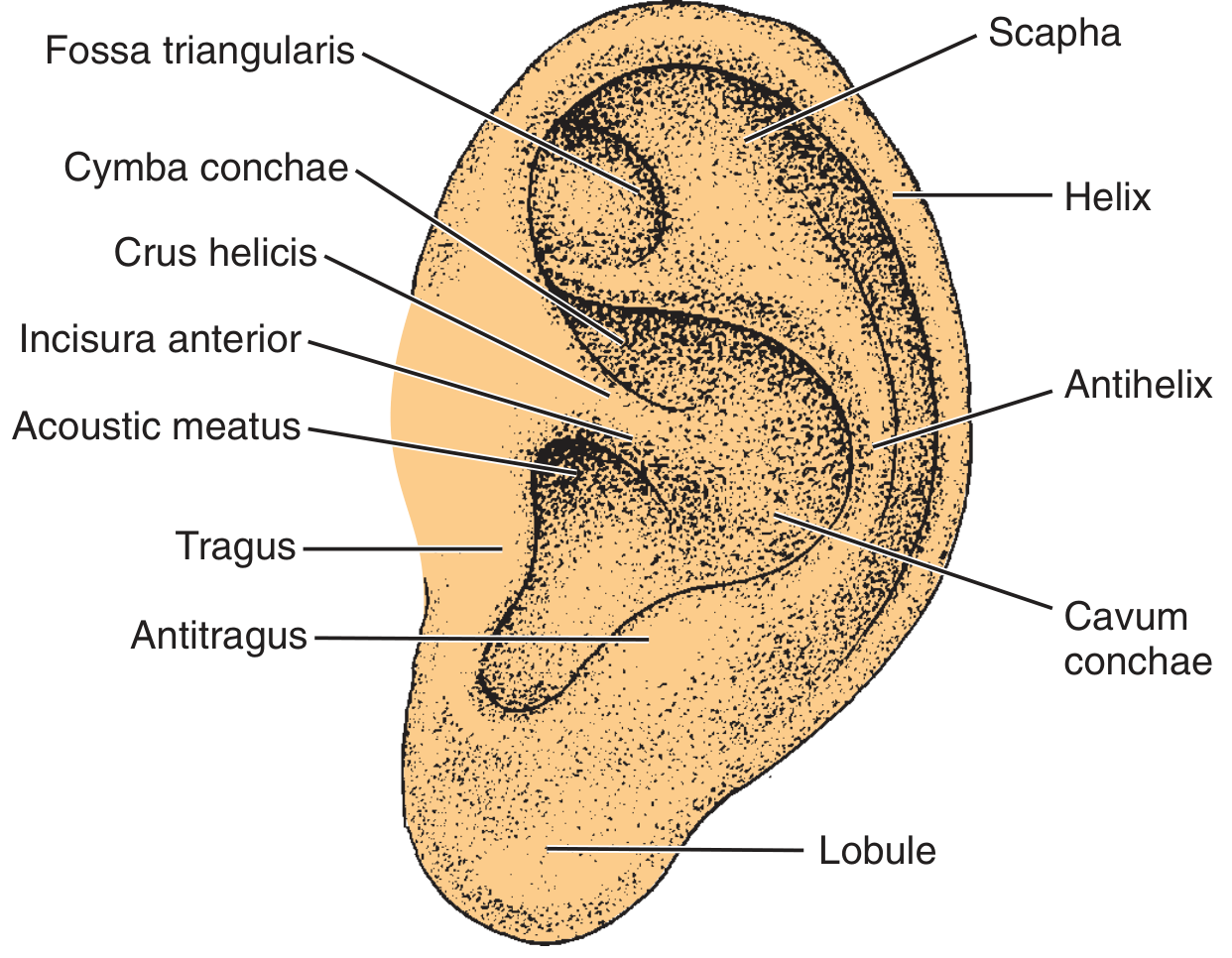
The auricle is a funnel-shaped cartilaginous structure made of elastic cartilage covered by keratinizing squamous epithelium (skin). It has no fat except in the earlobe (lobule). Key surface landmarks:
| Structure | What it is |
|---|---|
| Helix | The outer curved rim |
| Antihelix | The curved ridge inside the helix |
| Tragus | The little bump in front of the ear canal |
| Antitragus | The bump opposite the tragus |
| Lobule | The earlobe — the only fat-containing part |
| Concha | The bowl-shaped depression leading to the canal |
| Acoustic meatus | The opening of the ear canal |
Blood supply: Posterior auricular artery + superficial temporal artery (both from the external carotid artery).
Nerve supply: Auriculotemporal branch of CN V3 (trigeminal nerve) + cutaneous branch of the facial nerve (CN VII). That's why ear pain can be referred from teeth and jaw problems!
Embryology: The auricle forms from the hillocks of His — 6 tissue bumps on the 1st and 2nd branchial arches.
2. The External Auditory Canal (EAC) — "The tunnel to your eardrum"
The EAC is about 2.5 cm long in adults and runs slightly upward and forward. It has two parts:
Lateral 1/3 — Cartilaginous (membranous) portion:
- Has hair follicles, sebaceous glands, and apocrine (ceruminous) glands
- These glands make cerumen (earwax) — a hydrophobic, slightly acidic substance (pH 6.0–6.5) that protects the canal
- Has fissures of Santorini — natural gaps in cartilage that can allow infection to spread to the parotid gland
Medial 2/3 — Bony portion:
- Covered by thin skin with no glands and no hair follicles
- Continuous with the outer surface of the eardrum
Isthmus: The narrowest point where bony meets cartilaginous canal.
Foramen of Huschke: An incomplete ossification defect in the anterior bony canal — a pathway for tumor spread to the parotid gland.
Self-cleaning mechanism: Dead skin cells from the eardrum migrate outward toward the cartilaginous canal like a conveyor belt — mixing with wax and falling out. This is called epithelial migration.
Function of the Outer Ear
Think of the pinna as a satellite dish — it captures sound waves from the air and funnels them into the ear canal, directing them onto the eardrum.
- Collects and focuses sound waves
- The shape of the pinna helps with vertical sound localization (telling whether a sound comes from above or below)
- Cerumen provides antibacterial and waterproofing protection
PART 2: THE MIDDLE EAR
Overview
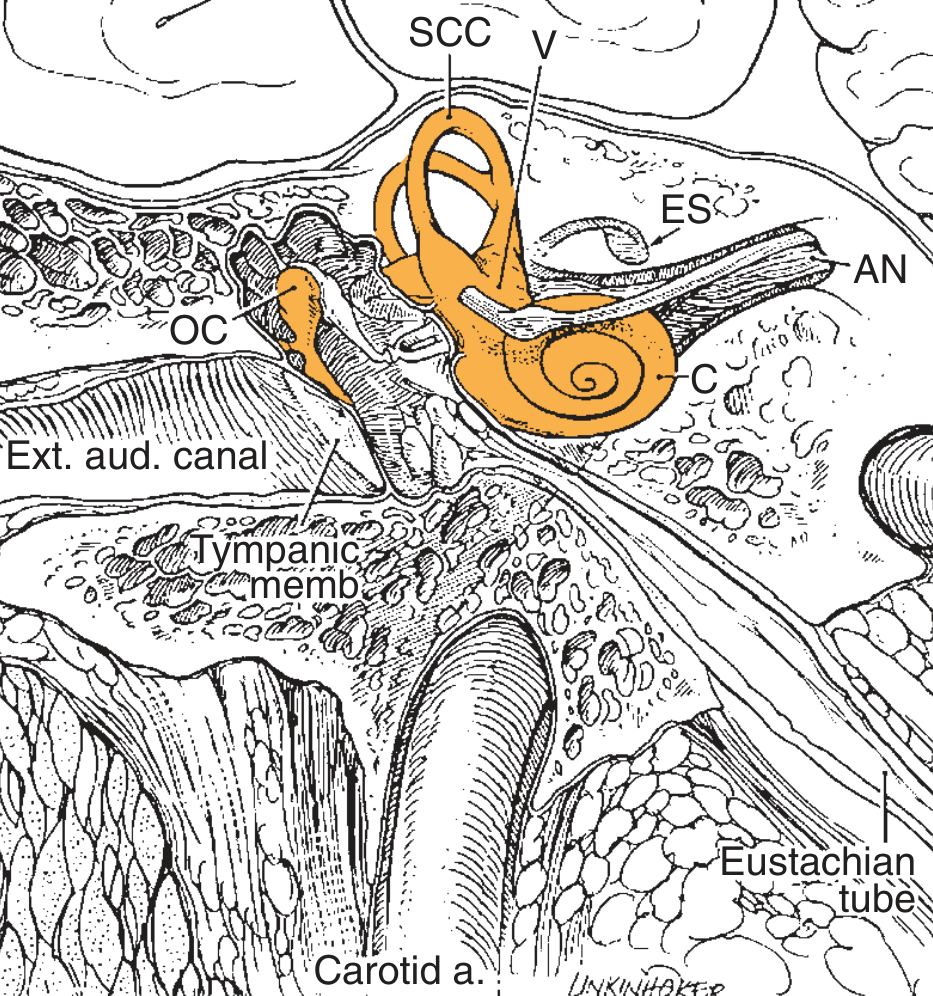
The middle ear is an air-filled space inside the temporal bone, like a tiny room between the eardrum and the inner ear. Think of it as the amplifier room.
It extends from the tympanic membrane laterally to the oval window medially.
The Tympanic Membrane (TM) — "The eardrum"
The eardrum is a four-layered, concave membrane (like a cone pointing inward):
- Outer layer: Thin skin (continuous with EAC epithelium)
- Two fibrous layers: Outer radiate fibres + inner circular fibres (these give it strength)
- Inner layer: Middle ear mucosa
Two parts of the TM:
- Pars tensa — the large, stiff lower portion with all 4 layers; vibrates well
- Pars flaccida (Shrapnell's membrane) — the small, floppy upper portion lacking fibrous layers; sits above the mallear folds — clinically important because cholesteatoma tends to start here
Key landmarks on the TM (visible on otoscopy):
- Umbo — the central dimple where the tip of the malleus attaches
- Mallear stria — vertical line going up from the umbo (the handle/manubrium of malleus)
- Lateral process of malleus — a white dot at the top of the mallear stria
- Light reflex — a triangle of light in the anterior inferior quadrant
The Ossicles — "The three tiniest bones in your whole body"
The ossicular chain is a mechanical lever system that connects the eardrum to the inner ear. Named from Latin for their shapes:
| Bone | Latin meaning | Connection |
|---|---|---|
| Malleus (hammer) | Hammer | Handle embedded in TM; head articulates with incus |
| Incus (anvil) | Anvil | Connects malleus to stapes |
| Stapes (stirrup) | Stirrup | Footplate sits in the oval window |
The most vulnerable part of the ossicular chain: The long process of the incus — it has only one nutrient vessel and no collateral blood supply, so it's the first to erode in chronic ear disease.
Two tiny muscles of the middle ear:
- Tensor tympani (innervated by CN V3 — mandibular nerve): attaches to the malleus; tenses the TM
- Stapedius (innervated by CN VII — facial nerve): attaches to the neck of the stapes; pulls it back
These muscles create the acoustic reflex (stapedius reflex) — they contract when a loud sound occurs, stiffening the ossicular chain to protect the inner ear from damage. Like automatic ear protection!
Key Spaces of the Middle Ear
The middle ear cavity is divided into regions:
- Epitympanum (attic) — above the level of the TM; contains the head of malleus and body of incus
- Mesotympanum — middle portion at the level of the TM
- Hypotympanum — below the level of the TM
Important landmarks on the medial wall of the middle ear:
- Oval window — where stapes footplate sits (leads to cochlea's scala vestibuli)
- Round window — a second membrane-covered opening (allows pressure relief when stapes pushes fluid)
- Promontory — the bulge of the basal turn of the cochlea
- Facial nerve canal — the facial nerve runs through the medial wall of the middle ear (tympanic/horizontal segment)
The Eustachian Tube — "The pressure equalizer pipe"
The Eustachian tube connects the middle ear to the nasopharynx (back of the nose/throat). It is:
- About 35 mm long in adults
- Normally closed (opens during swallowing, yawning, chewing)
- In children: shorter, wider, more horizontal → more prone to infections spreading from throat
Functions:
- Pressure equalization — balances air pressure on both sides of the eardrum (that's what happens when your ears "pop" on a plane)
- Drainage — clears secretions from the middle ear into the throat
- Protection — prevents reflux of nasopharyngeal secretions into the middle ear
The Big Physics of the Middle Ear — Impedance Matching
Here's the exam-critical concept: Air and fluid have very different resistances to sound (acoustic impedance). Without amplification, 99.9% of sound energy would be lost trying to pass from air into the fluid of the inner ear.
The middle ear solves this with two amplification tricks:
-
Area ratio: The TM is large (~55 mm²) but the oval window is tiny (~3.2 mm²). Concentrating force from a big area onto a tiny area amplifies pressure ~17×
-
Lever action of ossicles: The malleus handle is longer than the long process of the incus → lever ratio of ~1.3:1
Together these give ~25–30 dB of amplification — enough to match the impedance between air and cochlear fluid.
PART 3: THE INNER EAR (Labyrinth)
The inner ear is a fluid-filled system buried deep in the petrous part of the temporal bone. It has two functional divisions:
- Cochlea → hearing
- Vestibular labyrinth → balance
Both share the same fluid systems.
The Bony vs. Membranous Labyrinth
| Bony Labyrinth | Membranous Labyrinth | |
|---|---|---|
| What it is | Outer bony shell | Inner soft tubes inside the bony shell |
| Fluid | Perilymph (between bony and membranous walls) | Endolymph (inside the membranous labyrinth) |
| Composition | Like ECF: high Na⁺, low K⁺ | Like ICF: HIGH K⁺, low Na⁺ (unusual!) |
The high K⁺ content of endolymph is critically important for hair cell transduction (explained below).
THE COCHLEA — "The hearing snail"
Anatomy of the Cochlea
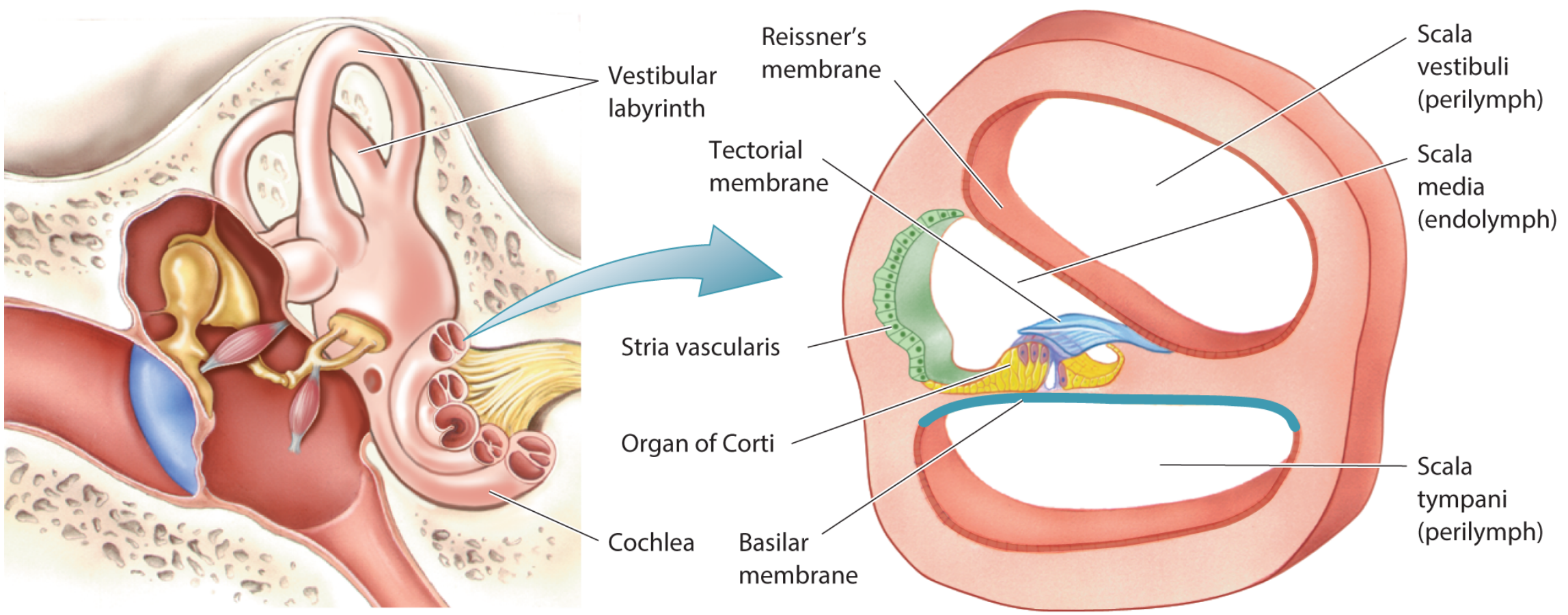
The cochlea is a spiral-shaped, snail-shell structure (~32 mm long, coiled 2½ turns). Think of it as a rolled-up garden hose divided into 3 chambers.
Cut in cross-section, you see three fluid-filled scalae (chambers):
| Scala | Fluid | Separated by |
|---|---|---|
| Scala vestibuli | Perilymph | Reissner's membrane (above) |
| Scala media (cochlear duct) | Endolymph | Basilar membrane (below) |
| Scala tympani | Perilymph | — |
- The scala vestibuli and scala tympani communicate at the apex of the cochlea through the helicotrema
- The scala vestibuli begins at the oval window; the scala tympani ends at the round window
Stria vascularis: A specialized epithelium lining the outer wall of the scala media — it generates and maintains endolymph and creates the endocochlear potential (+80 mV), the battery that powers hair cell transduction.
The Organ of Corti — "The actual hearing receptor"
Sitting on the basilar membrane inside the scala media is the organ of Corti — the true sensory organ of hearing. It contains ~16,000 mechanosensory hair cells.
Two types of hair cells:
| Inner Hair Cells (IHC) | Outer Hair Cells (OHC) | |
|---|---|---|
| Number | ~3,500 (single row) | ~12,000–20,000 (3 rows) |
| Function | Primary sensory transducers (send signals to brain) | Amplifiers — they actively contract to amplify basilar membrane motion |
| Afferent innervation | 95% of all auditory nerve fibres | 5% of auditory nerve fibres |
Each hair cell has 50–150 stereocilia (stiff hair-like projections) on its top surface. The stereocilia of outer hair cells are embedded in the tectorial membrane above. The stereocilia of inner hair cells float just beneath the tectorial membrane.
The Basilar Membrane — "The frequency analyzer"
This is the most important structure in hearing science. The basilar membrane does NOT vibrate uniformly — different parts respond to different frequencies. This is called tonotopy.
| Location on Basilar Membrane | Properties | Best Frequency |
|---|---|---|
| Base (near oval window) | Narrow, stiff | High frequencies (20,000 Hz) |
| Apex (tip of cochlea) | Wide, floppy | Low frequencies (20 Hz) |
Think of it like a piano: the high notes are at one end, the low notes at the other. This spatial mapping of frequency is maintained all the way up to the auditory cortex.
AUDITORY TRANSDUCTION — "How sound becomes electricity"
This is the chain of events that converts a sound wave into a nerve impulse:
Step-by-step (the complete pathway):
1. Sound wave enters the outer ear → funnelled down the EAC → vibrates the tympanic membrane
2. TM movement → ossicle movement:
Malleus → Incus → Stapes footplate pushes into the oval window
3. Oval window movement → fluid waves in cochlea:
- Stapes pushes perilymph in scala vestibuli
- Wave travels through fluid → crosses helicotrema → scala tympani
- Round window membrane bulges outward to accommodate (pressure relief valve!)
4. Fluid waves → basilar membrane vibration:
The travelling wave peaks at a specific location depending on the sound's frequency (tonotopy)
5. Basilar membrane movement → hair cell stimulation (the key step):
- Basilar membrane (on which hair cells sit) moves up and down
- But tectorial membrane stays relatively still
- This creates a shearing force that bends the stereocilia
6. Stereocilia bending → ion channels open:
- When stereocilia bend toward the tallest stereocilium → tip links pull open mechanosensitive K⁺/Ca²⁺ channels
- K⁺ flows INTO the hair cell from endolymph (remember endolymph has HIGH K⁺) → depolarization
- Bending the other way → channels close → hyperpolarization
7. Depolarization → neurotransmitter release:
- Ca²⁺ channels open at the base of the hair cell
- Ca²⁺ influx → glutamate released onto spiral ganglion neurons
8. Spiral ganglion neurons → action potentials → auditory nerve (CN VIII)
9. Auditory pathway:
Cochlear nuclei (medulla) → Superior olivary complex → Inferior colliculus (midbrain) → Medial geniculate nucleus of thalamus → Primary auditory cortex (Heschl's gyrus, temporal lobe)
The tonotopic map from the cochlea is preserved at every level of this pathway all the way to the cortex!
THE VESTIBULAR SYSTEM — "Your internal spirit level"
The vestibular labyrinth has two types of sensors that detect two different kinds of head movement:
1. Semicircular Canals (SCCs) — "Detect rotation"
There are 3 semicircular canals, each in a different plane:
- Horizontal (lateral) SCC — detects rotation in the horizontal plane (shaking head "no")
- Anterior (superior) SCC — detects sagittal plane rotation (nodding "yes")
- Posterior SCC — detects frontal plane rotation (tilting ear to shoulder)
Each SCC has a swelling at one end called the ampulla, inside which sits the crista ampullaris — the sensory organ. The crista contains hair cells topped by a gelatinous cap called the cupula that spans the entire width of the ampulla.
How it works: When the head rotates, the fluid (endolymph) in the SCC initially lags behind (inertia) → this bends the cupula → bends hair cell stereocilia → generates nerve impulse. Each canal works as a pair with the opposite canal (push-pull system).
2. Otolith Organs — "Detect gravity and linear acceleration"
There are two otolith organs:
- Utricle — detects horizontal linear acceleration (moving forward in a car)
- Saccule — detects vertical linear acceleration (going up in a lift)
Each contains a macula — a patch of hair cells. On top of the hair cells sits the otolithic membrane, embedded with otoconia (otoliths) — tiny calcium carbonate crystals ("ear rocks"!).
How it works: When the head tilts or accelerates linearly, gravity pulls the heavy otoconia, which tilts the membrane → bends hair cell stereocilia → generates a signal. The brain uses this to sense tilt relative to gravity.
Central vestibular pathways:
Vestibular nerve (CN VIII) → Vestibular nuclei (brainstem) → Cerebellum, spinal cord, eyes (via MLF), cerebral cortex
Key reflexes:
- Vestibulo-ocular reflex (VOR): Keeps your vision stable when your head moves — moves eyes in the opposite direction to head rotation
- Vestibulospinal reflex: Adjusts body posture to maintain balance
SOUND LOCALIZATION — "How you know where a sound is coming from"
Horizontal plane (left vs. right): Your brain compares the arrival time of sound at each ear:
- Interaural Time Difference (ITD): A sound from the right reaches the right ear ~0.6 ms earlier → brain detects this delay
- Interaural Level Difference (ILD): The head creates a "sound shadow" → one ear hears a slightly quieter sound
Specialized binaural neurons in the superior olivary complex detect these tiny differences (as small as 10 microseconds!).
Vertical plane (up vs. down): The shape of the pinna introduces frequency-dependent delays → detected with just one ear.
CLINICAL PEARLS FOR YOUR EXAM 📋
| Clinical Point | Explanation |
|---|---|
| Conductive hearing loss | Problem in outer or middle ear (wax, TM perforation, ossicular damage, otitis media) — air-bone gap on audiogram |
| Sensorineural hearing loss | Problem in cochlea (hair cell damage) or CN VIII — no air-bone gap; high frequencies lost first (noise damage affects basal cochlea) |
| Acoustic neuroma (vestibular schwannoma) | Tumour on CN VIII → unilateral sensorineural hearing loss + tinnitus + vestibular symptoms |
| Otosclerosis | Abnormal bone fixation of the stapes footplate → conductive hearing loss; Schwartze sign (flamingo pink blush through TM) |
| Benign Paroxysmal Positional Vertigo (BPPV) | Otoconia fall into posterior SCC → brief positional vertigo; positive Dix-Hallpike test |
| Presbycusis | Age-related hearing loss — high-frequency sensorineural loss (basal hair cells die first) |
| Stapedius reflex | CN VII damage → no stapedius reflex (tested by audiologist) |
| Eustachian tube dysfunction | Negative middle ear pressure → retracted TM, glue ear, otitis media with effusion |
| Cholesteatoma | Skin growing into the wrong place (middle ear) — starts at pars flaccida; destroys bone |
| Endolymphatic hydrops (Ménière's disease) | Excess endolymph → fluctuating low-frequency sensorineural hearing loss + vertigo + tinnitus + ear fullness (the four classic symptoms) |
SUMMARY DIAGRAM — The Sound Path 🔊➡️🧠
SOUND WAVE
    ↓
Pinna (captures & focuses)
    ↓
External Auditory Canal (2.5 cm tube)
    ↓
Tympanic Membrane (vibrates)
    ↓
Malleus → Incus → Stapes (ossicular lever amplifies ~25–30 dB)
    ↓
Oval Window → Perilymph waves in Scala Vestibuli
    ↓
Basilar Membrane vibrates (tonotopy: high freq = base, low freq = apex)
    ↓
Organ of Corti — Hair cell stereocilia bend
    ↓
K⁺ influx → Depolarization → Glutamate release
    ↓
CN VIII (Cochlear nerve)
    ↓
Cochlear nuclei → Superior olive → Inferior colliculus
→ Medial Geniculate (thalamus) → Auditory Cortex (Heschl's gyrus)
    ↓
YOU HEAR THE SOUND! 🎵
Sources: Cummings Otolaryngology Head and Neck Surgery; Costanzo Physiology 7th Ed.; Neuroscience: Exploring the Brain 5th Ed.; Eric Kandel Principles of Neural Science 6th Ed.
This is a shared conversation. Sign in to Orris to start your own chat.