
Explain the EGC pattern in abnormal conditions
Reading File
The user is asking about "EGC pattern" — this likely means ECG (electrocardiogram) patterns in abnormal conditions. Let me search the medical library comprehensively.
Finding Sources
Finding Sources
Finding Sources
Finding Sources
Reading File
Finding Sources
Now let me get more comprehensive ECG content from the cardiology textbooks:
Finding Sources
Finding Sources
Reading File
Reading File
Reading File
Finding Sources
Reading File
Finding Sources
Reading File
Finding Sources
I now have comprehensive content from Harrison's, Tintinalli's, Rosen's, and Fuster's textbooks. Let me fetch the key ECG images and compile the full answer.
Loading Image
Loading Image
Reading File
I now have rich, comprehensive content from multiple authoritative sources. Let me compile the complete answer.
ECG Patterns in Abnormal Conditions
The ECG (electrocardiogram) records the electrical activity of the heart across 14 key parameters: rhythm, heart rate, PR interval, QRS interval, QT/QTc, mean axis, P waves, QRS voltage, precordial R-wave progression, Q waves, ST segments, T waves, U waves, and calibration. Abnormalities in these components map to specific pathological states.
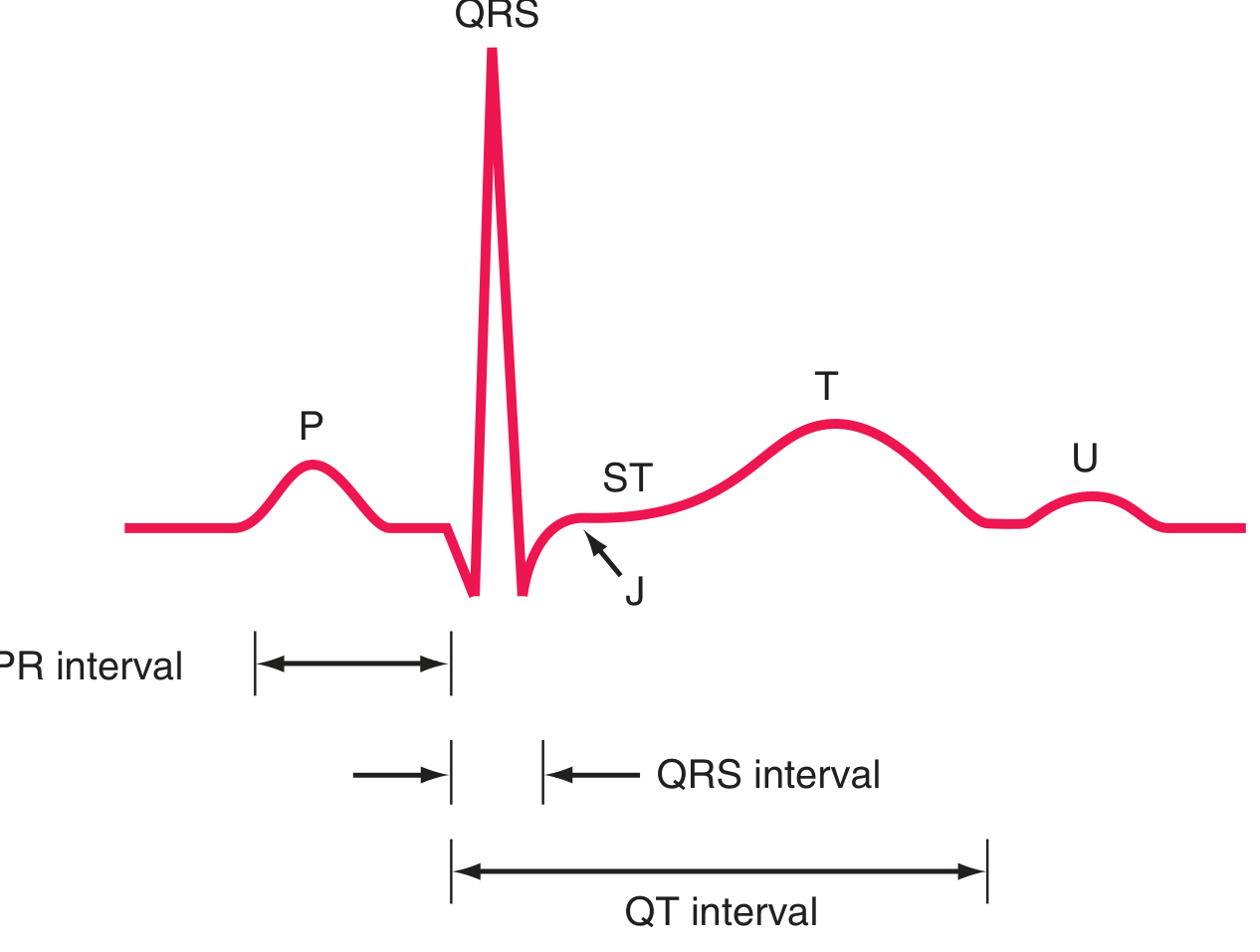
1. Myocardial Ischemia and Infarction
This is the most critical application of ECG pattern recognition.
Mechanism of ST Changes
Severe acute ischemia lowers the resting membrane potential and shortens action potential duration, creating a current of injury between normal and ischemic zones expressed as ST deviation.
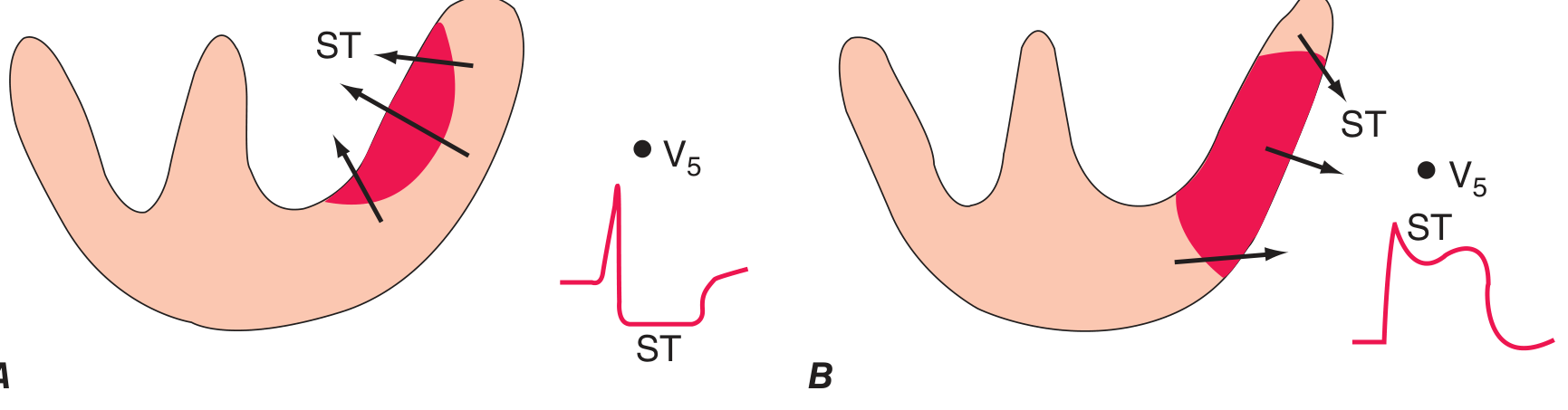
| Ischemia Type | ST Change | Mechanism |
|---|---|---|
| Transmural (epicardial) | ST elevation in overlying leads | ST vector directed outward |
| Subendocardial | ST depression in precordial leads | ST vector toward ventricular cavity |
STEMI Localisation
| Territory | Leads with ST Elevation | Culprit Artery |
|---|---|---|
| Anterior | V1–V3 (± I, aVL) | LAD (distal) |
| Anteroseptal (proximal) | V1–V3 + ST depression in II, III, aVF | Proximal LAD |
| Inferior | II, III, aVF (III > II) + depression in I, aVL | RCA |
| Inferior-lateral | II, III, aVF + V2 | LCx |
| Posterior | Reciprocal ST depression V1–V3 + upright T, tall R | RCA/LCx |
| Right ventricular | Inferior STEMI + ST elevation in V1 and right-sided leads (V3R–V5R) | Proximal RCA |
| Left main | ST elevation in aVR > V1 | LMCA occlusion |
(Tintinalli's Emergency Medicine, 9e)
Evolutionary Q-wave Pattern
- Hyperacute T waves — tall, broad, upright (minutes)
- ST elevation — current of injury (minutes to hours)
- Pathological Q waves — necrosis of sufficient myocardium; usually develop 8–12 hours after infarction
- T-wave inversion — repolarization abnormality
- Normalisation — possible weeks to months later (more common with smaller infarcts); persistent ST elevation after weeks suggests severe wall motion disorder
A minority presenting without ST elevation may still develop Q-wave MI. Conversely, transmural MI may occur without Q waves. — Harrison's Principles of Internal Medicine, 22e
Wellens' Syndrome (Critical LAD Stenosis)
A pattern of deep symmetric T-wave inversions (or biphasic T waves) in V1–V3 during a pain-free interval. This finding indicates >90% LAD stenosis and impending anterior MI. T waves may paradoxically normalise when chest pain recurs.
2. Bundle Branch Blocks
In bundle branch blocks, excitation passes normally down the intact bundle and sweeps retrogradely through muscle to activate the blocked side, prolonging QRS and altering repolarisation.
| Feature | RBBB | LBBB |
|---|---|---|
| QRS duration | ≥120 ms | ≥120 ms |
| Morphology in V1 | rSR' ("M shape") | Broad monophasic S |
| Morphology in V5/V6 | Wide S wave | Broad notched R (no Q) |
| T-wave | Opposite to terminal QRS deflection (secondary change) | Opposite to QRS (secondary change) |
| Clinical significance | May be congenital or organic; complete RBBB carries ~50% greater 20-year mortality | Hypertensive heart disease, cardiomyopathy, aortic valve disease |
Secondary vs. Primary T-wave changes:
- Secondary T-wave inversions result from the altered sequence of depolarisation in bundle branch blocks (expected, discordant with the last QRS deflection).
- Primary T-wave inversions are independent of QRS changes, indicating ischemia, electrolyte disturbance, or drug effects.
- T-wave inversions in the right precordial leads with LBBB (or left precordial leads with RBBB) are warning signs of coexisting ischemia.
(Harrison's, 22e; Ganong's Review of Medical Physiology, 26e)
AMI in the Presence of LBBB (Sgarbossa Criteria)
- ST elevation ≥1 mm concordant with QRS (OR 25.2) ← strongest predictor
- ST depression ≥1 mm in V1, V2, or V3 (OR 6.0)
- ST elevation ≥5 mm discordant with QRS (OR 4.3)
(Tintinalli's, 9e)
3. Fascicular (Hemiblock) Patterns
These do not significantly prolong QRS but shift the frontal axis:
| Block | Axis | Rarity |
|---|---|---|
| Left anterior fascicular block | ≤ −45° (left axis deviation) | Most common cause of marked LAD |
| Left posterior fascicular block | ≥ +110–120° (right axis deviation) | Extremely rare in isolation; exclude RVH, pulmonary disease |
4. Electrolyte and Metabolic Disorders
| Condition | ECG Changes |
|---|---|
| Hyperkalemia | Peaked tall T waves → PR prolongation → widening QRS → sine-wave pattern → VF/asystole. Can also produce type I Brugada-like pattern (pseudo-RBBB + coved ST elevation in V1–V3). |
| Hypokalemia | ST depression, flattened/inverted T waves, prominent U waves, QT (QU) prolongation |
| Hypercalcemia | Short QT interval (abbreviated phase 2 of action potential) |
| Hypocalcemia | Prolonged QT interval (prolonged phase 2–3) |
| Digoxin | "Scooped" ST depression, T-wave flattening/inversion (primary changes); shortened QT |
| Amiodarone / Class Ia drugs / Tricyclics | Prolonged QT; TCAs also widen QRS |
| Flecainide / Class I | QRS widening (impaired Na⁺ influx, slowed phase 0) |
Factors decreasing the slope of phase 0 (e.g., hyperkalemia, flecainide) increase QRS duration. Factors prolonging phase 2 or 3 (e.g., amiodarone, hypocalcemia) increase the QT interval. — Harrison's Principles of Internal Medicine, 22e
5. Brugada Pattern / Syndrome
- Type 1 (diagnostic): Coved ST-segment elevation ≥2 mm followed by a negative T wave in ≥1 lead from V1–V3. This is the only diagnostic ECG finding for Brugada syndrome.
- Type 2: Saddle-back ST elevation (not diagnostic alone).
- Can be mimicked by hyperkalemia (hyperkalemic Brugada sign).
- Associated with risk of ventricular fibrillation and sudden cardiac death.
(Fuster & Hurst's The Heart, 15e; Harrison's, 22e)
6. Ventricular Hypertrophy
| Type | Key ECG Criteria |
|---|---|
| LVH | Increased QRS voltage (e.g., S in V1 + R in V5/V6 ≥35 mm); left axis deviation; ST depression + T-wave inversion in lateral leads ("strain pattern") |
| RVH | Right axis deviation ≥+110°; dominant R in V1 (R/S > 1); ST changes in right precordial leads |
7. Pacemaker Rhythms
- Right ventricular pacing causes secondary repolarisation changes: most leads show predominantly negative QRS with ST elevation and positive T waves (expected secondary changes).
- ST elevation ≥5 mm in leads with predominantly negative QRS = suspect AMI.
- Any ST elevation concordant with a predominantly positive QRS = highly specific for AMI.
- ST depression in V1–V3 has 80% specificity for AMI in RV-paced rhythms.
(Tintinalli's, 9e)
8. WPW (Pre-excitation)
- Short PR interval (<120 ms) + delta wave (slurred initial QRS upstroke) + widened QRS.
- Can mimic bundle branch block, RVH, ischemia, MI, or ventricular tachycardia (especially during atrial fibrillation with rapid conduction down the accessory pathway).
9. Arrhythmias — Key Patterns
| Arrhythmia | ECG Pattern |
|---|---|
| 1st-degree AV block | PR > 200 ms, every P conducts |
| Wenckebach (Mobitz I) | Progressive PR lengthening → dropped QRS |
| Mobitz II | Constant PR, sudden dropped QRS; high risk of complete block |
| Complete (3rd-degree) AV block | P waves and QRS completely dissociated; ventricular escape |
| Atrial flutter | Sawtooth flutter waves at ~300/min; ventricular rate typically 150/min (2:1 block) |
| AVNRT / AVRT | Regular narrow complex tachycardia, P waves buried in or just after QRS |
| VT | Wide QRS (>120 ms), AV dissociation, fusion/capture beats; rate 100–250/min |
| VF | Chaotic, irregular, no identifiable waveforms |
Sinister PVC Context
PVCs are ominous only in patients with LV dysfunction, severe ischemia, valvular disease, cardiomyopathy, or a family history of sudden cardiac death. A "salvo" of 3 unifocal PVCs terminates the exercise stress test. (Pfenninger & Fowler's, 3e)
10. QT Prolongation
QTc upper normal limits: 460 ms (women), 450 ms (men).
Causes of QT prolongation: hypokalemia, hypocalcemia, hypomagnesemia, drugs (sotalol, dofetilide, haloperidol, macrolides, quinolones, TCAs), congenital long QT syndrome.
Risk: Torsades de pointes (polymorphic VT), which can degenerate to VF.
Key Diagnostic Pitfalls
From Tintinalli's Emergency Medicine, 9e:
- LBBB — masks acute ischemia; use Sgarbossa criteria
- Ventricular pacing — standard STEMI criteria unreliable; see criteria above
- WPW — mimics MI, BBB, VT
- Ischemic changes confined to inferior leads only (without lateral leads) are usually false-positives from atrial repolarisation (common with short PR)
- Normal ECG does not exclude ACS or even acute infarction; a normal ECG throughout the entire course of infarction is uncommon
Sources:
- Harrison's Principles of Internal Medicine, 22e — Chapter 247: Electrocardiography
- Tintinalli's Emergency Medicine, 9e — Chapter 49: Electrocardiography
- Fuster & Hurst's The Heart, 15e — Brugada Syndrome
- Pfenninger & Fowler's Procedures for Primary Care, 3e — ECG Abnormal section
- Ganong's Review of Medical Physiology, 26e — Bundle branch block mechanisms
This is a shared conversation. Sign in to Orris to start your own chat.