


456d1950-9e47-45c2-a154-07cd65dabf9a.jpeg
1120ea4a-399f-4675-83ab-e29e42b64733.jpeg
Ayurvedic and modern prospective of this disease and line of treatment
analyse_media
analyse_media
The images show a male patient with facial erythema, edematous/indurated plaques involving the cheek and beard area bilaterally, some follicular papules, fine scaling, and what appears to be a topical cream already applied. The presentation is most consistent with Seborrheic Dermatitis (possibly with secondary folliculitis/Sycosis Barbae), given the distribution over sebum-rich facial zones, follicular involvement in the beard area, and bilateral mid-face involvement.
Searching sources...
Reading File
Finding Sources
Finding Sources
Searching PubMed
"seborrheic dermatitis" treatment
Reading File
Reading File
Finding Sources
Finding Sources
Searching the Web
Ayurvedic treatment seborrheic dermatitis darunaka face rosacea Ayurveda line of treatment 2024
Reading File
Reading File
Reading Web Page
https://wjbphs.com/sites/default/files/fulltext_pdf/WJBPHS-2…
Loading Image
Reading Web Page
https://ayurvedayoga.com.au/blog/ayurveda-offers-treatments-…
I now have comprehensive information from the images, textbooks, and Ayurvedic sources. Here is the complete answer:
Diagnosis: Seborrheic Dermatitis (Facial)
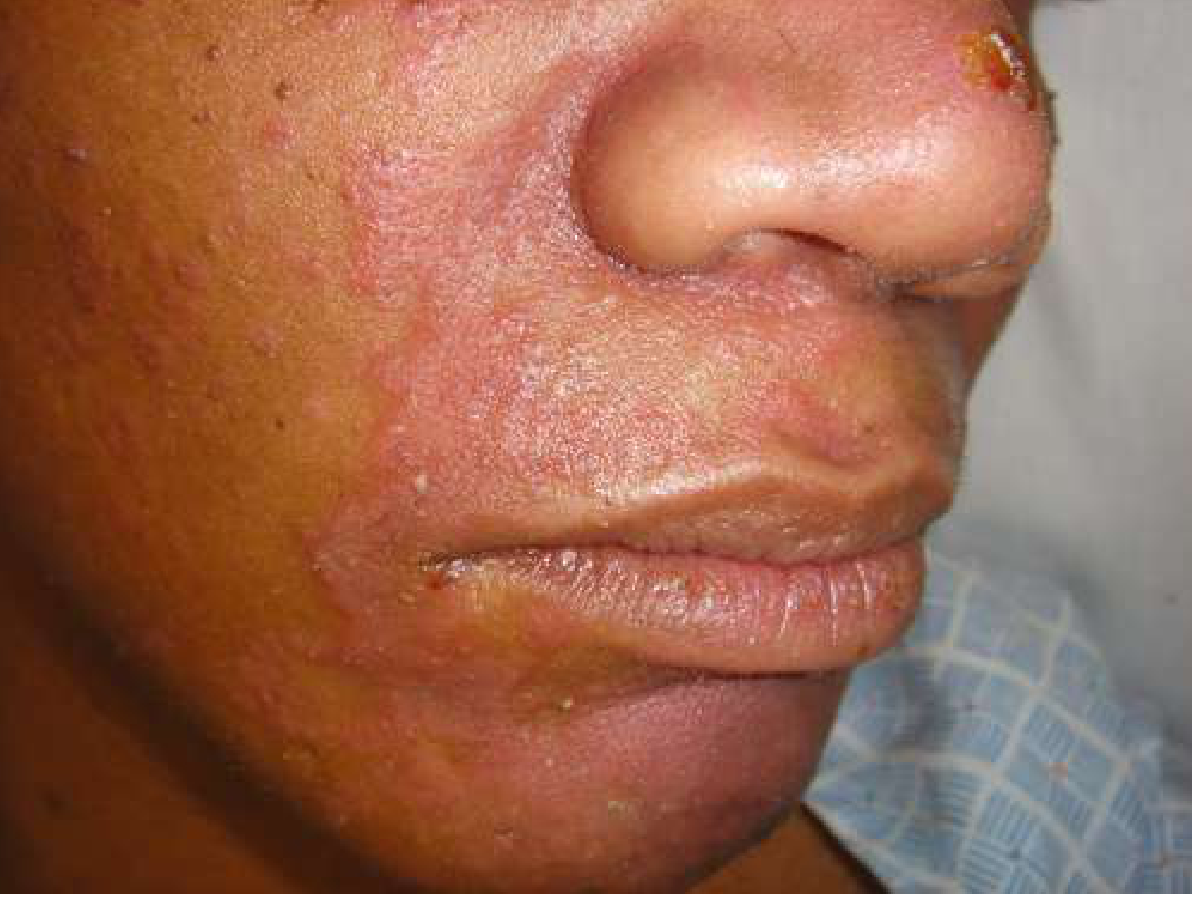
The images show bilateral facial erythema with edematous, indurated plaques across the malar region, infraorbital area, nasolabial folds, and beard region - with follicular papules and fine scaling. A white topical cream is already applied. This presentation is classic for facial seborrheic dermatitis, with secondary follicular involvement (Sycosis Barbae pattern in beard area). The textbook image from Goldman-Cecil below closely matches:
Modern (Allopathic) Perspective
Pathophysiology
Seborrheic dermatitis is a chronic relapsing inflammatory skin disorder of sebum-rich areas. The pathogenesis involves:
- Overgrowth of Malassezia species (lipophilic yeast normally present on skin)
- Abnormal immune/inflammatory response to Malassezia metabolites
- Excess sebum production providing substrate for the yeast
- Individual genetic susceptibility
- Triggers: stress, cold/dry weather, immunosuppression (SD can be severe and extensive in HIV, affecting up to 83%), fatigue, and hormonal changes
Classic Features
- Erythematous patches with fine greasy scales on malar area, nasolabial folds, midforehead, eyebrows, beard, and scalp
- Chronic relapsing course
- In dark-skinned individuals, lesions may appear hypopigmented
Modern Line of Treatment
Step 1 - Initial inflammation control (face):
| Drug | Dose/Application | Notes |
|---|---|---|
| Hydrocortisone 1–2.5% cream | Twice daily, 1–2 weeks | First-line for face; short course only |
| Desonide 0.05% lotion | Twice daily, short term | Safe for facial use |
| Fluocinolone acetonide 0.01% | Twice daily, 3–4 weeks | Avoid prolonged use |
Important: High-potency steroids (betamethasone, clobetasol) must NOT be used on the face - risk of steroid-induced rosacea and skin atrophy. - Harrison's Principles of Internal Medicine 22E, p. 429
Step 2 - Antifungal (mainstay long-term):
| Drug | Form | Use |
|---|---|---|
| Ketoconazole 2% cream or gel | Twice daily until cleared | Facial SD - most effective; safe for long-term use |
| Ciclopirox olamine cream | Twice daily | Alternative to ketoconazole (75-90% response rate) |
| Zinc pyrithione shampoo | Leave 3-5 min before rinsing | Beard/scalp |
| Selenium sulfide shampoo | Leave 3-5 min | Beard/scalp |
Per Katzung Pharmacology, 16th ed.: "Seborrheic dermatitis should be treated with twice-daily applications of ketoconazole until clinical clearing is obtained."
Step 3 - Maintenance:
- Ketoconazole 2% shampoo or cream 1-2x/week as needed
- Intermittent low-potency topical corticosteroid during flares
Step 4 - Severe/refractory cases:
- Oral terbinafine 250 mg daily x 4 weeks (SOR: A)
- Tacrolimus (Protopic) or pimecrolimus (Elidel) - calcineurin inhibitors; effective without steroid side effects
- UVB phototherapy for very severe cases
- If HIV-positive: optimize ART + topical ketoconazole per WHO guidelines
Ayurvedic Perspective
Ayurvedic Correlation: Darunaka (Seborrheic Dermatitis)
In Ayurveda, seborrheic dermatitis affecting the scalp and face is correlated with Darunaka - classified as:
- A Kapalaroga (head region disease) by Vagbhata and Sharangadhara
- A Kshudraroga (minor disease) by Sushruta, Bhavaprakasha, and Chakradatta
- When facial redness (Pitta/Rakta involvement) is prominent, it may also overlap with Mukha Roga classifications
Dosha Involvement
- Primarily: Vata + Kapha vitiation
- Vidaha's view: Pitta and Rakta are also involved (explains the erythema seen in this case)
- Aggravated doshas disturb the Twak (skin) and Sira (hair follicles)
Cardinal Symptoms (Lakshana)
- Kandu - Itching/pruritus
- Rukshata - Dryness of skin
- Twak Sphutanam - Cracking/flaking of skin
- Keshachyuti - Hair fall
Nidana (Causative Factors)
- Improper diet (Viruddha Anna) - incompatible foods
- Excess Katu (pungent) and Amla (sour) tastes
- Excess Lavana (salt) intake
- Chemical exposure to scalp/face
- Kshavathu nigraha (suppression of sneezing)
- Poor hygiene; lack of regular hair oiling
Ayurvedic Line of Treatment
Principle of Treatment
Three fundamental approaches apply:
- Nidana Parivarjana - Removal of causative factors (dietary/lifestyle correction)
- Shodhana Chikitsa - Purificatory therapies (Panchakarma)
- Shamana Aushadhis - Palliative/internal medicines
Shodhana (Purification) Therapies
| Therapy | Purpose |
|---|---|
| Virechana (therapeutic purgation) | For Pitta-Rakta dominant type with facial erythema |
| Nasya | Medicated nasal instillation - for head/face involvement |
| Raktamokshana (bloodletting) | For Pitta-Rakta type with marked redness |
| Vamana | For Kapha-dominant type |
| Shirobasti | Medicated oil pooling over head - for scalp involvement |
Shamana (Internal Medicines)
| Medicine | Action | Dosage |
|---|---|---|
| Arogyavardhini Rasa | Hepatoprotective, anti-inflammatory, skin purifier | 250 mg TDS with lukewarm water after meals |
| Manjishthadi Kwath | Blood purifier, anti-inflammatory (Manjistha - Rubia cordifolia) | 20 ml before meals BD |
| Triphala Churna | Bowel regulator, antioxidant | 3 gm BD with lukewarm water |
| Tikta Ghritam | Bitter medicated ghee - Pitta-rakta pacifier | As directed by physician |
| Trifla Ghritam | Rasayana, skin nourisher | As directed |
| Guduchi (Tinospora cordifolia) | Immunomodulator, anti-inflammatory | Kwath or tablets |
| Khadirarishtam | Blood purifier for chronic skin conditions | 15-20 ml BD after food |
Bahya Chikitsa (External/Local Therapies)
| Therapy | Method/Medicine |
|---|---|
| Lepa (paste application) | Turmeric (Haridra) + Neem + Chandana paste; Multani mitti (Fuller's earth) with rose water |
| Dhavana (face wash) | Triphala Yavkut (coarse powder) + Shuddha Tankana (purified borax) wash - thrice weekly |
| Abhyanga (massage) | Yashti Churna with coconut oil / Neem taila gently over affected area - thrice weekly |
| Talam | Application of herbal paste to scalp |
| Seka | Pouring of medicated decoctions |
Key Ayurvedic Herbs
- Neem (Azadirachta indica) - antifungal, antibacterial
- Turmeric / Haridra (Curcuma longa) - anti-inflammatory, antifungal
- Daruharidra (Berberis aristata) - antimicrobial, Pitta-pacifying
- Manjistha (Rubia cordifolia) - blood purifier, anti-inflammatory
- Amalaki (Emblica officinalis) - Rasayana, Pitta-pacifier
- Bakuchi (Psoralea corylifolia) - Kushthaghna (skin disease remover)
- Gotu Kola / Mandookparni (Centella asiatica) - skin healing, Medhya
Pathya-Apathya (Do's and Don'ts)
Pathya (Beneficial):
- Shastika Shali (red rice), milk (Ksheera), Amalaki, pomegranate (Dadima)
- Coconut, buttermilk (Takra), lemon, Yusha (lentil soup)
- Regular oil application, gentle cleansing
Apathya (Harmful):
- Excess salt (Lavana rasa), alkaline foods (Kshara), spicy/sour foods
- Incompatible food combinations (Viruddha Anna)
- Suppression of natural urges
- Chemical hair products, excess hot water exposure
Integrated Summary
| Aspect | Modern Medicine | Ayurveda |
|---|---|---|
| Disease name | Seborrheic Dermatitis | Darunaka (Mukha/Kshudra Roga) |
| Cause | Malassezia overgrowth + immune dysregulation | Vata-Kapha vitiation; Pitta-Rakta in facial erythema |
| Key treatment | Ketoconazole 2% cream + low-potency steroid (short course) | Virechana/Raktamokshana + Manjishthadi Kwath + Neem/Turmeric lepa |
| Long-term control | Antifungal maintenance; calcineurin inhibitors | Rasayana herbs, dietary regulation, Nidana Parivarjana |
| Prognosis | Chronic relapsing, controllable (not curable) | Sadhya (treatable/curable) per Vagbhata |
Clinical note: This patient has significant bilateral facial involvement with periorbital edema visible in the first image - rule out erysipelas/cellulitis (fever, rapid spread, systemic symptoms) before initiating only topical treatment. If there is any doubt, a physician evaluation is essential, especially given the proximity to the eye. An antifungal + short-course mild topical steroid combination is appropriate first-line for confirmed seborrheic dermatitis. An HIV screening should be considered if the presentation is atypically severe or refractory.
Sources: Fitzpatrick's Dermatology Vol 1-2; Harrison's Principles of Internal Medicine 22E; Goldman-Cecil Medicine; Textbook of Family Medicine 9e; Darunaka Vyadhi: A Literature Review, WJBPHS 2024; Ayurveda case series - IJHSR 2020
This is a shared conversation. Sign in to Orris to start your own chat.