
Telle me how to diagnoseulm embolism
I'll start by reading the medical library skill before answering this medical question.
Reading File
Now I'll search the medical library and PubMed in parallel for pulmonary embolism diagnosis.
Finding Sources
Searching PubMed
"pulmonary embolism"[MeSH Terms] AND "diagnosis"[MeSH Terms]
Good hits. Now I'll read the two most relevant textbook sections in parallel.
Reading File
Reading File
The Furst/Hurst section shows a table of contents. Let me read the actual clinical content from that book and the Fishman's PIOPED section simultaneously.
Reading File
Reading File
There's a great flowchart image and a detailed chapter. Let me fetch the flowchart image and also read the detailed clinical diagnosis section from Furst & Hurst.
Loading Image
Reading File
Excellent content. Now let me read the detailed diagnosis section from Furst & Hurst which covers Wells criteria, D-dimer, imaging in detail.
Reading File
I now have very rich content. Let me also read the Wells criteria and imaging sections.
Reading File
I now have comprehensive content to write a thorough answer. Let me compile everything.
Diagnosis of Pulmonary Embolism (PE)
Pulmonary embolism (PE) is a potentially fatal condition where a blood clot (usually from a deep vein thrombosis) lodges in the pulmonary vasculature. Diagnosis requires integrating clinical probability scoring, laboratory tests, and imaging in a stepwise fashion.
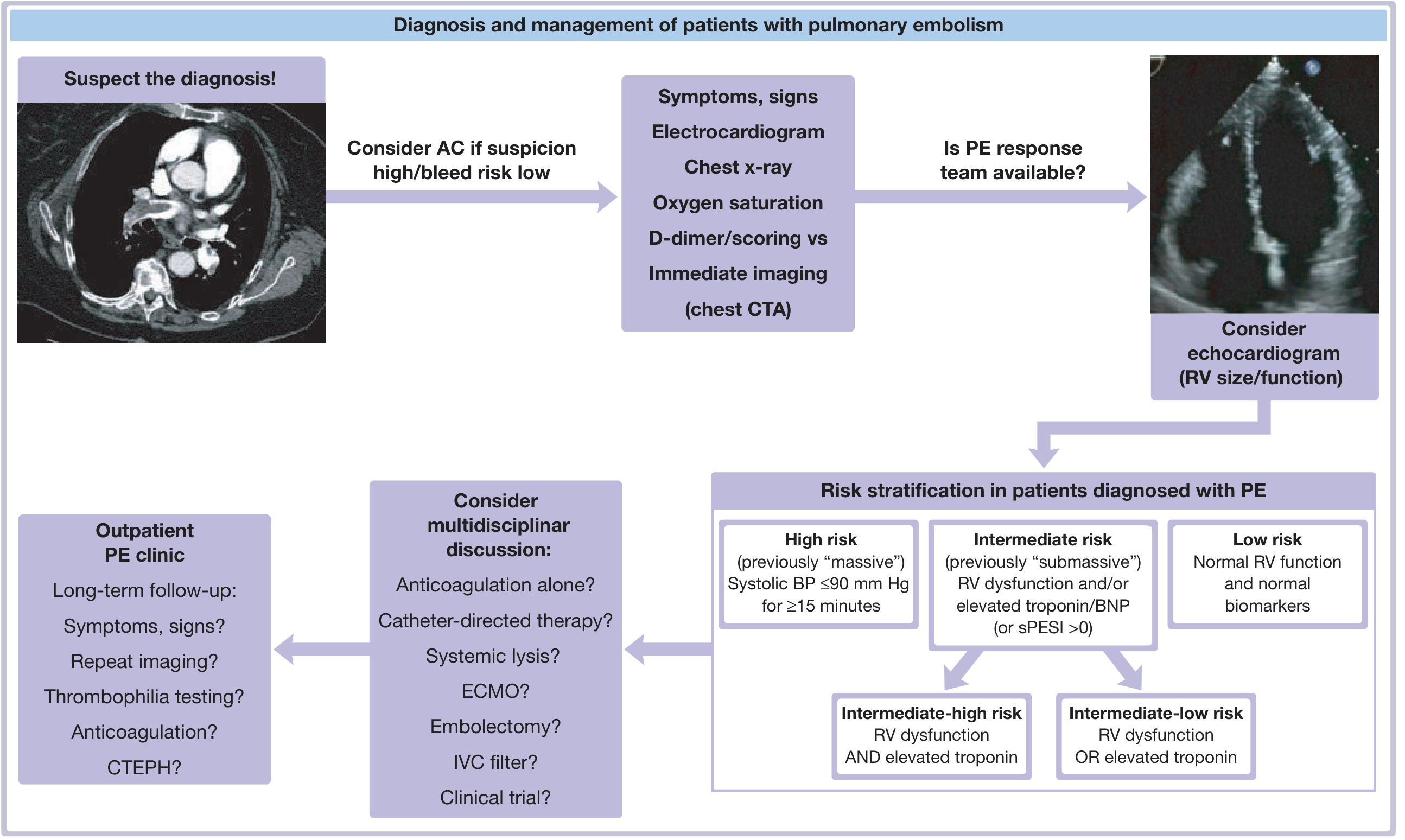
Fuster and Hurst's The Heart, 15th Ed. - Central Illustration: Diagnosis and Management of PE
1. Symptoms and Signs (Suspect the Diagnosis!)
The most important first step is clinical suspicion. PE is commonly missed because its presentation is nonspecific.
Symptoms:
- Dyspnea (most common), pleuritic chest pain, hemoptysis
- Angina-like chest pain, palpitations
- Wheezing, syncope
Signs:
- Tachycardia, tachypnea, hypotension (in severe/massive PE)
- Leg swelling and tenderness (suggesting DVT as source)
- Neck vein distension or right ventricular S3 (signs of RV failure)
- Fever, visible anxiety, chest wall tenderness (with pulmonary infarction)
- Reduced oxygen saturation
The PIOPED study found that >90% of PE patients had at least one of: dyspnea, tachycardia, or pleuritic chest pain. (Fishman's Pulmonary Diseases)
2. Differential Diagnosis
Before pursuing PE workup, consider mimics: acute MI, aortic dissection, pneumothorax, pneumonia, congestive heart failure, pleuritis, pericarditis, costochondritis, and anxiety.
3. Clinical Probability Scoring
A structured pre-test probability score must be calculated before ordering tests. Three validated tools exist:
Wells Score (most widely used)
| Variable | Points |
|---|---|
| Clinical signs/symptoms of DVT | +3 |
| PE is the #1 diagnosis, or equally likely | +3 |
| Heart rate >100/min | +1.5 |
| Immobilization ≥3 days or surgery in previous 4 weeks | +1.5 |
| Previous DVT or PE | +1.5 |
| Hemoptysis | +1 |
| Malignancy (treatment ongoing, or within last 6 months) | +1 |
- Score ≤4 = PE unlikely
- Score >4 = PE likely (proceed to imaging)
Revised Geneva Score (no blood gas required)
| Variable | Points |
|---|---|
| Age ≥65 years | 1 |
| Previous DVT or PE | 3 |
| Surgery or fracture within 1 month | 2 |
| Active malignancy | 2 |
| Hemoptysis | 2 |
| Heart rate 75-94/min | 3 |
| Heart rate >95/min | 5 |
| Unilateral lower limb pain | 3 |
| Pain on deep palpation and unilateral edema | 4 |
Simplified Geneva score <2 + normal D-dimer = ~3% probability of PE.
PERC Rule (to rule out PE without further testing)
PE can be ruled out if ALL 8 are absent AND pre-test probability is ≤15%:
- Age <50 years
- Pulse <100/min
- O2 saturation >94%
- No unilateral leg swelling
- No hemoptysis
- No recent surgery/trauma
- No prior DVT/PE
- No oral contraceptive use
Sensitivity 97.4%, specificity 21.9%. (Fuster and Hurst's The Heart, 15th Ed.)
YEARS Algorithm (newer)
Three items: (1) clinical signs of DVT, (2) hemoptysis, (3) PE most likely diagnosis, plus D-dimer thresholds:
- No YEARS items + D-dimer <1000 ng/mL → PE excluded
- ≥1 YEARS items + D-dimer <500 ng/mL → PE excluded
- All others → proceed to CT angiography
4. Laboratory Tests
D-Dimer
- A breakdown product of cross-linked fibrin
- Measured by high-sensitivity ELISA or ELISA-derived assay
- Sensitivity and NPV ≥95% when below the cutoff
- Use to exclude PE in low-to-moderate pre-test probability patients
- Not useful in hospitalized patients - many comorbidities elevate it non-specifically
- Age-adjusted cutoff: D-dimer threshold = age × 10 ng/mL (in patients >50 years) increases specificity without sacrificing sensitivity
Troponin & BNP/NT-proBNP
- Used for risk stratification after diagnosis, not to diagnose PE
- Elevated troponin = RV myocardial injury
- Elevated BNP/NT-proBNP = RV strain
- Their combination with RV dysfunction on echo helps stratify intermediate vs. high risk
Arterial Blood Gas (ABG)
- Typically shows hypoxemia, hypocapnia (from hyperventilation), and a raised A-a gradient
- Not diagnostic on its own but supports suspicion
- An O2 saturation of 95% doesn't rule out PE - the patient may be working hard to maintain it
5. Electrocardiogram (ECG)
ECG findings are generally nonspecific but important to obtain:
- Sinus tachycardia - most common finding
- S1Q3T3 pattern - classic but present in only ~20% of cases
- Right bundle branch block (complete or incomplete)
- Right axis deviation
- T-wave inversions in V1-V4 (RV strain pattern)
- ST-segment abnormalities
ECG is essential to rule out MI and to suggest RV strain in the right clinical context.
6. Chest X-Ray (CXR)
CXR is usually abnormal but nonspecific. Key findings:
- Atelectasis and parenchymal opacity - most common findings (PIOPED data)
- Hampton's hump - wedge-shaped pleural-based opacity (pulmonary infarction)
- Westermark sign - focal oligemia (area of decreased vascularity)
- Palla's sign - enlarged right descending pulmonary artery
- Normal CXR in a hypoxic, dyspneic patient should raise suspicion for PE
CXR also helps determine whether a V/Q scan is appropriate (abnormal CXR reduces V/Q scan utility). (Fishman's Pulmonary Diseases)
7. Imaging
CT Pulmonary Angiography (CTPA) - Gold Standard
- The primary and preferred imaging modality for diagnosing PE
- Direct visualization of clot in pulmonary arteries
- High sensitivity (~83%) and specificity (~96%)
- Also detects alternative diagnoses in ~17-19% of cases
- MDCT-PA (multidetector CT) has replaced conventional pulmonary angiography in most centers
- Contraindications: severe contrast allergy, renal impairment, pregnancy (relative)
Ventilation-Perfusion (V/Q) Scan
- Preferred when CTPA is contraindicated (renal failure, contrast allergy, pregnancy)
- Results reported as: normal, very low, low, intermediate, or high probability
- High-probability scan + high clinical probability → treat for PE
- Normal scan → effectively excludes PE
- PIOPED showed the problem: most patients get an intermediate probability scan, which requires further testing
- Sensitivity/specificity vary depending on underlying lung disease (COPD worsens accuracy significantly)
- Intermediate scans occurred in 60% of COPD patients vs. only 13% in those with normal CXR (PIOPED)
Pulmonary Angiography (Conventional)
- Historical "gold standard" - now rarely used
- Replaced by CTPA
- Still used in select cases (e.g., prior to catheter-directed therapy)
Echocardiography
- Not diagnostic for PE in most cases, but extremely useful for:
- Detecting RV dilation and dysfunction (RV:LV ratio >0.9)
- Assessing hemodynamic compromise
- Risk stratification after diagnosis
- Bedside evaluation in hemodynamically unstable patients (to identify massive PE quickly)
- Rarely, a clot may be visualized directly in the right heart or main pulmonary artery
MRI/MRA
- Limited utility; lower sensitivity than CTPA
- Used in special circumstances (e.g., pregnancy, contrast allergy)
Compression Ultrasonography (CUS) for DVT
- Useful when PE is suspected but CTPA cannot be done
- Positive CUS (non-compressibility of vein) in a patient with PE symptoms = treat for VTE
- Sensitivity for DVT is lower in pregnancy due to prevalence of isolated pelvic DVT
8. Diagnostic Strategy
Hemodynamically UNSTABLE (shock/hypotension):
- Immediate bedside echocardiography
- If RV dilation or clot-in-transit seen → treat for massive (high-risk) PE immediately
- CTPA if patient can be stabilized
Hemodynamically STABLE:
- Calculate pre-test probability (Wells / Geneva / PERC)
- Low probability: D-dimer → if negative, PE excluded; if positive → CTPA
- Moderate probability: D-dimer → if negative, PE excluded; if positive → CTPA
- High probability: go straight to CTPA (don't wait for D-dimer result, start anticoagulation)
Key principle: Consider starting anticoagulation before diagnosis is confirmed if pre-test probability is high and bleeding risk is acceptable. (Fuster and Hurst's The Heart, 15th Ed.)
9. Risk Stratification After Diagnosis
Once PE is confirmed, classify into:
| Category | Criteria |
|---|---|
| High-risk (previously "massive") | Systolic BP ≤90 mmHg for ≥15 minutes |
| Intermediate-high risk | RV dysfunction AND elevated troponin |
| Intermediate-low risk | RV dysfunction OR elevated troponin |
| Low risk | Normal RV function and normal biomarkers |
The simplified PESI (sPESI) score is also used: score >0 = not low risk.
Sources:
- Fuster and Hurst's The Heart, 15th Edition, Chapter 58 (Diagnosis of DVT and PE)
- Fishman's Pulmonary Diseases and Disorders, Chapter 30 (PIOPED study; V/Q scanning)
- 2025 ESVM Guidelines on VTE interventional treatment (PMID: 40587333)
Find recent guidelines on PE management and treatment options
PE management guidelines recommend anticoagulation as the cornerstone of treatment, with DOACs (rivaroxaban, apixaban) now preferred over LMWH/warfarin for most patients. High-risk (massive) PE with hemodynamic instability warrants systemic thrombolysis or catheter-directed therapy. Risk stratification drives treatment intensity.
Searching sources...
Searching PubMed
"pulmonary embolism"[MeSH Terms] AND "management"[MeSH Terms]
Searching PubMed
"pulmonary embolism"[MeSH Terms] AND "anticoagulants"[MeSH Terms]
Finding Sources
Excellent - the 2026 AHA/ACC guideline is live. Let me pull details on it plus the textbook treatment section and the cancer-associated thrombosis meta-analysis in parallel.
Reading Article
PMID: 41712677
Reading Article
PMID: 40578592
Finding Sources
Searching PubMed
"pulmonary embolism"[MeSH Terms] AND "catheter directed thrombolysis"
The PEERLESS RCT is very recent and directly relevant. Let me get the details on it and the mechanical thrombectomy vs CDT meta-analysis, plus the 2026 guideline from the textbook management section, all in parallel.
Reading Article
PMID: 39470698
Reading Article
PMID: 40602356
Reading File
There's a risk classification flowchart and detailed treatment content. Let me fetch the image and read the treatment section.
Loading Image
Reading File
Excellent - I now have very rich content. Let me read the actual therapeutic approaches section from the textbook.
Reading File
I have comprehensive content on all treatment modalities. I have enough to write a thorough, well-cited answer now.
Recent Guidelines on Pulmonary Embolism Management and Treatment Options
Guideline Landscape (2025-2026)
The most current and authoritative guidance comes from the 2026 AHA/ACC/ACCP/ACEP/CHEST/SCAI/SHM/SIR/SVM/SVN Joint Guideline (published March/April 2026 in Circulation and JACC). A key feature of this guideline is the introduction of new AHA/ACC Acute PE Clinical Categories to sharpen severity classification and therapy decisions. It covers the full period from symptom onset through clinical follow-up. 2026 AHA/ACC PE Guideline (PMID: 41712677)
Step 1: Risk Stratification - The Foundation of All Treatment Decisions
Treatment intensity is entirely driven by risk category. Before any therapy is chosen, patients must be classified.
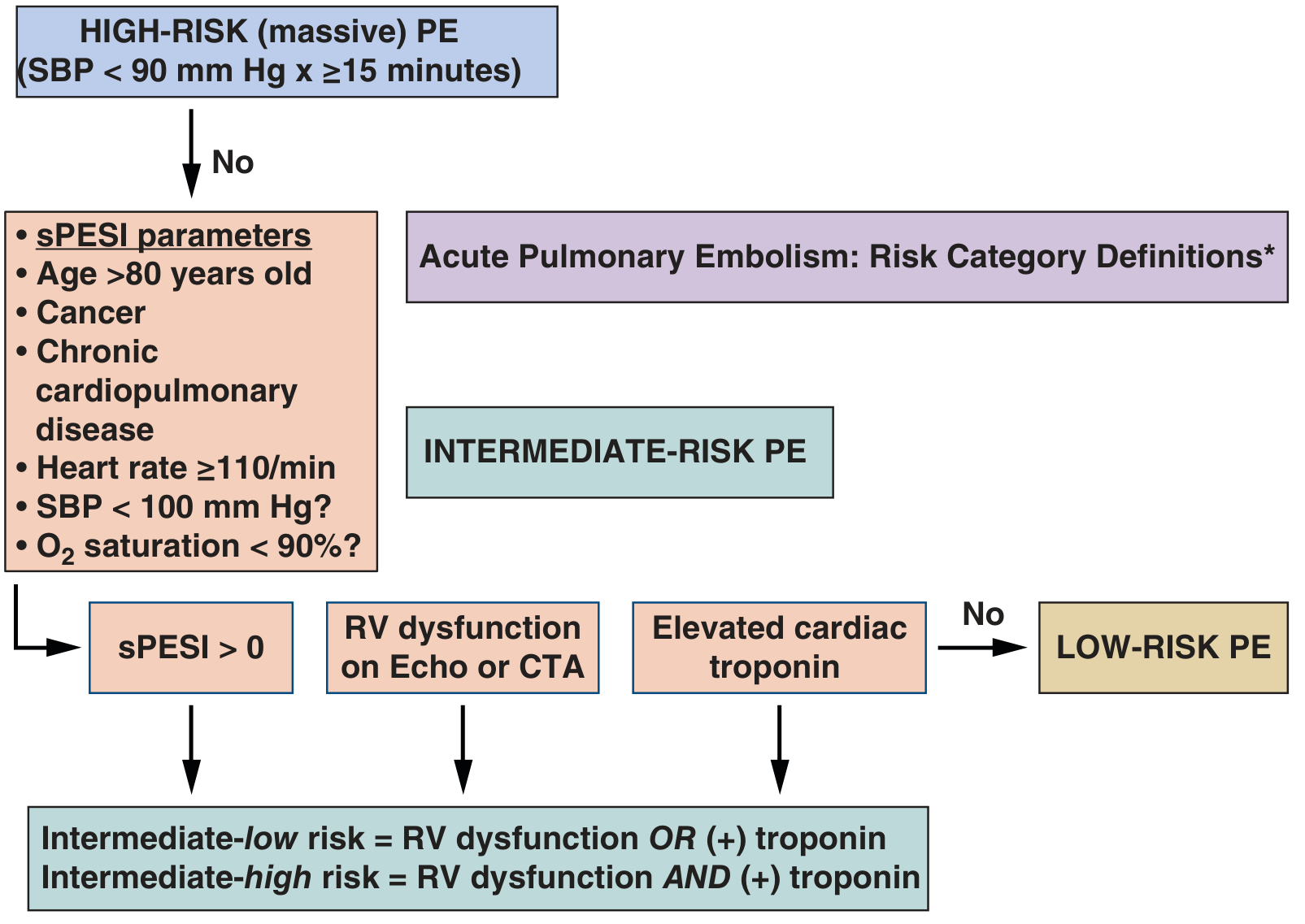
| Risk Category | Definition |
|---|---|
| High-risk (previously "massive") | SBP ≤90 mmHg for ≥15 minutes |
| Intermediate-high risk | sPESI >0 + RV dysfunction (echo or CTA) AND elevated troponin |
| Intermediate-low risk | sPESI >0 + RV dysfunction OR elevated troponin |
| Low-risk | Normal RV function + normal biomarkers; sPESI = 0 |
sPESI parameters (1 point each): age >80, cancer, chronic cardiopulmonary disease, HR ≥110/min, SBP <100 mmHg, O2 sat <90%.
Step 2: Immediate Supportive Measures
Regardless of risk, all unstable patients receive:
- Oxygen supplementation / mechanical ventilation if needed
- Vasopressors (norepinephrine preferred) for hypotension
- ECMO in refractory cases while planning definitive therapy
- Anticoagulation should be started even before diagnosis is confirmed if suspicion is high and bleeding risk is low - this is the single intervention proven to reduce mortality
Step 3: Anticoagulation - The Cornerstone of Treatment
A. Direct Oral Anticoagulants (DOACs) - Now Preferred First Line
Four DOACs are approved for VTE/PE in the US and Europe. Phase III trials showed they are non-inferior in efficacy and safer on major bleeding vs. the traditional parenteral/warfarin regimen. (Fuster and Hurst's The Heart, 15th Ed.)
| Drug | Class | Dosing | Parenteral lead-in needed? |
|---|---|---|---|
| Rivaroxaban | Factor Xa inhibitor | 15 mg BID x 21 days → 20 mg daily | No |
| Apixaban | Factor Xa inhibitor | 10 mg BID x 7 days → 5 mg BID | No |
| Edoxaban | Factor Xa inhibitor | 60 mg daily | Yes (5-10 days LMWH) |
| Dabigatran | Direct thrombin inhibitor | 150 mg BID | Yes (5-10 days LMWH) |
- Rivaroxaban and apixaban allow single-drug therapy - no bridging needed
- DOACs do NOT require INR monitoring and have fewer drug/food interactions than warfarin
- Reversal agents: idarucizumab (dabigatran), andexanet alfa (rivaroxaban, apixaban, edoxaban) - reserved for life-threatening bleeding
B. Parenteral Anticoagulation (Bridge or Primary)
When DOACs can't be used (e.g., massive PE requiring thrombolysis, renal failure, pregnancy):
- Unfractionated heparin (UFH): Weight-based IV infusion, titrated to aPTT. Preferred in high-risk PE and when thrombolysis may be needed (reversible, short half-life).
- Low-molecular-weight heparin (LMWH): e.g., enoxaparin 1 mg/kg SC BID. Preferred for cancer-associated PE (see below).
- Fondaparinux: Once-daily SC, anti-Xa, no HIT risk.
C. Vitamin K Antagonists (Warfarin)
- Still used when DOACs are contraindicated
- Target INR 2.0-3.0
- Must overlap with heparin for ≥5 days (warfarin initially prothrombotic due to protein C/S depletion)
- Initial dose 10 mg for 2 days; 5 mg for elderly/malnourished
Step 4: Advanced/Escalated Therapy
High-Risk (Massive) PE with Hemodynamic Collapse
Systemic Thrombolysis
- Alteplase 100 mg IV over 2 hours is the primary reperfusion therapy for high-risk PE with hemodynamic instability
- Rapidly dissolves thrombus and restores hemodynamics
- Major risk: bleeding, including intracranial hemorrhage (~2%)
- Absolute contraindications: recent stroke, active internal bleeding, recent CNS surgery
- Reduced-dose thrombolysis is being studied (37060258) but not yet standard
Surgical Embolectomy
- Indicated when thrombolysis is contraindicated or fails
- High-volume centers report good outcomes
- Direct surgical extraction from pulmonary arteries under cardiopulmonary bypass
Intermediate-Risk (Submassive) PE
This is the most actively evolving area. Current options include:
Catheter-Directed Thrombolysis (CDT)
- Low-dose tPA infused directly into the clot via catheter
- Lower bleeding risk than systemic thrombolysis
- Standard approach for intermediate PE where intervention is warranted
Large-Bore Mechanical Thrombectomy (LBMT)
-
The PEERLESS RCT (2025, Circulation, n=550, PMID: 39470698) compared LBMT vs CDT in intermediate-risk PE with RV dilation:
- LBMT won on the primary hierarchical composite (win ratio 5.01, p<0.001)
- Fewer episodes of clinical deterioration (1.8% vs 5.4%)
- Markedly less post-procedural ICU use (41.6% vs 98.6% ICU admission)
- Shorter hospital stay (4.5 vs 5.3 nights)
- No difference in mortality, intracranial hemorrhage, or major bleeding
- Better dyspnea scores and RV function at 24 hours
A 2025 meta-analysis (PMID: 40602356) pooling PEERLESS + 6 observational studies confirmed MT results in shorter hospital stays vs CDT, with comparable mortality and readmission rates overall.
Bottom line on catheter therapies: LBMT appears to offer clinical advantages over CDT for intermediate-risk PE, particularly in reducing ICU utilization. However, mortality is equivalent and further RCTs are needed before definitive guideline adoption.
IVC Filter Placement
- Not routinely recommended
- Indications: PE with absolute contraindication to anticoagulation, or recurrent PE despite adequate anticoagulation
- Retrievable filters preferred
Step 5: Treatment by Special Populations
Cancer-Associated PE (CAT)
A 2025 meta-analysis (10 RCTs, n=4713, PMID: 40578592) comparing DOACs vs LMWH in CAT found:
- DOACs reduced recurrent VTE significantly vs LMWH (IRR 0.66, 95% CI 0.56-0.79)
- Total bleeding and all-cause mortality were not significantly different
- DOACs are now considered a viable and potentially preferred option over LMWH in many cancer patients (preferred DOACs: apixaban, rivaroxaban, edoxaban)
- Exception: luminal GI or genitourinary cancers carry higher bleeding risk with DOACs - LMWH still preferred there
Low-Risk PE - Outpatient Management
- HESTIA criteria or sPESI = 0 identifies patients safe for home treatment
- DOAC started in ED, patient discharged with close follow-up
- Reduces hospitalization without increasing adverse events
Pregnancy
- LMWH is the drug of choice (DOACs are teratogenic; warfarin teratogenic in weeks 6-12)
- Dose adjustments needed as pregnancy progresses
- Postpartum: DOACs can be used after delivery
Duration of Anticoagulation
| PE Type | Recommended Duration |
|---|---|
| Provoked PE (surgery, trauma, transient risk) | 3 months |
| Unprovoked first PE | At least 3-6 months; consider indefinite if low bleeding risk |
| Recurrent unprovoked PE | Indefinite anticoagulation |
| Cancer-associated PE | Continue as long as cancer active |
PE Response Teams (PERT)
The 2026 guideline and current practice emphasize multidisciplinary PE response teams (PERT) at high-volume centers. These teams rapidly convene specialists (pulmonology, cardiology, interventional radiology, cardiovascular surgery, hematology) for intermediate-high and high-risk PE to guide escalation decisions in real time.
Long-Term Follow-Up
After discharge all PE patients need:
- Repeat imaging if symptoms persist (to detect CTEPH - chronic thromboembolic pulmonary hypertension, which develops in ~1% of cases)
- Thrombophilia testing (especially for unprovoked or recurrent PE)
- Duration of anticoagulation reassessment
Key Sources:
- 2026 AHA/ACC PE Guideline (Circulation, PMID 41712677) - the most current comprehensive guidance
- PEERLESS RCT 2025 - LBMT vs CDT in intermediate-risk PE (Circulation, PMID 39470698)
- DOACs vs LMWH in cancer-associated PE - meta-analysis 2025 (Am J Cardiol, PMID 40578592)
- MT vs CDT meta-analysis 2025 (Am J Emerg Med, PMID 40602356)
- Fuster and Hurst's The Heart, 15th Edition, Chapter 58
This is a shared conversation. Sign in to Orris to start your own chat.