
Give me 3d model or image of all bones with surface markings and and origin and insertion of muscles
Reading File
This is a broad visual anatomy question covering the entire skeleton with surface markings and muscle attachments. Let me clarify the scope before diving in, since "all bones" is an enormous topic.
Asking for Preferences
Which region of the skeleton are you focusing on? · What format would be most useful?
Full skeleton with both images and text. Let me search the medical library for anatomy diagrams and muscle origin/insertion content across all regions simultaneously.
Finding Sources
Finding Sources
Finding Sources
Searching the Web
free 3D interactive skeleton surface markings muscle origin insertion anatomy tool
Good - I have the anatomy books. Now let me pull content and images from the key anatomy textbooks simultaneously across all regions.
Finding Sources
Finding Sources
Finding Sources
Finding Sources
Excellent - the THIEME General Anatomy atlas has exactly what I need. Let me now read the key blocks covering all regions and fetch bone images simultaneously.
Reading File
Finding Sources
Finding Sources
I have the image URLs from the THIEME atlas. Let me fetch multiple anatomical images across regions and read more content simultaneously.
Loading Image
Loading Image
Loading Image
Reading File
Excellent content! Now let me fetch more images covering lower limb, spine, and read more muscle attachment data.
Loading Image
Reading File
Reading File
I have a wealth of detailed content. Let me now fetch the key lower limb, spine, and muscle images to complete the full-skeleton coverage.
Loading Image
Loading Image
Finding Sources
I've used my DB query budget. Let me now read the lower limb content and fetch those images simultaneously.
Reading File
Reading File
I have comprehensive content and images from the THIEME atlas. Let me fetch a couple more key images - the rotator cuff schematic and deltoid - then compile the full comprehensive answer.
Loading Image
Loading Image
Reading File
I now have rich content for a comprehensive answer. Let me compile everything into a full, well-organized response covering all bones with surface markings and muscle origins/insertions.
Full Skeleton: Bones with Surface Markings & Muscle Origins/Insertions
Source: THIEME Atlas of Anatomy - General Anatomy and Musculoskeletal System
UPPER LIMB
Humerus
Surface Markings - Proximal end:
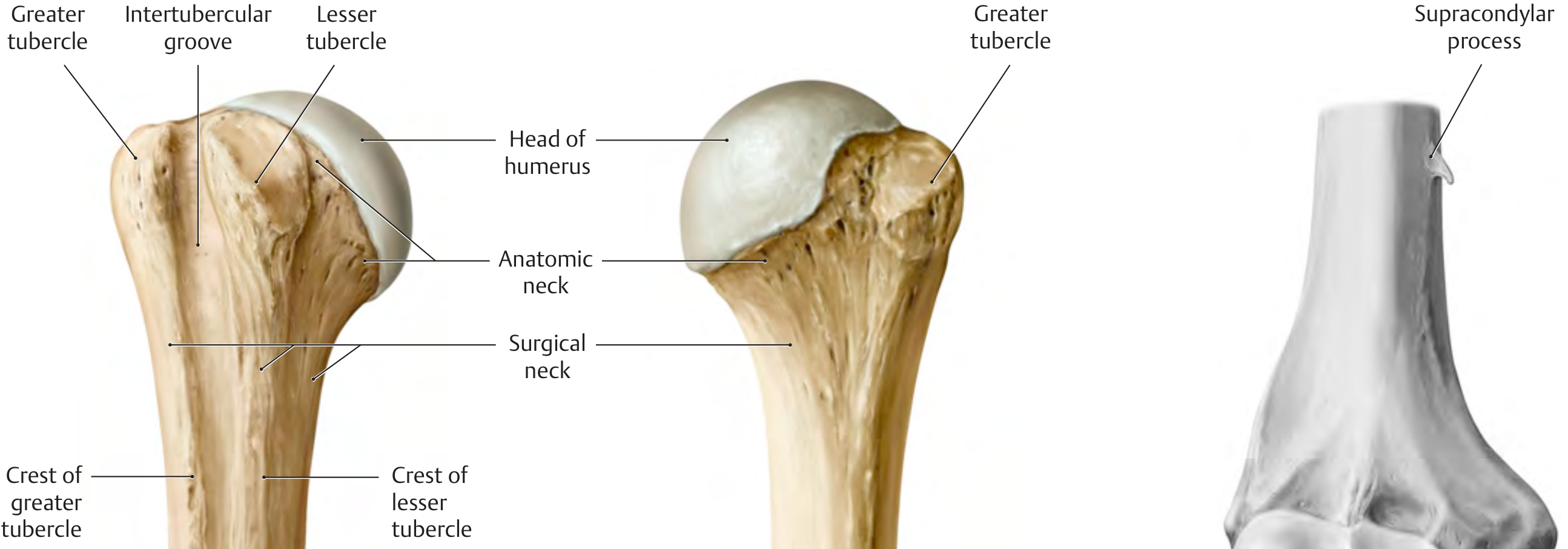
| Marking | Description |
|---|---|
| Head of humerus | Articular surface facing the glenoid cavity |
| Anatomic neck | Groove separating head from tubercles |
| Surgical neck | Narrow zone below tubercles - common fracture site |
| Greater tubercle | Lateral projection; site of rotator cuff insertions (SITS) |
| Lesser tubercle | Anterior projection; subscapularis inserts here |
| Intertubercular (bicipital) groove | Between tubercles; transmits long head of biceps tendon |
| Crest of greater tubercle | Pectoralis major inserts |
| Crest of lesser tubercle | Teres major inserts |
Surface Markings - Distal end:
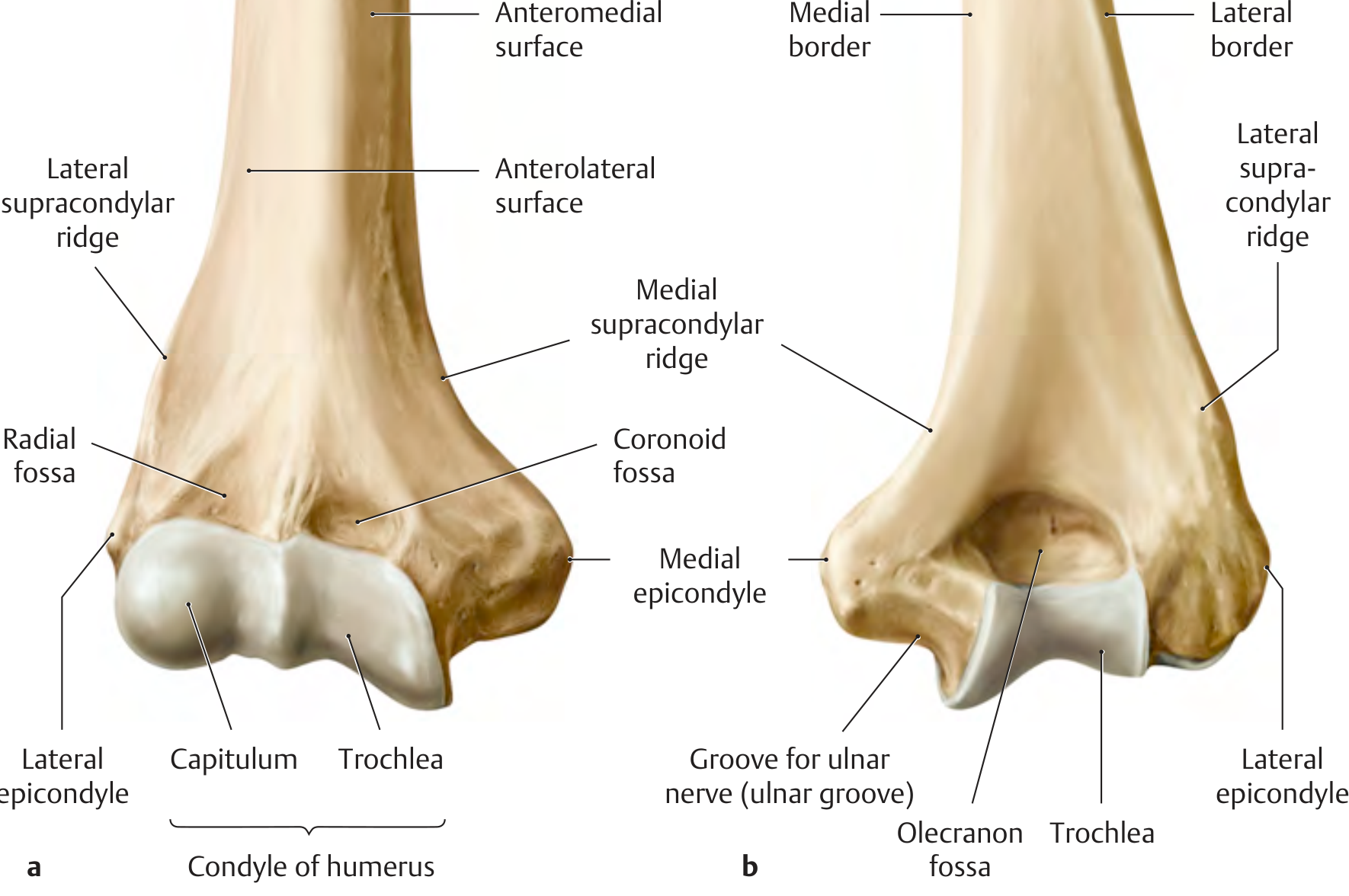
| Marking | Description |
|---|---|
| Capitulum | Articulates with head of radius |
| Trochlea | Articulates with trochlear notch of ulna |
| Medial epicondyle | Common flexor origin; ulnar nerve passes posteriorly |
| Lateral epicondyle | Common extensor origin |
| Medial supracondylar ridge | Origin of pronator teres (medial head) |
| Lateral supracondylar ridge | Origin of brachioradialis, ECRL |
| Coronoid fossa | Receives coronoid process during elbow flexion |
| Radial fossa | Receives head of radius during elbow flexion |
| Olecranon fossa (posterior) | Receives olecranon during elbow extension |
| Ulnar groove | Groove for ulnar nerve posteriorly |
| Deltoid tuberosity | Shaft marking; deltoid inserts here |
Scapula and shoulder relationship:
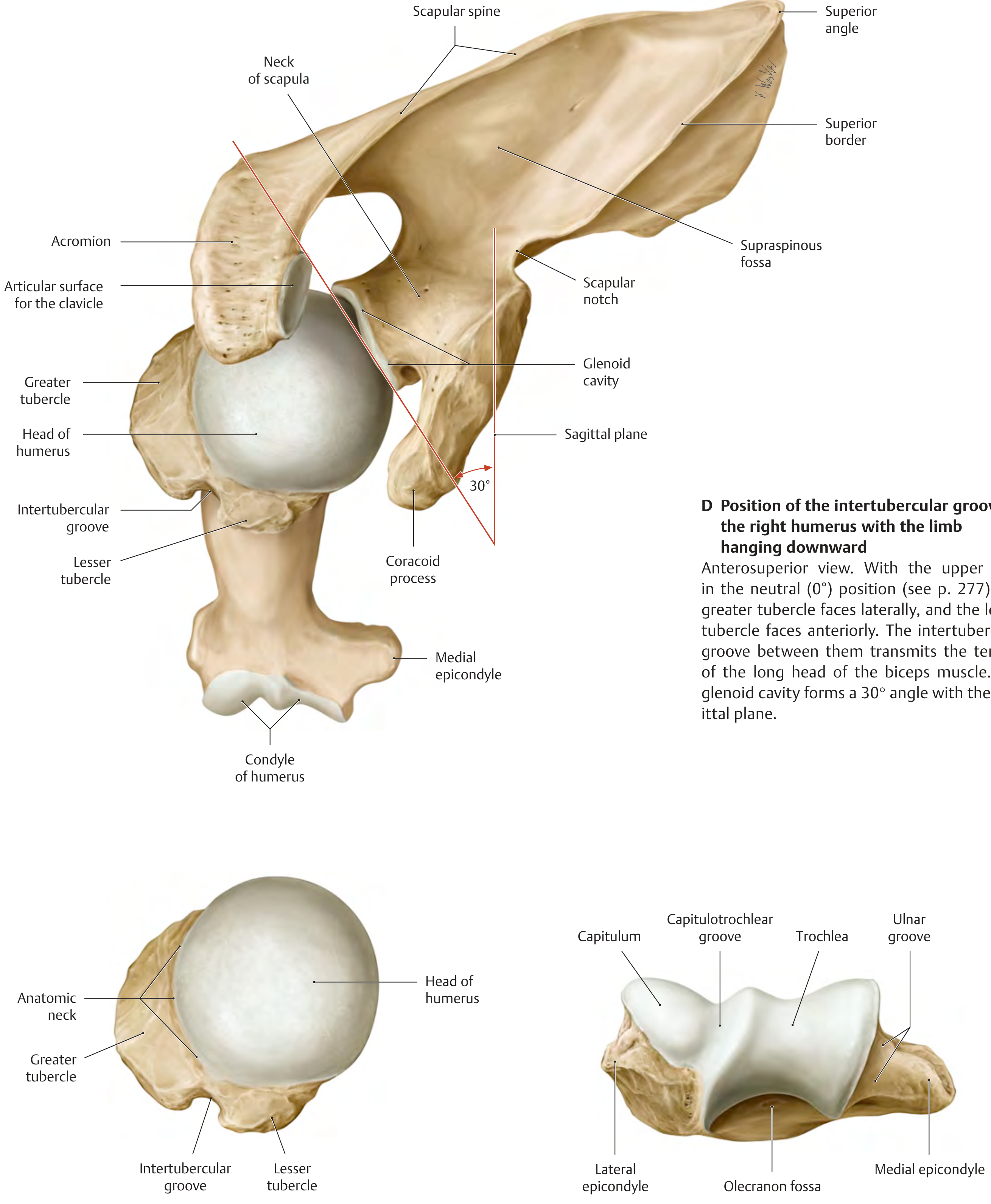
| Scapular Marking | Significance |
|---|---|
| Acromion | Deltoid and trapezius attach; forms acromioclavicular joint |
| Coracoid process | Origin of coracobrachialis, short head of biceps; pectoralis minor inserts |
| Glenoid cavity | Articulates with humeral head |
| Scapular spine | Trapezius inserts; deltoid originates |
| Supraspinous fossa | Supraspinatus originates here |
| Infraspinous fossa | Infraspinatus originates here |
| Subscapular fossa | Subscapularis originates here |
| Lateral border | Teres minor and teres major originate |
| Scapular notch | Suprascapular nerve passes here |
| Superior angle, Superior border | Serratus anterior inserts on medial border |
Rotator Cuff (SITS) - Origins & Insertions
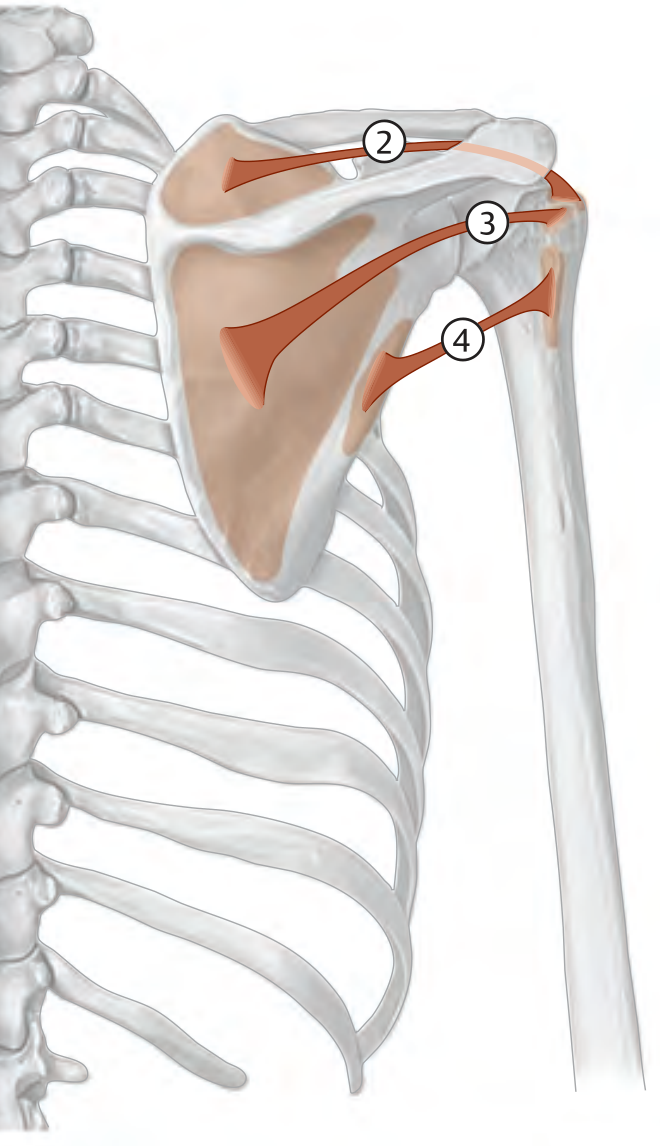
| Muscle | Origin | Insertion | Action | Nerve |
|---|---|---|---|---|
| Subscapularis | Subscapular fossa | Lesser tubercle of humerus | Internal rotation | Upper & lower subscapular (C5-C6) |
| Supraspinatus | Supraspinous fossa | Greater tubercle (superior facet) | Abduction (initiates 0-15°) | Suprascapular (C4-C6) |
| Infraspinatus | Infraspinous fossa | Greater tubercle (middle facet) | External rotation | Suprascapular (C4-C6) |
| Teres minor | Lateral border of scapula | Greater tubercle (inferior facet) | External rotation, weak adduction | Axillary (C5-C6) |
Deltoid
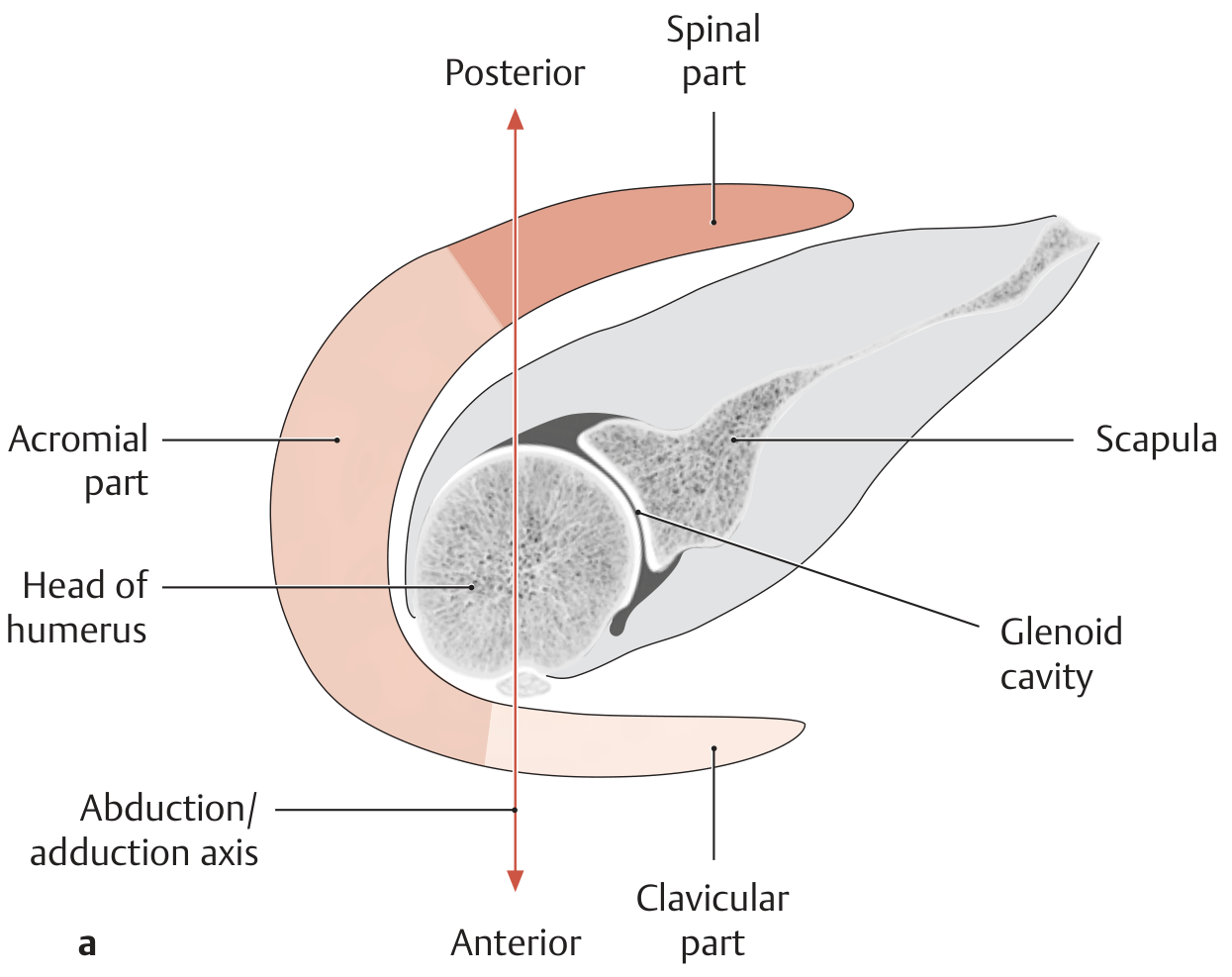
| Part | Origin | Insertion | Action |
|---|---|---|---|
| Clavicular part | Lateral 1/3 of clavicle | Deltoid tuberosity of humerus | Flexion, internal rotation, adduction |
| Acromial part | Acromion | Deltoid tuberosity | Abduction (main) |
| Spinal part | Scapular spine | Deltoid tuberosity | Extension, external rotation, adduction |
Nerve: Axillary nerve (C5, C6)
Radius and Ulna
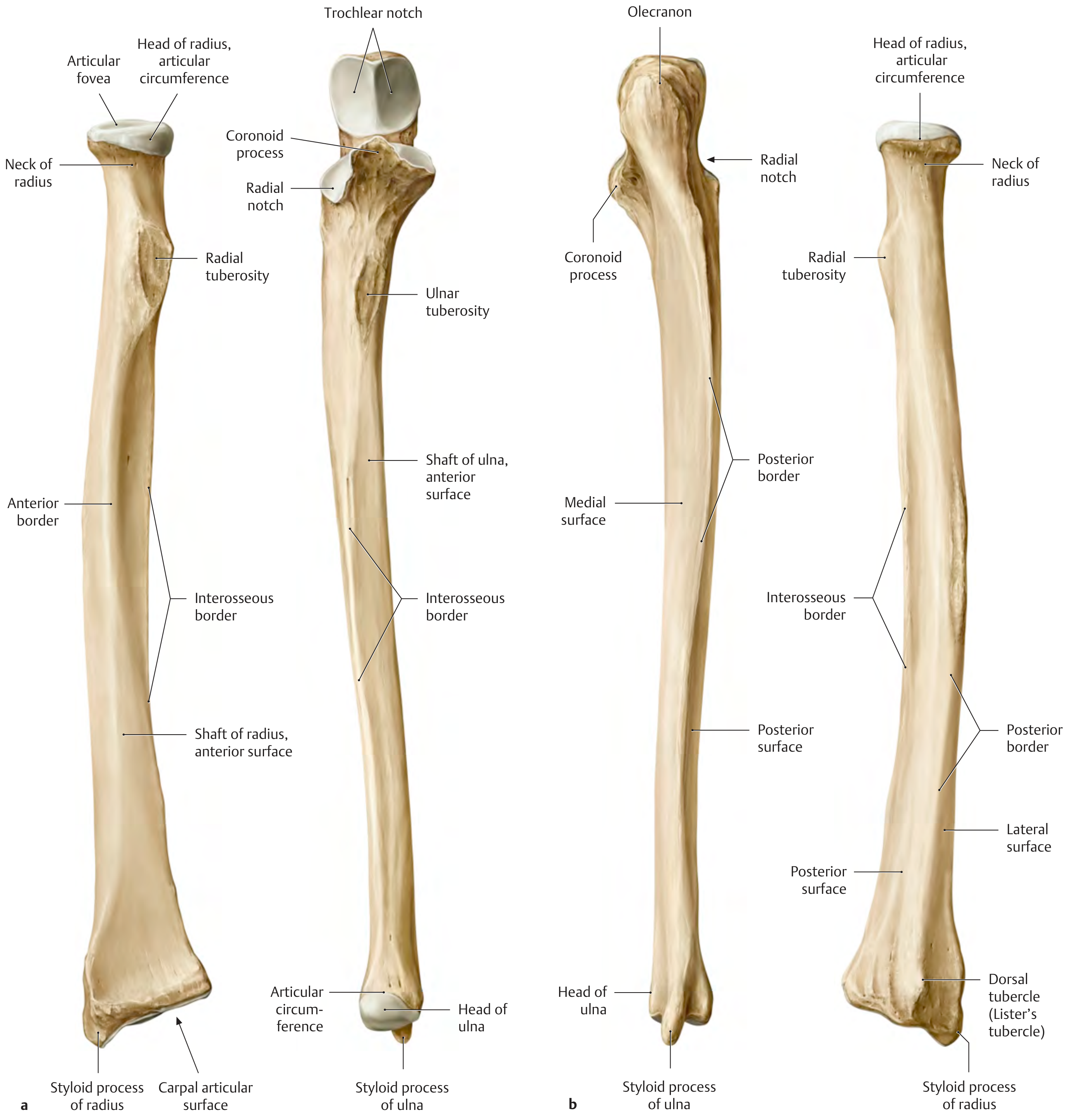
Radius surface markings:
- Head of radius, Articular fovea, Articular circumference
- Neck of radius
- Radial tuberosity - biceps brachii inserts
- Anterior border, Interosseous border (for interosseous membrane)
- Shaft - anterior surface
- Styloid process of radius
- Dorsal tubercle (Lister's tubercle) - extensor pollicis longus turns around it
- Carpal articular surface
Ulna surface markings:
- Olecranon - triceps inserts
- Trochlear notch (semilunar notch) - articulates with trochlea of humerus
- Coronoid process - brachialis inserts
- Radial notch - articulates with head of radius (proximal radioulnar joint)
- Ulnar tuberosity
- Interosseous border
- Shaft: anterior, medial, posterior surfaces
- Head of ulna, Styloid process of ulna
Forearm Flexors - Origins & Insertions (Common Flexor Origin = Medial Epicondyle)
| Muscle | Origin | Insertion | Action | Nerve |
|---|---|---|---|---|
| Pronator teres | Medial epicondyle (humeral head) + coronoid process (ulnar head) | Lateral surface of radius (mid-shaft) | Pronation, weak elbow flexion | Median (C6) |
| Flexor carpi radialis | Medial epicondyle | Base of 2nd (±3rd) metacarpal | Wrist flexion, radial deviation | Median (C6-C8) |
| Palmaris longus | Medial epicondyle | Palmar aponeurosis | Wrist palmar flexion | Median (C8-T1) |
| Flexor carpi ulnaris | Medial epicondyle + olecranon | Pisiform, hook of hamate, 5th metacarpal base | Wrist flexion, ulnar deviation | Ulnar (C8-T1) |
| Flexor digitorum superficialis | Medial epicondyle + coronoid process + radius | Sides of middle phalanges (digits 2-5) | Flexion of PIP joints, wrist | Median (C7-T1) |
| Flexor digitorum profundus | Proximal 2/3 of flexor surface of ulna + interosseous membrane | Base of distal phalanges (digits 2-5) | Flexion of DIP joints | Median (digits 2-3), Ulnar (digits 4-5) |
Carpal Bones
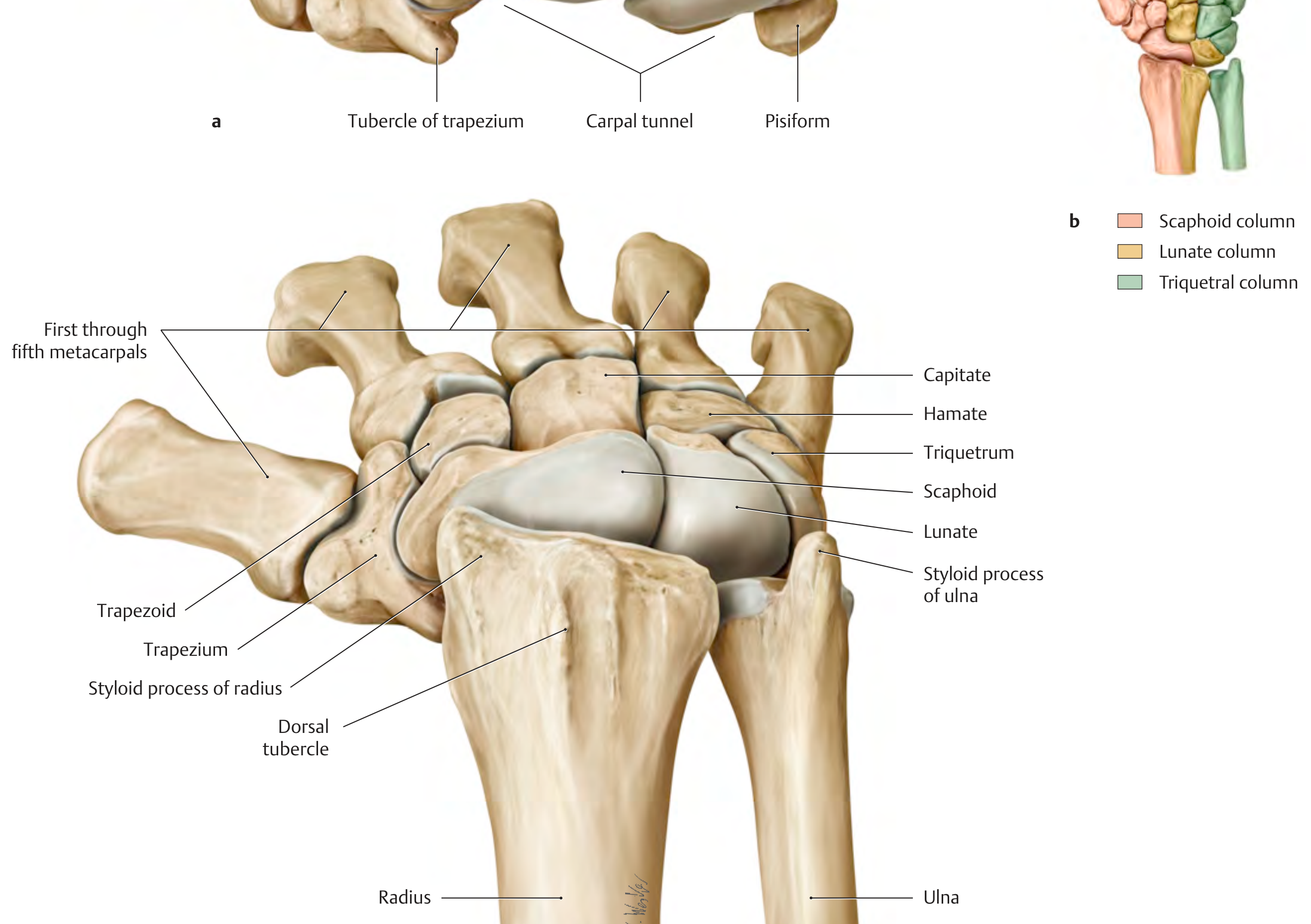
Proximal row (lateral to medial): Scaphoid - Lunate - Triquetrum - Pisiform (sesamoid in FCU tendon)
Distal row (lateral to medial): Trapezium - Trapezoid - Capitate - Hamate (with hook)
- Tubercle of trapezium + pisiform = lateral/medial walls of carpal tunnel
- Hook of hamate: origin of flexor digiti minimi brevis, opponens digiti minimi
LOWER LIMB
Femur - Surface Markings & Muscle Attachments
| Marking | Location | Muscle Attachment |
|---|---|---|
| Greater trochanter | Lateral proximal | Gluteus medius/minimus (insertion), obturators, piriformis |
| Lesser trochanter | Posteromedial proximal | Iliopsoas (insertion) |
| Intertrochanteric line (anterior) | Between trochanters | Iliofemoral ligament |
| Intertrochanteric crest (posterior) | Between trochanters | Quadratus femoris inserts |
| Neck of femur | Between head and shaft | Fracture-prone region |
| Head of femur | Proximal | Articular surface; ligamentum teres attached to fovea |
| Gluteal tuberosity | Posterior shaft | Gluteus maximus (lower fibers) inserts |
| Linea aspera | Posterior shaft (medial + lateral lips) | Vastus medialis, vastus lateralis, adductors, biceps femoris (short head) |
| Pectineal line | Medial proximal shaft | Pectineus inserts |
| Medial condyle | Distal | Medial collateral ligament |
| Lateral condyle | Distal | Lateral collateral ligament, popliteus |
| Lateral epicondyle | Distal | Gastrocnemius lateral head; fibular collateral lig. |
| Medial epicondyle | Distal | Gastrocnemius medial head |
| Adductor tubercle | Superior medial epicondyle | Adductor magnus inserts |
| Patellar surface | Anterior distal | Patella articulates |
Hip muscles - Origins & Insertions:
| Muscle | Origin | Insertion | Action | Nerve |
|---|---|---|---|---|
| Gluteus maximus | Posterior ilium, sacrum, coccyx | Gluteal tuberosity + iliotibial tract | Extension, external rotation of hip | Inferior gluteal (L5-S2) |
| Gluteus medius | External surface of ilium (between ant/post gluteal lines) | Greater trochanter | Abduction, internal rotation | Superior gluteal (L4-S1) |
| Gluteus minimus | External surface of ilium (between ant/inf gluteal lines) | Greater trochanter (anterior facet) | Abduction, internal rotation | Superior gluteal (L4-S1) |
| Iliopsoas | Iliacus: iliac fossa; Psoas major: T12-L5 vertebrae | Lesser trochanter | Hip flexion | Femoral n. (L2-L4) |
| Tensor fasciae latae | ASIS, anterior iliac crest | Iliotibial tract | Hip flexion, abduction | Superior gluteal (L4-S1) |
| Piriformis | Anterior surface of sacrum (S2-S4) | Greater trochanter (superior border) | External rotation, abduction | S1-S2 |
Thigh muscles - Origins & Insertions:
| Muscle | Origin | Insertion | Action | Nerve |
|---|---|---|---|---|
| Rectus femoris | AIIS (straight head), acetabular rim (reflected head) | Tibial tuberosity (via patella + patellar lig.) | Knee extension, hip flexion | Femoral (L2-L4) |
| Vastus lateralis | Lateral lip of linea aspera, greater trochanter | Tibial tuberosity | Knee extension | Femoral |
| Vastus medialis | Medial lip of linea aspera | Tibial tuberosity | Knee extension | Femoral |
| Vastus intermedius | Anterior/lateral femoral shaft | Tibial tuberosity | Knee extension | Femoral |
| Biceps femoris | Long head: ischial tuberosity; Short head: lateral lip of linea aspera | Head of fibula | Knee flexion, hip extension | Sciatic (tibial + common peroneal) |
| Semitendinosus | Ischial tuberosity | Medial surface of tibia (pes anserinus) | Knee flexion, hip extension | Sciatic (tibial) |
| Semimembranosus | Ischial tuberosity | Posterior medial tibial condyle | Knee flexion, hip extension | Sciatic (tibial) |
| Adductor longus | Pubic body below pubic crest | Medial lip of linea aspera | Adduction | Obturator (L2-L4) |
| Adductor magnus | Ischiopubic ramus (adductor part), ischial tuberosity (hamstring part) | Linea aspera + adductor tubercle | Adduction, extension | Obturator + sciatic |
| Gracilis | Body and inferior ramus of pubis | Medial tibia (pes anserinus) | Adduction, knee flexion | Obturator |
| Pectineus | Pectineal line of pubis | Pectineal line of femur | Adduction, flexion | Femoral ± obturator |
Tibia and Fibula - Surface Markings
| Tibia Marking | Significance |
|---|---|
| Medial condyle | Articulates with medial femoral condyle; semimembranosus inserts posteriorly |
| Lateral condyle | Articulates with lateral femoral condyle; iliotibial band inserts |
| Intercondylar eminence | Between condyles; ACL, PCL attach |
| Tibial tuberosity | Patellar ligament (quadriceps) inserts |
| Anterior border (shin) | Subcutaneous; palpable landmark |
| Medial surface | Subcutaneous throughout |
| Medial malleolus | Distal; forms medial ankle mortise |
| Soleal line (posterior) | Soleus originates |
| Fibula Marking | Significance |
|---|---|
| Head of fibula | Biceps femoris inserts; fibular collateral lig. |
| Neck | Common peroneal nerve winds around |
| Lateral malleolus | Forms lateral ankle mortise; distal fibula |
Leg muscles - Key Origins & Insertions:
| Muscle | Origin | Insertion | Action | Nerve |
|---|---|---|---|---|
| Tibialis anterior | Lateral tibial condyle, lateral tibial shaft, interosseous membrane | Medial cuneiform, 1st metatarsal base | Dorsiflexion, inversion | Deep peroneal (L4-L5) |
| Extensor hallucis longus | Middle fibula, interosseous membrane | Dorsum of great toe (distal phalanx) | Extends hallux, dorsiflexion | Deep peroneal (L5-S1) |
| Gastrocnemius | Lateral/medial femoral condyles (two heads) | Calcaneus (via Achilles tendon) | Plantarflexion, knee flexion | Tibial (S1-S2) |
| Soleus | Head and posterior fibula, soleal line of tibia | Calcaneus (via Achilles tendon) | Plantarflexion | Tibial (S1-S2) |
| Tibialis posterior | Posterior tibia, fibula, interosseous membrane | Navicular tuberosity, cuneiforms, metatarsal bases 2-4 | Plantarflexion, inversion | Tibial (L4-L5) |
| Peroneus longus | Head and upper lateral fibula | 1st metatarsal base, medial cuneiform (plantar) | Eversion, plantarflexion | Superficial peroneal (L5-S1) |
| Peroneus brevis | Lower 2/3 lateral fibula | Base of 5th metatarsal | Eversion | Superficial peroneal (L5-S1) |
VERTEBRAL COLUMN
Vertebral Surface Markings
| Feature | Location | Significance |
|---|---|---|
| Spinous process | Posterior | Nuchal ligament, interspinous ligaments, back muscles |
| Transverse processes | Lateral | Costotransverse joints (T); intertransverse ligaments; deep back muscles |
| Articular processes (facets) | Superior/inferior | Zygapophyseal joints |
| Vertebral body | Anterior | Weight-bearing; disc articulations |
| Pedicles | Between body and arch | Form intervertebral foramina |
| Laminae | Connect pedicles to spinous | Ligamentum flavum |
| C1 (Atlas) | No body or spinous process | Posterior arch with posterior tubercle |
| C2 (Axis) | Dens (odontoid process) | Pivot for head rotation |
| C7 (Vertebra prominens) | Long non-bifid spinous | Key landmark |
Deep back muscles (erector spinae group):
| Muscle | Origin | Insertion | Action |
|---|---|---|---|
| Iliocostalis | Iliac crest, sacrum | Ribs, cervical transverse processes | Back extension, lateral flexion |
| Longissimus | Transverse processes (lumbar-thoracic) | Ribs, transverse processes, mastoid | Back extension, lateral flexion |
| Spinalis | Spinous processes | Spinous processes | Back extension |
THORAX
Ribs and Sternum - Surface Markings
| Marking | Significance |
|---|---|
| Manubrium | Sternal angle (Louis angle) at rib 2 junction; clavicle articulates |
| Sternal angle (of Louis) | Level of rib 2, T4/T5 vertebral disc, bifurcation of trachea |
| Body of sternum | Ribs 2-7 articulate via costal cartilages |
| Xiphoid process | Lower sternum; T10 level; diaphragm and rectus abdominis attach |
| Costal angle | Posterior angle of rib; external to internal intercostal overlap |
| Costal groove | Inferior surface of rib; VAN = vein, artery, nerve |
| Tubercle of rib | Posterior; articulates with transverse process of vertebra |
SKULL AND MANDIBLE - Key Surface Markings
| Marking | Bone | Muscle/Structure |
|---|---|---|
| External occipital protuberance | Occipital | Trapezius; nuchal ligament |
| Mastoid process | Temporal | Sternocleidomastoid inserts |
| Styloid process | Temporal | Stylohyoid, styloglossus, stylopharyngeus originate |
| Zygomatic arch | Temporal + zygomatic | Masseter originates (inferior surface) |
| Temporal fossa | Temporal, parietal, frontal, sphenoid | Temporalis muscle |
| Pterygoid plates | Sphenoid | Medial/lateral pterygoids originate |
| Mental protuberance | Mandible | Mentalis inserts |
| Coronoid process of mandible | Mandible | Temporalis inserts |
| Angle of mandible | Mandible | Masseter inserts (lateral), medial pterygoid (medial) |
| Mylohyoid line (internal) | Mandible | Mylohyoid muscle |
| Condylar process | Mandible | Forms temporomandibular joint |
PELVIS
| Marking | Significance |
|---|---|
| ASIS (Anterior Superior Iliac Spine) | Sartorius + TFL originate; inguinal ligament lateral attachment |
| AIIS (Anterior Inferior Iliac Spine) | Rectus femoris straight head originates |
| Iliac crest | Gluteal muscles originate; external oblique inserts |
| PSIS (Posterior Superior Iliac Spine) | Sacroiliac joint; dimple of Venus |
| Ischial tuberosity | Hamstrings (biceps femoris, semitendinosus, semimembranosus) originate; "sitting bone" |
| Ischial spine | Sacrospinous ligament; coccygeus muscle |
| Pubic symphysis | Rectus abdominis inserts at pubic crest; adductors originate |
| Acetabulum | Hip socket; ilium/ischium/pubis contribution |
| Obturator foramen | Obturator internus/externus muscles |
INTERACTIVE 3D RESOURCES
For true 3D visualization with surface markings and muscle origins/insertions, these are the top tools:
1. Complete Anatomy (3D4Medical) - best clinical tool
Shows all muscles with origin/insertion highlights on the 3D skeleton.
2. 3D Bones and Muscles App (iOS/Android) - free
145 detailed muscles, all bones, virtual dissection layers.
3. Muscle and Motion - animated muscle videos with O&I
4. Sketchfab - free 3D muscular insertions model
Quick Reference: Key Muscle Memory Rules
- Common flexor origin = medial epicondyle of humerus (all forearm flexors + pronator teres)
- Common extensor origin = lateral epicondyle of humerus (all forearm extensors)
- Pes anserinus = gracilis + sartorius + semitendinosus insert on medial tibia (mnemonic: Girls Sew Stockings)
- SITS = rotator cuff: Supraspinatus, Infraspinatus, Teres minor (all insert on greater tubercle), Subscapularis (lesser tubercle)
- Adductor tubercle = adductor magnus hamstring head only
- Achilles tendon = gastrocnemius + soleus (triceps surae) into calcaneus
Source: THIEME Atlas of Anatomy - General Anatomy and Musculoskeletal System, Gray's Anatomy for Students
This is a shared conversation. Sign in to Orris to start your own chat.