
Breech presentation clinical features
Reading File
Now let me search the library for breech presentation content in parallel.
Finding Sources
Finding Sources
Reading File
Reading File
Finding Sources
Reading File
Reading File
Finding Sources
Finding Sources
Reading File
Loading Image
Loading Image
Reading File
Now let me get the image of the different breech types and also read more about specific clinical features like auscultation findings and Leopold maneuvers.
Finding Sources
Reading File
I now have comprehensive information to write a detailed answer. Let me also fetch the breech types image from the Roberts & Hedges textbook.
Finding Sources
I have sufficient information from the textbooks to compile a comprehensive answer. Here is the full response:
Breech Presentation - Clinical Features
Definition
Breech presentation is a malpresentation where the fetal buttocks, feet, or knees occupy the lower uterine segment, with the fetal head in the uterine fundus. It is the most common malpresentation, occurring in approximately 3-4% of term deliveries (roughly 1 in 25 live births).
Types of Breech Presentation
| Type | Description |
|---|---|
| Frank breech | Hips flexed, legs extended (knees straight, feet near face). Most common (~65-70%). Buttocks present. |
| Complete breech | Hips AND knees flexed ("cross-legged"). Buttocks and feet present. |
| Incomplete / Footling breech | One or both feet/knees are lowermost in the canal. Highest risk of cord prolapse. |
The reference point for position in breech (equivalent to occiput in vertex) is the fetal sacrum - e.g., "left sacro-anterior" (LSA).
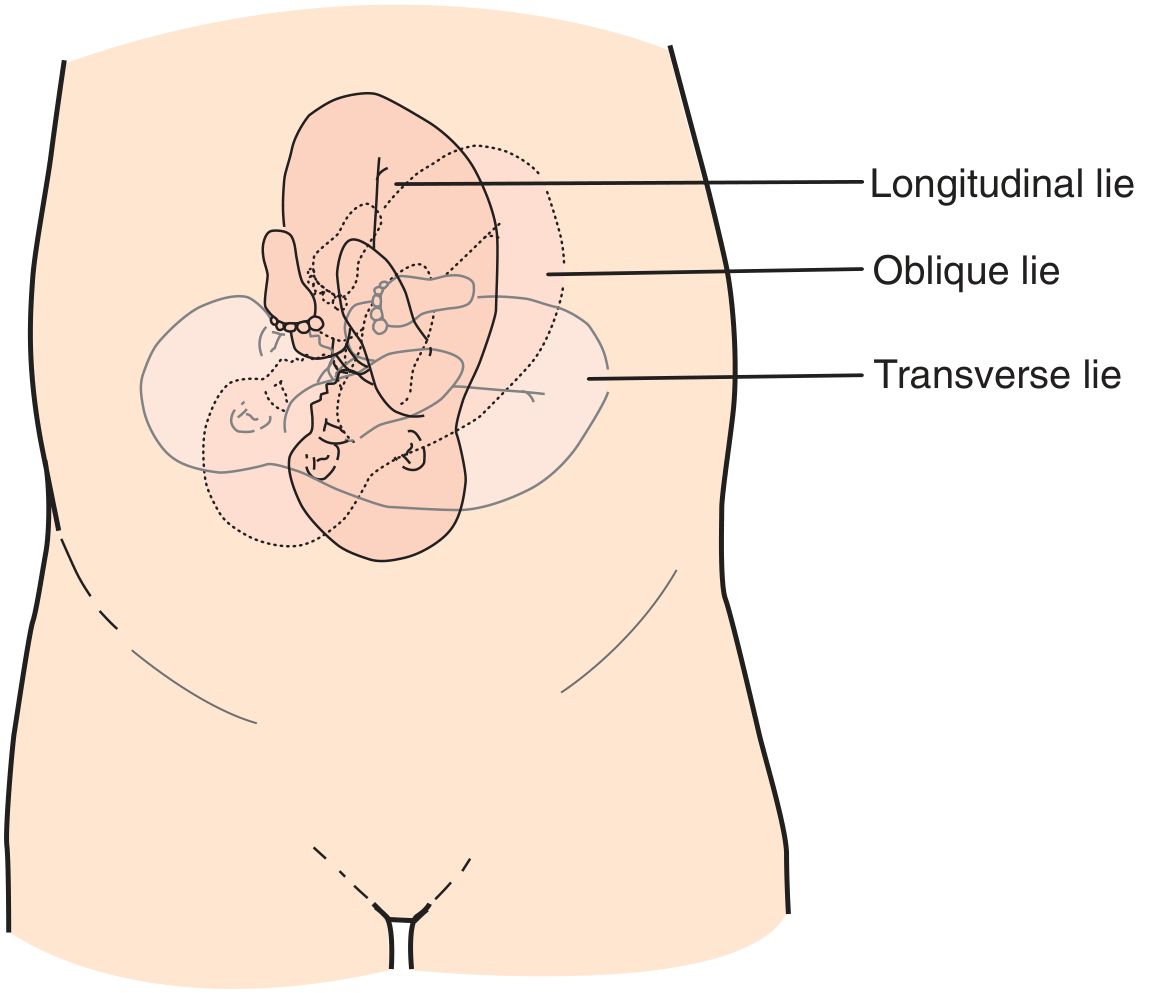
Incidence by Gestational Age
Breech is far more common in early pregnancy and converts to vertex with advancing gestation:
- 24% at 18-22 weeks
- 8% at 28-30 weeks
- 7% at 34 weeks
- 3% at 38-40 weeks (term)
- ~25-30% of all preterm infants (<28 weeks) are in breech position
Predisposing Factors / Etiology
- Prematurity (most common - the fetus has not yet rotated)
- Fundal-cornual placental implantation (occurs in 7% of pregnancies; restricts space for the head at the fundus, making breech position more "comfortable")
- Polyhydramnios (excessive fluid allows free fetal movement and instability)
- Oligohydramnios (limits movement, prevents version)
- Multiple pregnancy (twins, triplets - space constraint)
- Uterine abnormalities (fibroids, bicornuate uterus, septate uterus)
- Fetal abnormalities / neuromuscular disorders - fetuses with diminished muscle tone or motor deficits cannot rotate; neuromuscular conditions carry an inordinately high rate of breech presentation
- Prior breech presentation (recurrence risk)
- Multiparity (lax uterine walls)
- Contracted pelvis (CPD - prevents engagement of vertex)
- Placenta previa (occupies lower segment)
- Hydrocephalus (large head floats to fundus)
Clinical Features
1. Symptoms
- Often asymptomatic - the patient typically notices no difference
- May feel kicking or hard fetal parts in the lower abdomen
- Discomfort or pressure in the upper abdomen / under the ribs (head at fundus)
2. Abdominal Examination - Leopold's Maneuvers
Leopold's 1st maneuver (fundal grip):
- A hard, round, ballottable mass felt at the fundus - this is the fetal head
- The head is smooth, hard, and globular; moves independently of the trunk on ballottement (cephalic sulcus can be felt)
Leopold's 2nd maneuver (lateral grip):
- Fetal back felt as a smooth, firm resistance on one side
- Small irregular parts (limbs) on the other side
Leopold's 3rd maneuver (Pawlik's grip):
- Soft, irregular, non-ballottable mass presenting at the lower pole / over the pelvic brim - this is the breech
- The breech is softer, less regular, and does NOT ballotte independently (unlike the head)
Leopold's 4th maneuver:
- Confirms the presenting part in the pelvis is soft / irregular (breech)
- The presenting part is not engaged or poorly engaged (breech engages later than vertex)
Note: In active labor, Leopold maneuvers may be difficult to perform reliably; vaginal examination is then required. - Rosen's Emergency Medicine
3. Auscultation
- Fetal heart sounds are heard above the umbilicus (in vertex they are below the umbilicus)
- Specifically heard at or above the umbilical level, toward the fetal back
4. Vaginal Examination
- Feel soft, irregular tissue (buttocks) instead of the hard, smooth head
- Anus and ischial tuberosities may be palpable; the anal orifice is flanked by bone on only two sides, whereas the face and skull have a complete circle of bone
- Meconium may stain the examining finger (from fetal gut compression)
- In frank breech: external genitalia may be felt
- In footling: feet may be felt (toes are distinguished from fingers by their alignment)
- In complete: both buttocks and feet/knees
Key distinguishing point: Whenever a fontanel is not identified on vaginal examination, a breech presentation should be suspected. - Rosen's Emergency Medicine
5. Ultrasound (Confirmation)
- Bedside ultrasound is the definitive confirmatory tool
- Establishes type of breech, gestational age, fetal weight, amniotic fluid index
- Identifies hyperextended fetal neck (risk of spinal cord injury with vaginal delivery) and position of arms (nuchal arms increase dystocia)
- Rules out placenta previa and fetal anomalies
Associated Risks / Complications
- Cord prolapse - especially in footling breech (incomplete occlusion of cervical os)
- Head entrapment - after-coming head trapped by incompletely dilated cervix (particularly with preterm <1500 g)
- Fetal asphyxia - cord compression, entrapment
- Birth trauma - neck/arm injuries if delivery technique is incorrect; brachial plexus injury
- Hyperextended neck - associated with spinal cord injury if vaginal delivery attempted
- Developmental hip dysplasia - frank breech position (hips flexed, knees extended) increases risk
Key Differentiating Points on Vaginal Examination
| Feature | Vertex | Breech |
|---|---|---|
| Presenting part | Hard, smooth, round | Soft, irregular |
| Ballottement | Present (independent) | Absent / reduced |
| Sutures/fontanelles | Palpable | Not palpable |
| Orifice palpated | Mouth (triangle, firm margins) or nose | Anus (flanked by bone on 2 sides only) |
| Meconium on glove | Absent (normally) | May be present |
Summary
Breech presentation is diagnosed by a combination of:
- Fundal head on Leopold maneuvers (hard, round, ballottable)
- Soft presenting part in the lower pole / pelvis
- Fetal heart sounds above the umbilicus
- Vaginal examination - soft irregular presenting part without fontanelles
- Ultrasound confirmation - mandatory before any management decision
Management centers on external cephalic version (ECV) if appropriate, with cesarean section recommended for term breech given the evidence that planned vaginal breech delivery carries higher perinatal morbidity and mortality.
Sources:
- Creasy & Resnik's Maternal-Fetal Medicine: Principles and Practice
- Rosen's Emergency Medicine: Concepts and Clinical Practice
- Roberts and Hedges' Clinical Procedures in Emergency Medicine
- Tintinalli's Emergency Medicine: A Comprehensive Study Guide
This is a shared conversation. Sign in to Orris to start your own chat.