Give me the photo of the galvanic corrosion for oral teeth

Reading File
Searching Images

galvanic corrosion oral teeth dental amalgam gold restoration intraoral electrochemical corrosion clinical photograph

Searching the Web

galvanic corrosion dental restorations oral cavity image

Searching PubMed

dental galvanic corrosion

Reading Web Page

https://pmc.ncbi.nlm.nih.gov/articles/PMC10558418
Loading Image
Loading Image
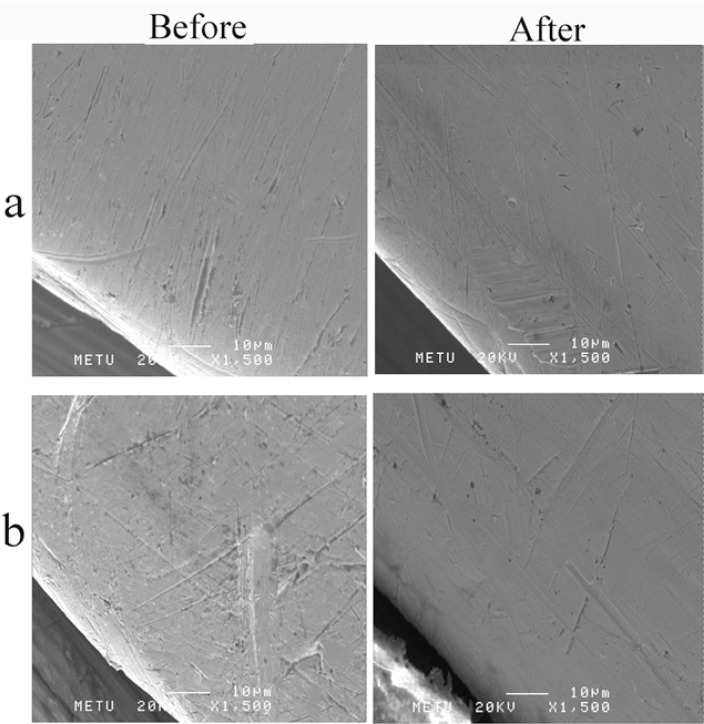
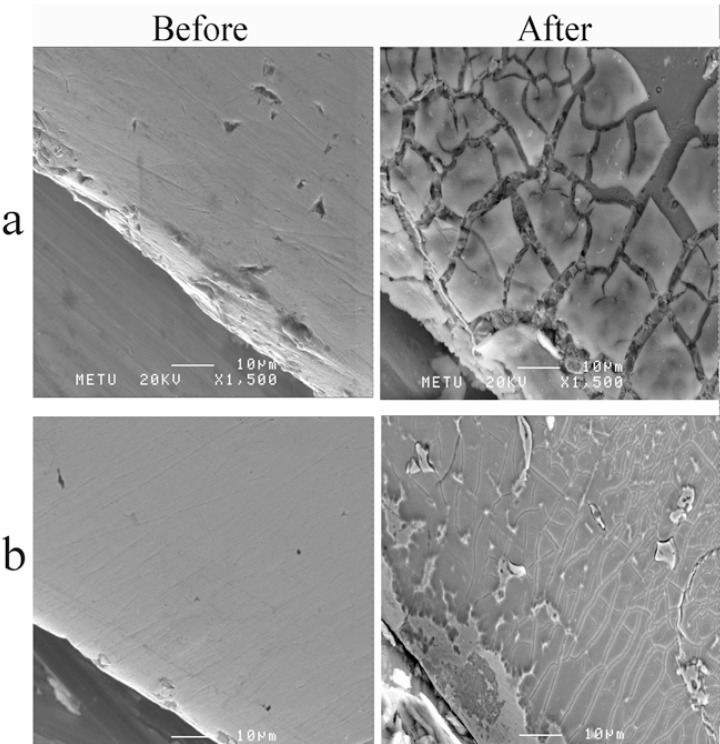
Here are scanning electron microscope (SEM) photographs showing corrosion damage in dental alloys used with titanium implants. The corroded surface shows breakdown and grain-boundary changes after electrochemical testing in artificial saliva.
SEM photograph showing corrosion of a dental alloy coupled with titanium
SEM photograph showing comparison of dental alloy surfaces after corrosion testing
Galvanic corrosion happens when two dissimilar dental metals, for example an amalgam filling and a metal crown, contact each other in saliva, which acts as an electrolyte. It can also occur at titanium implant-abutment-restoration interfaces. The implant corrosion review describes this mechanism and its clinical settings.

For drawing in the exam

Reading File
Generating Image

Simple hand-drawn exam diagram of galvanic corrosion in the oral cavity: cross-section of two adjacent molar teeth, left tooth with an amalgam restoration labelled anode, right tooth with a gold metal crown labelled cathode, saliva between them labelled electrolyte, arrows showing electron flow through metallic contact and ionic current through saliva. Include a small corrosion/metal ion release symbol near the amalgam. Clear labels suitable for a dental exam.
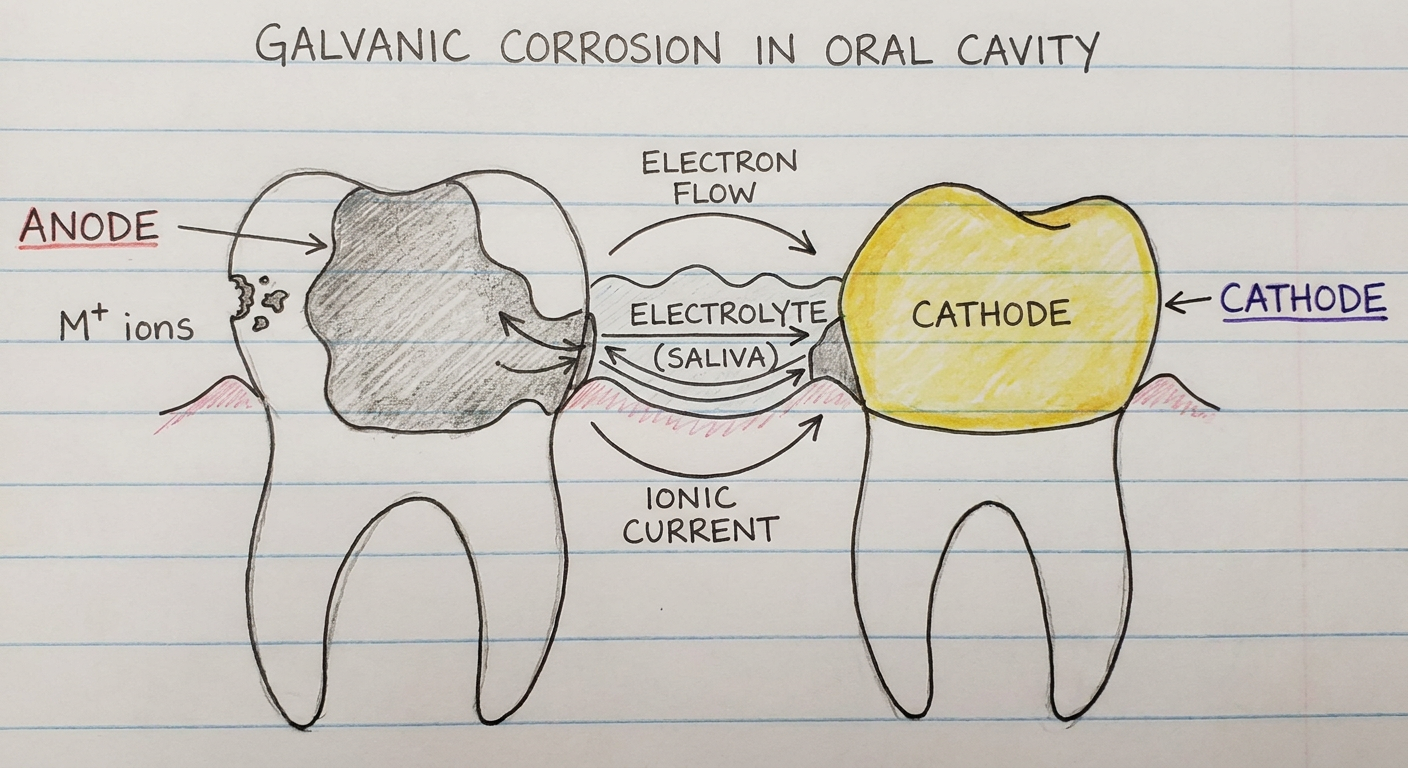
Use this simplified labelled diagram for an exam:
Exam drawing: galvanic corrosion between dissimilar dental restorations
Labels to write:
  1. Amalgam restoration or base metal alloy - anode
  2. Gold crown or noble metal restoration - cathode
  3. Saliva - electrolyte
  4. Electron flow through metallic contact
  5. Ionic current through saliva
  6. Corrosion with release of metal ions at the anode
Caption: Galvanic corrosion occurs when dissimilar metallic restorations are electrically connected in the presence of saliva, forming an electrochemical cell.

From Phillips book

Reading File
Finding Sources
Searching the Web

Phillips science dental materials galvanic corrosion figure

Searching PubMed

dental galvanic corrosion

Finding Sources
Finding Sources
I could not locate Phillips' Science of Dental Materials in the available textbook library, so I cannot give you the exact Phillips figure.
For an exam, draw the standard galvanic cell diagram in this format:
      Metal restoration A                     Metal restoration B
      (less noble metal)                      (more noble metal)
            ANODE                                  CATHODE
             |                                        |
             |_________ metallic contact _____________|
                       ← electron flow

        ┌──────────────── SALIVA ────────────────┐
        │               electrolyte               │
        │          ionic current through saliva   │
        └────────────────────────────────────────┘

      Anode: oxidation and metal-ion release
      M  →  Mⁿ⁺ + ne⁻
Title: Galvanic corrosion between dissimilar dental restorations.
Key statement to write: When dissimilar metallic restorations are in electrical contact in the presence of saliva, a galvanic cell forms. The less noble metal acts as the anode and undergoes corrosion, while the more noble metal acts as the cathode.
If you tell me the edition of Phillips you use, I can help identify the appropriate chapter/figure wording for your exam notes.
This is a shared conversation. Sign in to Orris to start your own chat.