
Compound A 5 marks answer
I need a bit more context before I can give you a useful answer. "Compound A" could refer to many different topics depending on your subject area.
Asking for Preferences
Which subject or topic is this 'Compound A' question from? · Can you share the full question or any additional context (e.g., a description of Compound A, what it does, or the chapter it's from)?
Compound A in anaesthesia 5 mark answer
Compound A in anaesthesia refers to a nephrotoxic degradation product formed when sevoflurane reacts with carbon dioxide absorbents (soda lime/baralyme) in anaesthesia machines. It is a vinyl ether compound (fluoromethyl-2,2-difluoro-1-(trifluoromethyl)vinyl ether) that raises concerns about renal toxicity, especially at low fresh gas flows.
Searching sources...
Reading File
Finding Sources
Searching the Web
Compound A sevoflurane anaesthesia nephrotoxicity 5 marks exam answer
Reading File
Reading File
Reading File
Loading Image
Here is a complete, exam-ready 5-mark answer on Compound A in Anaesthesia, sourced directly from Miller's Anesthesia (10th edition):
Compound A in Anaesthesia
Definition and Formation
Compound A is a haloalkene - specifically fluoromethyl-2,2-difluoro-1-(trifluoromethyl) vinyl ether - formed by the chemical degradation of sevoflurane when it comes into contact with strong base-containing CO2 absorbents (soda lime or Baralyme) in rebreathing circuits. Strong bases (NaOH and KOH) extract a proton from the isopropyl group of sevoflurane, generating this volatile degradation product.
Factors Affecting Compound A Concentration
| Factor | Effect on Compound A levels |
|---|---|
| Low fresh gas flow (FGF) | Increases accumulation (FGF 1 L/min → ~20 ppm with soda lime, ~30 ppm with Baralyme) |
| High FGF (≥2 L/min) | Reduces accumulation |
| Baralyme (vs. soda lime) | Produces more Compound A |
| Longer case duration | Greater cumulative exposure (ppm-hours) |
| Higher vaporizer output | Increases formation |
Nephrotoxicity - Animal vs. Human
In rats: Compound A is dose-dependent nephrotoxin.
- Renal injury occurs above 150 ppm-hours (e.g., 50 ppm for 3 hours)
- Above 200 ppm-hours: moderately severe but reversible proximal tubular necrosis, raised BUN and creatinine
- Above 1000 ppm-hours: lethal in 50% of rats
In humans: No clinically significant nephrotoxicity has been demonstrated, even at exposures >200 ppm-hours. BUN, creatinine, urinary protein/glucose, and sensitive markers (N-acetyl-beta-glucosaminidase, beta2-microglobulin) remain unchanged.
Mechanism of Nephrotoxicity (Rodents)
The proposed pathway is shown below:
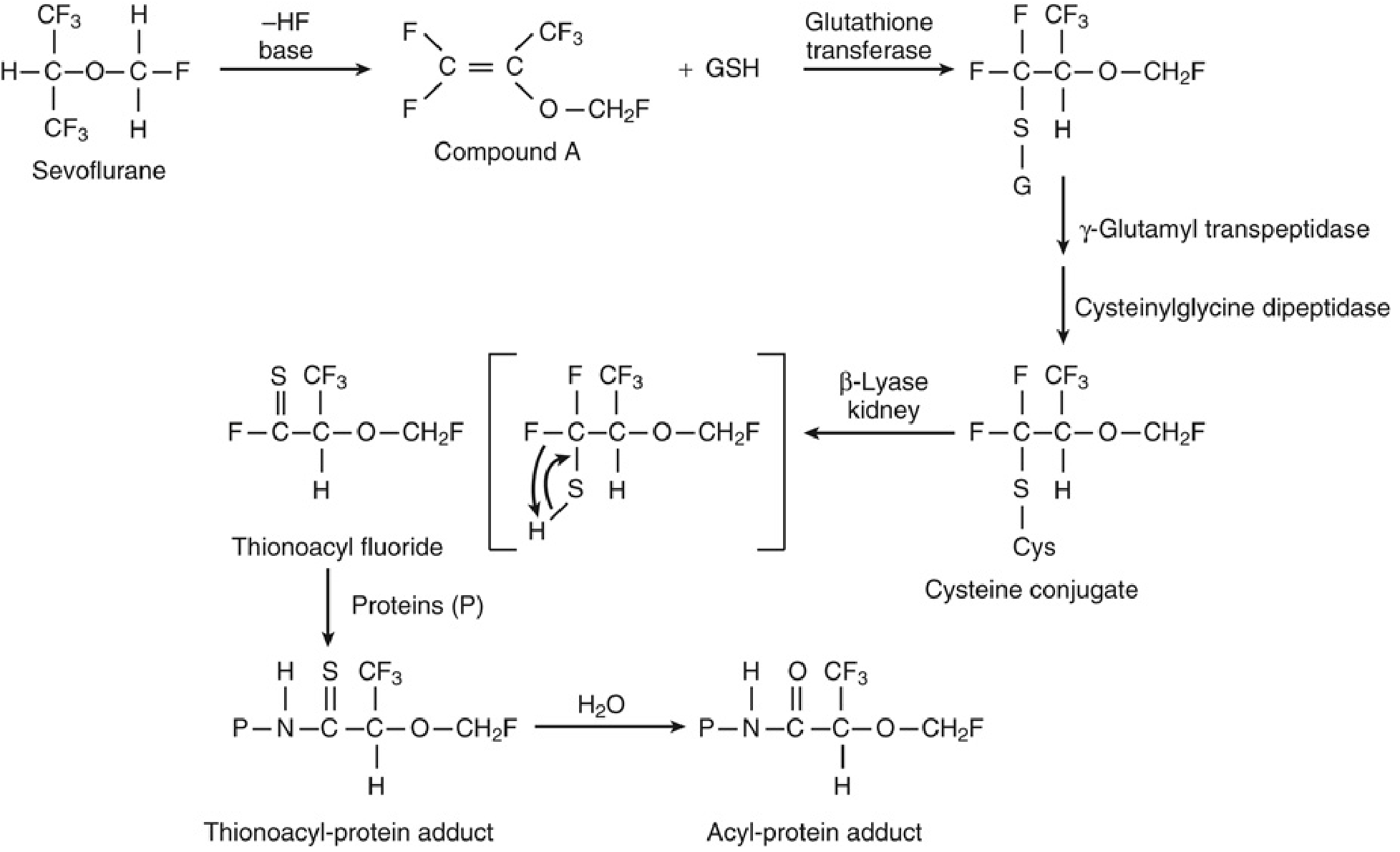
- Sevoflurane degrades to Compound A (via base-catalyzed elimination of HF)
- Compound A undergoes hepatic S-conjugation with glutathione (via glutathione transferase)
- Further metabolism by gamma-glutamyl transpeptidase and cysteinylglycine dipeptidase yields an S-cysteine conjugate delivered to the kidney
- Renal beta-lyase cleaves the cysteine conjugate to produce a reactive thionoacyl fluoride intermediate
- This intermediate acylates renal proteins, causing proximal tubular cell damage
Why Humans Are Less Susceptible
Human kidneys have far lower beta-lyase activity than rat kidneys. An alternative mechanism (formation of reactive sulfoxides via renal CYP3A isozymes) has also been proposed, but these isozymes are also more active in rats than humans. This interspecies difference in metabolic activation explains the differential toxicity.
Clinical Significance and Safety Guidelines
- Compound A nephrotoxicity in humans is not clinically significant - even in patients with pre-existing renal insufficiency, no difference in postoperative renal function was found when comparing low-flow sevoflurane to isoflurane
- FDA/package labeling recommends:
- FGF ≥ 2 L/min to minimize Compound A accumulation
- FGF < 1 L/min is not recommended
- Limit sevoflurane to < 2 MAC-hours at FGF 1 to <2 L/min
- Newer CO2 absorbents that contain no NaOH or KOH (e.g., Amsorb, Drägersorb Free) produce minimal or no Compound A
Summary for exam: Compound A is a volatile nephrotoxic sevoflurane degradation product formed by reaction with strong bases in CO2 absorbents. It causes proximal tubular necrosis in rats via the beta-lyase pathway, but humans are largely resistant due to very low renal beta-lyase activity. Clinically, it is managed by using fresh gas flows ≥2 L/min.
(Source: Miller's Anesthesia, 10th edition, Ch. 18 - "Sevoflurane, Compound A, and Renal Toxicity")
This is a shared conversation. Sign in to Orris to start your own chat.