
Anatomy of parotid gland
Reading File
Now let me search the medical library for parotid gland anatomy content in parallel.
Finding Sources
Finding Sources
Excellent results. Now let me read the most comprehensive sources - Gray's Anatomy for Students and KJ Lee's Essential Otolaryngology, plus Scott-Brown's, in parallel.
Reading File
Reading File
Reading File
Good content so far. Let me get more from KJ Lee (facial nerve branches, lymphatics) and Scott-Brown's parotid anatomy section, and fetch the key diagram image simultaneously.
Reading File
Reading File
Loading Image
Now let me get the Scott-Brown's dedicated parotid anatomy section and the parotid anatomy image from Scott-Brown's.
Reading File
Reading File
Let me also fetch the Scott-Brown parotid anatomy figure and get the lymphatics/innervation content from Gray's Anatomy.
Reading File
Loading Image
I now have comprehensive content from multiple authoritative sources. Let me compile a thorough, well-organized answer.
Anatomy of the Parotid Gland
Overview
The parotid gland is the largest of the three pairs of major salivary glands. It is a purely serous gland, producing watery saliva rich in salivary amylase - important for food bolus formation and the initial digestion of carbohydrates. - Gray's Anatomy for Students
Location and Extent
The gland is situated in a shallow, triangular-shaped trench on the lateral face, in front of and below the lower half of the ear. Its boundaries are:
- Anterior - the ramus of the mandible (the gland extends anteriorly halfway across the masseter muscle)
- Posterior - the anterior part of the sternocleidomastoid muscle; the external acoustic meatus superiorly
- Superior - up to the zygomatic arch
- Inferior - down to the lower border of the mandible, overlying the posterior belly of the digastric muscle
- Deep border - the pretyloid compartment of the parapharyngeal space
An accessory parotid gland exists in approximately 1% of individuals, found along the course of Stensen's duct. - K.J. Lee's Essential Otolaryngology
Parotid Duct (Stensen's Duct)
- Leaves the anterior border of the gland midway between the zygomatic arch and the corner of the mouth
- Passes transversely across the masseter muscle
- At the anterior border of masseter, turns medially, pierces the buccal fat pad and then the buccinator muscle
- Opens into the oral cavity at a small papilla adjacent to the second upper molar tooth (maxillary second molar)
Lobes and the Facial Nerve Plane
The facial nerve divides the gland into superficial and deep lobes - this is a surgical (not histological) distinction:
- Superficial lobe - approximately 80% of the parotid parenchyma, lying lateral to the facial nerve
- Deep lobe - the remaining ~20%, medial to the facial nerve, in contact with the parapharyngeal space
Because 80-90% of the gland is superficial to the nerve, a similar proportion of all parotid tumors arise in the superficial lobe. - Scott-Brown's Otorhinolaryngology
Fascial Covering
The parotid is invested by the parotidomasseteric fascia (a split of the investing layer of deep cervical fascia):
- Attaches to the root of the zygoma superiorly
- Attaches firmly to the mastoid process posteriorly (thick fascia)
- Thin fascia separates it from the tragal and conchal cartilage anteriorly
- Thick fascia at the inferior tip separates the parotid from the submandibular gland
Structures Passing Through the Parotid Gland
Three major structures traverse the substance of the gland (from superficial to deep):
1. Facial Nerve (CN VII) - Most Superficial
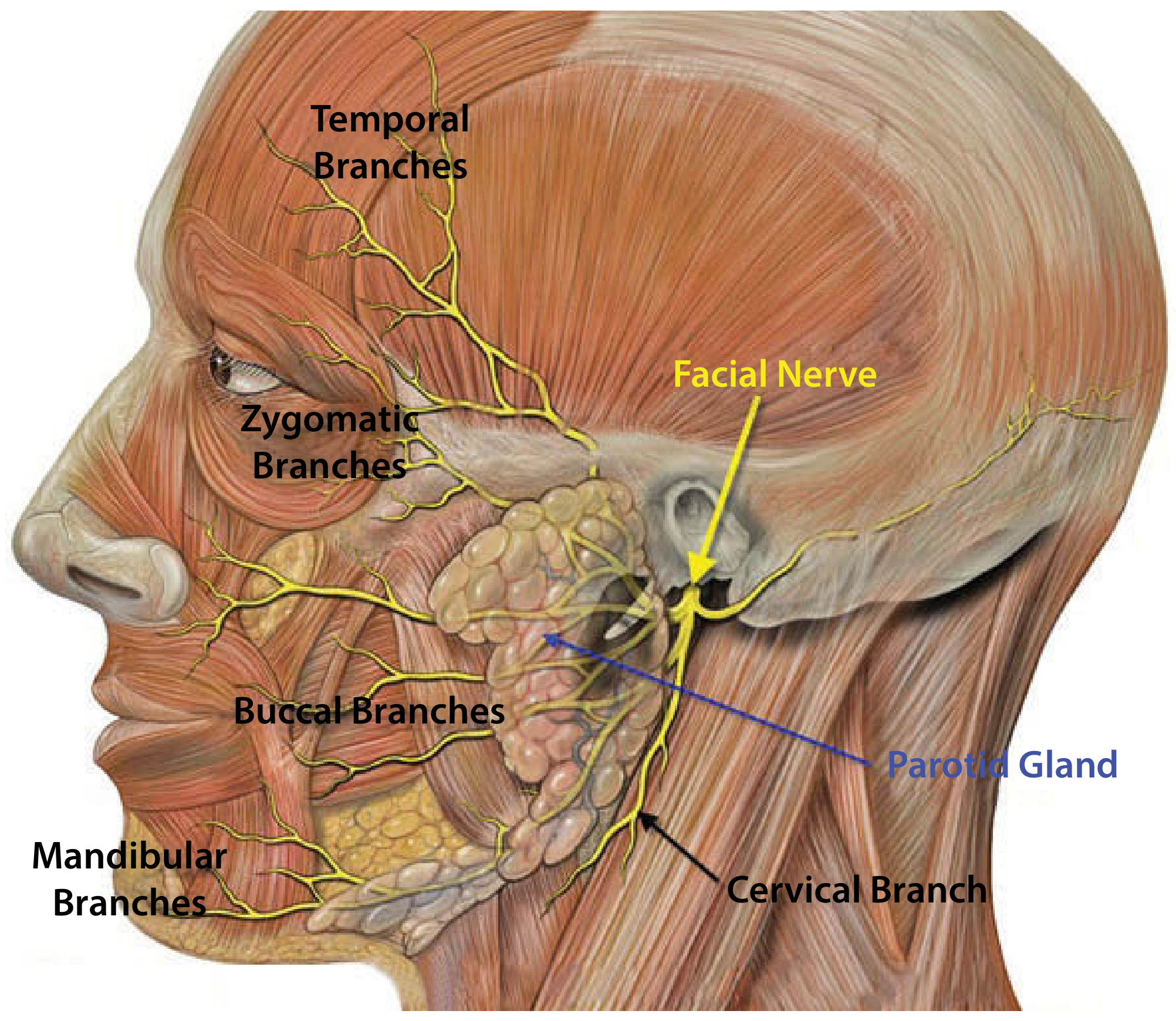
- Exits the skull via the stylomastoid foramen (posterolateral to the styloid process, anteromedial to the mastoid process)
- Enters the parotid and branches into the pes anserinus ("goose's foot")
- Divides into upper (temporofacial) and lower (cervicofacial) trunks, with numerous branching patterns possible
- Five terminal branch groups emerge from the gland borders:
- Temporal - from upper border
- Zygomatic - from upper/anterior border
- Buccal - from anterior border
- Marginal mandibular - from lower border
- Cervical - from lower border
Surgical landmarks for locating the facial nerve trunk include:
- The tympanomastoid suture line
- The posterior belly of the digastric muscle (marks depth of the nerve)
- The tragal pointer (the nerve lies ~1 cm deep and inferior to this)
- Retrograde identification by tracing a terminal branch
Note: The facial nerve trunk and its divisions lie more superficially in children younger than 2 years - a critical surgical consideration.
2. External Carotid Artery and Branches - Deep to CN VII
- The external carotid artery courses medial to the parotid, entering at or just deep to the inferior border
- Within the gland it gives off the posterior auricular artery, then divides into its two terminal branches:
- Maxillary artery - passes horizontally, deep to the mandible
- Superficial temporal artery - continues superiorly, emerging from the upper border after giving off the transverse facial artery
3. Retromandibular Vein - Deepest
- Formed within the gland by the union of the superficial temporal and maxillary veins
- Passes inferiorly through the gland, then divides just below the inferior border into:
- Anterior branch - joins the common facial vein (draining into the internal jugular vein); lies just deep to the marginal mandibular branch of CN VII
- Posterior branch - joins the external jugular vein via the posterior facial vein
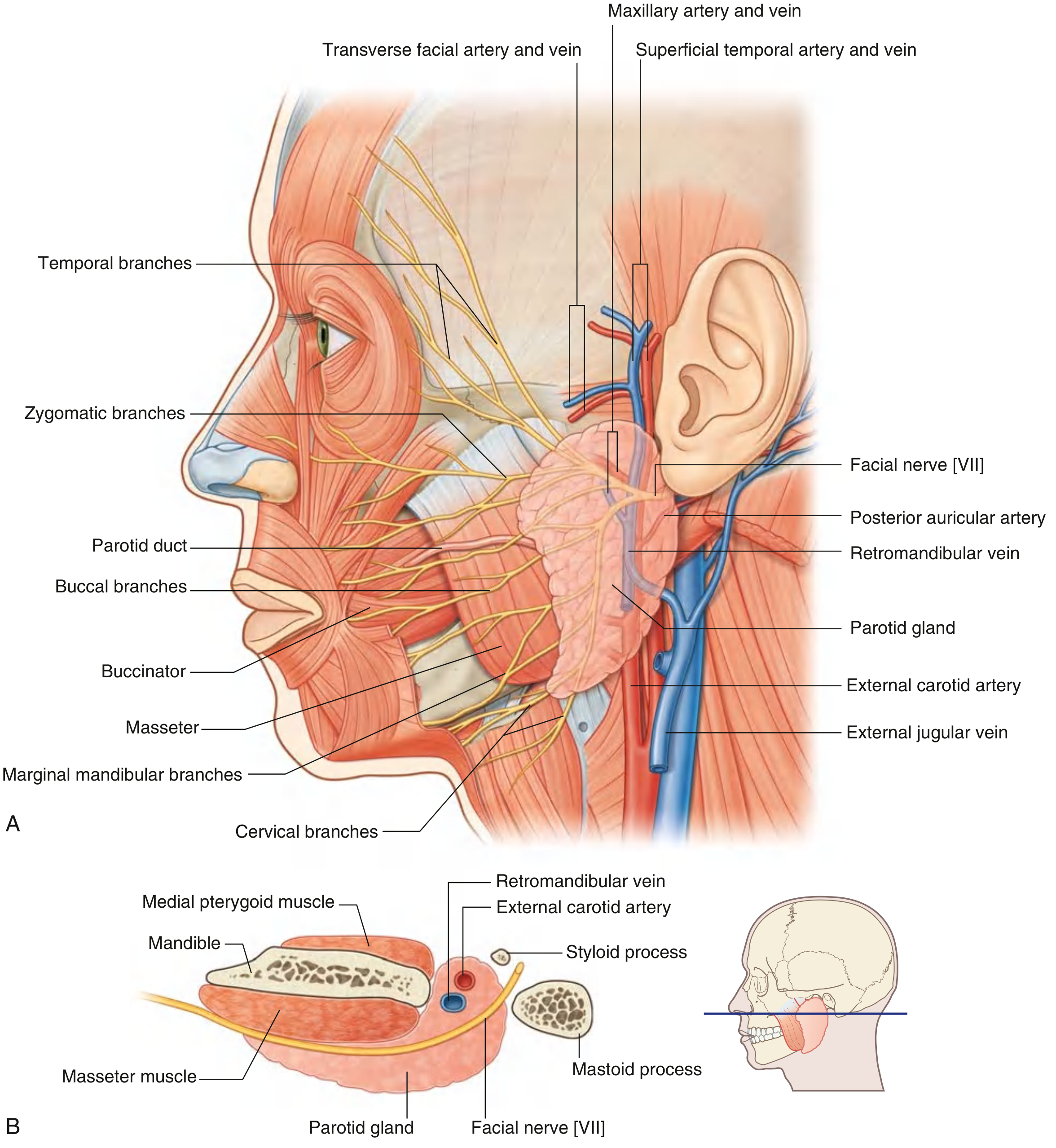
Parotid gland - lateral view (A) and axial cross-section (B) showing key relationships. From Gray's Anatomy for Students.
Innervation
| Type | Source | Pathway |
|---|---|---|
| Parasympathetic (secretomotor) | CN IX (glossopharyngeal) | Preganglionic via tympanic branch (Jacobson's nerve) → tympanic plexus → lesser petrosal nerve → otic ganglion → postganglionic fibers travel with the auriculotemporal nerve to the gland |
| Sympathetic | Superior cervical ganglion | Postganglionic fibers travel along the external carotid artery |
| Sensory | Auriculotemporal nerve (branch of mandibular nerve V3) | Exits skull via foramen ovale; provides general sensation to the gland and overlying skin |
| Cutaneous (skin overlying gland) | Great auricular nerve (C2, C3) | Divides into anterior and posterior branches; posterior branch can often be preserved during parotidectomy to reduce auricular numbness |
Frey's syndrome (gustatory sweating) is a well-known complication of parotidectomy - caused by aberrant regeneration of parasympathetic secretomotor fibers that reconnect to the cutaneous sweat glands rather than the gland itself.
Lymphatics
The parotid is unique among the major salivary glands in having intraglandular lymph nodes (~20 nodes), in addition to periglandular nodes. The submandibular and sublingual glands have only periglandular nodes. These nodes drain the:
- Scalp and forehead
- Eyelids
- External ear
- Nasal cavity
Efferent drainage is to the superficial and deep cervical lymph nodes.
Deep Relations and the Parapharyngeal Space
- The deep lobe of the parotid is in contact with the pretyloid compartment of the parapharyngeal space
- Deep parotid tumors can extend into this space, presenting as a swelling of the soft palate or lateral oropharynx
- The parapharyngeal space is an inverted pyramid: base at the petrous bone; medial wall is the lateral pharyngeal wall; lateral wall is the medial pterygoid; posterior boundary is the carotid sheath - K.J. Lee's Essential Otolaryngology
Summary of Contents "Within" the Parotid (Superficial to Deep)
Mnemonic: "Some Romantic French Medical Dentists" (from superficial to deep)
- Skin
- Retromandibular vein
- Facial nerve
- Maxillary artery / external carotid artery
- Deep lobe
Sources: Gray's Anatomy for Students, p. 1051-1052 | K.J. Lee's Essential Otolaryngology, p. 642-643 | Scott-Brown's Otorhinolaryngology Head & Neck Surgery | Bailey and Love's Short Practice of Surgery, 28th Ed.
This is a shared conversation. Sign in to Orris to start your own chat.