
Placenta privia for 5 marks
Reading File
Placenta previa is a condition where the placenta partially or completely covers the internal os of the cervix, predisposing to antepartum haemorrhage. Let me pull the full textbook content now.
Searching sources...
Finding Sources
Finding Sources
Reading File
Reading File
Reading File
Reading File
Reading File
Reading File
I now have comprehensive textbook content. Let me compile a well-structured 5-mark answer.
Loading Image
Here is a complete, exam-ready 5-mark answer on Placenta Previa:
Placenta Previa
Definition
Placenta previa is the implantation of the placenta over or within 2 cm of the internal cervical os. It is a leading cause of antepartum hemorrhage (APH) in the second half of pregnancy.
- Low-lying placenta: placental edge within 2 cm of the internal os but not covering it
- Placenta previa (proper): placenta covers the internal os completely or partially
Modern classification (per NICHD) has replaced the older terms "complete," "partial," and "marginal" - the preferred terms are simply "placenta previa" (covering the os) and "low-lying placenta" (within 2 cm).
- Creasy & Resnik's Maternal-Fetal Medicine, p. 611
Incidence
- Affects approximately 0.5% (1 in 200) of all third-trimester pregnancies
- Diagnosed incidentally in ~10% of mid-trimester sonograms, but ~90% resolve before delivery (placental migration/trophotropism toward the fundus)
- Creasy & Resnik's Maternal-Fetal Medicine, p. 1018
Risk Factors
| Risk Factor | Relative Risk Increase |
|---|---|
| Previous placenta previa | 8x |
| Previous cesarean section | 1.5-15x |
| Age > 35 years | 4.7x; age >40 = 9x |
| Multiparity | 1.1-1.7x |
| Prior curettage/abortion | 1.3x |
| Smoking, IVF conception | Elevated |
Underlying mechanism: prior endometrial damage and uterine scarring predisposes implantation to the lower segment.
- Creasy & Resnik's Maternal-Fetal Medicine, p. 1018
Pathophysiology
Bleeding occurs because marginal placental vessels in the lower uterine segment are torn as:
- The lower uterine segment develops and elongates with advancing gestation
- The cervix effaces and dilates (labor or prelabor contractions)
- Intercourse or inadvertent vaginal examination disrupts vessels
Once labor begins, significant hemorrhage occurs as the cervix dilates and the placenta separates from the underlying decidua.
- Rosen's Emergency Medicine, p. 3356
Clinical Features
- Painless, bright-red vaginal bleeding in the second/third trimester - the hallmark
- Bleeding is sudden and recurrent ("herald bleeds" before major hemorrhage)
- Uterus is soft and non-tender (unlike abruptio placentae)
- Fetal lie may be abnormal (transverse/oblique) - the placenta prevents engagement
- Up to 10% of cases have no bleeding until onset of labor
- Rosen's Emergency Medicine, p. 3355
Important: Never perform digital vaginal examination in suspected placenta previa - this can precipitate catastrophic hemorrhage. Limit to atraumatic speculum examination only.
Diagnosis
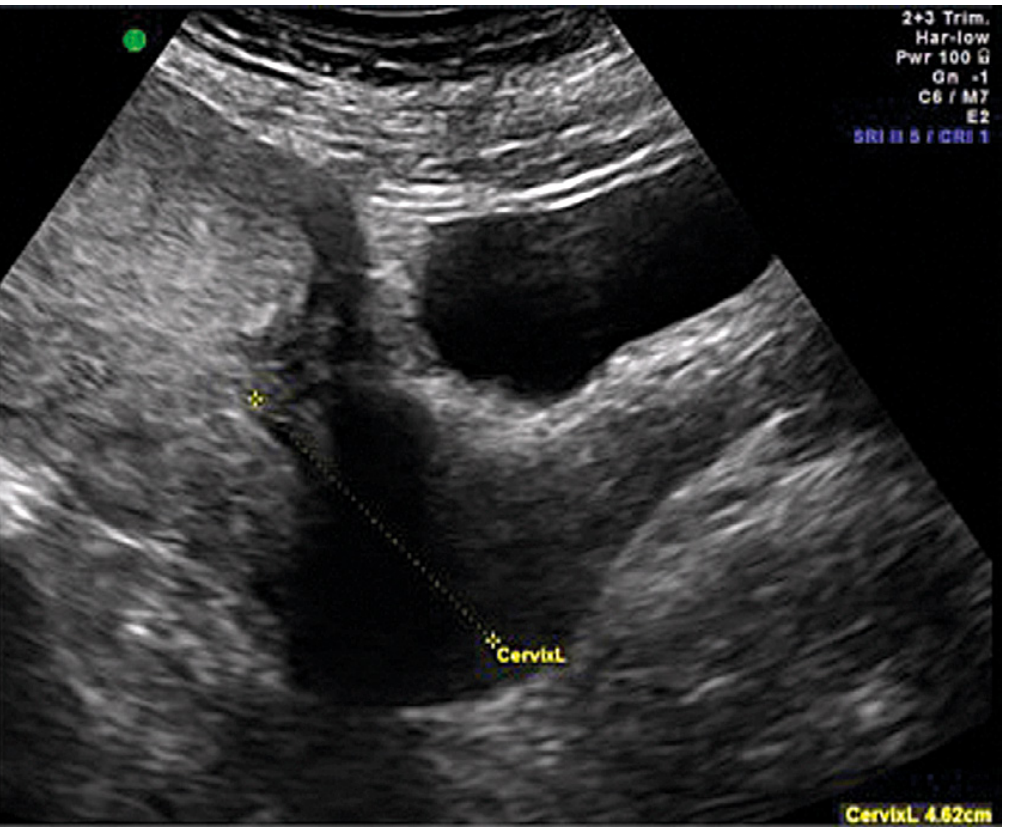
Transvaginal ultrasound (TVUS) is the gold standard:
- More accurate than transabdominal US for placental-os relationship
- Bladder must be emptied before transabdominal scan to avoid false-positive diagnosis
- Placental edge >20 mm from internal os = normal
- Placental edge <20 mm but not covering os = low-lying placenta
- Placenta covering os = placenta previa
Management
Expectant (Conservative) Management
- Indicated if bleeding is not life-threatening and gestation < 36 weeks
- Hospital admission, two large-bore IV lines, fluid resuscitation, continuous fetal monitoring
- Baseline Hb, type and crossmatch, coagulation studies (fibrinogen <300 mg/dL = coagulopathy)
- Betamethasone (corticosteroids for lung maturity) if <34 weeks gestation
- Tocolytics (MgSO4 or beta-mimetics) may be used cautiously
- Rh-negative patients: 300 mcg anti-D immunoglobulin within 72 hours
- Bed rest, pelvic rest; avoid intercourse
- Cervical cerclage is NOT recommended
Definitive Management - Delivery
- All women with placenta within 2 cm of os → cesarean section (CS)
- Elective CS planned at 36-37 weeks (risk of sudden hemorrhage outweighs fetal benefit of continuing)
- Amniocentesis for lung maturity confirmation is not needed
- CS should be performed by the most experienced surgeon given high risk of intraoperative hemorrhage
- If anterior placenta: clamp umbilical cord immediately on entry
- Postpartum hemorrhage control: oxytocin, Methergine, carboprost (15-methyl PGF2α), B-Lynch suture, Bakri balloon; in refractory cases - hysterectomy
- Creasy & Resnik's Maternal-Fetal Medicine, p. 1019-1020
Complications
- Maternal: antepartum/postpartum hemorrhage, DIC, shock, hysterectomy
- Fetal: prematurity, IUGR, fetal distress, perinatal mortality
- Associated conditions: placenta accreta spectrum (especially with prior CS + anterior previa), vasa previa
Key exam points to remember:
- Painless APH = placenta previa until proven otherwise
- NO digital vaginal examination
- TVUS is diagnostic
- Delivery by CS if placenta within 2 cm of os
- Plan elective CS at 36 weeks if asymptomatic
This is a shared conversation. Sign in to Orris to start your own chat.