
2005 ma burn thau hoy atyare hair follicles absant and no skin grafting and no ROM affected to a ne only skin cover disfigurement kevay ke full thickness loss...??
Burn Classification - Tara Case No Analysis (2005 Burn)
- Hair follicles absent ✓
- No skin grafting done ✓
- ROM affected nathi (ROM preserved) ✓
- Only skin cover loss + disfigurement ✓
Aa Konno Burn Hato? - Deep Partial Thickness (IIb / Deep Second Degree)
Full Thickness (3rd Degree) thi alag che - Kem?
| Feature | Deep Partial Thickness (IIb) | Full Thickness (III) |
|---|---|---|
| Hair follicles | Significantly lost/absent | Completely destroyed |
| Healing | Heals (slowly, with scarring) | Cannot heal spontaneously - NEEDS graft |
| ROM | Usually preserved | Preserved unless circumferential |
| Skin grafting | Sometimes needed | Always required |
| Sensation | Decreased but some present | Insensate (no pain) |
KEY POINT: Tara case ma no skin grafting = NOT true Full Thickness
"Full-thickness burns require full-thickness excision of the skin... these cannot heal spontaneously."
- Bailey & Love's Surgery, 28th Ed.
"Full thickness burns... Need for excision and grafting = +"
- Rosen's Emergency Medicine, Table 54.1
- Reticular dermis involve thay
- Hair follicles significantly damage/absent thay
- Wound slowly (weeks) heal thaay
- Skin grafting without bhi heal thaay (though with scarring/disfigurement)
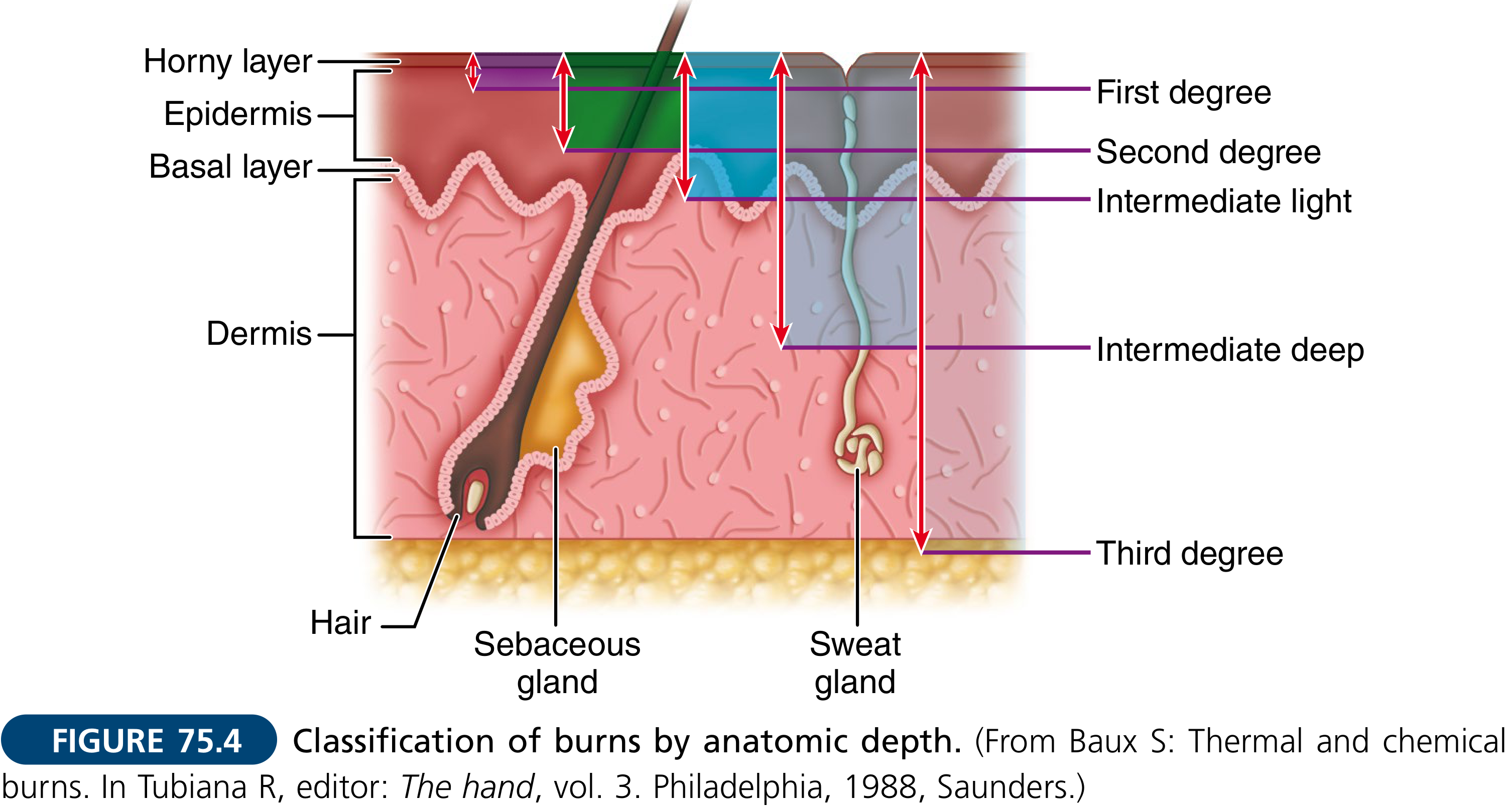
Classification Diagram (Campbell's Operative Orthopaedics)
Summary - Tara Patient No Diagnosis
- Kem? - Hair follicles absent (deep dermis involvement), par graft vagar heal thayun, ROM preserved, skin cover loss with disfigurement/hypertrophic scarring
- Full thickness nahi - kyunki full thickness = mandatory grafting, completely insensate, cannot heal on its own
- Result = 2005 thi abhi disfigurement present che = hypertrophic scar ya contracture without functional (ROM) limitation
- IIb (Deep 2nd): "Reticular dermis involving significant loss of skin appendages... Decreased sensation... heals slowly with scarring"
- III (Full Thickness): "Complete destruction of all skin layers... requires skin substitute/grafting"
Clincal Pearl: Jya patient koi 2005 naa burn thi aaj disfigurement saathe aave ane ROM normal hoy to most likely deep partial thickness burn hato jo conservative management thi heal thayun - skin grafting na leva thi proper skin cover nahi mali ane scar/disfigurement rahi gayu.
Find latest guidelines on burn reconstruction and scar management
"burn" AND "scar management" AND "reconstruction"
"burn scar" AND treatment
"burn reconstruction" AND guideline
burn scar reconstruction guidelines 2024 2025 international consensus
PMID: 39435560
PMID: 41003790
PMID: 40817644
"hypertrophic scar" AND "burn" AND (laser OR compression OR corticosteroid)
PMID: 37756273
PMID: 38072714
"burn scar" AND (silicone OR "pressure garment" OR compression)
Burn Reconstruction & Scar Management - Latest Guidelines (2023-2025)
1. RECONSTRUCTION PHILOSOPHY (Current Standard)
"The primary goals of burn reconstruction are restoration of function and form via the prevention and treatment of contractures and hypertrophic scarring."
- Judicious fluid resuscitation
- Early joint splinting
- Early excision and grafting
- Scar prevention starting in the acute phase
2. PREVENTION MEASURES (First Line)
| Modality | Evidence | Notes |
|---|---|---|
| Compression garments / pressure therapy | Established | Worn 23 hrs/day for 12-24 months |
| Silicone gel sheeting | Established | Reduces hypertrophic scarring |
| Splinting | Established | Prevents contracture formation |
| Physiotherapy / OT | Mandatory | ROM preservation and function |
| Scar massage | Systematic Review (PMID: 35758338) | Reduces thickness, pruritus, pain |
3. NON-SURGICAL TREATMENTS
A. Laser Therapy (Strongest Non-surgical Evidence)
- Laser therapy significantly improved overall VSS/POSAS scores, vascularity, pliability, pigmentation, and scar height
- PDL (Pulsed Dye Laser) gave the greatest reduction in VSS/POSAS scores overall
- Best results when laser started >12 months after injury (vascularity improvement: -1.50 vs -0.39 for <12 months)
- Interval between sessions also matters significantly
- Compared PDL vs Fractional CO2 (AFCL) vs Combination
- PDL showed significantly better total VSS score reduction than combination therapy (MD = -0.90)
- AFCL and PDL had comparable efficacy for individual scar characteristics
- Both show good safety profiles and high patient satisfaction
- Most commonly used for hypertrophic burn scars
- Meta-analysis (Skin Res Technol, 2024) [PMID: 38332516]: CO2 fractional laser effective in children for post-burn hypertrophic scars
- Ablative fractional preferred for texture/pliability; PDL preferred for vascularity/erythema
B. Shockwave Therapy
- Shockwave reduces pain (MD -0.8 on 0-10 scale)
- Reduces pruritus (MD -1.3 on 0-10 scale)
- Low-to-moderate quality evidence
C. Intralesional Steroid Injections
- Triamcinolone acetonide - standard for keloids/hypertrophic scars
- Often combined with laser therapy for enhanced effect
D. Microneedling / RF Needling
- Microneedling and RF-needling are comparable to ablative fractional lasers for hypertrophic scars
- RF needling showed slight advantages in combined outcomes
- Useful when laser access is limited
4. SURGICAL RECONSTRUCTION
A. Dermal Substitutes (Important 2024 Update)
- Acellular dermal matrix (ADM) showed significantly better subjective scar quality at 6 months vs split-thickness skin graft (STSG) in acute burns (MD -1.95, p<0.01)
- Collagen-elastin matrix caused delayed re-epithelialization (-7.30% at 4-7 days vs STSG) - but better long-term scar quality
- Dermal substitutes hold promise for enhancing scar quality in both acute burns and scar reconstruction
- Limitation: Initially delayed wound healing compared to STSG
- Autograft (STSG or FTSG) - gold standard
- Acellular Dermal Matrix (ADM) + thin autograft
- Dermal substitutes (Integra, Matriderm) for scar reconstruction
B. Contracture Release & Flap Reconstruction
- Flap-based reconstruction for post-burn joint contractures: 98.9% resolution with pedicled flaps, 90.1% with free flaps
- Contracture recurrence: only 1.8% (pedicled) and 0.6% (free flaps)
- Total flap loss: 1.5% (pedicled), 2.9% (free flaps)
- No significant difference between pedicled and free flap outcomes (p=0.50)
- Conclusion: Flap reconstruction is highly effective with minimal complications
| Technique | Best Use |
|---|---|
| Z-plasty / W-plasty | Linear band contractures, web spaces |
| Local flaps (rotational, transposition) | Small to medium defects |
| Pedicled regional flaps | Moderate-large defects near donor site |
| Free flap (microsurgical) | Large defects, complex anatomy |
| STSG / FTSG | Post-release resurfacing |
5. TREATMENT ALGORITHM (Reconstructive Ladder)
OLD SCAR (like your 2005 patient)
         ↓
1. Conservative: Silicone + Massage + Compression
         ↓  (if scar active / hypertrophic)
2. Intralesional steroids ± PDL Laser
         ↓  (if scar mature + cosmetic concern)
3. Ablative Fractional CO2 / PDL laser series
         ↓  (if contracture / functional problem)
4. Surgical: Z-plasty / Flap / FTSG
         ↓  (complex large area)
5. Dermal substitute + thin autograft
6. KEY 2024-2025 EVIDENCE SUMMARY
| Topic | Source | Key Finding |
|---|---|---|
| Laser timing | Ma et al. 2023 [PMID: 37756273] | >12 months post-injury gives better outcomes |
| PDL vs CO2 | Li et al. 2025 [PMID: 41003790] | PDL better for overall VSS; CO2 comparable for individual features |
| Dermal substitutes | van den Bosch et al. 2024 [PMID: 39435560] | ADM gives better scar quality than STSG alone |
| Flap reconstruction | Elemosho et al. 2025 [PMID: 40817644] | 98.9% contracture resolution; pedicled = free flap outcomes |
| Non-invasive | Santuzzi et al. 2024 [PMID: 38072714] | Massage + laser + shockwave reduce pain & pruritus |
Tara 2005 Case ke Apply Kariye to:
- Scar assessment - Vancouver Scar Scale (VSS) or POSAS scoring
- Non-surgical first - scar massage + silicone if scar still active
- Laser therapy - PDL for erythema/vascularity, Fractional CO2 for texture/thickness (>12 months post-burn - certainly satisfied here)
- Surgical only if significant cosmetic deformity affecting quality of life - FTSG or local flap for resurfacing
To a case full thickness loss nathi ne khali only skin cover disfigurement che ne...??
Taro Point 100% Correct Che! ✓
Full Thickness Burn ni Definition + Mandatory Requirement:
"This full-thickness burn WILL NOT HEAL without a skin graft."
- Roberts & Hedges' Clinical Procedures in Emergency Medicine
"Third-degree burns... appear dry, leathery, even charred... insensate with no blistering."
- Schwartz's Principles of Surgery, 11th Ed.
Comparison Table - Aa Clearly Show Kare Che:
| Feature | Deep Partial Thickness (IIb) | Full Thickness (III) |
|---|---|---|
| Healing without graft | YES - heals (slowly, 3+ weeks) | NO - cannot heal |
| Hair follicles | Significantly damaged/absent | Completely destroyed |
| Skin appendages | Lost in reticular dermis | All lost |
| Grafting needed | Sometimes (outcomes better with graft) | Always mandatory |
| Sensation | Reduced but present | Completely insensate |
| Appearance | Pale/white/mottled | Leathery, dry, charred, waxy |
| Scarring | HIGH risk hypertrophic scar | Eschar forms - needs excision |
| ROM affected? | Usually NO | NO (unless circumferential) |
Tara Case Ka Logic (2005 Burn):
Hair follicles absent  →  Deep dermis (reticular) involved
No skin grafting done  →  Wound healed on its own  →  NOT full thickness
Only disfigurement     →  Hypertrophic scar / dyspigmentation from deep partial thickness
ROM preserved          →  No circumferential involvement, no deep structure damage
- Fitzpatrick's Dermatology confirms: "Deep partial-thickness: high risk of hypertrophic scar and pigment change... involves epidermis, papillary dermis, AND reticular dermis"
- Schwartz's confirms: "Deep partial-thickness burns involve damage to the reticular dermis with damage to skin appendages... Damage to skin appendages precludes spontaneous healing without scar"
In Short - Aa Case Ma Jo Thayun:
Search for dermatological management of post-burn scars and dyspigmentation
"post-burn" AND dyspigmentation AND treatment
"burn scar" AND (hyperpigmentation OR depigmentation OR pigmentation) AND laser
post-burn dyspigmentation dermatological management guidelines 2024 2025
PMID: 39779541
PMID: 37393760
"post-inflammatory hyperpigmentation" AND treatment AND (laser OR topical)
PMID: 37843491
PMID: 39075672
PMID: 40515775
https://pmc.ncbi.nlm.nih.gov/articles/PMC13109754
Dermatological Management of Post-Burn Scars & Dyspigmentation
| Type | Appearance | Cause | Difficulty |
|---|---|---|---|
| Hyperpigmentation (PIH) | Darker than surrounding skin | Melanocyte stimulation by inflammation | Moderate - responds to topicals |
| Hypopigmentation / Depigmentation | Lighter / white patches | Melanocyte destruction in deep dermis | Difficult - resistant to most treatments |
PART 1 - POST-INFLAMMATORY HYPERPIGMENTATION (PIH) Management
Pathogenesis
"Inflammatory markers stimulate melanocytes... epidermal inflammation causes increase in epidermal keratinocytes; dermal inflammation results in pigment incontinence into dermis. Melanin is eventually cleared by macrophages."
- Epidermal PIH = Brown discoloration - responds well to topicals
- Dermal PIH = Gray-brown discoloration - harder to treat, needs lasers
STEP 1 - SUN PROTECTION (Mandatory, Always First)
"The importance of photoprotection should not be underestimated. Pretreatment and posttreatment regimens are critical... especially for persons with skin of color."
- Fitzpatrick's Dermatology
- Broad-spectrum SPF 30-50+ daily - strict
- Avoid midday sun, use physical blockers (zinc oxide, titanium dioxide)
- This alone can cause PIH to fade gradually in many cases
STEP 2 - TOPICAL AGENTS (First Line)
| Agent | Mechanism | Notes |
|---|---|---|
| Hydroquinone 2-4% | Tyrosinase inhibitor | Gold standard - Fitzpatrick's; use for 3-6 months max |
| Topical Retinoids (tretinoin 0.025-0.05%) | Keratinocyte turnover + reduce melanosome transfer | Combine with HQ for synergy |
| Azelaic Acid 15-20% | Tyrosinase inhibitor | Safer for skin of color; anti-inflammatory too |
| Kojic Acid | Inhibits tyrosinase via copper interaction | OTC / Rx creams |
| Niacinamide 4-5% | Inhibits melanosome transfer | Well-tolerated, safe |
| Tranexamic Acid (topical/oral) | Plasmin inhibition + antioxidant | Growing evidence; oral 250mg BD |
| Thiamidol | Tyrosinase inhibitor | Newer agent, [Systematic Review 2024, PMID: 39496126] confirms efficacy |
| Triple Combination (Kligman's Formula) | HQ + Tretinoin + Topical Corticosteroid | Standard for darker skin types |
| Cysteamine cream | Anti-melanogenic | Alternative to HQ |
| Vitamin C (ascorbic acid) | Antioxidant + tyrosinase inhibitor | Add-on, brightening |
- Combination therapies gave best partial response: 84.9%
- Topicals alone: 72.4% partial response, only 5.4% complete response
- Laser/energy devices: 61.2% partial response, 18.1% complete response
- Conclusion: No single modality achieves complete response reliably - combination is key
STEP 3 - PROCEDURAL / LASER THERAPY (Second Line)
- Laser = only modality achieving complete resolution (26% patients)
- Topical retinoids: 85% partial improvement (most frequent, best tolerated)
- Chemical peels and HQ: less effective, higher risk of rebound PIH
Laser Options for Burn Scar Hyperpigmentation:
| Laser | Target | Best For | Risk |
|---|---|---|---|
| Q-switched Nd:YAG (1064nm) | Melanin (dermal) | Dermal PIH, persistent pigment | Low PIH risk; safe for dark skin |
| Picosecond Laser | Melanin | Epidermal + mixed PIH | Faster clearance than QS |
| Pulsed Dye Laser (PDL, 585/595nm) | Vascularity + erythema | Erythematous/vascular component | Risk of PIH in dark skin |
| Fractional CO2 (ablative) | Texture + scar depth | Hypertrophic scar + pigment | Higher PIH risk - caution in dark skin |
| IPL (Intense Pulsed Light) | Broad spectrum | Mixed pigment + vascular | Risk of rebound PIH |
- Ablative Fractional CO2 laser significantly improved scar thickness and texture
- No significant improvement in pigmentation on VSS with CO2 alone
- Better for texture/structure than for pure pigmentation
- PDL gave the greatest reduction in overall scar scores including pigmentation
- Early laser (>12 months post-burn gives better vascularity/pigment outcomes)
- Topicals FIRST - hydroquinone, thiamidol, azelaic acid, tranexamic acid
- Chemical peels + low-fluence Q-switched Nd:YAG as second-line procedures
Chemical Peels:
- Glycolic acid (AHA) 20-70%
- TCA (trichloroacetic acid) 10-25%
- Lactic acid, mandelic acid (safer for darker skin)
- Caution: aggressive peels can WORSEN PIH in darker skin types
PART 2 - HYPOPIGMENTATION / DEPIGMENTATION Management
Why Hypopigmentation is Difficult:
- Melanocytes are destroyed in deep dermis (reticular layer)
- Hair follicle melanocyte reservoir is lost (AA thi hair follicles absent - this is significant!)
- Repigmentation requires surviving melanocytes to migrate from wound edges
Treatment Options:
1. Fractional CO2 Laser (Creates Channels for Repigmentation)
Fractional CO2 laser + topical Latanoprost (0.005% prostaglandin analog) applied twice daily for 6 months:
- 85.7% achieved 50-74% improvement (grade 4 on SGAIS)
- Placebo group: 71.4% showed only 0-24% improvement
- Mechanism: CO2 laser creates micro-channels → latanoprost penetrates → stimulates surviving melanocytes
- No severe side effects in either group
- Patient satisfaction: 8.5/10 (latanoprost group) vs 4.6/10 (placebo)
2. Other Options for Hypopigmentation:
| Treatment | Evidence | Notes |
|---|---|---|
| Narrowband UVB phototherapy | Moderate | Stimulates surviving melanocytes |
| Excimer laser (308nm) | Moderate | Targeted melanocyte stimulation |
| Tacrolimus 0.1% topical | Some evidence | Off-label; calcineurin inhibitor |
| Latanoprost + fractional laser | RCT 2025 evidence | Best current evidence |
| Split-thickness skin graft | Established | For large depigmented areas - surgical |
| Suction blister epidermal graft | Established | Surgical repigmentation |
| Cell suspension (ReCell) | Emerging | Autologous melanocyte transfer |
TREATMENT ALGORITHM - Tara 2005 Case Ke Apply Kariye
POST-BURN DYSPIGMENTATION (2005 Burn, No ROM Deficit)
              ↓
Assess Type:
  Hyperpigmentation (dark)?  →  OR  ←  Hypopigmentation (light)?
         ↓                                        ↓
STEP 1: SPF 50+ strict daily             STEP 1: SPF 50+ strict daily
         ↓                                        ↓
STEP 2: Triple combo topical             STEP 2: Fractional CO2 laser
 (HQ 4% + Tretinoin + steroid)           + Latanoprost 0.005% topical
         ↓  (if no response 3 months)            ↓  (x 6 monthly sessions)
STEP 3: Q-switched / Picosecond          STEP 3: NB-UVB / Excimer laser
         laser + chemical peels                   ↓  (if large area)
         ↓  (stubborn deep dermal)       STEP 4: Surgical - epidermal graft
STEP 4: Low-fluence Nd:YAG                        or ReCell
SKIN TYPE CONSIDERATION (Critical for Indian/South Asian Patients)
"Patient skin type influenced treatment choice due to the risk of post-inflammatory hyperpigmentation."
- Haji Mohammadi et al. 2025, [PMID: 40515775]
- Avoid aggressive ablative lasers at high settings
- Always pre-treat with HQ/azelaic acid 4-6 weeks before any laser
- Use low fluence settings, longer intervals
- Test patch before full treatment
- Post-laser strict SPF + HQ to prevent rebound PIH
Summary of Key 2024-2025 Evidence
| Study | Finding | PMID |
|---|---|---|
| Kashetsky et al. 2024 (Syst Rev) | Combination therapy = best partial response (84.9%); no modality gives reliable complete response | 37843491 |
| Mar et al. 2024 (Syst Rev, Skin of Color) | Laser only modality with complete resolution (26%); topical retinoids best tolerated | 39075672 |
| Atefi et al. 2025 (RCT) | Fractional CO2 + Latanoprost: 85.7% significant improvement in hypopigmented burn scars | 39779541 |
| Global Consensus 2025 | Topicals first-line PIH; Q-switched Nd:YAG + chemical peels second-line | PMC13109754 |
| Haji Mohammadi 2025 (Syst Rev) | Ablative lasers better for atrophic/textural scars; skin type must guide laser choice | 40515775 |
Compare prostaglandin analogs vs other agents for burn scar repigmentation
"prostaglandin" AND "burn scar" AND repigmentation
"hypopigmented burn scar" AND treatment
"latanoprost" OR "bimatoprost" AND repigmentation AND scar
prostaglandin analogs latanoprost bimatoprost hypopigmented burn scar repigmentation 2024 2025
Rpwbd pramane a candicton kema ave...?? Only skin cover disfigurement ma ke full thickness loss ma...??
RPWBD 2016 acid attack burn disfigurement disability criteria India percentage assessment
https://theleaflet.in/women-and-children/can-burn-survivors-…
RPWBD 2016 "acid attack victim" burn injury disability certificate 40% TBSA disfigurement criteria India 2024
RPWBD disability assessment guidelines 2024 burn scar disfigurement percentage calculation TBSA face
https://disabilityrightsallianceindia.wordpress.com/wp-conte…
RPWBD 2016 - Burn Injury Ma Disability Classification
RPWBD 2016 Ma Burn Case Kema Ave?
Under Kaun Sa Category?
"Acid Attack Victims" = "a person disfigured due to violent assaults by throwing of acid or similar corrosive substance"
- Listed under Locomotor Disability - Physical Disability category
- Burn survivors directly under "acid attack victim" category ma nahi ave - aa Act ni limitation che
- Par "similar corrosive substance" wording thi thermal burn survivors argue kari shake che
SC ye direct karyun ke "acid attack victims" ma ab internal injuries ane forcible acid ingestion victims pan include thay - even without external disfigurement. Scope broadly interpret karvu.
SABATHI IMPORTANT - Disability % Calculation
Body Part-Wise Disability % Table
| Body Part | Only Skin Cover Disfigurement | Deformity / Full Thickness Loss |
|---|---|---|
| Scalp + Forehead | 5% | 10% |
| Eyebrows (one/both) | 3% each / 5% each | - |
| Eyelids (upper/lower) | Skin disfigurement = 3% each | Full thickness loss = 5% each |
| Cheek + Lateral Face | 5% each side | 10% each side |
| Nose | 3% (skin only) | Full thickness - one nare obliterated = 10%; both = 20% |
| Lips (one lip) | 3% | Full thickness one lip = 5%; both lips contracture = 10% |
| Ear (Pinna) | 2% each | FT with cartilage, no meatus = 3%; with meatus obliteration = 5% |
| Neck | 5% | Skin + muscle + deeper = 10% |
| Breast (Female) | 5% each | Areola + nipple = 10%; + parenchyma = 15% |
| Front of Trunk / Abdomen | 5% | 10% |
| Total Back | 5% | 10% |
| Groins | 2% each | 5% each |
| Buttocks | 3% each | 5% each |
| Genitalia | Mild deformity = 7% | Severe contracture/sloughing = 20% |
| Thigh | 3% each | 5% each |
| Lower Leg | 3% each | 3% each |
| Foot | 3% each | 5% each |
| Upper Arm | 3% each | 5% each |
| Forearm | 3% each | 5% each |
| Hand | 5% each | 10% each |
| Mouth (lips + area) | Up to 20% total | - |
| Esophagus/Respiratory | Up to 20% each | - |
TARA CASE KA ANSWER - Only Skin Cover Disfigurement:
Comparison at a Glance:
ONLY SKIN COVER DISFIGUREMENT       vs       FULL THICKNESS LOSS
        (Taro Case)                          (Deeper injury)
             ↓                                      ↓
     LOWER % disability                    HIGHER % disability
         (3-5%)                               (5-20%)
             ↓                                      ↓
  Example: Forearm skin scar = 3%        Forearm FT loss = 5%
  Example: Face cheek scar = 5%         Face cheek FT = 10%
  Example: Trunk scar = 5%              Trunk FT loss = 10%
Taro 2005 Case - Practical Disability Assessment:
- Jo forearm/arm involved = 3% per limb
- Jo face/cheek involved = 5% per side
- Jo trunk involved = 5%
- Jo neck involved = 5%
Key Legal Points:
| Point | Detail |
|---|---|
| Certifying Authority | District Medical Board / Designated Medical Authority |
| Benchmark threshold | 40% minimum for most RPWBD benefits |
| "Acid attack victim" category | Burn survivors cover thay - "similar corrosive substance" as per legal interpretation |
| Disfigurement only (no ROM loss) | Lower % - multiple parts add karvana pade 40% reach karva |
| Full thickness loss | Higher % - easier to reach 40% benchmark |
| SC Ruling 2026 | Expanded scope - even internal injuries covered |
| UDID Card | Unique Disability ID - apply via UDID portal |
Bottom Line:
"Only skin cover disfigurement" = LOWER disability % (3-5% per body part) "Full thickness loss / deformity" = HIGHER disability % (5-20% per body part)
Search for guidelines on preventing post-inflammatory hyperpigmentation in dark skin types
"post-inflammatory hyperpigmentation" AND prevention AND "skin of color"
"dark skin" AND hyperpigmentation AND (laser OR peel) AND prevention
post-inflammatory hyperpigmentation prevention dark skin Fitzpatrick IV V VI guidelines 2024 2025
"post-inflammatory hyperpigmentation" AND prevention AND "skin of colour"
hyperpigmentation AND Fitzpatrick AND (hydroquinone OR tranexamic OR niacinamide) AND prevention
https://pmc.ncbi.nlm.nih.gov/articles/PMC13012588
PMID: 39953770
tranexamic acid hyperpigmentation prevention dark skin
tranexamic acid AND "post-inflammatory hyperpigmentation" AND laser
hydroquinone pretreatment laser burn scar dark skin prevention hyperpigmentation
Prevention of Post-Inflammatory Hyperpigmentation in Dark Skin Types (Fitzpatrick III-VI)
Why Dark Skin is More Vulnerable
- Higher baseline melanocyte activity - melanocytes respond more aggressively to any inflammatory trigger
- Prostaglandins + leukotrienes released during inflammation upregulate tyrosinase activity directly
- PIH in darker skin is more pronounced, more persistent, and lasts years (especially after lichenoid processes)
- Two mechanisms operate simultaneously:
- Epidermal PIH - increased melanocyte activity → brown/tan color → responds to Wood's lamp (enhances)
- Dermal melanosis - melanin dropout into dermis → gray-brown color → does NOT enhance on Wood's lamp, harder to treat
"In darker patients, especially with lichenoid diseases, the dyspigmentation can last for years... Laser treatments and chemical peels must be done with extreme caution, because results are unpredictable and increased pigmentation may result."
- Andrews' Diseases of the Skin
KEY 2025 SYSTEMATIC REVIEW - Most Authoritative Source
- 14 studies, 369 cases (FST III-VI), mean age 38 years, 72% female
- Nearly all cases triggered by laser therapy (>95%) - confirms laser is biggest PIH trigger
- Face most common location (85%)
| Preventive Measure | Outcome |
|---|---|
| Sunscreen alone or combined | Most successful - consistently prevented PIH incidence |
| Topical corticosteroids | Less successful |
| Systemic tranexamic acid | Less successful for prevention (though useful for treatment) |
| Cooling air devices | Worsened PIH - counter-intuitive, avoid |
PREVENTION FRAMEWORK - Before, During, After
PHASE 1 - PRE-PROCEDURE PRIMING (4-8 Weeks Before Any Laser/Peel)
| Agent | Duration | Purpose |
|---|---|---|
| Hydroquinone 2-4% | 2-6 weeks before | Suppress melanocyte activity - gold standard |
| Tretinoin 0.025-0.05% | 2-4 weeks before | Speed reepithelialization, ↓ PIH severity |
| Topical corticosteroid (mild) | 1-2 weeks before | Reduce baseline inflammation |
| SPF 50+ broad-spectrum | Start immediately, continue throughout | Block UV triggering melanogenesis |
Recommended Triple Pretreatment: Hydroquinone 8% + Hydrocortisone 1% + Retinoic acid 0.05% - apply twice daily for 4-6 weeks before procedure
PHASE 2 - DURING PROCEDURE (Laser/Peel Settings for Dark Skin)
| Parameter | Adjustment for Dark Skin | Why |
|---|---|---|
| Wavelength | Use longer wavelengths (Nd:YAG 1064nm preferred) | Less melanin absorption, safer |
| Fluence | Minimal threshold - lower energy | Avoid over-injury |
| Pulse width | Shorter | Limit thermal diffusion |
| Density | Lower density, fewer passes | Reduce epidermal disruption |
| Cooling | Appropriate post-treatment cooling | BUT avoid excessive cold air (worsens PIH) |
| Time between sessions | Longer intervals (6-8 weeks, not 4) | Allow full recovery |
| Test patch | ALWAYS do test patch first | Assess individual response |
| Goal | Preferred Laser (Dark Skin) | Avoid |
|---|---|---|
| Pigmentation/erythema | Low-fluence Q-switched Nd:YAG 1064nm | PDL at high settings |
| Scar texture | Low-density Fractional CO2 | High-density ablative CO2 |
| Vascular component | Long-pulse Nd:YAG | IPL (high PIH risk) |
- Glycolic acid 20-30% - safest, superficial
- Salicylic acid 20-30% - anti-inflammatory, suits acne-PIH
- Lactic acid, mandelic acid - gentle, lower risk
- TCA only 10-25% max, light frosting endpoint
- AVOID: High-concentration TCA (>35%), phenol peels
PHASE 3 - POST-PROCEDURE (First 4-6 Weeks Most Critical)
| Measure | Details | Evidence |
|---|---|---|
| SPF 50+ broad-spectrum | Every day, reapply every 2 hours outdoors | Most effective single measure [PMID: 39953770] |
| Physical sunscreen (zinc oxide/titanium dioxide) | Better for dark skin - less photosensitivity | Preferred over chemical filters |
| Sun avoidance | Avoid direct sun 4-6 weeks post-procedure | Mandatory |
| Resume hydroquinone | Restart HQ 2% within 1-2 weeks post-procedure | Suppresses rebound melanogenesis |
| Resume topical retinoid | 1-2 weeks after full re-epithelialization | Speeds normalization |
| Avoid heat/inflammation | No hot yoga, steam rooms, vigorous exercise | Heat triggers melanocyte activity |
| Gentle cleanser + moisturizer | Protect barrier, reduce inflammation | Barrier disruption = more PIH |
PHASE 4 - ONGOING MAINTENANCE
| Measure | Details |
|---|---|
| Year-round SPF 50+ | UV triggers melanogenesis even in healed scars - non-negotiable |
| Niacinamide 5-10% | Inhibits melanosome transfer; very safe for long-term use |
| Azelaic acid 15-20% | Anti-inflammatory + tyrosinase inhibitor; safe for chronic use |
| Vitamin C (L-ascorbic acid) 10-20% | Antioxidant; reduces oxidative melanin formation |
| Avoid irritants | No fragrances, harsh actives near scar tissue |
| Tranexamic acid (topical or oral 250mg BD) | Useful as add-on for persistent PIH |
SUMMARY TABLE - Prevention Hierarchy
FITZPATRICK IV-VI BURN SCAR - PIH PREVENTION

MOST EFFECTIVE
      ↑
  SPF 50+ broad-spectrum (daily, year-round) ← SINGLE MOST EFFECTIVE [2025 Syst. Review]
  Pre-procedure HQ + tretinoin priming (4-6 weeks)
  Post-procedure HQ restart (within 1-2 weeks)
  Conservative laser parameters (low fluence, long wavelength)
  Niacinamide + azelaic acid maintenance
  Systemic tranexamic acid (for active PIH treatment)
  Topical corticosteroids (short-term, pre/post procedure)
      ↓
LESS EFFECTIVE / AVOID
  Cooling air devices (worsens PIH - avoid)
  Aggressive ablative lasers at standard settings
  High-concentration TCA peels
  IPL in high-fluence settings
MOST RISKY
Clinical Pearls for Indian/South Asian Patients (Fitzpatrick III-V):
- Treat the burn scar inflammation first - active inflammation = ongoing PIH trigger
- Never skip sunscreen - even on cloudy days, even indoors (UVA penetrates glass)
- Patch test ALWAYS before any laser/peel procedure
- Slow and low - underdose is recoverable, overdose causes worse PIH
- Combination is king - no single agent prevents PIH completely; layered approach works best
- Set patient expectations - PIH in FST IV-V can take 12-18 months to fade even with treatment
- Wood's lamp examination before treatment - epidermal PIH responds better than dermal PIH