
Hey how are you different from ChatGPT and Gemini
Great question! Here's how I, Orris, differ from ChatGPT and Gemini:
Orris vs. ChatGPT vs. Gemini
What I Am
I'm Orris, a specialized AI assistant built on top of a large language model, but configured with a specific focus, tools, and workflows - particularly strong in medical and clinical knowledge. I'm not a general-purpose consumer product like ChatGPT or Gemini.
Key Differences
| Feature | Orris | ChatGPT | Gemini |
|---|---|---|---|
| Medical Library | Indexed textbook database I query in real-time | General training data only | General training data only |
| PubMed Integration | Direct search of peer-reviewed literature | No direct PubMed access | No direct PubMed access |
| Tool Access | Specialized tools (sandbox, file ops, medical DB) | Plugins/tools vary by plan | Extensions vary by product |
| Audience | Medical professionals, researchers, students | General public | General public |
| Citations | Textbook page-level citations, PMID links | Rarely cites sources reliably | Rarely cites sources reliably |
| Hallucination guard | Explicit "I don't know" policy, source-backed answers | Known to confidently hallucinate | Known to confidently hallucinate |
| File generation | PPTX, DOCX, XLSX, PDF creation in sandbox | Varies by plan | Limited |
| Code execution | Persistent Linux sandbox | Code interpreter (session-limited) | Limited |
The Big Picture
- ChatGPT (OpenAI) and Gemini (Google) are broad consumer AI products designed for general use - writing, coding, Q&A, images, etc.
- Orris is purpose-built with a medical-first design, real-time access to authoritative textbooks, PubMed literature search, and a strict no-hallucination policy for clinical content.
- I also run in a persistent sandbox environment where I can generate and deliver actual files (documents, spreadsheets, presentations).
The short version: if you need a reliable, source-backed answer to a medical or research question, I'm built for that in a way the general-purpose assistants aren't.
Short note - sickle cell anemia
Reading File
Finding Sources
Searching PubMed
"sickle cell disease"[MeSH Terms] AND management
I'll pull from Robbins Pathology (best for a short note) and the Emergency Medicine text for clinical coverage, in parallel.
Reading File
Reading File
Reading File
Loading Image
Loading Image
Reading File
Here is a comprehensive short note on Sickle Cell Anemia, drawn from Robbins & Kumar Basic Pathology.
Sickle Cell Anemia
Definition & Genetics
Sickle cell anemia is the most common familial hemolytic anemia, caused by a point mutation in the β-globin gene on chromosome 11. A single nucleotide change results in valine substituting glutamate at the 6th amino acid position of β-globin, producing sickle hemoglobin (HbS). Inheritance is autosomal recessive - homozygotes (HbSS) have disease, heterozygotes (HbAS) have sickle cell trait.
Epidemiology: ~8% of Americans of African descent are HbS carriers; ~1 in 600 have sickle cell anemia. The HbS allele is prevalent in equatorial Africa, parts of India, and southern Europe due to its protective effect against Plasmodium falciparum malaria.
Pathogenesis
The mechanism hinges on the behavior of deoxygenated HbS:
- On deoxygenation, HbS molecules undergo a conformational change and polymerize via abnormal intermolecular contacts at the valine residue.
- Polymers distort red cells into the characteristic elongated, crescentic (sickle) shape.
- Repeated sickling causes calcium influx, potassium/water loss, and membrane skeleton damage, producing irreversibly sickled cells.
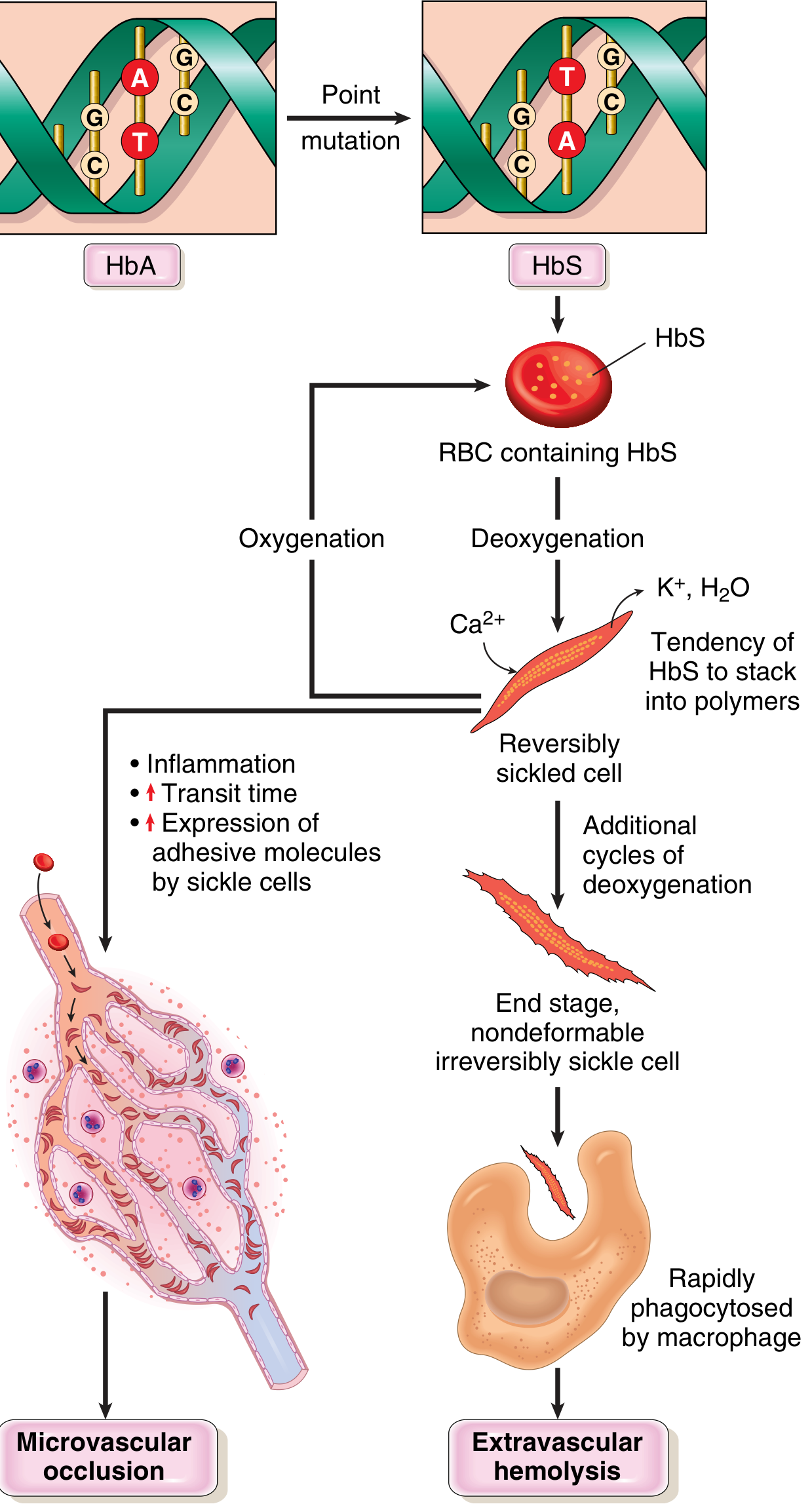
Three factors determine clinical severity of polymerization:
- Co-presence of other Hb types: HbA and HbF retard HbS polymerization (explains why newborns are protected until HbF falls at 5-6 months; also why HbAS carriers rarely sickle in vivo)
- Intracellular HbS concentration: Dehydration increases concentration and promotes sickling; co-existing α-thalassemia is protective
- Microvascular transit time: Slow-flow organs (spleen, bone marrow) are most vulnerable; inflammation further retards transit, triggering sickling
Peripheral Blood Smear
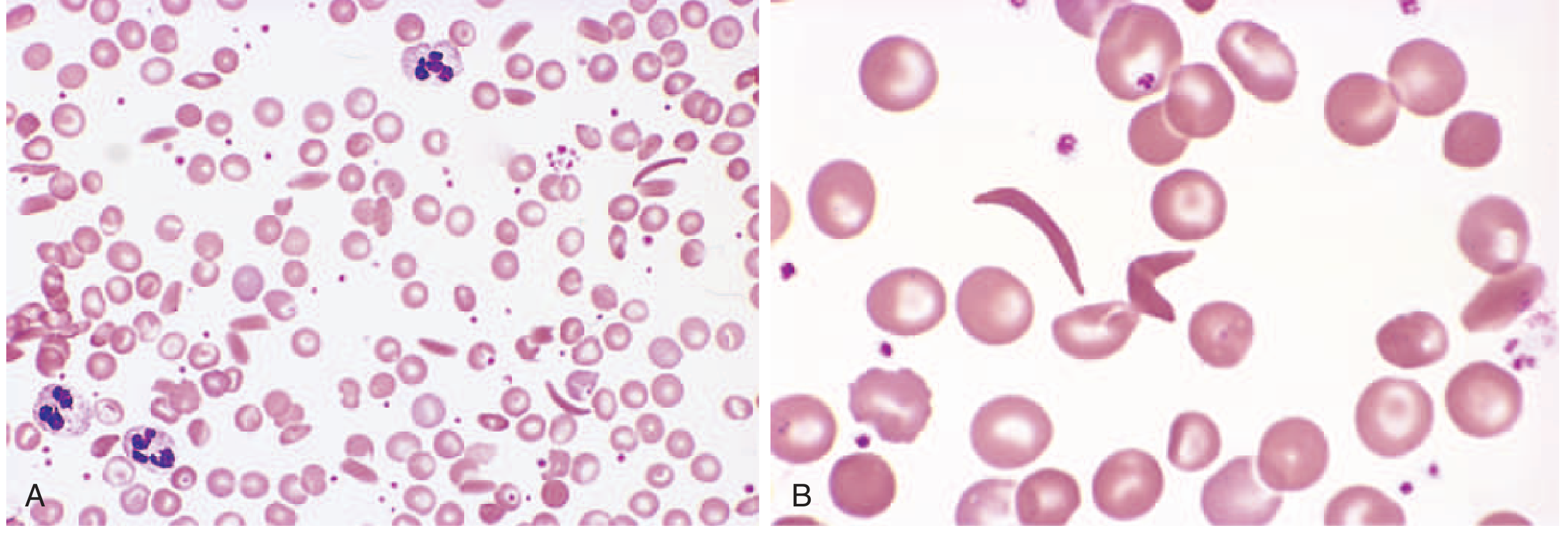
Two Major Pathological Consequences
| Consequence | Mechanism | Result |
|---|---|---|
| Chronic hemolytic anemia | Irreversibly sickled cell membrane damage | RBC lifespan ~20 days (normal ~120); severity correlates with irreversibly sickled cell fraction |
| Vascular occlusion | Sticky sickled cells adhere to endothelium; triggered by infection, inflammation, dehydration, acidosis | Ischemic tissue damage, pain crises |
Morphological Consequences (Organs)
- Spleen: Splenomegaly in children (congested red pulp) → progressive infarction → autosplenectomy by adulthood (fibrotic nubbin)
- Bones: Medullary hyperplasia causes bone resorption + new bone formation; skull shows "crew-cut" appearance on X-ray; prone to osteomyelitis (especially Salmonella)
- Heart, liver, kidneys: Hypoxia-induced fatty change
- Brain, lung, retina: Vascular thrombosis and infarction
- Gallbladder: Pigment gallstones (bilirubin from hemolysis)
- Penis: Priapism → penile fibrosis, erectile dysfunction
- Extramedullary hematopoiesis: Liver and spleen
Clinical Features & Crises
| Crisis Type | Trigger | Features |
|---|---|---|
| Vaso-occlusive (pain) crisis | Infection, dehydration, cold, acidosis | Bone pain, acute chest syndrome, stroke, priapism |
| Aplastic crisis | Parvovirus B19 (infects erythroblasts) | Sudden drop in RBC production; self-limited |
| Sequestration crisis | Trapping of sickled RBCs in spleen/liver | Sudden massive splenomegaly, rapid anemia; mainly in children |
| Hemolytic crisis | Accelerated RBC destruction | Worsening anemia, jaundice |
Infections: Functional asplenia makes patients highly susceptible to encapsulated bacteria (pneumococci, H. influenzae). Fatal septicemia is a major cause of death, especially in children.
Diagnosis
- Peripheral smear: Irreversibly sickled cells, anisocytosis, poikilocytosis
- Hemoglobin electrophoresis: HbSS (no HbA); HbAS in trait (HbA + HbS ~50:50)
- Newborn screening: Mandated in the US (gel electrophoresis on heel-stick blood)
- Prenatal diagnosis: DNA analysis of fetal DNA via amniocentesis or chorionic villus biopsy
Treatment
| Drug/Intervention | Mechanism |
|---|---|
| Hydroxyurea | Increases HbF levels; anti-inflammatory (reduces WBC); increases RBC size (lowers intracellular HbS concentration); metabolized to NO (vasodilator, anti-platelet) |
| Penicillin prophylaxis | Prevents pneumococcal infections in children <5 years |
| Vaccination | Against encapsulated organisms (pneumococcus, H. influenzae, meningococcus) |
| Blood transfusion / exchange transfusion | Target HbS <40%, Hb ~10 g/dL for severe crises; exchange preferred in acute chest syndrome/stroke |
| Allogeneic bone marrow transplant | Potentially curative |
| Gene therapy | Corrective - increasingly promising results |
Prognosis: With improved supportive care, ~50% of patients now survive beyond the 5th decade.
Sources: Robbins & Kumar Basic Pathology (9780323790185); Robbins, Cotran & Kumar Pathologic Basis of Disease (9780443264528); Rosen's Emergency Medicine (9780323757898)
??
Could you clarify what you mean? Are you:
- Confused about something in the sickle cell note?
- Asking about something else entirely?
- Reacting to the length - would you like a shorter/simpler version?
Just let me know what you need!
Why was my previous prompt not answered
Your previous prompt was answered! Here's what happened:
- You typed "Short note - sickle cell anemia"
- I responded with a detailed, structured short note covering definition, genetics, pathogenesis, morphology, clinical features, diagnosis, and treatment - complete with two textbook images from Robbins & Kumar.
Then you sent "??" which I interpreted as confusion, so I asked for clarification.
Possible reasons it may have seemed unanswered:
- The response was very long and may have taken time to load fully
- The images in the response may not have rendered on your device
- You may have been expecting a shorter/simpler format
Would you like me to re-send a shorter version, or is there something specific from the sickle cell note you'd like me to address?
Create a one-page PDF reference card on sickle cell anemia
Reading File
Running Command
mkdir -p /home/daytona/workspace/sickle-cell-pdf && ls /home/daytona/workspace/sickle-cell-pdf
Writing File
~/sickle-cell-pdf/generate_pdf.py
from reportlab.lib.pagesizes import A4
from reportlab.lib import colors
from reportlab.lib.units import mm
from reportlab.platypus import (
SimpleDocTemplate, Paragraph, Spacer, Table, TableStyle, HRFlowable
)
from reportlab.lib.styles import ParagraphStyle
from reportlab.lib.enums import TA_LEFT, TA_CENTER
OUTPUT = "/home/daytona/workspace/sickle-cell-pdf/Sickle_Cell_Anemia_Reference_Card.pdf"
# ── Colour palette ──────────────────────────────────────────────────────────
RED = colors.HexColor("#C0392B")
DARK_RED = colors.HexColor("#922B21")
LIGHT_RED = colors.HexColor("#FADBD8")
GREY_BG = colors.HexColor("#F4F6F7")
MID_GREY = colors.HexColor("#AAB7B8")
DARK = colors.HexColor("#1C2833")
WHITE = colors.white
# ── Styles ───────────────────────────────────────────────────────────────────
def S(name, **kw):
base = dict(fontName="Helvetica", fontSize=7.5, leading=10,
textColor=DARK, spaceAfter=0, spaceBefore=0)
base.update(kw)
return ParagraphStyle(name, **base)
title_style = S("title", fontName="Helvetica-Bold", fontSize=17,
textColor=WHITE, alignment=TA_CENTER, leading=20)
sub_style = S("sub", fontName="Helvetica", fontSize=8,
textColor=WHITE, alignment=TA_CENTER)
sec_style = S("sec", fontName="Helvetica-Bold", fontSize=8,
textColor=WHITE)
body_style = S("body")
bold_style = S("bold", fontName="Helvetica-Bold")
small_style = S("small", fontSize=6.8, textColor=colors.HexColor("#555"))
bullet_style = S("bullet", leftIndent=8, bulletIndent=0,
bulletText="\u2022 ")
W, H = A4
MARGIN = 10 * mm
doc = SimpleDocTemplate(
OUTPUT,
pagesize=A4,
leftMargin=MARGIN, rightMargin=MARGIN,
topMargin=MARGIN, bottomMargin=8*mm,
)
story = []
# ── HEADER BANNER ────────────────────────────────────────────────────────────
header_data = [[
Paragraph("SICKLE CELL ANEMIA", title_style),
Paragraph("Quick Reference Card • Robbins & Kumar Basic Pathology", sub_style),
]]
header_tbl = Table(header_data, colWidths=[(W - 2*MARGIN) * 0.58,
(W - 2*MARGIN) * 0.42])
header_tbl.setStyle(TableStyle([
("BACKGROUND", (0, 0), (-1, -1), RED),
("VALIGN", (0, 0), (-1, -1), "MIDDLE"),
("TOPPADDING", (0, 0), (-1, -1), 6),
("BOTTOMPADDING",(0,0), (-1, -1), 6),
("LEFTPADDING", (0, 0), (-1, -1), 8),
("ROUNDEDCORNERS", [4]),
]))
story.append(header_tbl)
story.append(Spacer(1, 4))
# ── helper: section header ───────────────────────────────────────────────────
def section_header(text):
tbl = Table([[Paragraph(text, sec_style)]],
colWidths=[W - 2*MARGIN])
tbl.setStyle(TableStyle([
("BACKGROUND", (0, 0), (-1, -1), DARK_RED),
("TOPPADDING", (0, 0), (-1, -1), 3),
("BOTTOMPADDING",(0, 0), (-1, -1), 3),
("LEFTPADDING", (0, 0), (-1, -1), 6),
]))
return tbl
def shaded_table(data, col_widths, header_bg=RED):
tbl = Table(data, colWidths=col_widths, repeatRows=1)
style = [
("BACKGROUND", (0, 0), (-1, 0), header_bg),
("TEXTCOLOR", (0, 0), (-1, 0), WHITE),
("FONTNAME", (0, 0), (-1, 0), "Helvetica-Bold"),
("FONTSIZE", (0, 0), (-1, -1), 7.2),
("LEADING", (0, 0), (-1, -1), 9.5),
("ROWBACKGROUNDS",(0, 1), (-1, -1), [WHITE, GREY_BG]),
("GRID", (0, 0), (-1, -1), 0.3, MID_GREY),
("TOPPADDING", (0, 0), (-1, -1), 2.5),
("BOTTOMPADDING",(0, 0), (-1, -1), 2.5),
("LEFTPADDING", (0, 0), (-1, -1), 4),
("VALIGN", (0, 0), (-1, -1), "TOP"),
]
tbl.setStyle(TableStyle(style))
return tbl
CW = W - 2 * MARGIN # usable width
# ══════════════════════════════════════════════════════════════════════════════
# ROW 1 — Definition/Genetics | Pathogenesis
# ══════════════════════════════════════════════════════════════════════════════
LEFT_W = CW * 0.38
RIGHT_W = CW * 0.62
GAP = 3
def left_cell():
items = []
items.append(section_header("DEFINITION & GENETICS"))
items.append(Spacer(1, 2))
def_data = [
["Gene", "β-globin (chromosome 11)"],
["Mutation", "GAG→GTG → Glu6Val (valine replaces\nglutamate at position 6 of β-globin)"],
["Hb formed", "HbS (α₂β²S)"],
["Inheritance", "Autosomal recessive"],
["Homozygote", "Sickle cell DISEASE (HbSS)"],
["Heterozygote","Sickle cell TRAIT (HbAS)\n— usually asymptomatic"],
]
t = Table(def_data, colWidths=[LEFT_W*0.35, LEFT_W*0.65])
t.setStyle(TableStyle([
("FONTNAME", (0, 0), (0, -1), "Helvetica-Bold"),
("FONTNAME", (1, 0), (1, -1), "Helvetica"),
("FONTSIZE", (0, 0), (-1, -1), 7),
("LEADING", (0, 0), (-1, -1), 9),
("ROWBACKGROUNDS",(0,0),(-1,-1),[WHITE, GREY_BG]),
("GRID", (0, 0), (-1, -1), 0.3, MID_GREY),
("TOPPADDING",(0, 0), (-1, -1), 2),
("BOTTOMPADDING",(0,0),(-1,-1), 2),
("LEFTPADDING",(0,0),(-1,-1), 3),
("VALIGN", (0,0), (-1,-1), "TOP"),
]))
items.append(t)
items.append(Spacer(1, 4))
items.append(section_header("EPIDEMIOLOGY"))
items.append(Spacer(1, 2))
epi = [
"~8% of African-Americans are HbS carriers",
"1 in 600 African-Americans have sickle cell anemia",
"HbS prevalent where P. falciparum malaria is/was endemic (equatorial Africa, parts of India, S. Europe)",
"Median life expectancy: ~5th decade",
]
for e in epi:
items.append(Paragraph(f"• {e}", S("ep", fontSize=7, leading=9.5, leftIndent=4)))
return items
def right_cell():
items = []
items.append(section_header("PATHOGENESIS"))
items.append(Spacer(1, 2))
path_text = (
"On <b>deoxygenation</b>, HbS undergoes conformational change → <b>polymerization</b> "
"via abnormal intermolecular contacts at Val6 → distorts RBC into elongated sickle shape."
)
items.append(Paragraph(path_text, S("pt", fontSize=7, leading=9.5)))
items.append(Spacer(1, 3))
factors_data = [
["Factor", "Effect"],
["Co-existing HbF or HbA", "Retard HbS polymerization — newborns protected until HbF falls (~5–6 months)"],
["HbS concentration", "Dehydration ↑ concentration → promotes sickling; α-thalassemia is protective"],
["Microvascular transit time", "Slow-flow organs (spleen, marrow) most at risk; inflammation worsens sickling"],
]
items.append(shaded_table(factors_data, [RIGHT_W*0.32, RIGHT_W*0.68]))
items.append(Spacer(1, 3))
conseq_text = "<b>Two major consequences:</b>"
items.append(Paragraph(conseq_text, S("ct", fontSize=7, fontName="Helvetica-Bold")))
conseq = [
"<b>Chronic hemolytic anemia</b> — RBC lifespan ~20 days (normal ~120); severity ∝ irreversibly sickled cells",
"<b>Vascular occlusion</b> — ischemia, pain crises; triggered by infection, dehydration, acidosis, inflammation",
]
for c in conseq:
items.append(Paragraph(f"• {c}", S("cp", fontSize=7, leading=9.5, leftIndent=4)))
return items
lc = left_cell()
rc = right_cell()
# pad to same length
while len(lc) < len(rc): lc.append(Spacer(1, 1))
while len(rc) < len(lc): rc.append(Spacer(1, 1))
row1 = Table([[lc, rc]], colWidths=[LEFT_W, RIGHT_W])
row1.setStyle(TableStyle([
("VALIGN", (0,0), (-1,-1), "TOP"),
("LEFTPADDING", (0,0), (-1,-1), 0),
("RIGHTPADDING",(0,0), (-1,-1), GAP),
("TOPPADDING", (0,0), (-1,-1), 0),
("BOTTOMPADDING",(0,0),(-1,-1), 0),
]))
story.append(row1)
story.append(Spacer(1, 4))
# ══════════════════════════════════════════════════════════════════════════════
# ROW 2 — Clinical Crises | Organ Complications
# ══════════════════════════════════════════════════════════════════════════════
L2 = CW * 0.52
R2 = CW * 0.48
crises_items = []
crises_items.append(section_header("CLINICAL CRISES"))
crises_items.append(Spacer(1, 2))
crises_data = [
["Crisis", "Trigger", "Features"],
["Vaso-occlusive\n(pain)", "Infection, dehydration,\ncold, acidosis",
"Bone pain, acute chest syndrome,\nstroke, priapism"],
["Aplastic", "Parvovirus B19\n(infects erythroblasts)",
"Sudden ↓ RBC production;\nself-limited"],
["Sequestration", "Trapped sickled RBCs\nin spleen/liver",
"Sudden massive splenomegaly,\nrapid anemia (mainly children)"],
["Hemolytic", "Accelerated RBC\ndestruction",
"Worsening anemia, jaundice"],
]
crises_items.append(shaded_table(crises_data, [L2*0.22, L2*0.30, L2*0.48]))
organ_items = []
organ_items.append(section_header("ORGAN COMPLICATIONS"))
organ_items.append(Spacer(1, 2))
organ_data = [
["Organ/System", "Complication"],
["Spleen", "Autosplenectomy (children: splenomegaly → adult: fibrotic nubbin)"],
["Bone", "'Crew-cut' skull on X-ray; osteomyelitis (Salmonella, E. coli)"],
["Brain", "Stroke (infarction from vascular occlusion)"],
["Lung", "Acute chest syndrome"],
["Kidney", "Renal tubular fatty change, papillary necrosis"],
["Eye", "Retinal infarction → blindness"],
["Liver/Heart", "Fatty change from chronic hypoxia"],
["Gallbladder", "Pigment gallstones (↑ bilirubin from hemolysis)"],
["Penis", "Priapism → fibrosis, erectile dysfunction"],
["Infection risk","Encapsulated bacteria (pneumococci, H. influenzae, meningococci)"],
]
organ_items.append(shaded_table(organ_data, [R2*0.30, R2*0.70]))
row2 = Table([[crises_items, organ_items]], colWidths=[L2, R2])
row2.setStyle(TableStyle([
("VALIGN", (0,0), (-1,-1), "TOP"),
("LEFTPADDING", (0,0), (-1,-1), 0),
("RIGHTPADDING",(0,0), (-1,-1), GAP),
("TOPPADDING", (0,0), (-1,-1), 0),
("BOTTOMPADDING",(0,0),(-1,-1), 0),
]))
story.append(row2)
story.append(Spacer(1, 4))
# ══════════════════════════════════════════════════════════════════════════════
# ROW 3 — Diagnosis | Treatment
# ══════════════════════════════════════════════════════════════════════════════
L3 = CW * 0.42
R3 = CW * 0.58
diag_items = []
diag_items.append(section_header("DIAGNOSIS"))
diag_items.append(Spacer(1, 2))
diag_data = [
["Test", "Finding"],
["Peripheral smear", "Irreversibly sickled cells, anisocytosis, poikilocytosis"],
["Hb electrophoresis", "HbSS (no HbA) in disease;\nHbAS ~50:50 in trait"],
["Newborn screening", "Mandated in US — gel electrophoresis on heel-stick blood"],
["Prenatal diagnosis", "DNA analysis via amniocentesis or CVS"],
["Sickling test", "In vitro hypoxia induces sickling in HbAS trait cells"],
]
diag_items.append(shaded_table(diag_data, [L3*0.38, L3*0.62]))
tx_items = []
tx_items.append(section_header("TREATMENT"))
tx_items.append(Spacer(1, 2))
tx_data = [
["Treatment", "Mechanism / Notes"],
["Hydroxyurea", "↑ HbF; anti-inflammatory (↓ WBC); ↑ RBC size (↓ [HbS]);\nmetabolized to NO → vasodilation, anti-platelet"],
["Penicillin prophylaxis", "Prevent pneumococcal infections in children <5 yrs"],
["Vaccination", "Pneumococcus, H. influenzae type b, meningococcus"],
["Transfusion /\nExchange transfusion", "Target HbS <40%, Hb ~10 g/dL;\nexchange preferred in stroke, acute chest syndrome"],
["Bone marrow transplant", "Potentially curative (allogeneic)"],
["Gene therapy", "Corrective — increasingly promising"],
["Folic acid", "Compensate for ↑ RBC turnover"],
]
tx_items.append(shaded_table(tx_data, [R3*0.30, R3*0.70]))
row3 = Table([[diag_items, tx_items]], colWidths=[L3, R3])
row3.setStyle(TableStyle([
("VALIGN", (0,0), (-1,-1), "TOP"),
("LEFTPADDING", (0,0), (-1,-1), 0),
("RIGHTPADDING",(0,0), (-1,-1), GAP),
("TOPPADDING", (0,0), (-1,-1), 0),
("BOTTOMPADDING",(0,0),(-1,-1), 0),
]))
story.append(row3)
story.append(Spacer(1, 4))
# ══════════════════════════════════════════════════════════════════════════════
# FOOTER — Key Memory Points
# ══════════════════════════════════════════════════════════════════════════════
story.append(section_header("KEY MEMORY POINTS"))
story.append(Spacer(1, 2))
key_points = [
"<b>Mutation:</b> GAG→GTG • Glu→Val at β-globin position 6 • A→T transversion",
"<b>HbF protective:</b> Newborns asymptomatic until ~5–6 months when HbF replaced by HbS",
"<b>Autosplenectomy</b> → functional asplenia → susceptibility to <b>encapsulated bacteria</b>",
"<b>Crew-cut skull</b> on X-ray from marrow hyperplasia; <b>Salmonella</b> osteomyelitis is classic",
"<b>Parvovirus B19</b> → aplastic crisis • Dehydration/hypoxia/acidosis/infection trigger vaso-occlusive crisis",
"<b>Hydroxyurea</b> = mainstay of therapy (↑ HbF + anti-inflammatory + NO production)",
"RBC lifespan <b>~20 days</b> (vs normal ~120 days) • ~50% survive beyond 5th decade with modern care",
]
kp_data = [[Paragraph(p, S("kp", fontSize=7, leading=9.5))] for p in key_points]
kp_tbl = Table(kp_data, colWidths=[CW])
kp_tbl.setStyle(TableStyle([
("ROWBACKGROUNDS",(0,0),(-1,-1),[WHITE, LIGHT_RED]),
("GRID", (0,0),(-1,-1), 0.3, MID_GREY),
("TOPPADDING", (0,0),(-1,-1), 2.5),
("BOTTOMPADDING",(0,0),(-1,-1), 2.5),
("LEFTPADDING", (0,0),(-1,-1), 5),
("VALIGN", (0,0),(-1,-1), "MIDDLE"),
]))
story.append(kp_tbl)
story.append(Spacer(1, 3))
story.append(Paragraph(
"Source: Robbins & Kumar Basic Pathology (10th ed.) — For educational use only",
S("footer", fontSize=6, textColor=MID_GREY, alignment=TA_CENTER)
))
doc.build(story)
print("PDF created:", OUTPUT)
Running Command
cd /home/daytona/workspace/sickle-cell-pdf && python generate_pdf.py
Your reference card is ready:
Sickle Cell Anemia Reference Card
PDF Document · PDF
The one-page A4 card covers:
- Definition & Genetics - mutation details, inheritance, HbSS vs HbAS
- Epidemiology - prevalence, malaria connection
- Pathogenesis - the three key factors governing sickling
- Clinical Crises - vaso-occlusive, aplastic, sequestration, hemolytic
- Organ Complications - all major systems
- Diagnosis - smear, electrophoresis, screening
- Treatment - hydroxyurea, transfusion, BMT, gene therapy
- Key Memory Points - high-yield exam facts highlighted at the bottom
This is a shared conversation. Sign in to Orris to start your own chat.