
Thyroid storm
I'll read the medical library skill first, then research thyroid storm comprehensively.
Reading File
Now I'll run parallel searches across the textbook library and PubMed simultaneously.
Finding Sources
Finding Sources
Searching PubMed
"thyroid storm" management
Excellent - rich results. Now I'll read the best emergency medicine and pharmacology sections in parallel.
Reading File
Reading File
Reading File
Excellent content retrieved. Let me now get the full treatment section from Rosen's EM and fetch the key diagnostic/treatment images.
Reading File
Loading Image
Loading Image
I now have comprehensive, high-quality textbook content and excellent images. Let me compile the full answer.
Thyroid Storm
Thyroid storm (thyrotoxic crisis) is a rare, life-threatening endocrine emergency representing the extreme end of the thyrotoxicosis spectrum. Untreated mortality approaches 100%; with prompt recognition and treatment, it falls to 10-30%.
Definition & Pathophysiology
Thyroid storm is not simply severe hyperthyroidism - it is a state of multiorgan dysfunction triggered by an acute catecholamine-thyroid hormone synergy. The exact mechanism is incompletely understood, but involves:
- Sudden elevation of free thyroid hormones (T3/T4 released from binding proteins during stress)
- Increased adrenergic receptor sensitivity to circulating catecholamines
- Peripheral T4 → T3 conversion surge, amplifying active hormone levels
- T3 enters cell nuclei, binds thyroid hormone-responsive elements, drives widespread gene transcription and metabolic acceleration
The total thyroid hormone level may not be dramatically elevated over uncomplicated hyperthyroidism - the shift is in free hormone levels and receptor hyperresponsiveness.
Precipitating Factors
| Category | Examples |
|---|---|
| Systemic insult | Infection, trauma, general surgery |
| Cardiovascular | Myocardial infarction, pulmonary embolism, stroke |
| Endocrine | Diabetic ketoacidosis, hyperosmolar coma |
| Drug/hormone related | Withdrawal of antithyroid drugs, iodine load, radioactive iodine therapy, exogenous thyroid hormone ingestion |
| Obstetric | Labor and delivery, eclampsia, preeclampsia |
| Iatrogenic | Thyroid gland palpation (vigorous) |
| Unknown | Up to 25% of cases have no identifiable trigger |
The underlying cause is most often Graves disease, though toxic multinodular goiter, destructive thyroiditis, and hCG-secreting hydatidiform mole can also precipitate storm.
Clinical Features
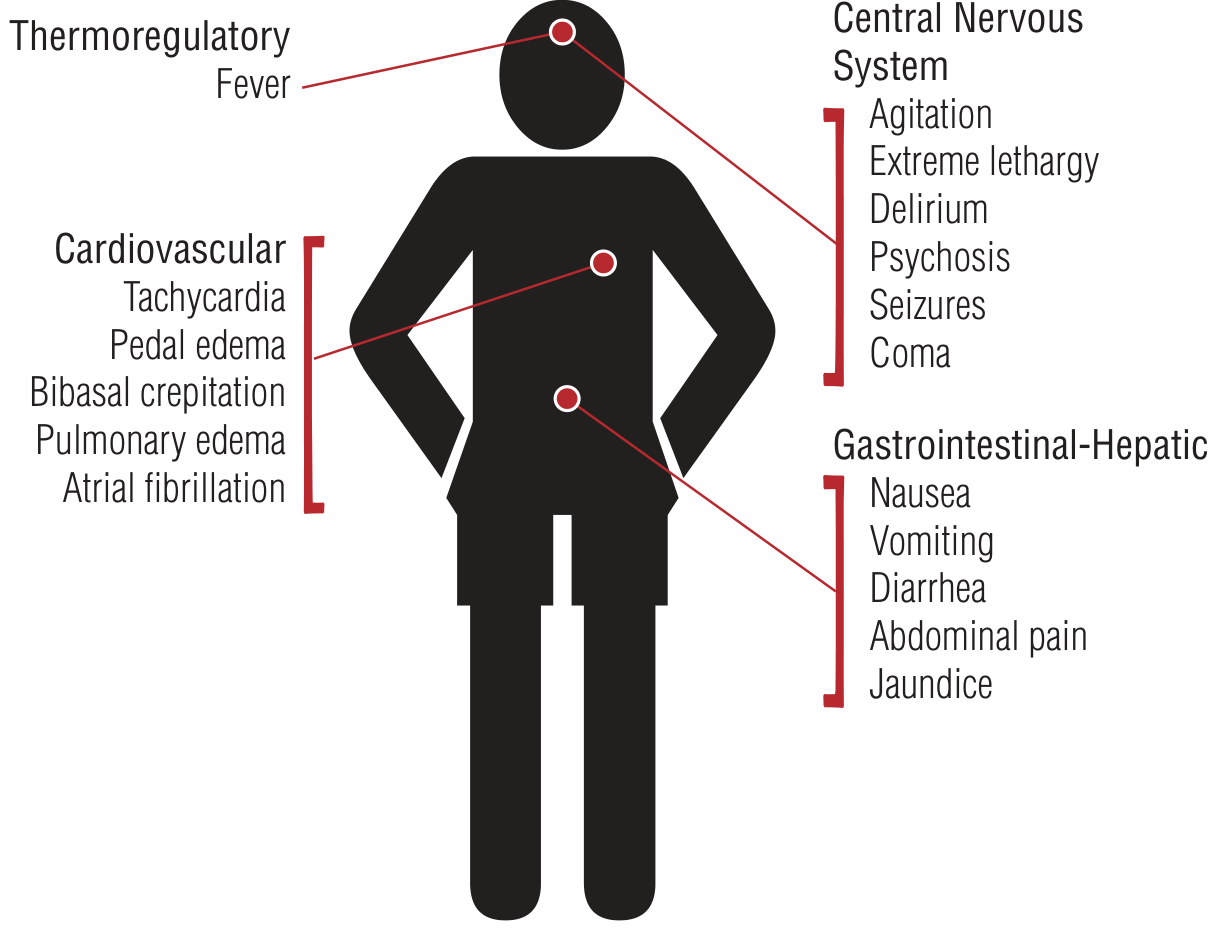
Figure: Clinical features of thyroid storm (Tintinalli's Emergency Medicine)
The cardinal triad is fever + extreme tachycardia + altered mental status, but the full picture spans four organ systems:
Thermoregulatory
- Hyperpyrexia: 104-106°F (40-41°C), often dramatic
Cardiovascular
- Tachycardia (often out of proportion to fever), atrial fibrillation
- Congestive heart failure, pulmonary edema, pedal edema
- Bibasal crepitations, hypotension (from volume depletion or cardiogenic shock)
Central Nervous System
- Agitation, anxiety, tremor
- Delirium, psychosis
- Seizures, extreme lethargy, coma
Gastrointestinal-Hepatic
- Nausea, vomiting, diarrhea
- Abdominal pain
- Hepatic failure with jaundice (poor prognostic sign)
Classic thyroid exam findings (goiter, ophthalmopathy, lid lag, stare) support the diagnosis but may be absent.
Diagnosis
Thyroid storm is a clinical diagnosis. Do not wait for labs to start treatment.
Labs to order: Free T4, Free T3, TSH (will show suppressed/undetectable TSH + elevated free hormones), CBC, metabolic panel, blood cultures, ECG.
Burch-Wartofsky Point Scale (BWPS)
| Parameter | Points |
|---|---|
| Fever | |
| 99-99.9°F | 5 |
| 100-100.9°F | 10 |
| 101-101.9°F | 15 |
| 102-102.9°F | 20 |
| 103-103.9°F | 25 |
| ≥104°F | 30 |
| Heart rate (bpm) | |
| 90-109 | 5 |
| 110-119 | 10 |
| 120-129 | 15 |
| 130-139 | 20 |
| ≥140 | 25 |
| Mental status | |
| Normal | 0 |
| Mild agitation | 10 |
| Delirium/psychosis/extreme lethargy | 20 |
| Seizure or coma | 30 |
| GI-hepatic dysfunction | |
| Absent | 0 |
| Moderate (diarrhea, nausea/vomiting) | 10 |
| Severe (jaundice) | 20 |
| Heart failure | |
| Absent | 0 |
| Mild (pedal edema) | 5 |
| Moderate (bibasal crepitations) | 10 |
| Severe (pulmonary edema) | 15 |
| Atrial fibrillation | 10 |
| Precipitating event identified | 10 |
- Score ≥45: thyroid storm (or impending storm) - treat aggressively
- Score 25-44: impending storm - treat and monitor closely
- Score <25: unlikely thyroid storm
Differential Diagnosis
| Condition | Distinguishing features |
|---|---|
| Heatstroke | No goiter, no thyroid history |
| Neuroleptic malignant syndrome | Recent antipsychotic use, rigidity |
| Serotonin syndrome | Serotonergic drug exposure, hyperreflexia, clonus |
| Anticholinergic crisis | Dry skin, urinary retention, mydriasis |
| Sympathomimetic toxidrome | Drug history, no goiter |
| Sepsis | Cultures positive, may coexist |
| Meningitis | Meningeal signs, CSF abnormalities |
Management
Treatment should be initiated simultaneously across all five pillars. Admit to ICU.
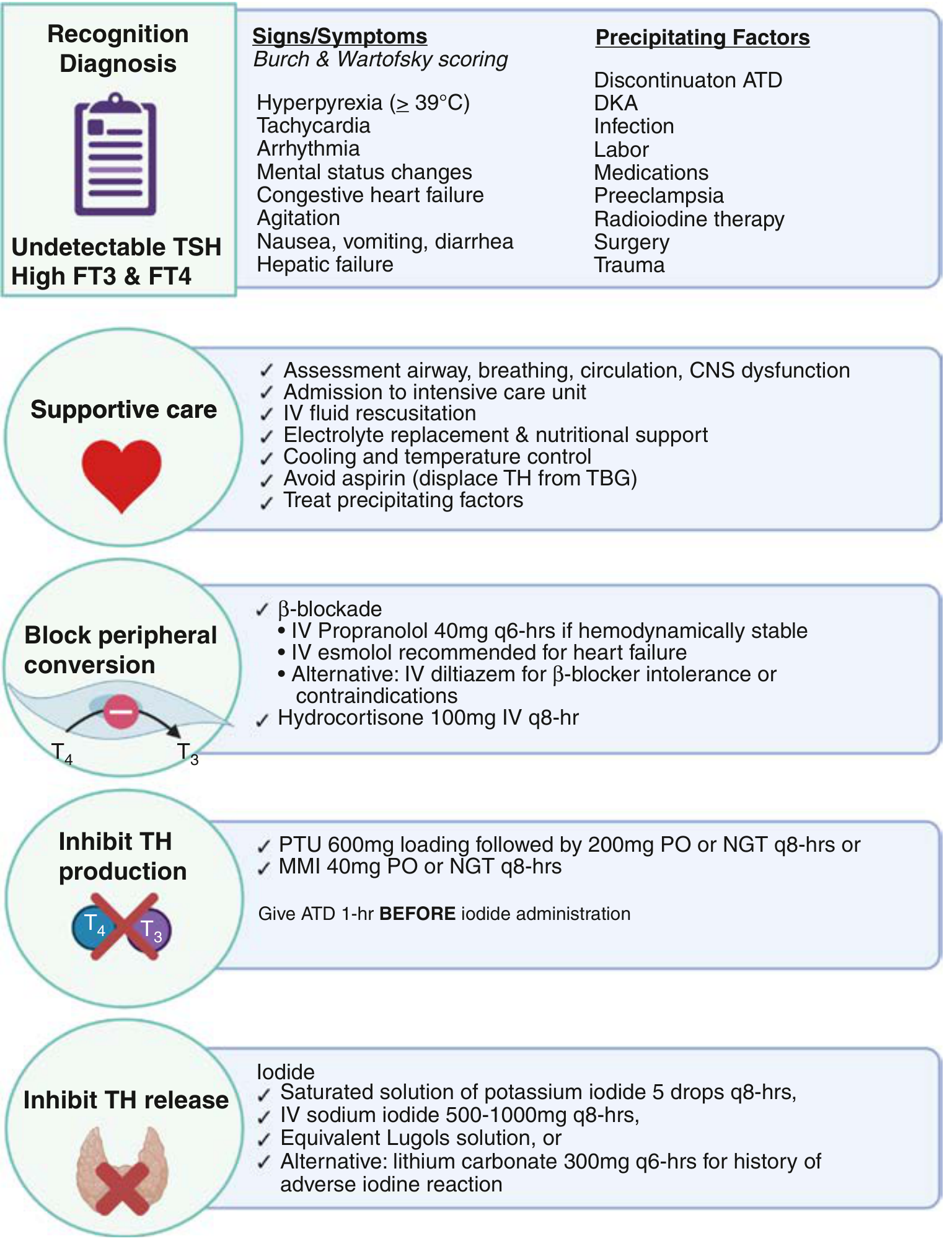
Figure: Thyroid storm recognition, diagnosis, and management algorithm (Creasy & Resnik's Maternal-Fetal Medicine)
Step 1 - Block peripheral T4 → T3 conversion (immediate)
Beta-blockers (reduce adrenergic symptoms AND slightly block T4→T3 conversion):
- Propranolol 60-80 mg PO q4h OR 0.5-1.0 mg IV slow push test dose, then 1-2 mg IV q15 min until controlled, then 1-2 mg IV q3h
- Esmolol 50-100 mcg/kg/min IV infusion (preferred in heart failure - titratable)
- Metoprolol 25-50 mg PO q6h (alternative)
- If beta-blockers strictly contraindicated: reserpine 2.5-5 mg IM q4h OR diltiazem IV
Corticosteroids (block T4→T3 + treat relative adrenal insufficiency):
- Hydrocortisone 300 mg IV loading dose, then 100 mg IV q8h
- OR Dexamethasone 2-4 mg IV q6h
Step 2 - Inhibit thyroid hormone synthesis (give 1 hour BEFORE iodide)
Antithyroid drugs (ATDs):
- PTU (propylthiouracil) 500-1000 mg loading dose PO/NG, then 250 mg q4h - preferred in storm because it also blocks peripheral T4→T3 conversion
- OR Methimazole 60-80 mg/day in divided doses
- Can be given PO, nasogastric, or PR (rectal enema prepared by pharmacy) - same dosing for all routes
Critical rule: ATD must be given at least 1 hour before iodide - otherwise iodide provides substrate for synthesis of even more thyroid hormone.
Step 3 - Inhibit thyroid hormone release (give AFTER ATD)
Iodide solutions (Wolff-Chaikoff effect - block organification and hormone release):
- SSKI (saturated solution of KI, 50 mg iodide/drop): 1-2 drops PO/PR three times daily
- OR Lugol's solution (8 mg iodide/drop): 5-7 drops PO/PR three times daily
- OR Sodium iodide IV per endocrinology guidance
- If iodine allergy: Lithium carbonate 300 mg PO/NG q6h (blocks hormone release)
- Cholestyramine 1-4 g PO twice daily - blocks enterohepatic recirculation of thyroid hormone (useful in refractory cases)
Step 4 - Supportive care
- IV fluids: D5/0.9NS for volume resuscitation and glycogen replacement (thyroid hormone depletes glycogen)
- Fever control: Acetaminophen (NOT aspirin - aspirin displaces T4 from thyroid-binding globulin, worsening free hormone levels), cooling blankets, ice packs, fans, ice lavage
- Electrolyte replacement and nutritional support
- Lorazepam or diazepam for agitation/seizures and to reduce central sympathetic outflow
- Supplemental oxygen, cardiac monitoring
Step 5 - Identify and treat the precipitating event
- Empirical broad-spectrum antibiotics if infection cannot be ruled out
- Treat concurrent DKA, pulmonary embolism, MI as indicated
Refractory/Escalation Options
If no clinical improvement after 24-48 hours of aggressive management:
- Plasma exchange (plasmapheresis) - directly removes circulating T3/T4 and TSH-receptor antibodies (TRAbs)
- Dialysis - transient reduction of thyroid hormone levels
- Near-total thyroidectomy - only if ATDs are contraindicated (e.g., agranulocytosis), requires stabilization first
Special Population: Pregnancy
- PTU is preferred over methimazole in the first trimester (methimazole has teratogenic risk - aplasia cutis, choanal atresia)
- Avoid aspirin - displaces thyroid hormones from TBG
- Short-acting beta-blockers preferred (e.g., esmolol, labetalol)
- Avoid delivery during active thyroid storm - fetal status typically improves as maternal status stabilizes
- Hydrocortisone is preferred over dexamethasone in pregnancy (largely inactivated by placental 11β-HSD to cortisone, reducing fetal exposure)
Causes of Death
- Multiorgan dysfunction syndrome
- Congestive heart failure / high-output cardiac failure
- Cardiac arrhythmias
- Respiratory failure
- Disseminated intravascular coagulation (DIC)
- Hypoxic brain injury
- Sepsis
- Hepatic failure (jaundice = poor prognosis)
Key Pearls
- Clinical diagnosis - never delay treatment waiting for thyroid function tests
- ATD before iodide - giving iodide first causes a surge in hormone synthesis
- Avoid aspirin for fever - use acetaminophen only
- PTU preferred over MMI in storm - dual benefit of synthesis inhibition AND peripheral conversion block
- Burch-Wartofsky ≥45 = treat as storm regardless of lab values
- Mortality is 10-30% even with treatment; unrecognized storm carries up to 75% mortality
- Esmolol preferred over propranolol in heart failure (short-acting, easily titrated, reversed)
Sources: Rosen's Emergency Medicine (9e), Tintinalli's Emergency Medicine (9e), Creasy & Resnik's Maternal-Fetal Medicine, Braunwald's Heart Disease, Miller's Anesthesia (10e)
This is a shared conversation. Sign in to Orris to start your own chat.