
Classification of bone
Reading File
Bones can be classified by shape (long, short, flat, irregular, sesamoid), by composition (cortical/compact vs. cancellous/trabecular), and by developmental origin (endochondral vs. intramembranous). Let me pull the full textbook coverage now.
Searching sources...
Finding Sources
Finding Sources
Finding Sources
Finding Sources
Good results. Now let me read the most comprehensive sections - from Histology (Wheater) and Gray's Anatomy:
Reading File
Reading File
Reading File
Excellent content from multiple authoritative textbooks. Now let me also get the histological classification content (compact vs. spongy) and bone formation classification, plus fetch relevant images:
Reading File
Loading Image
Loading Image
I now have rich, comprehensive content from multiple authoritative textbooks. Here is the full, well-structured answer:
Classification of Bone
Bones can be classified by three major criteria: shape, tissue structure (histology), and developmental origin (ossification).
1. Classification by Shape
This is the primary anatomical classification, dividing bones into five types:
A. Long Bones
- Tubular in shape - longer than they are wide
- Consist of a shaft (diaphysis) and two expanded ends (epiphyses); the flared junction is the metaphysis
- The diaphysis has a central medullary (marrow) cavity; the shaft wall is almost entirely compact bone, while the epiphyses are mostly spongy bone with only a thin outer compact shell
- Articular surfaces are covered by hyaline (articular) cartilage
- Examples: Femur, humerus, tibia, fibula, radius, ulna, metacarpals, phalanges
B. Short Bones
- Nearly equal in length and diameter - cuboidal in shape
- Possess a shell of compact bone with spongy bone and marrow space inside
- Articular surfaces covered by hyaline cartilage; rest covered by periosteum
- Examples: Carpal bones (wrist), tarsal bones (ankle)
C. Flat Bones
- Thin and plate-like
- Consist of two layers of relatively thick compact bone (inner and outer tables) separated by an intervening layer of spongy bone (called the diploe in the skull)
- Examples: Scapula, sternum, ilium, bones of the calvaria (skull vault), ribs
D. Irregular Bones
- Complex shapes that do not fit into the other categories
- May have intricate geometry or contain air spaces (sinuses)
- Examples: Vertebrae, bones of the face, ethmoid, hyoid, sacrum
E. Sesamoid Bones
- Round or oval bones that develop within tendons, protecting them from wear
- The largest is the patella (kneecap); others occur in tendons of the hands and feet (especially flexor tendons of the thumb and big toe)
- Note: Accessory (supernumerary) bones such as the os naviculare are a related variant - extra bones that arise from failure of fusion of ossification centers, commonly found in the wrist, ankle, and calvaria. These should not be mistaken for fractures on imaging.
Some atlases (e.g., THIEME Atlas of Anatomy) also include a sixth type:
F. Pneumatic Bones
- Contain air-filled spaces (paranasal sinuses)
- Examples: Frontal bone, maxilla, sphenoid, ethmoid
2. Classification by Tissue Structure (Histological)
All bones consist of two types of bone tissue:
| Feature | Compact (Cortical) Bone | Spongy (Cancellous / Trabecular) Bone |
|---|---|---|
| Structure | Dense, solid outer shell | Meshwork of interconnecting trabeculae |
| Structural unit | Osteons (Haversian systems) | Trabeculae (~200-300 µm thick) |
| Vascular supply | Haversian + Volkmann canals | Nourished by diffusion from marrow cavity |
| Location | Outer shell of all bones; full thickness of diaphysis | Interior of epiphyses, metaphyses, flat bones (diploe) |
| Marrow spaces | Surrounds medullary cavity | Trabeculae enclose marrow spaces |
Compact bone is organized into osteons (Haversian systems) - concentric lamellar cylinders ~1 cm long and 250-350 µm in diameter, each centered on a Haversian canal containing vessels and nerves. Volkmann canals run perpendicularly and connect Haversian canals to each other and to the periosteum.
Between lamellae, osteocytes sit in lacunae and communicate via fine cytoplasmic processes in canaliculi.
Immature (woven) bone vs. mature (lamellar) bone is another histological distinction:
- Woven bone: formed during development and fracture repair; collagen fibers arranged irregularly
- Lamellar bone: normal adult bone; collagen fibers in organized parallel sheets
3. Classification by Developmental Origin (Ossification)
| Type | Process | Bones |
|---|---|---|
| Intramembranous ossification | Bone forms directly from mesenchyme without a cartilage template | Flat bones of skull, mandible, clavicle |
| Endochondral ossification | A hyaline cartilage model is replaced by bone | All other bones (limb bones, vertebrae, ribs, base of skull) |
Structure of a Typical Long Bone
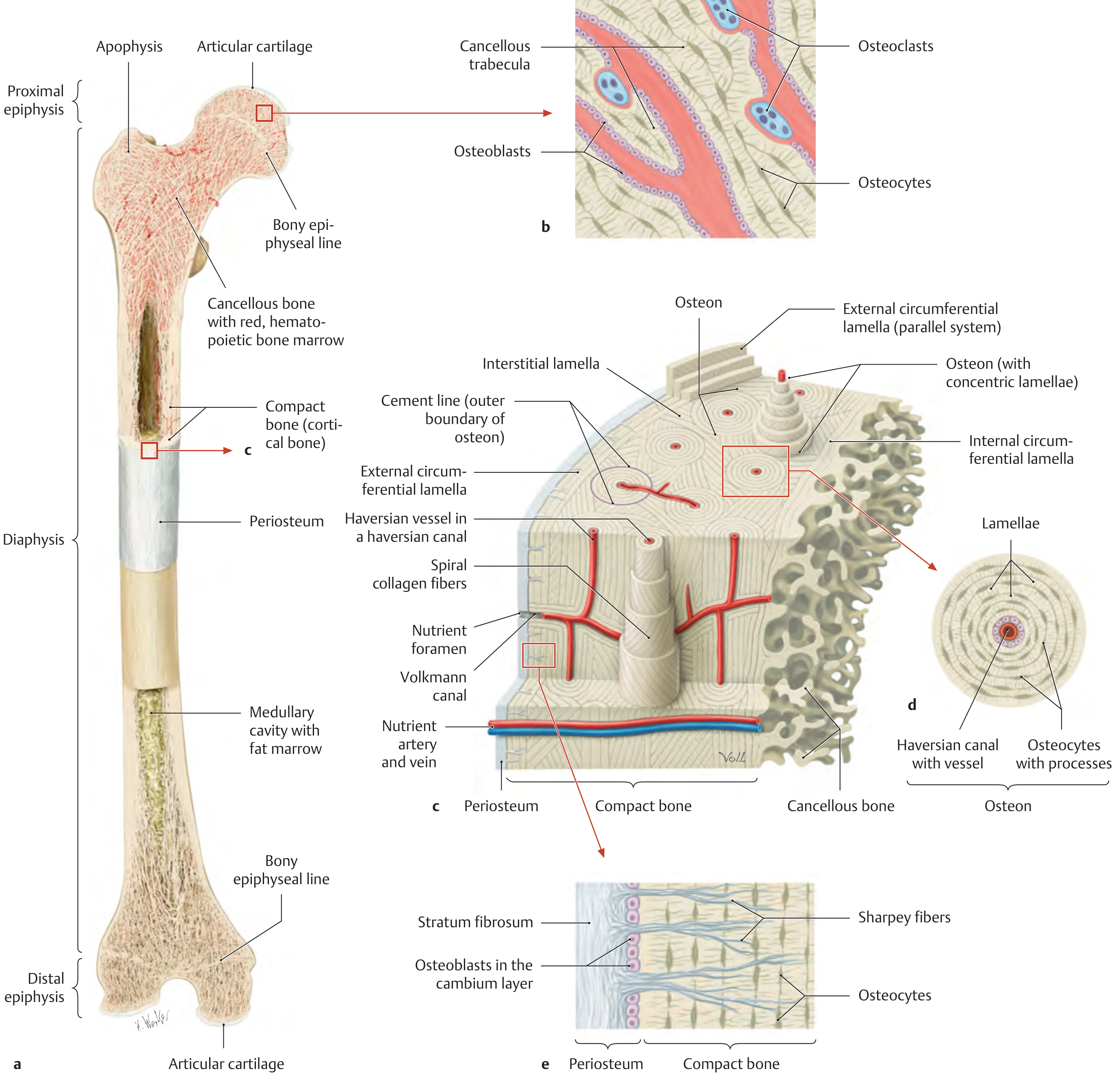
The diagram above (from THIEME Atlas of Anatomy) shows: (a) coronal section of the femur with cancellous and compact regions, (b) bone cells in cancellous trabeculae, (c) 3D microstructure of compact bone with osteons, Haversian canals, and Volkmann canals, (d) cross-section of a single osteon, and (e) the periosteum layers with Sharpey fibers.
Sources:
- Histology: A Text and Atlas (Pawlina), 9th Ed. - General Structure of Bones
- Gray's Anatomy for Students, 4th Ed. - Bone
- THIEME Atlas of Anatomy: General Anatomy and Musculoskeletal System - Types of Bone
- Histology: A Text and Atlas (Ross & Pawlina) - Bone as an Organ
- Imaging Anatomy: Bones, Joints, Vessels and Nerves - Bones
- Forensic Anthropology: A Comprehensive Introduction - Bone Types
This is a shared conversation. Sign in to Orris to start your own chat.