


1000081064.jpg
1000081026.jpg
What is probable diagnosis and treatment in detail a pt complaining of intensly itchy red brownish lesions with cystic postules
analyse_media
analyse_media
Reading File
Finding Sources
Finding Sources
Finding Sources
Reading File
Reading File
Reading File
Reading File
Finding Sources
Reading File
Reading File
Reading File
Loading Image
I now have all the information needed for a thorough answer.
Probable Diagnosis: Tinea Cruris (with superimposed Lichen Simplex Chronicus)
Primary diagnosis: Tinea Cruris ("jock itch") - a dermatophyte infection of the groin, perineum, inner thighs, and perianal/gluteal skin - with chronic lichenification (Lichen Simplex Chronicus) as a secondary change due to prolonged itch-scratch cycling.
Here is the classic textbook appearance for comparison (Fitzpatrick's Dermatology):
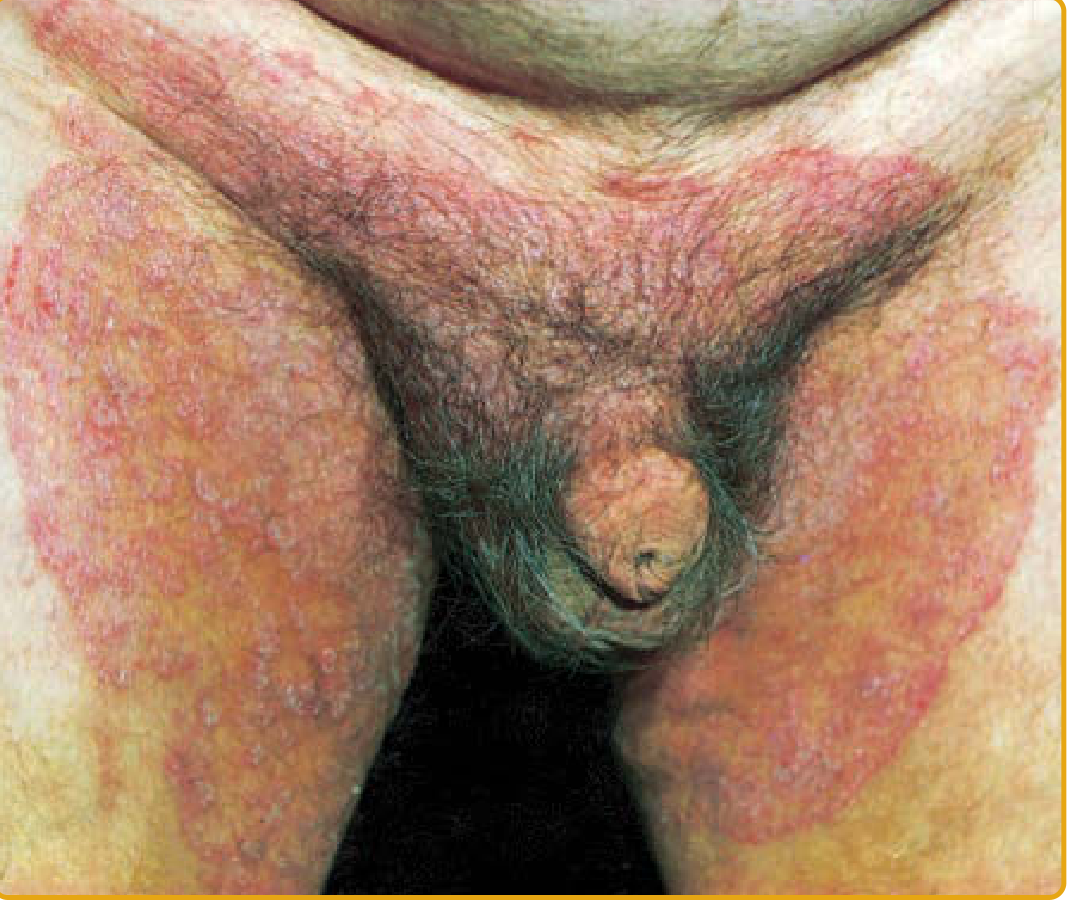
Why Tinea Cruris Fits
Based on image analysis and symptom description:
| Feature | Patient's Presentation | Tinea Cruris |
|---|---|---|
| Distribution | Bilateral inguinal folds, inner thighs, perineum, gluteal area | Bilateral genitocrural spread - classic for T. rubrum |
| Color | Dark red-brown to hyperpigmented | Erythematous plaques with post-inflammatory hyperpigmentation |
| Morphology | Lichenified plaques, thickened skin | Chronic scratching leads to lichenification |
| Symptoms | Intense pruritus | Pruritus is hallmark |
| Pustules | Cystic pustules noted | Border may have vesicles and pustules |
| Scaling | Fine peripheral scaling | Scaly raised border is characteristic |
According to Andrews' Diseases of the Skin, tinea cruris "begins as a small, erythematous, and scaling or vesicular and crusted patch that spreads peripherally. The border may have vesicles, pustules, or papules. It may extend downward on the thighs and backward on the perineum or about the anus."
Fitzpatrick's Dermatology notes that T. rubrum specifically causes coalescent plaques extending to the "pubic, perianal, buttock, and lower abdominal areas" - matching this patient exactly.
Differential Diagnoses to Rule Out
Per Fitzpatrick's Table 160-18:
- Erythrasma (Corynebacterium minutissimum) - similar reddish-brown intertriginous patches; distinguished by coral-red fluorescence on Wood's lamp. Usually less pruritic than tinea.
- Cutaneous Candidiasis - moister, more inflammatory, involves scrotum, satellite pustules/macules with collarette scales.
- Inverse/Intertriginous Psoriasis - well-demarcated, shiny red plaques; may have serpiginous pustules at border.
- Lichen Simplex Chronicus - may coexist; due to chronic scratching of any pruritic condition.
- Intertrigo - friction + moisture dermatitis, often Candida-secondarily infected.
- Contact Dermatitis - history of new soap/detergent/fabric.
Diagnosis Confirmation
- KOH preparation: Skin scraping from the active border - reveals branching hyphae under microscopy (most practical first step)
- Wood's lamp: Tinea cruris does NOT fluoresce (erythrasma fluoresces coral-red)
- Fungal culture: If KOH is negative but suspicion high
- Skin biopsy: If diagnosis remains unclear after above
Detailed Treatment Plan
Step 1 - General/Hygiene Measures (ALL patients)
- Keep the area dry - moisture and occlusion drive fungal growth
- Wear loose-fitting cotton underwear and trousers
- Apply plain talcum powder or antifungal powder to reduce friction and moisture
- Put on socks before underwear to prevent autoinfection from feet (tinea pedis is a common reservoir)
- Check feet - if tinea pedis is present, treat simultaneously to prevent re-infection
- Avoid sharing towels and clothing
Step 2 - Topical Antifungal Therapy (First-line for localized disease)
Apply to affected area AND 2-3 cm beyond visible borders:
| Drug | Formulation | Application | Duration |
|---|---|---|---|
| Terbinafine 1% cream (Lamisil) | Cream | Once daily | 1-2 weeks |
| Clotrimazole 1% cream | Cream/solution | Twice daily | 2-4 weeks |
| Miconazole 2% cream | Cream | Twice daily | 2-4 weeks |
| Ketoconazole 2% cream | Cream | Once daily | 2-4 weeks |
| Econazole 1% cream | Cream | Once daily | 2-4 weeks |
| Luliconazole 1% cream | Cream | Once daily | 1-2 weeks |
| Butenafine 1% cream | Cream | Once daily | 2 weeks |
| Ciclopirox 0.77% cream | Cream | Twice daily | 2-4 weeks |
| Naftifine 2% cream | Cream | Once daily | 2 weeks |
Per Red Book 2021: "Although clinical resolution may be evident within 2 weeks of therapy, continuing therapy for another 2 to 4 weeks is generally recommended."
IMPORTANT: Avoid combination steroid-antifungal products (e.g., clotrimazole + betamethasone/Lotriderm). These cause widespread tinea ("tinea incognita"), suppress the immune response, potentially lead to Majocchi granuloma, and worsen the infection long-term - per Andrews', Red Book, and Fitzpatrick's consistently.
Step 3 - Oral (Systemic) Antifungal Therapy
Indicated when:
- Disease is extensive (buttocks, lower abdomen, thighs beyond inguinal fold - as in this patient)
- Lesions involve hair follicles (fungal folliculitis)
- Topical therapy has failed after 4 weeks
- Immunocompromised patient
| Drug | Dose | Duration |
|---|---|---|
| Terbinafine (preferred) | 250 mg once daily | 2-4 weeks |
| Itraconazole | 100-200 mg once daily | 2-4 weeks |
| Fluconazole | 150 mg once weekly | 4-6 weeks |
| Griseofulvin (older, less preferred) | 500 mg daily (ultramicrosized) | 4-6 weeks |
Per Andrews' Dermatology: "Trichophyton species generally respond to shorter courses of terbinafine, and Microsporum species respond better to griseofulvin." Since T. rubrum (a Trichophyton) is the most likely causative agent here, oral terbinafine is preferred.
Step 4 - Managing the Lichenified Component (Lichen Simplex Chronicus)
Because chronic scratching has produced lichenification and hyperpigmentation as a secondary change, the itch-scratch cycle must also be broken:
- High-potency topical corticosteroid (e.g., clobetasol 0.05% or mometasone furoate 0.1%) applied for 1-2 weeks to reduce inflammation and itch - but ONLY after confirming antifungal coverage is in place (do not use steroid alone on a fungal infection)
- Sedating oral antihistamine at night (e.g., hydroxyzine 10-25 mg, chlorpheniramine 4 mg) to reduce nocturnal scratching
- Intralesional triamcinolone acetonide (10 mg/mL) injected into the thickest lichenified plaques if recalcitrant
- Per Harrison's Principles 22E: "High-potency topical glucocorticoids are helpful in most cases, but in recalcitrant cases, application under occlusion or intralesional injection may be required"
Practical Summary for This Patient
Given the extensive bilateral involvement of both buttocks and bilateral inguinal folds with lichenification:
- Confirm with KOH prep from the active border
- Start oral terbinafine 250 mg/day x 2-4 weeks (extensive disease)
- Apply topical terbinafine or clotrimazole cream twice daily for 4 weeks simultaneously
- Rule out concurrent tinea pedis and treat feet if present
- Short course of topical mometasone or betamethasone (not combined with antifungal in same product) for 1-2 weeks to control itch and lichenification, under antifungal cover
- Loose cotton clothing, keep dry, antifungal dusting powder
- Do not use clotrimazole-betamethasone combination products
Sources:
- Fitzpatrick's Dermatology, 9e, Vol 1 - Tinea Cruris (p. 2975)
- Andrews' Diseases of the Skin, Clinical Dermatology - Tinea Cruris Treatment
- Red Book 2021 - Table 3.70, Topical Treatment of Tinea Cruris
- Harrison's Principles of Internal Medicine 22E - Lichen Simplex Chronicus
This is a shared conversation. Sign in to Orris to start your own chat.