
Renin aldosteron mechanism
renin angiotensin aldosterone system RAAS mechanism diagram
renin angiotensin aldosterone system kidney blood pressure regulation
Renin-Angiotensin-Aldosterone System (RAAS)
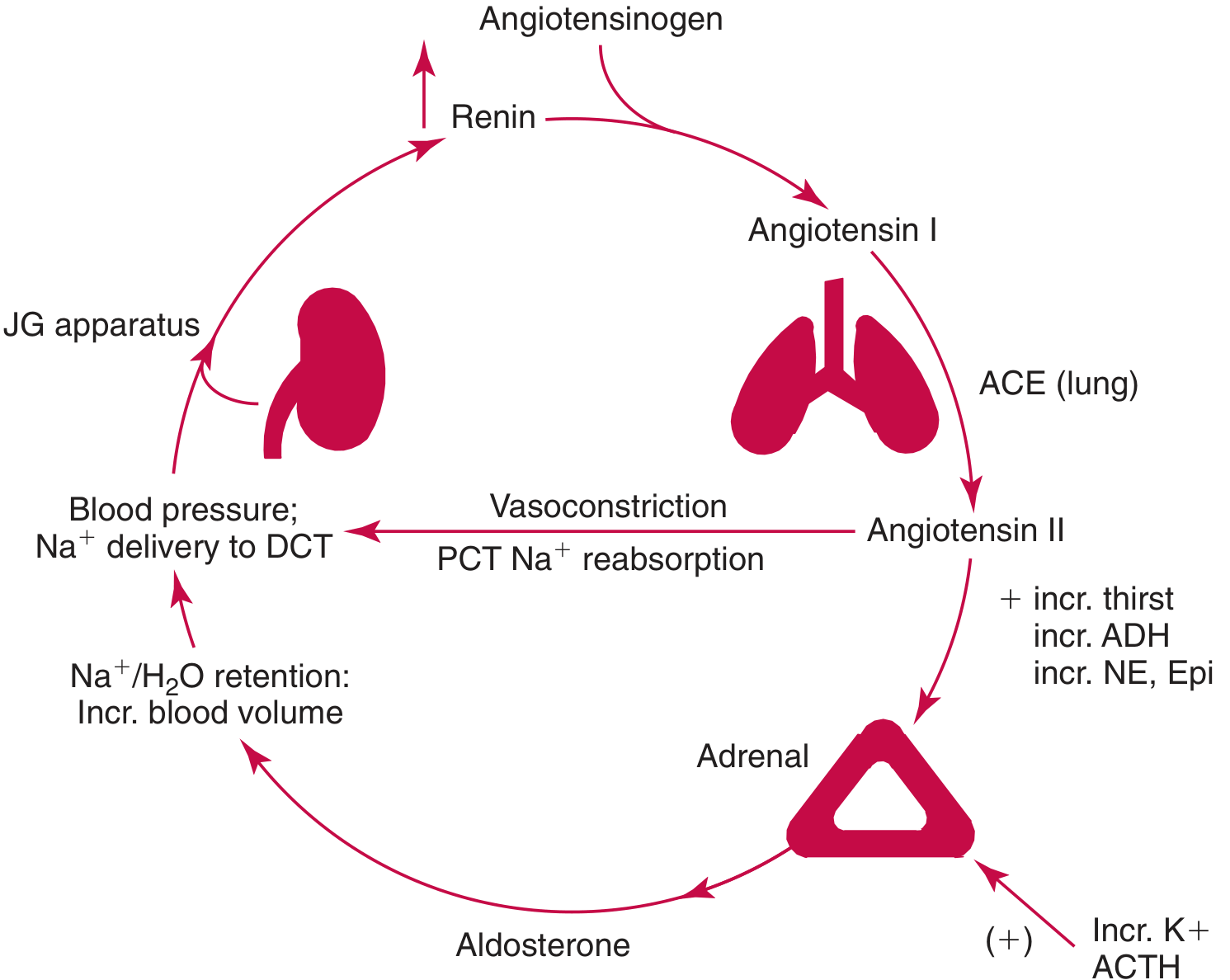
Overview
Step-by-Step Cascade
Step 1 - Renin Release
| Stimulus | Sensor |
|---|---|
| Decreased renal perfusion pressure | Baroreceptors (mechanoreceptors) in granular cells |
| Decreased Na⁺/Cl⁻ at distal tubule | Macula densa cells |
| Sympathetic activation | β1-adrenergic receptors on JG cells |
Step 2 - Angiotensin I Formation
Step 3 - Angiotensin II Formation
ACE inhibitors (e.g., captopril, enalapril) block this step and all downstream effects.
Step 4 - Angiotensin II Actions
| Target | Effect |
|---|---|
| Adrenal zona glomerulosa | Stimulates aldosterone synthesis and secretion |
| Renal proximal tubule | Stimulates Na⁺-H⁺ exchange → Na⁺ and HCO₃⁻ reabsorption (direct, aldosterone-independent) |
| Arterioles | Vasoconstriction via IP3/Ca²⁺ signaling → increased total peripheral resistance → increased Pa |
| Hypothalamus | Increases thirst and water intake |
| Posterior pituitary | Stimulates ADH (vasopressin) release → water reabsorption in collecting ducts |
| Adrenal medulla | Increases norepinephrine and epinephrine release |
| Heart/kidney (local RAAS) | Promotes cardiac hypertrophy, fibrosis, and tubular Na⁺ retention via local AT1 receptors |
AT1 receptor blockers (ARBs; e.g., losartan, valsartan) block all of these effects at the tissue level.
Step 5 - Aldosterone Release and Action
- Increase Na⁺ reabsorption (via ENaC channels and Na⁺/K⁺-ATPase)
- Increase K⁺ and H⁺ secretion
Additional Stimuli for Aldosterone (Independent of Renin)
- Hyperkalemia - directly stimulates zona glomerulosa cells via a calcium-mediated signaling pathway
- ACTH - causes a transient aldosterone rise; effect wanes even if ACTH remains elevated (escape phenomenon)
- Minor regulators: serotonin, local chromaffin/endothelial/immune cell factors
Negative Feedback
- Restoration of renal perfusion pressure and increased Na⁺ delivery to the macula densa suppresses further renin release
- There is evidence (not conclusively proven) that angiotensin II may inhibit renin secretion directly via AT1 receptors on JG cells ("short-loop" feedback)
- Aldosterone-mediated Na⁺ and volume retention reduces the original hypoperfusion stimulus
Key Pharmacological Targets
| Drug Class | Site of Action | Example |
|---|---|---|
| ACE inhibitors | Block ACE (Ang I → Ang II) | Captopril, Enalapril |
| ARBs | Block AT1 receptor | Losartan, Valsartan |
| Direct renin inhibitors | Block renin | Aliskiren |
| Aldosterone antagonists | Block mineralocorticoid receptor | Spironolactone, Eplerenone |
| β1-blockers | Reduce renin release | Propranolol, Metoprolol |
Clinical Importance
- Heart failure: RAAS activation is proportional to cardiac dysfunction severity. Initially compensatory (maintains perfusion), but chronic activation causes maladaptive myocardial remodeling, renal vasoconstriction, and progressive Na⁺ retention. RAAS inhibitors are foundational HF therapy.
- Primary hyperaldosteronism (Conn's syndrome): Autonomous aldosterone production independent of renin/angiotensin II (low renin, high aldosterone).
- Secondary hyperaldosteronism: High renin driving high aldosterone - seen in renal artery stenosis, heart failure, cirrhosis, nephrotic syndrome.
- Glucocorticoid-remediable aldosteronism (GRA): Autosomal dominant disorder where a hybrid 11β-hydroxylase/aldosterone synthase gene makes aldosterone ACTH-sensitive; corrected by glucocorticoid administration.
Pcod diagnosis treatment and new updates
polycystic ovary syndrome diagnosis treatment guidelines
PCOS PCOD new updates 2024 2025 diagnosis treatment guidelines
PMID: 37580861
https://www.ccjm.org/content/93/3/176
polycystic ovary syndrome ultrasound follicles hyperandrogenism
GLP-1 receptor agonist PCOS treatment semaglutide
PCOS / PCOD - Diagnosis, Treatment & New Updates (2023-2025)
Note on terminology: PCOD (Polycystic Ovarian Disease) and PCOS (Polycystic Ovary Syndrome) are used interchangeably in clinical practice. PCOS is the internationally preferred term. The 2023 International Evidence-Based Guideline (Teede et al., PMID 37580861) is the most current authoritative reference, covering 196 countries.
1. What Is PCOS?
2. Diagnosis
Diagnostic Criteria - Three Systems
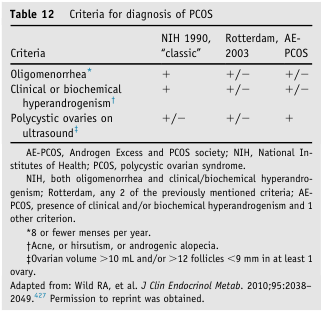
| Feature | Definition |
|---|---|
| Oligo/anovulation | Cycle < 21 days or > 35 days, or < 8 cycles/year (in women ≥3 years post-menarche) |
| Clinical hyperandrogenism | Acne, hirsutism, androgenic alopecia |
| Biochemical hyperandrogenism | Elevated free/total testosterone, DHEAS, androstenedione |
| Polycystic ovaries on US | Ovarian volume > 10 mL and/or ≥ 12 follicles < 9 mm in at least one ovary |
Other conditions must be excluded first: hypothyroidism, hyperprolactinemia, non-classical congenital adrenal hyperplasia (CAH), androgen-secreting tumors, Cushing syndrome, and pregnancy. LH:FSH ratio and hyperinsulinemia are NOT required for diagnosis.
NEW (2023 Guideline Update): Anti-Müllerian Hormone (AMH)
- AMH is now included as an alternative to ultrasound in adults only - elevated AMH reflects increased follicle number and is a useful biomarker
- AMH should be interpreted alongside clinical and biochemical findings - it cannot diagnose PCOS alone
- AMH is NOT recommended for diagnosis in adolescents (no universal cutoff; levels affected by age, BMI, OCP use, and prior ovarian surgery)
- The guideline recommends a simplified, sequential diagnostic algorithm:
Step 1: Assess menstrual irregularity + clinical hyperandrogenism
  → If BOTH present: PCOS diagnosed (no further testing needed)

Step 2: If only one feature:
  → Add biochemical tests (free testosterone, DHEAS)
  → In adults: pelvic USS or AMH measurement
  → If either adds a second criterion: PCOS diagnosed

Step 3: Exclude other causes at all stages
Diagnosis in Special Populations
| Population | Key Points |
|---|---|
| Adolescents | Both irregular cycles AND hyperandrogenism required (USS/AMH not used); anovulation is physiologic for 2 years post-menarche |
| Perimenopausal | Difficult to diagnose; prior history of PCOS most helpful |
| Lean women | Still at risk for insulin resistance and cardiometabolic disease - screen regardless of BMI |
3. Comorbidity Screening (Mandatory at Diagnosis)
| Comorbidity | Test |
|---|---|
| Insulin resistance / Type 2 DM | 75-g OGTT, HbA1c, fasting glucose |
| Dyslipidemia | Fasting lipid profile |
| Endometrial hyperplasia | Endometrial biopsy if prolonged amenorrhea |
| Cardiovascular risk | Blood pressure, BMI, waist circumference |
| Sleep apnea | Questionnaire (Berlin/Epworth) |
| Anxiety, depression, eating disorders | Validated psychological screening tools |
| Pregnancy complications | Gestational diabetes, preeclampsia, preterm birth risk counseling |
The 2023 guideline significantly strengthens recognition of cardiovascular risk in PCOS. A 2024 meta-analysis (PMID 39119982, JAHA) confirmed elevated clinical CVD risk even in non-obese young women with PCOS.
4. Treatment
First-Line for ALL patients: Lifestyle Modification
- Weight loss of even 5% improves insulin sensitivity, restores ovulation, and reduces androgen levels
- Caloric deficit of 500 kcal/day + regular physical activity
- A 2024 systematic review (PMID 39445724) confirmed that physical activity improves androgen levels, menstrual regularity, and quality of life in PCOS independently of weight loss
- Any healthy diet pattern (Mediterranean, low-GI, low-carb) is acceptable; no single diet is superior
Treatment by Specific Goal
A. Menstrual Irregularity + Endometrial Protection
| Drug | Mechanism | Notes |
|---|---|---|
| Combined OCP (COCP) | Suppresses LH, increases SHBG, opposes estrogen | First-line for cycle regulation; also treats hyperandrogenism |
| Cyclic progestin | Induces withdrawal bleed | Medroxyprogesterone acetate 10 mg x 10 days; at least 4x/year to prevent endometrial hyperplasia |
| Metformin | Reduces insulin resistance, lowers androgens | Also improves cycle regularity; especially useful in metabolic phenotype |
B. Hyperandrogenism (Acne, Hirsutism, Hair Loss)
| Drug | Use |
|---|---|
| COCP | First-line; lowers free androgens by raising SHBG |
| Spironolactone | Androgen receptor blocker; add-on for resistant hirsutism; needs contraception (teratogenic) |
| Flutamide | Anti-androgen; limited by hepatotoxicity risk |
| Finasteride | 5α-reductase inhibitor for androgenic alopecia |
| Eflornithine cream | Topical for facial hirsutism |
| Laser/electrolysis | For cosmetic hair removal |
| Metformin | Modest anti-androgen effect via insulin lowering |
C. Fertility / Ovulation Induction
| Option | Notes |
|---|---|
| Weight loss (first) | 5% weight loss can restore spontaneous ovulation; improves treatment response |
| Letrozole (aromatase inhibitor) | Now preferred first-line over clomiphene - higher live birth rates, lower multiple pregnancy risk |
| Clomiphene citrate | Blocks hypothalamic estrogen receptors → increases GnRH → FSH surge; 60-85% ovulation rate, 15-20% pregnancy per cycle, 50% pregnant by 6 months |
| Metformin + letrozole/clomiphene | Combination improves outcomes in insulin-resistant PCOS |
| Gonadotropins (FSH injections) | For clomiphene/letrozole failure; risk of OHSS |
| Laparoscopic ovarian drilling (LOD) | Surgical option for gonadotropin-resistant cases; reduces androgen-secreting stroma |
| IVF | Last resort; PCOS patients at high OHSS risk - GnRH antagonist + freeze-all protocol preferred |
D. Metabolic / Weight Management
| Drug | Notes |
|---|---|
| Metformin | Reduces insulin resistance; first-line metabolic agent; also mildly improves cycles and androgens |
| GLP-1 receptor agonists (liraglutide, semaglutide) | ⭐ Major new update - see below |
| Inositol (myo-inositol + D-chiro-inositol) | Insulin sensitizer; improving evidence; used as supplement |
5. New Updates (2023-2025)
⭐ GLP-1 Receptor Agonists in PCOS
- A 2025 meta-analysis (PMID 40360648) of RCTs found GLP-1 RAs significantly reduced BMI, waist circumference, fasting insulin, HOMA-IR, testosterone, and LH:FSH ratio in women with PCOS
- A 2025 meta-analysis (PMID 39881036) showed GLP-1 RA + metformin combination was superior to metformin alone for weight, insulin resistance, and androgen levels
- The 2023 international guideline explicitly recommends GLP-1 RAs (especially liraglutide) for obesity management in PCOS
- Semaglutide trials in PCOS are ongoing; current data is primarily from liraglutide and exenatide
- These agents do NOT replace standard ovulation-induction therapy but are valuable adjuncts in obese/insulin-resistant phenotypes
⭐ AMH as a Diagnostic Tool (2023 Guideline)
- AMH incorporated as an alternative to pelvic USS in adult women (see diagnosis section above)
- Simplifies diagnosis, especially for patients for whom USS is impractical
⭐ Cardiovascular Risk Recognition
- The 2023 guideline update formally elevated CVD screening as a mandatory component of PCOS assessment
- Even non-obese, lean women with PCOS have elevated long-term CVD risk
- Lipid, BP, and glucose screening should be performed regardless of BMI
⭐ Name Change Proposal (Emerging)
- Some endocrinologists have proposed renaming PCOS to "Polyendocrine Metabolic Ovarian Syndrome (PMOS)" to better reflect its systemic, metabolic nature and reduce stigma associated with "polycystic" - this is not yet formally adopted
⭐ Psychological Health
- The 2023 guideline mandates screening for anxiety, depression, disordered eating, and body image issues in ALL women with PCOS - previously underemphasized
- PCOS carries a very high prevalence of psychological comorbidities
6. Quick Reference Summary
DIAGNOSIS (Rotterdam - 2 of 3):
  Oligo/anovulation + Hyperandrogenism + Polycystic ovaries (USS or AMH in adults)
  ↳ Exclude: hypothyroid, hyperprolactinemia, CAH, androgen tumors, Cushing's

TREATMENT:
  All → Lifestyle modification (weight loss, exercise, diet)
  Cycles → COCP or cyclic progestin
  Hyperandrogenism → COCP ± spironolactone
  Fertility → Letrozole (1st line) → Clomiphene → Gonadotropins → IVF
  Metabolic → Metformin ± GLP-1 RA (new)
  Screen → OGTT, lipids, BP, mood, endometrium
New name for pcos
PCOS new name rename 2024 2025 proposal official
polycystic ovary syndrome renaming nomenclature
https://www.sciencedirect.com/science/article/pii/S014067362…
PCOS Has a New Name: PMOS
The Official Change
Polyendocrine Metabolic Ovarian Syndrome (PMOS)
Why Was the Name Changed?
| Problem with "PCOS" | Explanation |
|---|---|
| Cysts don't exist | There are no true ovarian cysts - the "polycystic" appearance on ultrasound is multiple small follicles, not cysts. The name caused widespread patient and clinician confusion |
| It's not just about the ovaries | PCOS affects metabolism, hormones, cardiovascular health, mental health, skin, and weight - reducing it to "ovarian" grossly understates the disease |
| Stigma and misunderstanding | Patients often thought they had ovarian cysts and felt dismissed; the name contributed to delayed diagnosis and fragmented care |
| Research and policy gaps | The name framed it as a reproductive/gynaecological condition, limiting research funding and policy attention for its systemic metabolic aspects |
How Was the New Name Chosen?
- 14,360 people with PCOS (patients) and multidisciplinary health professionals from all world regions were surveyed iteratively
- Methods included modified Delphi, nominal group workshops, marketing analyses, and implementation feasibility assessments
- Governance involved 56 leading academic, clinical, and patient organizations
- Key principles applied: scientific accuracy, clarity, stigma avoidance, cultural appropriateness, and feasibility
What Does "PMOS" Capture?
| Word | What it reflects |
|---|---|
| Poly-endocrine | Multiple hormone dysregulations - LH/FSH imbalance, hyperandrogenism, insulin resistance, adrenal involvement |
| Metabolic | Insulin resistance, obesity, dyslipidaemia, T2DM risk, cardiovascular risk |
| Ovarian | Retained to acknowledge the ovarian involvement (anovulation, follicular excess) - but no longer the only focus |
| Syndrome | Retained - reflects the heterogeneous, multi-feature nature |
What Changes in Practice?
- Diagnosis and treatment remain the same - the name change does not alter any diagnostic criteria or management protocols
- Both PCOS and PMOS will be used during a 3-year transition period - so you will see both terms interchangeably until about 2029
- ICD codes, health system classifications, and medical education materials are being updated
- A global implementation strategy with education and health system alignment is underway
Support from Medical Societies
- Endocrine Society - endorsed (May 12, 2026)
- ESHRE (European Society of Human Reproduction and Embryology) - welcomed the change
- International PCOS Network - led the process
- International Androgen Excess and PCOS Society - co-endorsed
Positioning of aiims in india
AIIMS ranking position India NIRF 2025 2026 all AIIMS list
Positioning of AIIMS in India
What Is AIIMS?
AIIMS New Delhi - National #1
| Ranking System | Rank | Score |
|---|---|---|
| NIRF Medical 2025/2026 | #1 | 91.80 |
| NIRF Overall 2025 | #2 (all institutions) | 88.50 |
| India Today Medical 2025 | #1 | 97.00 |
| IIRF Medical 2026 | #1 | 953.32 |
| QS World University Rankings (Medicine) | India's highest-ranked medical institution | - |
NIRF Top 50 Medical Colleges - AIIMS Positions (2025)
| NIRF Rank | AIIMS Institute | State |
|---|---|---|
| 1 | AIIMS New Delhi | Delhi |
| 13 | AIIMS Rishikesh | Uttarakhand |
| 14 | AIIMS Bhubaneswar | Odisha |
| 19 | AIIMS Jodhpur | Rajasthan |
| 25 | AIIMS Bhopal | Madhya Pradesh |
| 27 | AIIMS Patna | Bihar |
| 31 | AIIMS Raipur | Chhattisgarh |
All 23 AIIMS - Geographic Spread Across India
| Region | AIIMS Location |
|---|---|
| North | New Delhi, Rishikesh (Uttarakhand), Bathinda (Punjab), Bilaspur (Himachal Pradesh) |
| West | Jodhpur (Rajasthan), Nagpur (Maharashtra), Rajkot (Gujarat) |
| East | Patna (Bihar), Bhubaneswar (Odisha), Kalyani (West Bengal), Bibinagar (Telangana) |
| Central | Bhopal (MP), Raipur (Chhattisgarh) |
| South | Mangalagiri (Andhra Pradesh), Bibinagar (Telangana) |
| Northeast | Guwahati (Assam), Gorakhpur (UP - eastern region) |
| J&K / UT | Vijaypur (Jammu) |
Total MBBS Seats Across All AIIMS
| Category | Number |
|---|---|
| Total operational AIIMS | 23 |
| Total MBBS seats (all AIIMS) | ~2,207 |
| MBBS seats at AIIMS New Delhi | 125 |
| Seats at newer AIIMS (each) | 100-125 |
| No state quota | All India merit only |
NEET Cutoff Comparison (General Category, 2025)
| AIIMS | Approx. NEET Rank Cutoff |
|---|---|
| AIIMS New Delhi | Rank 1-48 |
| AIIMS Jodhpur | ~392 |
| AIIMS Bhopal | ~634 |
| AIIMS Rishikesh | ~816 |
| AIIMS Bhubaneswar | ~985 |
| AIIMS Nagpur | ~1030 |
| Newer AIIMS (Raipur, Bathinda, etc.) | 1,200-2,500+ |
Top 5 Medical Colleges Overall in India (NIRF 2025/2026)
| Rank | Institution | NIRF Score |
|---|---|---|
| 1 | AIIMS New Delhi | 91.80 |
| 2 | PGIMER Chandigarh | 79.20-81.50 |
| 3 | CMC Vellore | 72.60-78.25 |
| 4 | JIPMER Puducherry | 75.40 |
| 5 | SGPGI Lucknow | 72.10 |
Key Facts
- All AIIMS are central government institutions - fees are extremely subsidized (MBBS fees at most AIIMS: Rs 5,800 - 22,000/year)
- AIIMS are Institutes of National Importance under separate Acts of Parliament (AIIMS Act 1956 for Delhi; AIIMS Amendment Acts for newer institutes)
- They combine patient care, education, and research under one roof
- AIIMS New Delhi alone handles over 2 million outpatients per year
- The newer AIIMS (post-2012) were created under the Pradhan Mantri Swasthya Suraksha Yojana (PMSSY) to address regional healthcare disparities
Is aaims in kerala
AIIMS Kerala 2025 2026 approved status update
Is There an AIIMS in Kerala?
Current Status
- AIIMS Kerala has NOT been approved under the current phase of the PMSSY (Pradhan Mantri Swasthya Suraksha Yojana) scheme - this was officially confirmed by the Ministry of Health
- Kerala Chief Minister Pinarayi Vijayan has formally urged Prime Minister Narendra Modi to expedite approval for an AIIMS at Kinaloor, Kozhikode (Calicut) - this is the proposed location
- Union Minister Suresh Gopi (Kerala MP) has publicly stated that "Kerala will definitely get an AIIMS," suggesting political momentum, but no formal approval has been granted yet as of mid-2026
Proposed Location
- Kinaloor, Kozhikode (Calicut), Kerala - this is the site being discussed and for which land allocation is pending
Why Kerala Doesn't Have AIIMS Yet
| Reason | Details |
|---|---|
| PMSSY allocation | Kerala was not included in earlier phases; newer AIIMS were prioritized for states with weaker medical infrastructure |
| Kerala's existing strength | Kerala already has strong medical colleges (e.g., Government Medical College Thiruvananthapuram, Kozhikode, Thrissur, Kottayam) which may have reduced urgency in earlier rounds |
| Political/administrative delays | Land acquisition and Centre-State coordination issues have delayed the proposal |
Nearest AIIMS to Kerala
| AIIMS | Distance from Kerala |
|---|---|
| AIIMS Mangalagiri (Andhra Pradesh) | ~600 km |
| AIIMS Bibinagar (Telangana) | ~750 km |
| AIIMS Nagpur (Maharashtra) | ~1,200 km |
Nirf ranking of medical colleges
NIRF ranking 2025 medical colleges top 50 list India
NIRF Ranking 2025 - Medical Colleges in India
NIRF Ranking Parameters & Weightage
| Parameter | Weight |
|---|---|
| Teaching, Learning & Resources (TLR) | 30% |
| Research & Professional Practice (RP) | 30% |
| Graduation Outcomes (GO) | 20% |
| Outreach & Inclusivity (OI) | 10% |
| Perception (PR) | 10% |
Top 50 Medical Colleges - NIRF 2025
| Rank | Institute | City | State | NIRF Score |
|---|---|---|---|---|
| 1 | AIIMS New Delhi | New Delhi | Delhi | 91.80 |
| 2 | PGIMER | Chandigarh | Chandigarh | 82.58 |
| 3 | Christian Medical College (CMC) | Vellore | Tamil Nadu | 76.48 |
| 4 | JIPMER | Puducherry | Pondicherry | 73.30 |
| 5 | Sanjay Gandhi PGI (SGPGI) | Lucknow | Uttar Pradesh | 70.09 |
| 6 | Banaras Hindu University (BHU) | Varanasi | Uttar Pradesh | 70.05 |
| 7 | NIMHANS | Bengaluru | Karnataka | 69.77 |
| 8 | King George's Medical University (KGMU) | Lucknow | Uttar Pradesh | 68.77 |
| 9 | Amrita Vishwa Vidyapeetham | Coimbatore | Tamil Nadu | 68.52 |
| 10 | Kasturba Medical College, Manipal | Manipal | Karnataka | 68.05 |
| 11 | Sri Ramachandra Institute | Chennai | Tamil Nadu | - |
| 12 | Jawaharlal Nehru Medical College, AMU | Aligarh | Uttar Pradesh | - |
| 13 | AIIMS Rishikesh | Rishikesh | Uttarakhand | - |
| 14 | AIIMS Bhubaneswar | Bhubaneswar | Odisha | - |
| 15 | Medanta / Saveetha Medical College | - | Tamil Nadu | - |
| 16 | Hamdard Institute / Seth GS Medical | Mumbai | Maharashtra | - |
| 17 | Government Medical College | Nagpur | Maharashtra | - |
| 18 | PSG / JNMC Aligarh | - | - | - |
| 19 | AIIMS Jodhpur | Jodhpur | Rajasthan | - |
| 20 | Kasturba Medical College, Mangalore | Mangaluru | Karnataka | - |
| 21 | Institute of Liver & Biliary Sciences | New Delhi | Delhi | - |
| 22 | Madras Medical College | Chennai | Tamil Nadu | - |
| 23 | Grant Medical College (JJ Hospital) | Mumbai | Maharashtra | - |
| 24 | Government Medical College, Thiruvananthapuram | Thiruvananthapuram | Kerala | - |
| 25 | AIIMS Bhopal | Bhopal | Madhya Pradesh | - |
| 26 | Bangalore Medical College | Bengaluru | Karnataka | - |
| 27 | AIIMS Patna | Patna | Bihar | - |
| 28 | Maulana Azad Medical College | New Delhi | Delhi | - |
| 29 | Sri Venkateswara Institute (SVIMS) | Tirupati | Andhra Pradesh | - |
| 30 | St. John's Medical College | Bengaluru | Karnataka | - |
| 31 | AIIMS Raipur | Raipur | Chhattisgarh | - |
| 32 | Lady Hardinge Medical College | New Delhi | Delhi | - |
| 33 | Maharishi Markandeshwar | Ambala | Haryana | - |
| 34 | Govt. Medical College & Hospital | Chandigarh | Chandigarh | - |
| 35 | Kasturba Medical College, Mangalore | Mangaluru | Karnataka | - |
| 36 | Dayanand Medical College | Ludhiana | Punjab | - |
| 37 | JSS Medical College | Mysuru | Karnataka | - |
| 38 | Nil Ratan Sircar Medical College | Kolkata | West Bengal | - |
| 39 | Vardhman Mahavir Medical College | New Delhi | Delhi | - |
| 40 | Indira Gandhi Medical College | Shimla | Himachal Pradesh | - |
| 41 | Medical College, Kolkata | Kolkata | West Bengal | - |
| 42 | Mahatma Gandhi Medical College | Puducherry | Pondicherry | - |
| 43 | PSG Institute of Medical Sciences | Coimbatore | Tamil Nadu | - |
| 44 | Gujarat Cancer & Research Institute | Ahmedabad | Gujarat | - |
| 45 | B.J. Medical College | Ahmedabad | Gujarat | - |
| 46 | Jawaharlal Nehru Medical College | Belagavi | Karnataka | - |
| 47 | Christian Medical College, Ludhiana | Ludhiana | Punjab | - |
| 48 | Osmania Medical College | Hyderabad | Telangana | - |
| 49 | Chettinad Academy of Research and Education | Kelambakkam | Tamil Nadu | - |
| 50 | M.S. Ramaiah Medical College | Bengaluru | Karnataka | - |
Quick Highlights
| Category | Top Institution |
|---|---|
| #1 Overall | AIIMS New Delhi (8th consecutive year) |
| Best Private | CMC Vellore (#3) |
| Best South India | CMC Vellore (Tamil Nadu, #3) |
| Best in Kerala | Govt. Medical College Thiruvananthapuram (~Rank 24) |
| Best PG Institute | PGIMER Chandigarh (#2) |
| Best Mental Health | NIMHANS Bengaluru (#7) |
| AIIMS in Top 50 | 6 AIIMS (Delhi, Rishikesh, Bhubaneswar, Jodhpur, Bhopal, Patna, Raipur) |
State-wise Distribution - Top 50
| State | Colleges in Top 50 |
|---|---|
| Karnataka | 7 |
| Tamil Nadu | 6 |
| Uttar Pradesh | 5 |
| Delhi | 5 |
| Maharashtra | 3 |
| West Bengal | 2 |
| Punjab | 2 |
| Kerala | 1 (Govt. Medical College, Thiruvananthapuram) |
Key Notes
- NIRF 2025 was released on September 4, 2025 - this is the 9th edition
- Participation grew from 3,565 institutions in 2016 to over 10,845 in 2025
- AIIMS New Delhi leads by >9 points over #2 PGIMER - an extraordinary margin
- Rankings cover both government and private medical colleges
- Kerala's best: Government Medical College, Thiruvananthapuram features around rank 24, making it the highest-ranked medical college in Kerala
On kerala ranking basis college list
NIRF ranking 2025 medical colleges Kerala list top ranked
Kerala Medical Colleges - NIRF 2025 Rankings
Kerala's Top Ranked Medical College in India
| National NIRF Rank | College | City | Type | NIRF Score |
|---|---|---|---|---|
| 17 | Sree Chitra Tirunal Institute for Medical Sciences and Technology (SCTIMST) | Thiruvananthapuram | Govt. (Institute of National Importance) | 63.36 |
SCTIMST is Kerala's highest-ranked medical institution nationally - a landmark achievement, ranked 17th in India in NIRF 2025. It is a premier institute specializing in cardiology, neurosciences, and biomedical technology.
All Kerala Medical Colleges Featured in NIRF 2025
| National Rank (Approx.) | College | City/District | Type |
|---|---|---|---|
| 17 | Sree Chitra Tirunal Institute for Medical Sciences & Technology (SCTIMST) | Thiruvananthapuram | Central Govt. (INI) |
| ~24 | Government Medical College, Thiruvananthapuram | Thiruvananthapuram | State Govt. |
| ~50s | Amrita Institute of Medical Sciences & Research Centre | Kochi (Ernakulam) | Private (Deemed) |
| ~50-75 | Government Medical College, Kozhikode (Calicut) | Kozhikode | State Govt. |
| ~75-100 | Government Medical College, Kottayam | Kottayam | State Govt. |
| ~100+ | Government Medical College, Thrissur | Thrissur | State Govt. |
| ~100+ | Pushpagiri Institute of Medical Sciences | Tiruvalla (Pathanamthitta) | Private |
| ~100+ | Jubilee Mission Medical College | Thrissur | Private (Minority) |
| Ranked | KMCT Medical College | Calicut (Kozhikode) | Private |
| Ranked | Medical College, Gandhinagar, Kottayam | Kottayam | Govt. |
| Ranked | Malabar Cancer Centre (PG Institute of Oncology Sciences & Research) | Thalassery (Kannur) | Govt. |
| Ranked | Sree Narayana Institute of Ayurvedic Studies & Research | Kollam | Govt./Deemed |
Kerala's Performance in NIRF 2025 - Key Highlights
| Metric | Achievement |
|---|---|
| Total Kerala institutions in Top 300 (all categories) | 74 (up from 71 in 2024) |
| Kerala colleges in Top 100 (all categories) | 18 (up from 16) |
| Government colleges in Top 100 | 4 |
| Kerala's best medical rank nationally | 17th (SCTIMST) |
| Dental colleges ranked | Govt. Dental College Thiruvananthapuram (#35), Govt. Dental College Kozhikode (#38) |
Tier-wise Classification of Kerala Medical Colleges
Tier 1 - National Importance (INI)
- SCTIMST, Thiruvananthapuram - National Rank 17 ⭐ (Cardiology, Neurosciences, Biomedical Technology)
Tier 2 - Premier Government Medical Colleges
| College | Specialty / Strength |
|---|---|
| Govt. Medical College, Thiruvananthapuram | Oldest & largest; ~1,550+ beds |
| Govt. Medical College, Kozhikode (Calicut) | North Kerala's top referral center |
| Govt. Medical College, Kottayam | Strong in surgery & medicine |
| Govt. Medical College, Thrissur | Mid-Kerala hub |
| Govt. Medical College, Alapuzha (Alleppey) | South-central Kerala |
| Govt. Medical College, Ernakulam | Recently upgraded |
| Govt. Medical College, Manjeri | Malappuram district |
| Govt. Medical College, Kannur | North Kerala |
| Govt. Medical College, Palakkad | Central-north Kerala |
Tier 3 - Ranked Private / Deemed Medical Colleges
| College | City | Type |
|---|---|---|
| Amrita Institute of Medical Sciences | Kochi | Private (Deemed - AICTE) |
| Pushpagiri Institute of Medical Sciences | Tiruvalla | Private |
| Jubilee Mission Medical College | Thrissur | Private (Christian Minority) |
| KMCT Medical College | Calicut | Private |
| Malabar Medical College | Calicut | Private |
| Baby Memorial Hospital / MES Medical College | Calicut | Private |
| SUT Hospital Medical College | Thiruvananthapuram | Private |
NEET Cutoff for Top Kerala Govt. Medical Colleges (AIQ Seats, 2025)
| College | General Category (Approx. NEET Rank) |
|---|---|
| Govt. Medical College, Thiruvananthapuram | ~2,000-4,000 |
| Govt. Medical College, Kozhikode | ~3,000-6,000 |
| Govt. Medical College, Kottayam | ~4,000-7,000 |
| Amrita Institute, Kochi | ~12,000-20,000 |
Key Note for Kerala Students
- Kerala has no AIIMS (as discussed); SCTIMST is the closest equivalent for super-specialty care
- Kerala students compete for state quota seats (85% of seats in Kerala colleges) through the Kerala CEE (Commissioner for Entrance Examinations)
- Only 15% of seats in Kerala govt. medical colleges go to the All India Quota (via NEET All India merit)
- The state has strong government medical colleges compared to most Indian states - even smaller districts now have govt. medical colleges