
Describe about structure of Skeletal Muscle 5 mark question
Reading File
Finding Sources
Finding Sources
Reading File
Reading File
Reading File
Reading File
Reading File
Reading File
I now have comprehensive material from multiple authoritative textbooks. Let me fetch the key diagram images to include in the answer.
Loading Image
Loading Image
Here is a comprehensive 5-mark answer on the Structure of Skeletal Muscle, compiled from authoritative histology and anatomy textbooks.
Structure of Skeletal Muscle
Skeletal muscle is a type of striated, voluntary muscle attached to bone via tendons and responsible for movement of the skeleton and maintenance of posture.
1. Gross Organization — Connective Tissue Sheaths
A skeletal muscle is enclosed by concentric layers of connective tissue that support, protect, and transmit force:
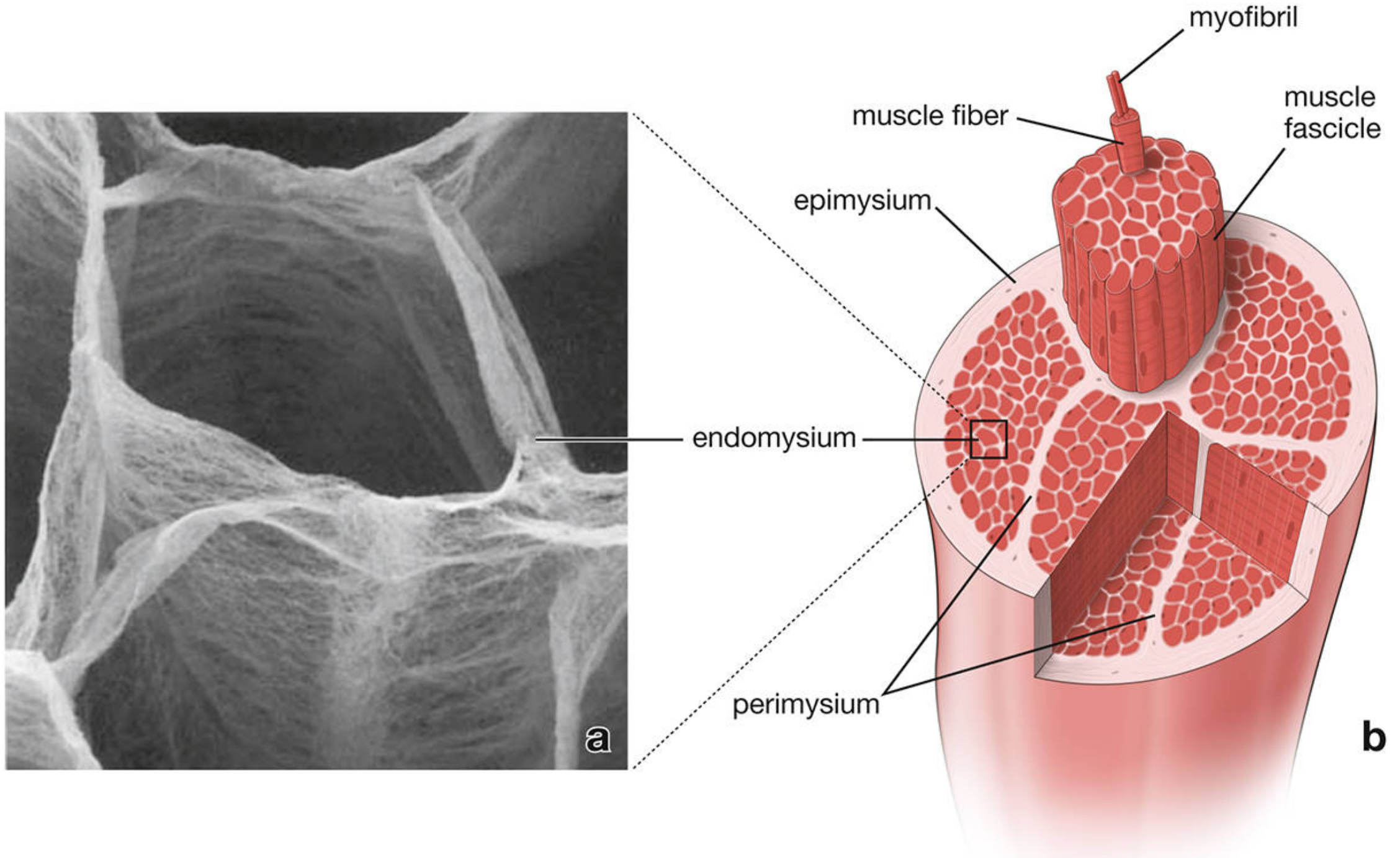
| Layer | Location | Function |
|---|---|---|
| Epimysium | Outermost sheath, surrounds the entire muscle | Dense irregular connective tissue; continuous with fascia and tendon; carries large nerves, blood vessels, and lymphatics |
| Perimysium | Surrounds bundles of fibers (fascicles) | Transmits muscle tensile force; nerves and vessels penetrate here to supply each fascicle |
| Endomysium | Surrounds each individual muscle fiber | Delicate reticular fibers + fibroblasts; contains a rich capillary network for O₂ supply |
At the ends of the muscle, all three sheaths converge into the tendon, attaching the muscle to bone.
— Junqueira's Basic Histology, 17e
2. The Muscle Fiber (Cell)
Each skeletal muscle cell is called a muscle fiber, a large, multinucleated syncytium formed by fusion of embryonic myoblasts.
- Size: Diameter 10–100 μm; length up to several cm (e.g., up to ~1 m in the sartorius)
- Nuclei: Numerous (~50/mm length), peripheral in location — situated just beneath the sarcolemma (plasma membrane). This peripheral nuclear placement is unique to skeletal muscle.
- Sarcolemma: Plasma membrane + external lamina + surrounding reticular lamina
- Satellite cells: Dormant stem cells (myoblasts) located between the sarcolemma and basal lamina; responsible for muscle regeneration after injury
The cytoplasm of the fiber is dominated by myofibrils, mitochondria, glycogen, and the sarcoplasmic reticulum (SR).
— Histology: A Text and Atlas, Histology, 9781975181512
3. Myofibrils, Myofilaments & the Sarcomere
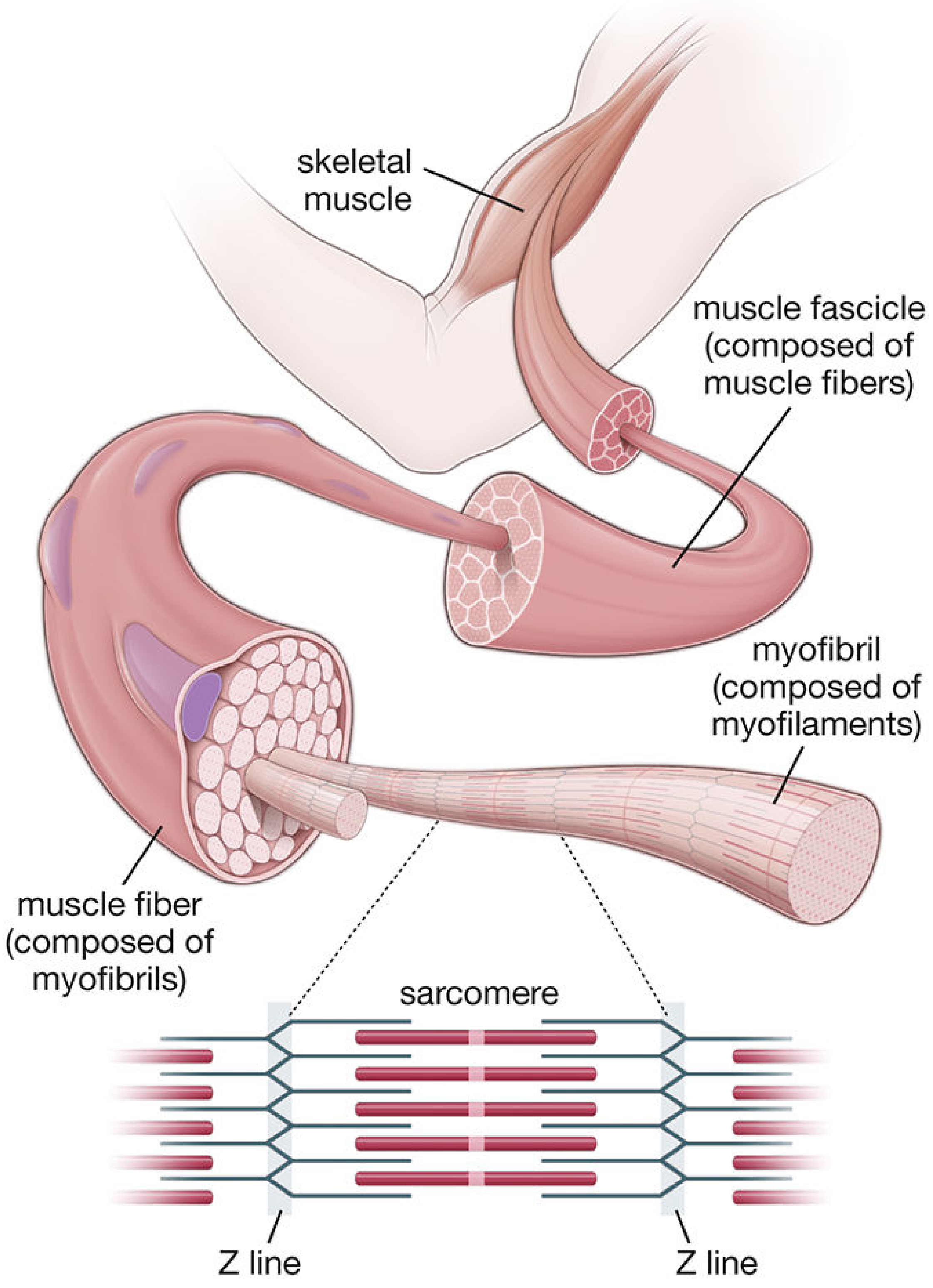
Myofibrils
- Cylindrical bundles (~1–2 μm diameter) running the full length of the fiber
- Composed of repeating contractile units called sarcomeres
Sarcomere — the functional unit
The sarcomere extends from one Z disc (Z line) to the next and is ~2–3 μm long at rest. It contains two types of myofilaments:
| Filament | Composition | Location |
|---|---|---|
| Thick filaments | 200–500 myosin-II molecules; 1.5 μm long, 15 nm wide | Occupy the A band |
| Thin filaments | F-actin + tropomyosin + troponin complex; 8 nm wide | Extend from Z disc into A band |
Banding Pattern (striations)
| Band/Line | Description |
|---|---|
| A band | Dark (anisotropic); full length of thick (myosin) filaments; visible under polarized light |
| I band | Light (isotropic); thin filaments only; bisected by the Z disc |
| H zone | Lighter region in the middle of A band; thick filaments with no thin filament overlap |
| M line | Dense line bisecting the H zone; anchors myosin filaments |
| Z disc (Z line) | Dense plate marking the border of each sarcomere; anchors thin filaments |
— Histology: A Text and Atlas; Junqueira's Basic Histology
4. Sarcoplasmic Reticulum (SR) and T-Tubule System
- Sarcoplasmic reticulum (L-system): Smooth ER that forms a tubular network around each myofibril; stores and releases Ca²⁺ during contraction
- T-tubules (T-system): Deep invaginations of the sarcolemma running transversely into the fiber; enlarge the membrane surface 5–10×; rapidly propagate the action potential deep into the fiber
- Triad: One T-tubule flanked by two SR cisternae; the critical structural unit for excitation-contraction coupling
— General Anatomy and Musculoskeletal System, THIEME Atlas
5. Muscle Fiber Types
Three fiber types exist within any skeletal muscle, distinguished by metabolic profile:
| Type | Name | Size | Mitochondria | Speed | Fatigue | Example |
|---|---|---|---|---|---|---|
| Type I | Slow oxidative | Small | Many | Slow twitch | Resistant | Erector spinae, marathon runners |
| Type IIa | Fast oxidative-glycolytic | Medium | Many | Fast twitch | Resistant | Middle-distance sprinters |
| Type IIb | Fast glycolytic | Large | Few | Fast twitch | Prone | Extraocular muscles, sprinters |
— Histology: A Text and Atlas, p. 795
Summary Hierarchy
Skeletal Muscle
  └── Epimysium
        └── Fascicles (Perimysium)
              └── Muscle Fibers/Cells (Endomysium + Sarcolemma)
                    └── Myofibrils
                          └── Sarcomeres (Z disc → Z disc)
                                └── Thick (myosin) + Thin (actin) Filaments
This hierarchical organization — from gross connective tissue sheaths down to molecular myofilaments — allows skeletal muscle to generate, transmit, and precisely control force during voluntary movement.
This is a shared conversation. Sign in to Orris to start your own chat.