
Congenital heart disease mindmap
congenital heart disease classification diagram acyanotic cyanotic
A comprehensive medical mindmap titled "Congenital Heart Disease" at the center. Two main branches: "ACYANOTIC" (left, in blue) and "CYANOTIC" (right, in red/purple). ACYANOTIC branch splits into: 1. LEFT-TO-RIGHT SHUNTS (with sub-nodes: VSD - most common CHD overall; ASD - ostium secundum most common; PDA - continuous machine murmur; AVSD/Endocardial cushion defect - associated with Down syndrome) 2. OBSTRUCTIVE LESIONS (with sub-nodes: Pulmonary Stenosis; Aortic Stenosis; Coarctation of Aorta - rib notching, radio-femoral delay) CYANOTIC branch splits into: 1. DECREASED PULMONARY BLOOD FLOW (with sub-nodes: Tetralogy of Fallot - 4 defects: VSD+overriding aorta+RVOT obstruction+RVH, boot-shaped heart; Tricuspid Atresia; Pulmonary Atresia) 2. INCREASED PULMONARY BLOOD FLOW / MIXING (with sub-nodes: Transposition of Great Arteries - egg-on-string X-ray; Total Anomalous Pulmonary Venous Return TAPVR - snowman sign; Truncus Arteriosus; Double Outlet RV; Single Ventricle) Additional small branches from center: "COMPLICATIONS" (Eisenmenger syndrome, IE endocarditis, arrhythmias, heart failure); "GENETICS" (Down syndrome - AVSD; Turner syndrome - Coarctation; DiGeorge/22q11 - Truncus/TOF; Marfan - aortic root); "DIAGNOSIS" (Echo - first line; CXR; ECG; Cardiac MRI; Cath); "MANAGEMENT" (Prostaglandin E1 for duct-dependent lesions; Surgical repair; Catheter intervention; Antibiotic prophylaxis IE) Clean, color-coded, professional medical mindmap with clear hierarchy and readable text on white background.
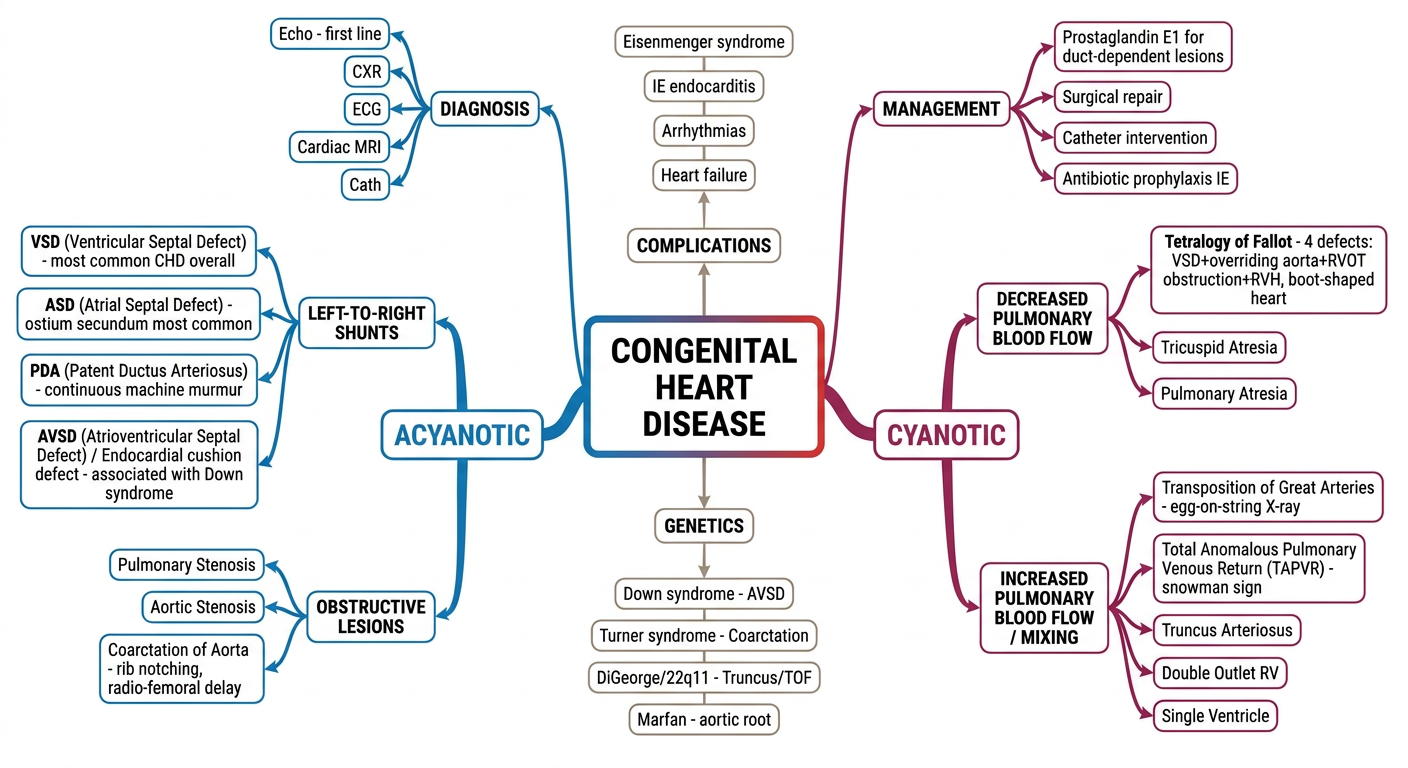
Congenital Heart Disease - Mindmap
ACYANOTIC (No cyanosis at rest; normal or elevated pulmonary blood flow)
Left-to-Right Shunts (Volume overload)
| Defect | Key Features | Murmur | Notes |
|---|---|---|---|
| VSD | Most common CHD overall (~30%); LV-RV shunt | Harsh pansystolic at LLSB | Most small VSDs close spontaneously; large ones → pulmonary HTN |
| ASD | Right heart volume overload; RA-LA shunt | Fixed split S2; ejection systolic murmur | Ostium secundum most common; risk of paradoxical embolism |
| PDA | Aorta → PA shunt; kept open by PGE2 | Continuous "machinery" murmur (infraclavicular) | Indomethacin closes in premature neonates; surgical ligation if needed |
| AVSD | Common atrium + common AV valve | Pan-systolic murmur | Strongly associated with Down syndrome (Trisomy 21) |
Obstructive Lesions (Pressure overload)
| Defect | Key Features | Notes |
|---|---|---|
| Pulmonary Stenosis | RV pressure overload | Ejection click; harsh systolic murmur; prominent a-wave JVP |
| Aortic Stenosis | LV pressure overload | Ejection systolic murmur radiating to carotids; syncope/angina/dyspnoea triad |
| Coarctation of Aorta | Narrowing of aortic isthmus distal to L subclavian | Radio-femoral delay; hypertension in upper limbs; rib notching on CXR; associated with Turner syndrome |
CYANOTIC (Right-to-Left shunt or mixing)
Decreased Pulmonary Blood Flow
- 4 Components: VSD + Overriding aorta + Pulmonary/RVOT obstruction + RV hypertrophy
- CXR: Boot-shaped heart (coeur en sabot), oligaemic lung fields
- Tet spells (hypercyanotic episodes) - knee-chest position, morphine, O2, propranolol
- Associated with DiGeorge syndrome (22q11)
- Absent tricuspid valve; requires ASD + VSD or PDA for survival
- ECG: left axis deviation (unusual in a right heart lesion), left ventricular hypertrophy
- Management: Fontan procedure (staged)
- Duct-dependent pulmonary circulation - needs Prostaglandin E1 (PGE1) immediately
Increased Pulmonary Blood Flow / Mixing
- Aorta arises from RV; PA from LV - two parallel circulations
- CXR: Egg-on-a-string (narrow mediastinum)
- Prostaglandin E1 to keep PDA open; balloon atrial septostomy (Rashkind) as bridge; definitive: Arterial Switch Operation (Jatene)
- Pulmonary veins drain into systemic venous system (not LA)
- Supracardiac type: Snowman sign on CXR
- ASD essential for survival; surgical repair urgently
- Single arterial trunk from heart; VSD always present
- Associated with DiGeorge/22q11 deletion
- Surgical repair with VSD closure + conduit
Pathophysiology: Eisenmenger Syndrome
- Prolonged large L→R shunt → pulmonary vascular remodelling → irreversible pulmonary HTN → shunt reversal (R→L) → cyanosis
- Contraindication to surgical repair at this stage
Genetic Associations
| Syndrome | CHD |
|---|---|
| Down (Trisomy 21) | AVSD, VSD, ASD |
| Turner (45X) | Bicuspid aortic valve, Coarctation |
| DiGeorge (22q11 deletion) | Truncus arteriosus, TOF, Interrupted aortic arch |
| Marfan syndrome | Aortic root dilation, MVP |
| Noonan syndrome | Pulmonary stenosis, HCM |
| Williams syndrome | Supravalvular aortic stenosis |
Diagnosis & Investigations
- Echo - first-line; delineates anatomy, estimates pressures
- CXR - assess cardiac size, shape, pulmonary vascularity, aortic arch
- ECG - rate, rhythm, ventricular dominance patterns
- Cardiac MRI - complex anatomy pre-surgery
- Cardiac catheterisation - measure Qp:Qs ratio; shunt ≥1.5:1 = significant
Management Principles
- PGE1 (Alprostadil) - keep PDA open for all duct-dependent lesions (cyanotic or systemic flow dependent)
- Diuretics + ACE inhibitors - heart failure from volume-overload shunts
- Antibiotic prophylaxis - for high-risk CHD before dental/surgical procedures (endocarditis prevention)
- Surgical repair - most lesions repaired in infancy/childhood
- Interventional catheterisation - ASD/PDA device closure, balloon valvuloplasty for PS