
Social medicine psm
Asking for Preferences
What aspect of Social Medicine / PSM (Preventive & Social Medicine) are you looking for?
Asking for Preferences
Which exam level? · What would you like to focus on?
I'll pull a broad PSM exam-prep overview from the medical library covering the major high-yield topics.
Searching sources...
Reading File
Finding Sources
Searching the Web
PSM social medicine high yield topics NEET PG exam preparation 2025
Park's Textbook of Preventive and Social Medicine is available. Let me pull the table of contents and key sections simultaneously.
Finding Sources
Reading Web Page
https://www.prepladder.com/neet-pg-study-material/high-yield…
Finding Sources
Finding Sources
Finding Sources
Finding Sources
Reading File
Finding Sources
Reading File
I now have comprehensive content from Park's textbook and the exam-prep sources. Let me compile the full exam-prep guide.
PSM / Community Medicine - Exam Preparation Guide (NEET PG / INI-CET / MBBS Prof)
Based on Park's Textbook of Preventive and Social Medicine and high-yield exam data, here is a structured breakdown of the subject. PSM carries 20-22 questions in NEET PG and 13-16 in INI-CET.
1. Concept of Health & Disease (HIGH YIELD)
Definitions to know:
- WHO definition of health - "a state of complete physical, mental and social well-being and not merely the absence of disease or infirmity"
- Operational definition: absence of objective disease + absence of subjective illness
- Dimensions of health: Physical, Mental, Social, Spiritual, Emotional, Vocational
Levels of Prevention (must-know framework):
| Level | Definition | Examples |
|---|---|---|
| Primordial | Prevent risk factors from emerging | Discourage childhood smoking/obesity habits |
| Primary | Action before disease onset | Immunization, health education, safe water |
| Secondary | Early diagnosis + prompt treatment | Screening tests, early case detection |
| Tertiary | Rehabilitation, limit disability | Physiotherapy post-stroke, occupational rehab |
Park's Textbook, pp. 52-54
Disease Causation Models:
- Germ theory: one agent → one disease (historically important but limited)
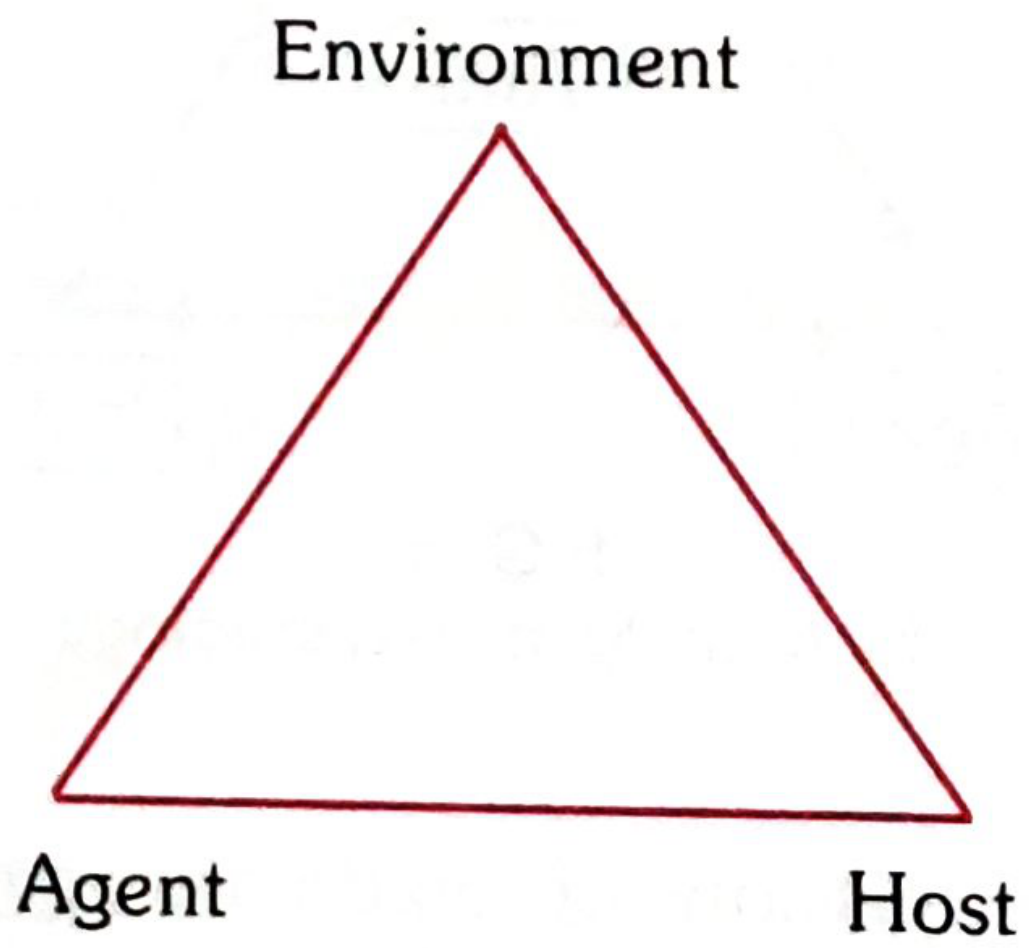
- Epidemiological Triad: Agent + Host + Environment + Time - the classic triangle
- Web of causation (MacMahon): multiple interacting causes - used for NCDs
- Wheel model, Iceberg phenomenon (visible disease vs. subclinical cases)
2. Epidemiology (Highest Weightage)
Study Designs - Quick Comparison:
| Study Type | Direction | Measure | Key Advantage |
|---|---|---|---|
| Cross-sectional | Simultaneous | Prevalence | Cheap, quick |
| Case-Control | Retrospective | Odds Ratio (OR) | Good for rare diseases |
| Cohort | Prospective | Relative Risk (RR), Attributable Risk | Causal relationship |
| RCT | Prospective | RR, NNT | Gold standard for causality |
| Meta-analysis | Retrospective | Pooled estimates | Highest evidence level |
Epidemic Investigation Steps (Park's classic sequence):
- Verify diagnosis
- Confirm epidemic
- Define cases - descriptive epidemiology (person, place, time)
- Formulate hypothesis
- Test hypothesis (analytic epidemiology)
- Draw conclusions, recommend control measures
- Write report
Types of Epidemics:
- Common source - single source, explosive onset (e.g., food poisoning)
- Propagated - person-to-person, gradual rise (e.g., measles)
- Mixed - starts as common source, then propagated
Key Epidemiological Measures:
- Attack rate = (cases / population at risk) x 100
- Secondary attack rate (SAR) = new cases in household / susceptible contacts x 100
- Case Fatality Rate (CFR) = deaths / cases x 100
- Incidence = new cases / population at risk / time
- Prevalence = existing cases / total population at a point in time
- Prevalence = Incidence x Duration (for stable endemic disease)
3. Biostatistics (High Weightage - especially INI-CET)
Central Tendency & Dispersion:
- Mean, Median, Mode - know when each is preferred
- Normal distribution: Mean = Median = Mode
- Positively skewed: Mean > Median > Mode
- Standard Deviation (SD): 1 SD = 68.2%, 2 SD = 95.4%, 3 SD = 99.7%
Statistical Tests (commonly asked):
| Situation | Test |
|---|---|
| Compare two means (independent) | Unpaired t-test |
| Compare two means (paired/before-after) | Paired t-test |
| Categorical data / proportions | Chi-square test |
| Correlation | Pearson's r (parametric), Spearman's (non-parametric) |
| >2 group means | ANOVA |
| Rank data | Mann-Whitney U |
Screening Tests:
- Sensitivity = TP / (TP + FN) - ability to detect true positives; best for ruling OUT disease (SnNout)
- Specificity = TN / (TN + FP) - ability to correctly identify negatives; best for ruling IN disease (SpPin)
- PPV = TP / (TP + FP) - increases with higher prevalence
- NPV = TN / (TN + FN) - increases with lower prevalence
- ROC curve: plots sensitivity vs. (1-specificity); area under curve = overall test accuracy
4. Vaccines & Cold Chain
Immunization Schedule (India UIP) - key facts:
- Birth: BCG, OPV-0, Hep B-1
- 6, 10, 14 weeks: DPT, OPV, IPV, Hep B, Hib, Rotavirus, PCV
- 9 months: Measles-Rubella (MR-1), Vitamin A-1
- 16-24 months: DPT booster, OPV booster, MR-2, Vitamin A-2
- 5 years: DPT booster 2
Cold Chain:
- Vaccines most sensitive to heat: BCG, measles, OPV (first to destroy)
- OPV and measles: store at -15°C to -25°C (freezer)
- Most others: +2°C to +8°C (refrigerator)
- Cold chain equipment: ILR (Ice-Lined Refrigerator), Walk-in cooler, Walk-in freezer
- Freeze indicator (FI-11) placed in cold box - if triangle is blue, freeze has occurred
5. Demography & Health Indicators
Key Demographic Rates:
- CBR (Crude Birth Rate): live births / mid-year population x 1000
- TFR (Total Fertility Rate): current India ~2.0
- IMR (Infant Mortality Rate): current India ~28/1000 (NFHS-5)
- MMR (Maternal Mortality Ratio): deaths per 100,000 live births; India ~97 (SRS 2018-20)
- Life Expectancy at birth (India): ~70.19 years
Composite Indices:
- HDI (Human Development Index): income + health + education
- PQLI (Physical Quality of Life Index): infant mortality + literacy + life expectancy at age 1 - max score 100
- DALY: Disability-Adjusted Life Year = YLL + YLD
- QALY: Quality-Adjusted Life Year - used in health economics
Demographic Transition (4 stages):
- High birth + high death rate (no growth)
- High birth + falling death (rapid growth)
- Falling birth + low death (moderate growth)
- Low birth + low death (stable) - India currently between stage 2 and 3
6. Nutrition
Protein-Energy Malnutrition (PEM):
- Kwashiorkor: protein deficiency, edema, moon face, dermatosis, fatty liver - adequate calories but poor protein
- Marasmus: total calorie deficiency, severe wasting, old man face - no edema
- Marasmic Kwashiorkor: combined
Grading of PEM:
- Gomez classification (weight for age): Grade I = 75-90%, Grade II = 60-75%, Grade III = <60% of expected
- IAP grades: Grade I = 71-80%, Grade II = 61-70%, Grade III = 51-60%, Grade IV = <50%
Nutritional Deficiencies:
| Deficiency | Disease |
|---|---|
| Vitamin A | Night blindness, xerophthalmia, Bitot's spots |
| Vitamin D | Rickets (children), Osteomalacia (adults) |
| Vitamin C | Scurvy - perifollicular hemorrhage, bleeding gums |
| Vitamin B1 (Thiamine) | Beriberi, Wernicke's encephalopathy |
| Vitamin B2 (Riboflavin) | Angular stomatitis, cheilosis |
| Vitamin B3 (Niacin) | Pellagra - 3 Ds: Dermatitis, Diarrhea, Dementia |
| Vitamin B12 / Folate | Megaloblastic anemia, NTDs |
| Iron | Microcytic anemia - most common deficiency worldwide |
| Iodine | Goiter, cretinism, hypothyroidism |
7. Environment & Occupational Health
Water Quality:
- WHO coliform standard: 0 coliforms/100 mL (treated water)
- MPN (Most Probable Number) - coliform test index
- Chlorine demand: amount of chlorine absorbed by water before free residual appears
- Residual chlorine in supply: 0.2 mg/L (minimum); 0.5 mg/L in cholera areas
Occupational Diseases (commonly asked):
| Hazard | Disease |
|---|---|
| Silica dust | Silicosis (most common pneumoconiosis) |
| Coal dust | Coal worker's pneumoconiosis (CWP) |
| Asbestos | Asbestosis, mesothelioma, lung cancer |
| Lead | Lead poisoning - Burton's line, basophilic stippling |
| Mercury | Minamata disease |
| Cadmium | Itai-itai disease |
| Benzene | Aplastic anemia, leukemia |
8. National Health Programs (Very High Yield)
| Program | Full Name | Key Targets |
|---|---|---|
| RNTCP / NTP | National Tuberculosis Programme / Elimination Programme | End TB by 2025; DOTS strategy |
| NVBDCP | National Vector Borne Disease Control Programme | Malaria, dengue, filaria, kala-azar, JE, chikungunya |
| NACP | National AIDS Control Programme | ICTC, PPTCT, ART services |
| IPPI/UIP | Universal Immunization Programme | All children under 2 years |
| NCD Programme | Non-Communicable Disease Control | CVD, cancer, diabetes, stroke |
| Ayushman Bharat | PM-JAY | Health insurance Rs. 5 lakh/family/year |
| PMSMA | PM Surakshit Matritva Abhiyan | ANC on 9th of every month |
| JSSK | Janani Shishu Suraksha Karyakram | Free delivery services |
9. Health Planning & Management
Health Committees (India) - chronological order:
- Bhore Committee (1946) - foundation of Indian public health system
- Mudaliar Committee (1962)
- Chadha Committee (1963)
- Mukherjee Committee (1965)
- Shrivastav Committee (1975) - community health workers (CHWs)
- Bajaj Committee (1986)
Primary Health Care (Alma Ata Declaration, 1978):
- "Health for All by 2000 AD"
- 8 elements: Education, Nutrition, Water & sanitation, MCH (including FP), Immunization, Endemic disease control, Essential drugs, Treatment of common diseases
- Mnemonic: E-NEW-MET
10. Biomedical Waste (BMW)
Categories & Disposal:
| Color | Category | Disposal |
|---|---|---|
| Yellow bag | Infectious/anatomical waste, discarded medicines | Incineration / deep burial |
| Red bag | Recyclable contaminated plastics, IV sets, syringes | Autoclaving then shredding |
| White/translucent puncture-proof | Sharps (needles, blades) | Autoclaving, shredding + sent to registered recycler |
| Blue bag | Glassware, metallic implants | Autoclaving/disinfection + recycling |
Quick Revision Mnemonics
- ICEBERG phenomenon: visible cases (clinical) float above, but most cases are subclinical below the surface
- Levels of Prevention = Primordial, 1°, 2°, 3° - "Prevent Perfectly, Stop Spreading, Support Survival"
- DALY = YLL + YLD (Years of Life Lost + Years Lived with Disability)
- PQLI components: IMR + Life expectancy at age 1 + Literacy rate
Exam Weightage Summary
| Topic | NEET PG Questions | INI-CET Questions |
|---|---|---|
| Epidemiology + Biostatistics | ~7-8 | ~5-6 |
| National Health Programs | ~4-5 | ~3-4 |
| Vaccines + Cold chain | ~2-3 | ~2-3 |
| Environment & Occupational | ~2-3 | ~2 |
| Demography + Nutrition | ~2-3 | ~2 |
| Health planning | ~1-2 | ~1-2 |
This covers the core high-yield content from Park's Textbook of Preventive and Social Medicine aligned with NEET PG / INI-CET patterns. Let me know which specific topic you want to go deeper on - biostatistics, a particular national program, vaccines, or anything else.
This is a shared conversation. Sign in to Orris to start your own chat.