
Show me the ecg interpretation of 10 cases with images and changes with diseases
Reading File
Finding Sources
Searching Images
ECG electrocardiogram disease interpretation abnormal
Finding Sources
Searching Images
myocardial infarction ST elevation ECG STEMI
Searching Images
atrial fibrillation ECG rhythm strip irregular
Searching Images
left bundle branch block LBBB right bundle branch block RBBB ECG
Reading File
Searching Images
hyperkalemia peaked T wave ECG potassium
Searching Images
Wolff-Parkinson-White WPW delta wave ECG pre-excitation
Searching Images
complete heart block third degree AV block ECG
Searching Images
pulmonary embolism ECG S1Q3T3 right heart strain
Searching Images
pericarditis saddle-shaped ST elevation diffuse ECG
Searching Images
ventricular tachycardia VT wide complex tachycardia ECG
Here are 10 ECG cases with images and characteristic changes for key diseases:
📋 ECG Interpretation: 10 Clinical Cases
Case 1 — Acute Anterior STEMI (Myocardial Infarction)
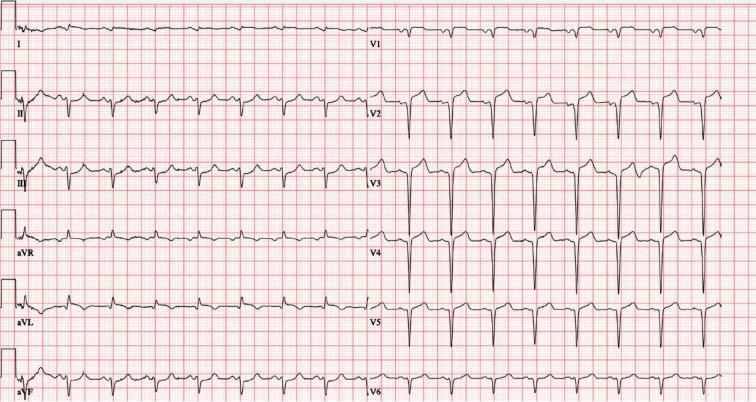
Key ECG Changes
| Feature | Finding |
|---|---|
| ST segments | Convex ("tombstone") ST elevation in V1–V6 |
| Reciprocal changes | ST depression in leads II, III, aVF |
| T waves | Hyperacute peaked T waves in precordial leads |
| Culprit vessel | Left Anterior Descending (LAD) artery |
Interpretation: Sinus rhythm with massive anterior STEMI. The prominent convex ST elevation across V2–V5 with reciprocal inferior depression indicates proximal LAD occlusion. Evolving QS waves in V2–V3 signal transmural necrosis. Requires urgent PCI/thrombolysis.
Case 2 — Inferolateral STEMI
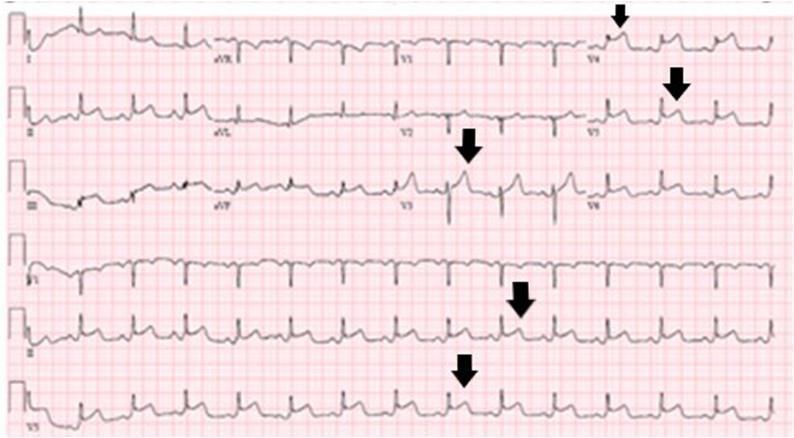
Key ECG Changes
| Feature | Finding |
|---|---|
| ST elevation | V4–V6, inferior leads (II, III, aVF) |
| Morphology | Convex, upward with hyperacute T waves |
| Reciprocal changes | ST depression in lead aVL, lead I |
| Culprit vessel | Right coronary artery (RCA) or left circumflex (LCx) |
Interpretation: Acute inferolateral STEMI. The classic reciprocal ST depression in aVL mirroring elevation in III is highly specific for inferior wall occlusion.
Case 3 — Atrial Fibrillation (AF)

Key ECG Changes
| Feature | Finding |
|---|---|
| Rhythm | Irregularly irregular |
| P waves | Absent; replaced by chaotic fibrillatory (f) waves |
| Baseline | Fine undulation, best seen in V1 |
| QRS | Narrow (unless aberrant conduction) |
| Rate | Variable — rapid ventricular response shown |
Interpretation: AF with rapid ventricular response (~130–150 bpm). No organized P waves. Associated with hypertension, hyperthyroidism, valvular disease, heart failure. Rate control with beta-blockers/calcium channel blockers; anticoagulate if CHA₂DS₂-VASc ≥ 2.
Case 4 — Complete (3rd Degree) AV Block
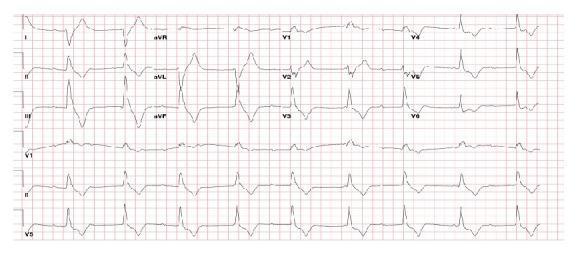
Key ECG Changes
| Feature | Finding |
|---|---|
| AV relationship | Complete dissociation — P waves and QRS have no relationship |
| Atrial rate | ~80 bpm (faster, regular P waves) |
| Ventricular rate | ~35–50 bpm (slow escape rhythm) |
| QRS | Wide (>120 ms) — infra-Hisian escape focus |
| P waves | March through QRS and T waves unrelated |
Interpretation: Third-degree (complete) AV block with ventricular escape rhythm. The ventricular rate is maintained by a slow infra-nodal pacemaker. Associated with inferior MI, Lyme disease, drug toxicity (digoxin, beta-blockers). Requires urgent temporary/permanent pacing.
Case 5 — Wolff-Parkinson-White (WPW) Syndrome
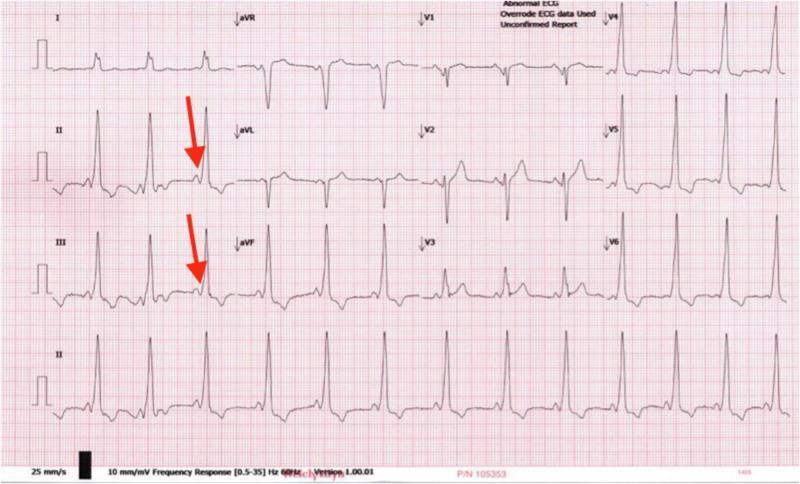
Key ECG Changes
| Feature | Finding |
|---|---|
| PR interval | Short (<120 ms) |
| QRS | Wide — slurred initial upstroke = delta wave |
| Delta waves | Positive in V1–V3 (anteroseptal pathway) |
| Secondary changes | Discordant ST-T changes |
| Risk | Rapid conduction via accessory pathway → risk of sudden death in AF |
Interpretation: Pre-excitation syndrome (WPW). Early ventricular depolarization via the Bundle of Kent bypasses the AV node. Avoid AV nodal blockers (digoxin, verapamil) in AF with WPW. Definitive treatment: radiofrequency catheter ablation.
Case 6 — Pulmonary Embolism (PE)
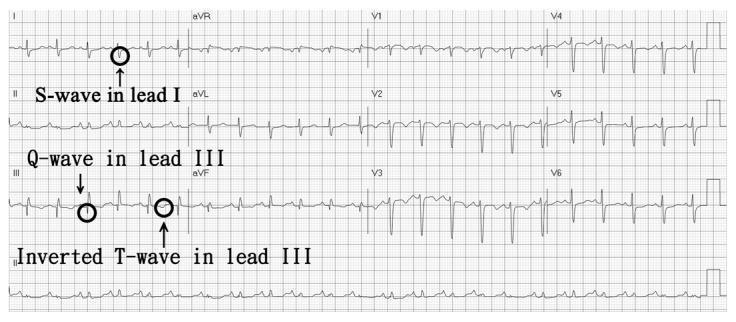
Key ECG Changes
| Feature | Finding |
|---|---|
| Classic pattern | S1Q3T3 — S wave in I, Q wave in III, T-wave inversion in III |
| Rhythm | Sinus tachycardia (most common, sensitive finding) |
| Right heart strain | T-wave inversions V1–V3, right axis deviation |
| Conduction | Incomplete RBBB (rSR' in V1) |
| P waves | P pulmonale (peaked P in II) if severe |
Interpretation: Acute cor pulmonale from massive PE. The S1Q3T3 pattern reflects acute right ventricular pressure overload. Only ~20% of PE show this pattern but it is highly specific. Treat with anticoagulation; consider thrombolysis for massive PE.
Case 7 — Acute Pericarditis
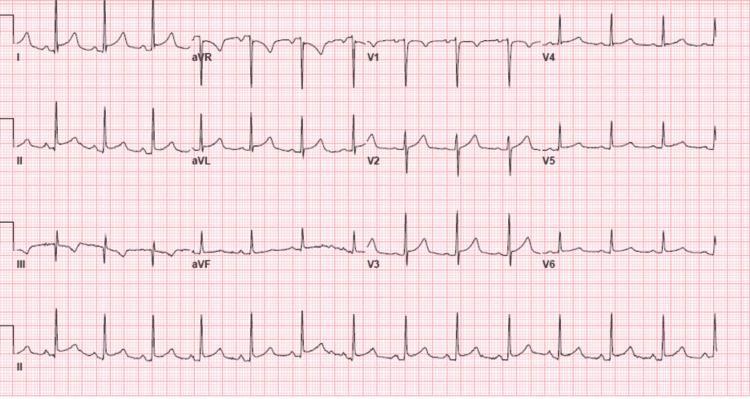
Key ECG Changes
| Feature | Finding |
|---|---|
| ST morphology | Diffuse concave ("saddle-shaped") ST elevation in most leads |
| Distribution | All territories (not following one coronary artery) |
| PR segment | PR depression in II, V4–V6; PR elevation in aVR |
| Spodick's sign | Downward sloping TP segment |
| Absent in | Lead aVR (shows reciprocal ST depression) |
Interpretation: Acute pericarditis — diffuse inflammation of the pericardium. Unlike STEMI, ST elevation is concave, diffuse (all territories), and associated with PR depression. No localized reciprocal changes. Caused by viruses (Coxsackievirus), autoimmune disease, uremia, malignancy. Treat with NSAIDs + colchicine.
Case 8 — Hyperkalemia

Key ECG Changes by Severity
| K⁺ Level | ECG Change |
|---|---|
| 5.5–6.5 mEq/L | Tall, narrow, peaked (tented) T waves — earliest sign |
| 6.5–7.5 mEq/L | Prolonged PR, widening of QRS, P wave flattening |
| >7.5 mEq/L | Absent P waves (sinoventricular rhythm) |
| >9 mEq/L | Sine-wave pattern, VF, asystole |
Interpretation (shown): Moderate hyperkalemia (K⁺ ~7.3 mEq/L) with prominent peaked T waves in V2–V4. A life-threatening emergency in renal failure, Addison's disease, or massive tissue breakdown. Treat with IV calcium gluconate, insulin/dextrose, bicarbonate, kayexalate, dialysis.
Case 9 — Bundle Branch Block (LBBB vs RBBB)
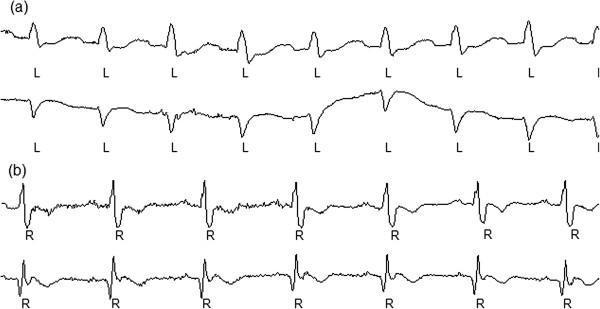
Differentiating Features
| Feature | LBBB | RBBB |
|---|---|---|
| QRS duration | ≥120 ms | ≥120 ms |
| V1 morphology | Broad QS or rS | rSR' ("rabbit ears") |
| V6 morphology | Tall, broad, notched R | Broad S wave |
| Lead I, aVL | Broad notched R | Deep slurred S |
| Axis | Left axis deviation | Usually normal |
| Significance | Often structural disease | Can be normal variant or RV strain |
Interpretation: LBBB is a more ominous finding, often indicating cardiomyopathy, STEMI (new LBBB = STEMI equivalent — Sgarbossa criteria apply), or severe hypertensive disease. RBBB may be seen in PE, congenital heart disease, or be benign.
Case 10 — Ventricular Tachycardia (VT)
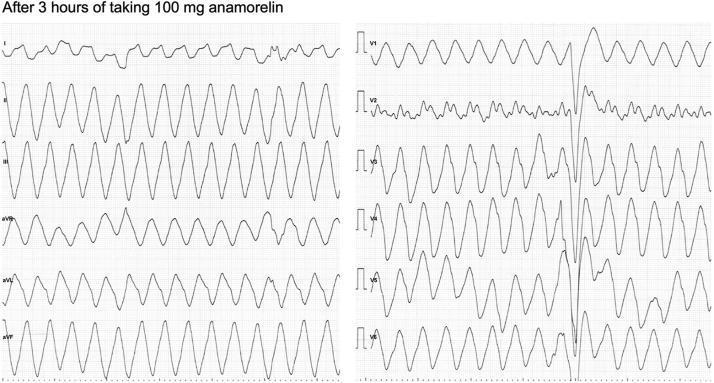
Key ECG Changes
| Feature | Finding |
|---|---|
| Rate | 120–250 bpm (shown: ~202 bpm) |
| QRS | Wide (>120 ms) — markedly prolonged |
| Rhythm | Regular (monomorphic VT) |
| P waves | Absent or dissociated from QRS |
| Concordance | Positive concordance in precordial leads = VT until proven otherwise |
| Axis | Superior axis in most VT |
Diagnostic clues favoring VT over SVT with aberrancy:
- AV dissociation (pathognomonic)
- Capture beats / fusion beats
- QRS >160 ms
- Concordance across all precordial leads
Interpretation: Monomorphic VT — a life-threatening arrhythmia. Associated with prior MI (scar re-entry), cardiomyopathy, channelopathies (Brugada, Long QT). Hemodynamically unstable → immediate DC cardioversion. Stable → amiodarone or procainamide IV.
Quick Reference: ECG Changes by Disease
| Disease | Key ECG Pattern |
|---|---|
| Anterior STEMI | ST elevation V1–V6, convex, hyperacute T waves |
| Inferior STEMI | ST elevation II, III, aVF; reciprocal changes I, aVL |
| Atrial Fibrillation | Irregularly irregular, absent P waves, fibrillatory baseline |
| Complete AV Block | AV dissociation, slow escape rhythm, P marching through QRS |
| WPW Syndrome | Short PR, delta wave, wide QRS |
| Pulmonary Embolism | S1Q3T3, sinus tachycardia, T-inversion V1–V3 |
| Pericarditis | Diffuse concave ST elevation, PR depression, saddle-shape |
| Hyperkalemia | Peaked T waves → QRS widening → sine wave → VF |
| Bundle Branch Block | RBBB: rSR' in V1; LBBB: broad notched R in V6 |
| Ventricular Tachycardia | Wide complex tachycardia, AV dissociation, capture beats |
*Sources: Braunwald's Heart Disease (9780323722193), Goldman-Cecil Medicine (9780323930345), Costanzo Physiology 7th Ed (9780323793339)*Here's a summary of what's covered across all 10 cases:
10 ECG Cases Covered:
- Anterior STEMI — Tombstone ST elevation V1–V6, LAD occlusion
- Inferolateral STEMI — ST elevation II/III/aVF + V4–V6, RCA/LCx occlusion
- Atrial Fibrillation — Irregularly irregular, absent P waves, chaotic baseline
- Complete (3rd Degree) AV Block — AV dissociation, slow wide escape rhythm
- WPW Syndrome — Short PR + delta wave = pre-excitation via Bundle of Kent
- Pulmonary Embolism — S1Q3T3 + sinus tachycardia + right heart strain pattern
- Acute Pericarditis — Diffuse saddle-shaped ST elevation + PR depression
- Hyperkalemia — Peaked T waves → QRS widening → sine wave → cardiac arrest progression
- Bundle Branch Block — LBBB (broad notched R in V6) vs RBBB (rSR' in V1)
- Ventricular Tachycardia — Wide complex tachycardia + AV dissociation + capture beats
Each case includes a real ECG image from the medical literature, a structured feature table, clinical interpretation, associated conditions, and management highlights.
This is a shared conversation. Sign in to Orris to start your own chat.