
Function of insulin on protein metabolism
Reading File
Insulin is an anabolic hormone that promotes protein synthesis and inhibits protein breakdown (proteolysis). It increases amino acid uptake into cells, stimulates ribosomal translation, and suppresses the ubiquitin-proteasome degradation pathway. Net effect: positive nitrogen balance.
Searching sources...
Finding Sources
Searching PubMed
insulin protein metabolism anabolism
There's a dedicated section in Guyton and Hall. Let me read it now.
Reading File
I have all the information needed. Let me also fetch the figure for visual clarity.
Loading Image
Here is a complete, textbook-based answer on insulin's role in protein metabolism.
Effects of Insulin on Protein Metabolism
(Source: Guyton and Hall Textbook of Medical Physiology, p. 967)
1. Insulin Promotes Protein Synthesis and Storage
After a meal, when nutrients are abundant in the blood, insulin drives protein storage through several coordinated mechanisms:
a) Stimulates amino acid transport into cells
Insulin increases cellular uptake of amino acids, particularly the branched-chain and aromatic amino acids: valine, leucine, isoleucine, tyrosine, and phenylalanine. This is a function insulin shares with growth hormone, though the specific amino acids transported are not always identical.
b) Increases mRNA translation (ribosomal activation)
Insulin "turns on" the ribosomal machinery to increase translation of messenger RNA, forming new proteins. In the absence of insulin, ribosomes essentially stop working - insulin acts almost like an on/off switch for ribosomal protein synthesis.
c) Increases DNA transcription (longer-term effect)
Over a longer time course, insulin increases transcription of selected DNA sequences in the nucleus, producing more RNA and promoting synthesis of a large array of enzymes involved in carbohydrate, fat, and protein storage.
d) Inhibits protein catabolism (anti-proteolytic effect)
Insulin reduces normal protein degradation by cellular lysosomes, thereby decreasing the release of amino acids from cells - especially from muscle cells. This is the basis of its anti-catabolic role.
e) Suppresses gluconeogenesis in the liver
Insulin inhibits gluconeogenic enzymes in the liver. Since plasma amino acids are the primary substrates for gluconeogenesis, this suppression conserves amino acids in the body's protein stores.
Net result: Insulin promotes protein formation and prevents protein degradation - a state of positive nitrogen balance.
2. Insulin Deficiency Causes Protein Depletion
When insulin is absent (e.g., in uncontrolled diabetes mellitus):
- All protein storage comes to a halt
- Protein catabolism increases markedly
- Protein synthesis stops
- Large quantities of amino acids are released into the plasma (elevated plasma amino acids)
- Excess amino acids are used for energy or as gluconeogenic substrates
- This leads to increased urea excretion in urine
- The resulting protein wasting is one of the most serious consequences of severe diabetes - causing extreme weakness and multi-organ dysfunction
3. Insulin and Growth Hormone: Synergistic Effect on Growth
Because insulin is required for protein synthesis, it is as essential as growth hormone for growth. The figure below demonstrates this synergy:
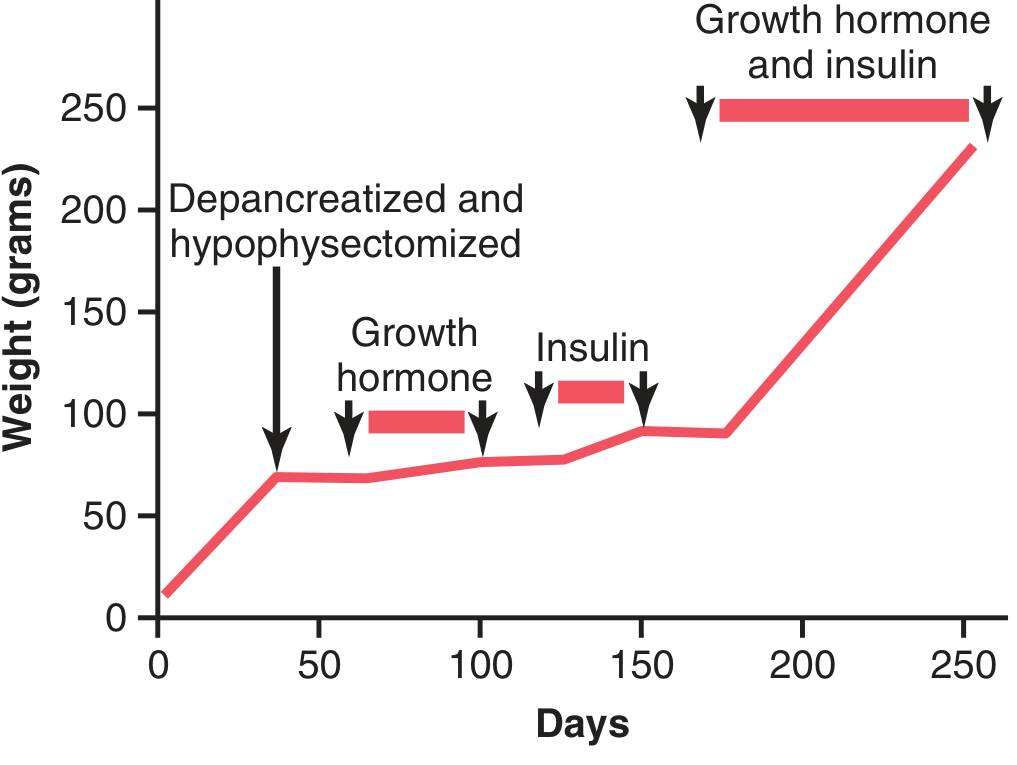
Figure: In a depancreatized and hypophysectomized animal, neither growth hormone alone nor insulin alone produces significant growth. Only the combination of both hormones produces dramatic growth - illustrating their synergistic relationship in protein anabolism.
Summary Table
| Effect | Mechanism | Outcome |
|---|---|---|
| Increased amino acid uptake | Stimulates specific amino acid transporters | More substrate for synthesis |
| Increased translation | Activates ribosomes | More protein built |
| Increased transcription | Acts on nuclear DNA sequences | More RNA and enzymatic protein |
| Decreased proteolysis | Inhibits lysosomal degradation | Less protein breakdown |
| Decreased gluconeogenesis | Inhibits gluconeogenic enzymes | Amino acids spared from conversion to glucose |
In insulin deficiency, all these effects reverse - resulting in net protein catabolism, negative nitrogen balance, elevated plasma amino acids, and increased urea excretion.
This is a shared conversation. Sign in to Orris to start your own chat.