
Sjogren syndrome
Reading File
Now I'll search the medical library and PubMed in parallel for comprehensive coverage.
Finding Sources
Searching PubMed
"Sjogren syndrome"[MeSH Terms]
Finding Sources
Searching PubMed
"Sjogren syndrome" AND treatment
Now let me read the key textbook sections in parallel - the comprehensive Cummings ENT section, the Family Medicine section, and search for pathology/autoimmune content:
Reading File
Reading File
Finding Sources
Let me read the rest of the Cummings ENT section (diagnosis + treatment) and search for Robbins pathology content:
Reading File
Finding Sources
Reading File
Finding Sources
Reading File
Finding Sources
Finding Sources
Reading File
I have comprehensive content now. Let me fetch the key histopathology image and get the 2016 ACR/EULAR classification criteria:
Loading Image
Reading File
I now have comprehensive information from multiple authoritative textbooks. Let me compile the full answer.
Sjögren Syndrome
Sjögren syndrome is a chronic systemic autoimmune disease primarily targeting exocrine glands, characterized by lymphoplasmacytic infiltration, glandular hypofunction, and the hallmark sicca complex of dry eyes and dry mouth. It predominantly affects women (~90% of patients) in their fourth to fifth decades of life, with an estimated prevalence of 1-3%.
Classification
| Type | Definition |
|---|---|
| Primary | Sicca features confined to exocrine glands, without another underlying autoimmune disease |
| Secondary | Sicca features occurring in the setting of another autoimmune disease (RA, SLE, polymyositis, systemic sclerosis, or primary biliary cirrhosis) |
Pathophysiology
The etiology involves a multifactorial interaction between genetics, the immune system, and environmental triggers.
- Genetic predisposition: HLA alleles B8 and DR3 create susceptibility. The major histocompatibility complex is involved.
- Triggering event: Likely a viral infection (e.g., Epstein-Barr virus has been implicated) that initiates an aberrant autoimmune reaction.
- Immune mechanism:
- Dense lymphocytic infiltration of exocrine glands - predominantly CD4+ T lymphocytes and B lymphocytes, with fewer CD8+ T cells, macrophages, and dendritic cells.
- B-cell overstimulation leads to excess immunoglobulins and autoantibodies, altered B-cell distribution peripherally and in salivary glands.
- Formation of germinal centers allows autoreactive B-cell clones to escape tolerance checkpoints.
- Follicular helper T-cell levels are increased.
- IL-12 and IFN-γ are upregulated; Th1 cytokines mediate interactions between APCs and CD4+ T cells in early lesions.
- Aquaporin water channels appear to be an important target - both duct and secretory cells are activated CD4+ T cell targets.
- Salivary gland epithelial cells display an activated phenotype and are presumed to drive the chronic inflammatory response.
Key autoantibodies:
- Anti-Ro (SS-A) - present in 40-80% of primary Sjögren syndrome cases
- Anti-La (SS-B) - another characteristic marker
- Both are ribonuclear proteins detected by ELISA
Clinical Features
Glandular (Sicca) Manifestations
Xerostomia (dry mouth):
- Difficulty chewing, swallowing, and phonation
- Dental caries (multiple)
- Food adherence to buccal mucosa
- Intolerance to acidic and spicy foods
- Smooth, fissured tongue with atrophy of filiform papillae
- Intraoral Candida albicans overgrowth (common)
- Parotid gland enlargement in 25-66% of patients - initially unilateral, eventually bilateral (recurrent/episodic or chronic/fixed)
Keratoconjunctivitis sicca (dry eyes):
- Foreign body sensation - described as "gritty" or "sandy"
- Dilation of bulbar conjunctival vessels, periorneal injection
- Irregularity of corneal image
- Occasionally lacrimal gland enlargement
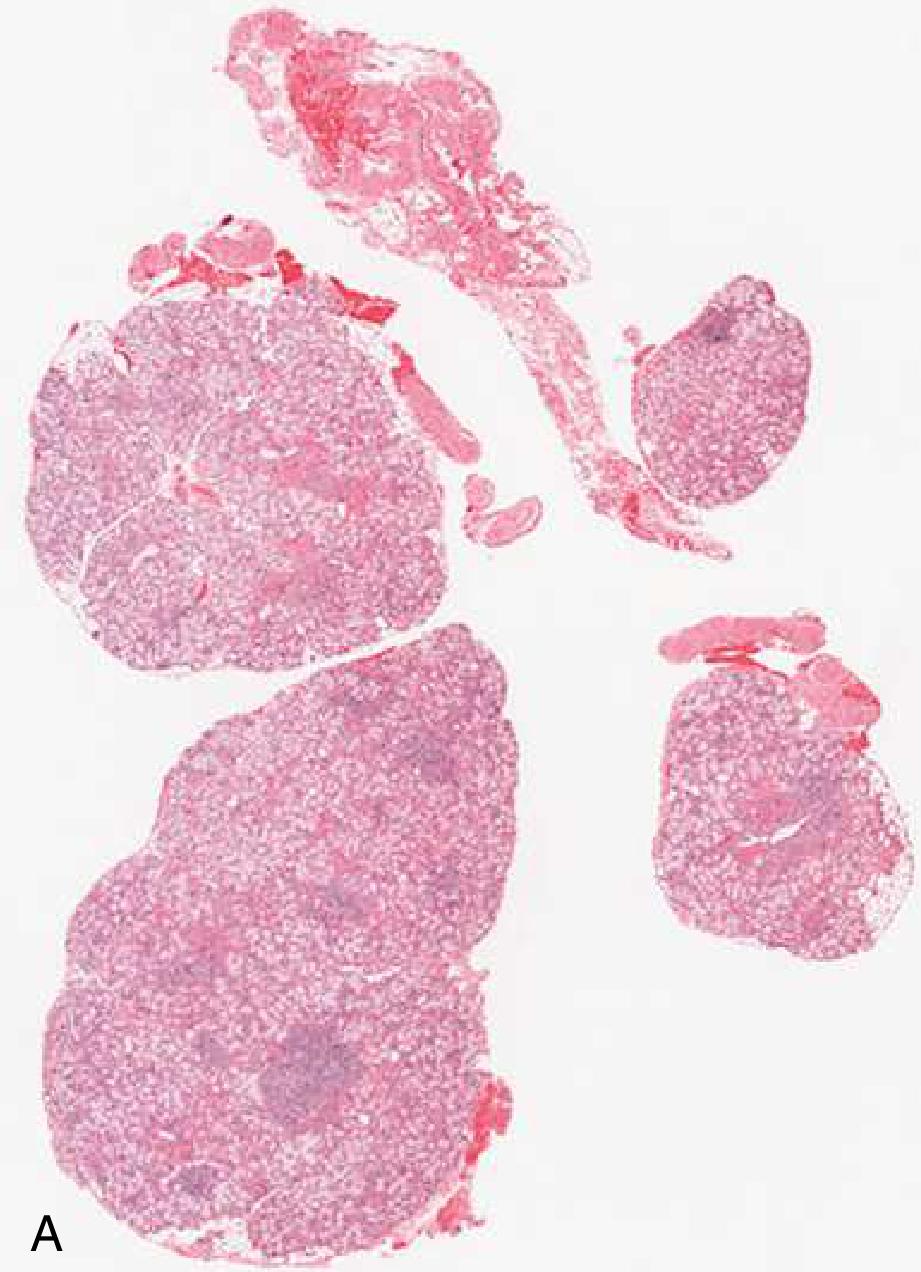
Histopathology of labial salivary glands in primary Sjögren syndrome: H&E staining showing focal lymphocytic sialadenitis - Goldman-Cecil Medicine
Extraglandular Manifestations
| System | Manifestations |
|---|---|
| Constitutional | Generalized malaise, fatigue, low-grade fever, myalgia, arthralgia |
| Skin | Xerosis, Raynaud phenomenon, palpable purpura, recurrent urticaria-like lesions |
| Musculoskeletal | Polyarthralgia/polyarthritis |
| Pulmonary | Dryness of pharynx/esophagus, dysphagia, bronchitis, pneumonia, interstitial lung disease |
| Renal | Renal tubular acidosis, interstitial nephritis |
| Neurological | Peripheral sensory and motor polyneuropathies (can mimic MS), central nervous system involvement, autonomic dysfunction |
| Vascular | Vasculitis in 20-30% |
| Hematologic | Hematologic abnormalities |
Malignant Transformation
- Sjögren syndrome predisposes to non-Hodgkin B-cell lymphoma (marginal zone B-cell lymphoma of salivary/lacrimal glands is most common).
- ~3% develop lymphoma during 9 years of observation; risk persists even after two decades of benign disease.
- High-risk features for lymphoma: palpable purpura, low C4, mixed monoclonal cryoglobulinemia, persistent unilateral or bilateral parotid enlargement.
Diagnosis
Objective Tests
Ocular dryness:
- Schirmer test: <5 mm wetting per 5 minutes (Schirmer I) or stimulated test using nasolacrimal reflex (Schirmer II, <8 mm/5 min)
- Rose bengal / lissamine green staining: identifies corneal/conjunctival epithelial damage; ocular staining score ≥5 (van Bijsterveld ≥4)
Oral dryness:
- Sialometry: Unstimulated whole saliva flow rate ≤0.1 mL/min (Lashley cups over Stensen duct)
- Sialography: demonstrates sialectasis in 85-97% of patients
Histopathology (gold standard):
- Minor salivary gland (labial) biopsy: focal lymphocytic sialadenitis with a focus score ≥1 foci/4 mm². Multiple mononuclear aggregates adjacent to and replacing normal acini. Scored 3 points in the 2016 ACR/EULAR criteria.
- Biopsy should include several glandular lobes from areas with normal overlying mucosa.
Serologic Testing
- Anti-SSA/Ro antibodies (3 points in 2016 criteria)
- Anti-SSB/La antibodies
- Elevated RF (>1:320), ANA (>1:320)
2016 ACR/EULAR Classification Criteria
Applicable to patients with at least one symptom of ocular or oral dryness. A score ≥4 is required for classification.
| Criterion | Score |
|---|---|
| Labial salivary gland biopsy: focal lymphocytic sialadenitis, focus score ≥1/4 mm² | 3 |
| Anti-SSA/Ro positive | 3 |
| Ocular staining score ≥5 (or van Bijsterveld ≥4) in at least one eye | 1 |
| Schirmer test ≤5 mm/5 min in at least one eye | 1 |
| Unstimulated whole saliva flow rate ≤0.1 mL/min | 1 |
Exclusions: Prior head/neck radiation, active hepatitis C (PCR+), AIDS, sarcoidosis, amyloidosis, graft-versus-host disease, IgG4-related disease.
From Shiboski et al., Ann Rheum Dis 2017 - Dermatology 2-Volume Set 5e, Dermatology 2-Volume Set 5e
Differential Diagnosis
- Sarcoidosis (Heerfordt syndrome)
- Lymphoma
- Amyloidosis
- HIV (diffuse infiltrative lymphocytosis syndrome - DILS: massive parotid enlargement, prominent renal/lung/GI manifestations, low autoantibody frequency)
- Hepatitis C infection
- Medications (sedatives, antipsychotics, antidepressants, antihistamines, diuretics)
- Diabetes, cystic fibrosis
Treatment
Treatment is largely symptomatic, though disease-modifying options are emerging.
Sicca Management
Dry mouth:
- Pilocarpine (muscarinic-cholinergic agonist): 5 mg three to four times daily; side effects include sweating, flushing, increased urination
- Cevimeline: another secretagogue
- Sugarless gum/candy (mechanical stimulation of residual gland function)
- Acid maltose lozenges (less expensive, useful for symptom relief)
- Saliva substitutes
- Topical fluoride for dental caries prevention and control
- Antifungals for oral candidiasis
Dry eyes:
- Artificial tears / eye lubricants
- Topical cyclosporine (immunomodulator)
- Pilocarpine also has benefit on subjective eye symptoms
- Eye patching if corneal ulceration develops
Systemic/Disease-Modifying Treatment
| Agent | Indication |
|---|---|
| Hydroxychloroquine | Systemic disease (arthralgia, fatigue); most commonly used |
| Immunosuppressive agents | Depending on severity and type of extraglandular manifestations |
| High-dose corticosteroids | Severe disease |
| Plasma exchange or Rituximab | Cryoglobulinemia; B-cell depletion improves both local and systemic symptoms (xerostomia, fatigue, joint tenderness) |
| TNF inhibitors | Show some promise |
- Rituximab (anti-CD20 monoclonal antibody): depletes B cells peripherally and in salivary glands; evidence for severe/refractory disease
- Systemic corticosteroids or cytotoxic drugs reserved for severe extraglandular complications (glomerulonephritis, necrotizing vasculitis)
Procedural Options
- Sialendoscopy: for recurrent sialadenitis - dilates and washes out affected ducts, reduces intensity/frequency of episodes
- Gland excision: last resort when all other treatments fail
Key Points Summary
- Who: 90% women, 4th-5th decade
- Mechanism: Autoimmune glandular destruction by CD4+ T cells and autoreactive B cells; autoantibodies SS-A/Ro and SS-B/La are characteristic
- Hallmarks: Keratoconjunctivitis sicca + xerostomia (sicca complex)
- Diagnosis: Minor salivary gland biopsy (gold standard) + anti-SSA/Ro + objective sicca tests; 2016 ACR/EULAR score ≥4
- Serious complication: Non-Hodgkin B-cell lymphoma (~44x increased risk vs. general population)
- Treatment: Pilocarpine/cevimeline for sicca, hydroxychloroquine for systemic disease, rituximab for severe B-cell driven disease
Sources: Cummings Otolaryngology Head and Neck Surgery, Goldman-Cecil Medicine International Edition, Textbook of Family Medicine 9e, Andrews' Diseases of the Skin, Dermatology 2-Volume Set 5e (Shiboski 2016 ACR/EULAR criteria)
This is a shared conversation. Sign in to Orris to start your own chat.