
Viral sti
Reading File
The query "viral STI" is quite broad. Let me clarify before diving deep.
Asking for Preferences
What aspect of viral STIs are you interested in? · What level of detail do you need?
Got it - a thorough clinical overview of all viral STIs. Let me pull from the medical library and recent literature simultaneously.
Finding Sources
Finding Sources
Searching PubMed
"sexually transmitted infections" AND viral
Good - found key sources. Now let me read the main viral STI section from Medical Microbiology, and the Tintinalli emergency medicine section, and also search for HPV and HIV sections in parallel.
Reading File
Reading File
Finding Sources
Finding Sources
Good data coming in. Now let me pull the detailed HSV clinical content from Robbins/Swanson, HPV from Dermatology, and the Genital Herpes content from Swanson.
Reading File
Reading File
Reading File
Excellent content. Now let me pull the HPV section from Robbins (it starts right at line 3896), and also search for HBV as STI and Molluscum/Zika detail.
Reading File
Reading File
Finding Sources
I have rich clinical content from multiple authoritative textbooks. I also captured two excellent pathology images. Let me now fetch the key images and compile the full answer.
Loading Image
Loading Image
I now have comprehensive clinical content from multiple authoritative sources. Let me compile the full in-depth answer.---
Viral Sexually Transmitted Infections (STIs) - Comprehensive Clinical Overview
Sexually transmitted viruses are a major public health challenge. Unlike bacterial STIs, they cannot be eradicated with antibiotics - they establish chronic, latent, or persistent infections. The key viral STIs are:
| Virus | Family | Genome | Oncogenic? |
|---|---|---|---|
| HSV-1 & HSV-2 | Herpesviridae | dsDNA | No |
| HPV (multiple types) | Papillomaviridae | dsDNA | Yes (types 16, 18, 31, 45) |
| HIV-1 & HIV-2 | Retroviridae | ssRNA | Indirectly (lymphoma, KS) |
| HBV | Hepadnaviridae | dsDNA | Yes (HCC) |
| HCV | Flaviviridae | ssRNA | Yes (HCC) |
| CMV | Herpesviridae | dsDNA | No |
| HTLV-1 | Retroviridae | ssRNA | Yes (ATL) |
| MCV (Molluscum) | Poxviridae | dsDNA | No |
| Zika virus | Flaviviridae | ssRNA | No |
Source: Medical Microbiology 9e, Box 38.6
1. Herpes Simplex Virus (HSV) - Genital Herpes
Virology
- HSV-2 causes the majority of genital herpes; HSV-1 is increasingly responsible for genital infections and produces fewer recurrences than HSV-2.
- Transmission requires direct contact with infected mucosa or broken skin - the virus is readily inactivated at room temperature and cannot survive indirect routes.
- ~1 in 8 Americans aged 14-49 is infected with HSV-2.
Pathology
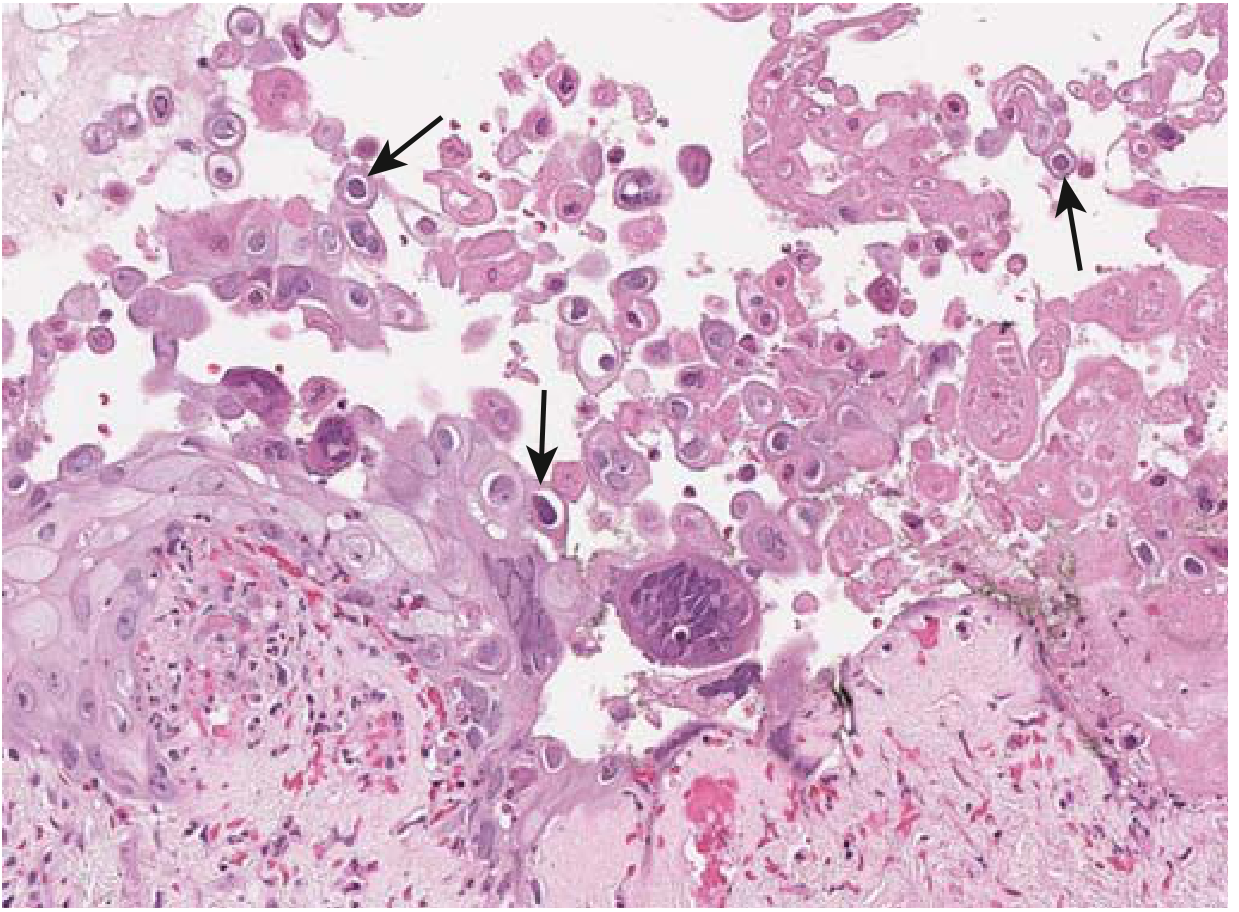
Initial lesions are painful, erythematous vesicles on the genitalia or adjacent skin. Histology shows:
- Intraepithelial vesicles with necrotic debris and neutrophils
- Cowdry type A inclusions: light purple, homogeneous intranuclear structures surrounded by a clear halo (arrows below)
- Multinucleate syncytia (cell fusion) - pathognomonic
Clinical Features
| Feature | Primary Infection | Recurrence |
|---|---|---|
| Severity | More severe, systemic | Milder, localized |
| Duration | Several weeks | Shorter |
| Symptoms | Painful vesicles/ulcers, dysuria, urethral discharge, tender lymphadenopathy, fever, myalgia | Prodrome of tingling/itching → vesicular ulcers |
| Viral shedding | High throughout | Asymptomatic shedding possible |
- Primary infection is often asymptomatic (important for transmission).
- HSV-2 infection increases risk of HIV acquisition due to mucosal ulceration.
Special Populations
- Neonatal herpes: Acquired during delivery through infected birth canal. Categorized as:
- Skin-eyes-mouth (SEM) - best prognosis
- CNS involvement (+/- SEM) - ~70% have neurodevelopmental abnormalities
- Disseminated disease - ~30% 1-year mortality
- Immunocompromised: Risk of fatal disseminated disease.
Diagnosis
- Viral culture (from vesicular fluid)
- Nucleic acid amplification test (NAAT/PCR) - most sensitive
- Type-specific serologic antibody tests
- Tzanck smear (multinucleated giant cells) - rapid but non-specific
Treatment
| Indication | Regimen |
|---|---|
| First episode | Oral acyclovir 400mg TID x 7-10 days OR valacyclovir 1g BD x 10 days OR famciclovir 250mg TID x 7-10 days |
| Episodic recurrence | Same antivirals, shorter course (3-5 days) |
| Suppressive therapy | Valacyclovir 500mg daily (reduces frequency and transmission risk) |
| Neonatal/disseminated | IV acyclovir |
2. Human Papillomavirus (HPV)
Virology & Types
HPV is a non-enveloped dsDNA virus. Over 200 types exist, classified by oncogenic risk:
| Risk Category | HPV Types | Disease |
|---|---|---|
| Low-risk | 6, 11, 42 | Condylomata acuminata (anogenital warts), recurrent respiratory papillomatosis |
| High-risk | 16, 18, 31, 45 (and others) | Cervical, anal, penile, vulvar, oropharyngeal carcinoma |
Clinical Manifestations
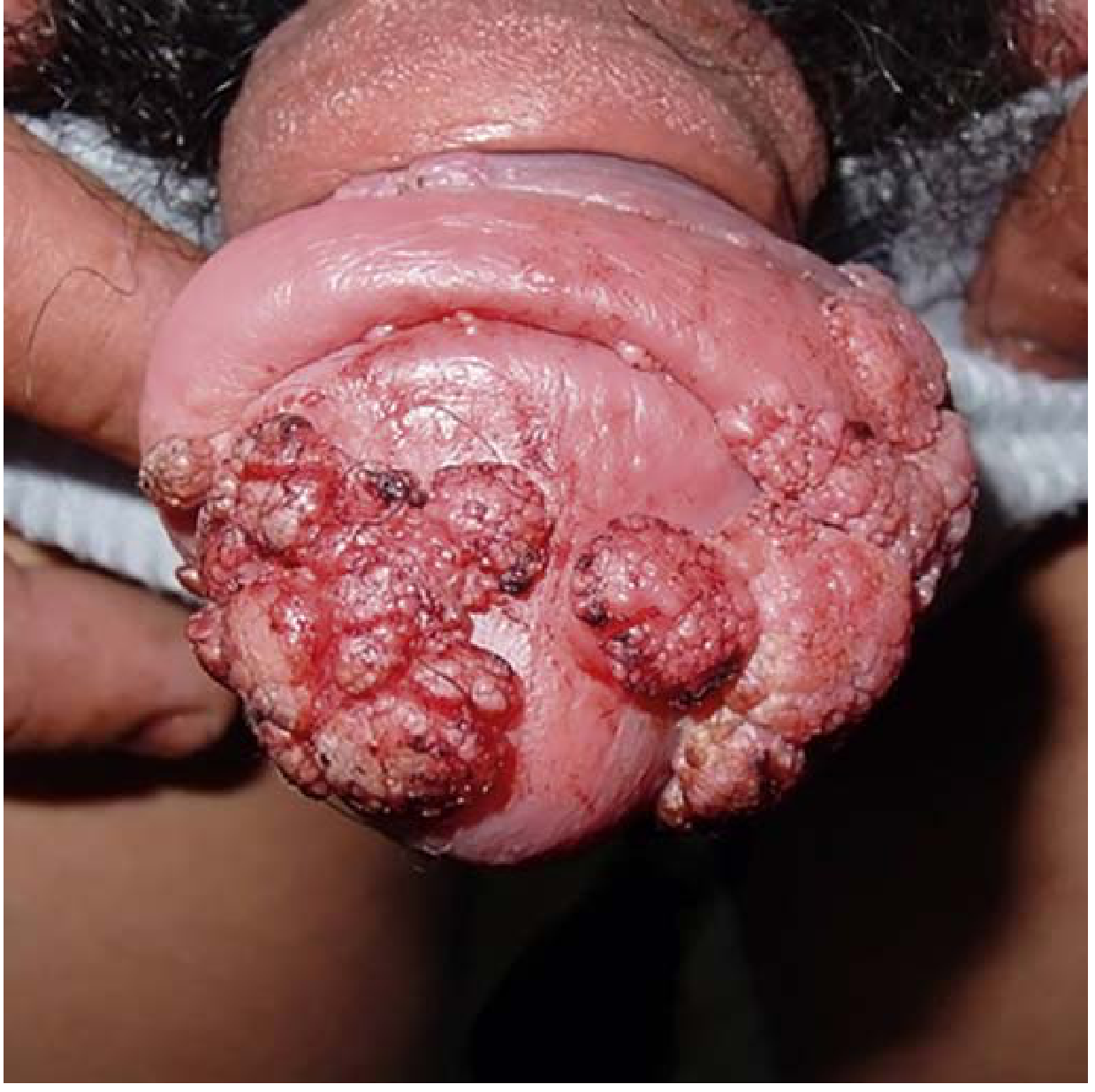
Condylomata acuminata (anogenital warts):
- Caused by HPV types 6 and 11
- Soft, flesh-colored, cauliflower-like papillary proliferations
- Male: coronal sulcus, inner prepuce, penile shaft
- Female: vulva, vaginal wall, cervix, perianal region
- Must be distinguished from condylomata lata of secondary syphilis (flat, moist, gray-white)
Pre-cancerous and cancerous lesions:
- Cervical intraepithelial neoplasia (CIN) → Cervical carcinoma
- Vulvar/vaginal/penile intraepithelial neoplasia
- Anal intraepithelial neoplasia (AIN) → Anal carcinoma
- Oropharyngeal squamous cell carcinoma (HPV-16 dominant)
HPV in HIV-positive patients:
- 3-fold increase in CIN incidence in HIV-positive women
-
90% of MSM with HIV have anal HPV; up to 50% have high-grade AIN
- 30-50-fold higher risk of anal cancer; 5-fold increased penile cancer risk
- Lesions are multiple, coalescent, treatment-resistant, with frequent recurrence
Diagnosis
- Clinical inspection; biopsy if uncertain
- Cervical cytology (Pap smear) + HPV DNA testing (co-testing)
- Colposcopy, proctoscopy with cytology/histology for high-risk groups
Treatment
| Modality | Notes |
|---|---|
| Cryotherapy | First-line destructive option |
| Electrosurgery / laser therapy | For larger lesions |
| Surgical excision | For bulky disease |
| Imiquimod (patient-applied) | Immune response modifier; 5% cream |
| Podophyllotoxin (patient-applied) | Antimitotic; not for internal use |
| 5-fluorouracil | For vaginal/urethral disease |
Prevention - Vaccines
- Gardasil 9 (nonavalent): covers types 6, 11, 16, 18, 31, 33, 45, 52, 58
- Recommended from age 9; ideally before sexual debut
- Effective and well-tolerated even in HIV-positive individuals
- A 2024 systematic review on HPV epidemiology in men estimated global genital HPV prevalence at ~31% in men.
3. Human Immunodeficiency Virus (HIV)
Virology
- HIV-1: Lentivirus (Retroviridae); responsible for the global pandemic. HIV-1 is the predominant strain in the US.
- HIV-2: Endemic to West Africa; slower progression.
- ssRNA retrovirus; uses reverse transcriptase to integrate proviral DNA into host genome.
Transmission
- Sexual contact (most common globally; male-to-male contact accounts for ~78% of new US infections)
- Parenteral (contaminated needles, transfusion)
- Vertical (mother-to-child: intrauterine, intrapartum, breastfeeding)
- Acute HIV infection carries the highest transmissibility - viral load is at its peak before seroconversion, and patients are often unaware. Epidemiologic data suggest up to half of all HIV transmissions come from acutely infected, unaware individuals.
Clinical Stages
- Acute retroviral syndrome (2-4 weeks post-exposure): Mononucleosis-like - fever, malaise, headache, sore throat, maculopapular rash, lymphadenopathy. Often missed clinically due to nonspecific presentation.
- Chronic/latent infection: Asymptomatic; CD4 count gradually declines over years (median ~10 years untreated to AIDS).
- AIDS: CD4 <200 cells/mm³ or AIDS-defining illness (PCP, CMV retinitis, Kaposi sarcoma, cryptococcal meningitis, etc.)
Diagnosis
- 4th generation HIV Ag/Ab assay (detects both p24 antigen and antibodies): initial test
- If reactive: confirmatory HIV-1/HIV-2 antibody differentiation assay
- If discordant: HIV-1 RNA PCR
- HIV RNA PCR (viral load) for monitoring
- CD4 count for staging and monitoring
Treatment
- Antiretroviral therapy (ART): combination regimens (typically 2 NRTIs + integrase inhibitor as preferred backbone)
- Goal: undetectable viral load (<50 copies/mL)
- ART started at all stages regardless of CD4 count
- U=U: Undetectable = Untransmittable (no sexual transmission with sustained undetectable viral load)
- PrEP (pre-exposure prophylaxis): Tenofovir/emtricitabine (TDF/FTC) or cabotegravir injection for HIV-negative individuals at risk
4. Hepatitis B Virus (HBV)
Transmission Routes
- Sexual (significant STI route - present in semen and vaginal secretions)
- Parenteral (needles, transfusion)
- Vertical (mother to child - major route, carries high chronicity risk)
Acute Infection
- Malaise, nausea, vomiting, fever, right upper quadrant pain, jaundice
- Serology: HBsAg +, Anti-HBc IgM +, HBeAg + (high replication)
- Window period: HBsAg may clear before anti-HBs appears
Chronicity Risk
- Adults: 6-10% develop chronic hepatitis after acute infection
- Children: much higher rate - highlights the critical importance of neonatal vaccination
- Chronic HBV: risk of cirrhosis and hepatocellular carcinoma (HCC)
Diagnosis
| Marker | Interpretation |
|---|---|
| HBsAg + | Active infection (acute or chronic) |
| Anti-HBs + | Immunity (vaccination or resolved infection) |
| HBeAg + | High viral replication, high infectivity |
| Anti-HBe + | Low replication (usually) |
| HBV DNA | Quantifies viral load |
Prevention
- HBV vaccine (3-dose series): highly effective; recommended universally for infants; catch-up for unvaccinated adults
- Hepatitis B immune globulin (HBIg) for post-exposure prophylaxis (e.g., needlestick, neonate born to HBsAg+ mother)
Treatment (Chronic)
- Entecavir or tenofovir (first-line antivirals)
- Pegylated interferon-alpha (selected cases)
5. Hepatitis C Virus (HCV)
- Primarily bloodborne (IVDU is the main risk in high-income countries); sexual transmission is possible but less efficient than HBV
- Risk is higher with multiple partners, HIV co-infection, MSM, and traumatic sex practices
- ~75-85% of acutely infected individuals develop chronic hepatitis C
- Long-term complications: cirrhosis, HCC
- Diagnosis: Anti-HCV antibody screening; confirmed by HCV RNA PCR; genotyping guides treatment
- Treatment: Direct-acting antivirals (DAAs) - sofosbuvir-based regimens achieve >95% cure (sustained virologic response - SVR)
- No vaccine available
6. Cytomegalovirus (CMV)
- Herpesviridae; establishes latency in myeloid/lymphoid cells beneath mucosal lining
- Transmitted in semen, vaginal secretions, blood
- In immunocompetent adults: usually asymptomatic or mild mononucleosis-like syndrome
- Immunocompromised (HIV/transplant): severe disease - retinitis, colitis, esophagitis, pneumonitis, encephalitis
- Congenital CMV: most common congenital infection; causes sensorineural hearing loss, chorioretinitis, intellectual disability
- Treatment: Ganciclovir, valganciclovir (IV/oral); foscarnet for resistant cases
7. Human T-cell Lymphotropic Virus Type 1 (HTLV-1)
- Retrovirus; sexually transmitted (in semen), also via blood/breastfeeding
- Endemic: Japan, Caribbean, sub-Saharan Africa
- Most carriers are asymptomatic lifelong
- Causes:
- Adult T-cell leukemia/lymphoma (ATL) - aggressive; occurs in ~5% of carriers after decades
- HTLV-1-associated myelopathy (HAM) / Tropical spastic paraparesis - progressive spastic paraplegia
- No curative treatment; AZT + interferon used for ATL
8. Molluscum Contagiosum
- Poxvirus (MCV types 1-4); spreads via direct skin-to-skin contact or fomites
- In sexually active adolescents/adults: genital area involvement strongly suggests sexual transmission
- Appearance: Skin-colored, pearly, umbilicated papules; may be scattered or clustered
- Immunosuppressed (especially HIV): extensive, coalescent, giant lesions
- Treatment: Usually self-limited in immunocompetent hosts
- Destructive options: cryotherapy, curettage, electrodesiccation, laser
- Topical: imiquimod, cantharidin, tretinoin
- Cidofovir for severe immunocompromised cases
9. Zika Virus
- Flavivirus; primarily mosquito-borne (Aedes aegypti) but confirmed sexual transmission - mainly male-to-female and male-to-male via semen
- Zika RNA persists in semen for weeks to months after recovery
- Clinical presentation: Incubation 2-14 days; mild febrile illness - headache, maculopapular rash, conjunctivitis, arthralgia; mostly self-limited
- Key concern: Teratogenicity in pregnancy:
- Microcephaly, CNS malformations (lissencephaly, ventriculomegaly)
- Seizures, clubfoot, arthrogryposis
- Prevention:
- Mosquito bite prevention (repellent, netting)
- Avoid travel to endemic areas when pregnant
- Condom use or abstinence if partner has traveled to endemic area
- No vaccine or specific antiviral treatment
Key Comparison: Prevention Strategies
| Virus | Vaccine | Antiviral | Barrier Protection |
|---|---|---|---|
| HSV | No | Yes (acyclovir, valacyclovir) - suppressive | Condoms (partial) |
| HPV | Yes (Gardasil 9) | No (treat lesions only) | Condoms (partial) |
| HIV | No (trials ongoing) | Yes (ART + PrEP) | Condoms |
| HBV | Yes (3-dose series) | Yes (entecavir, tenofovir) | Condoms |
| HCV | No | Yes (DAAs - curative) | Condoms |
| CMV | No | Yes (ganciclovir) | Condoms |
| HTLV-1 | No | No curative | Condoms |
| MCV | No | Destructive/topical | Condoms |
| Zika | No | No | Condoms, avoidance |
Perinatal/Neonatal Transmission Summary
| Virus | Timing | Key Consequence |
|---|---|---|
| HSV | Intrapartum (birth canal) | Neonatal herpes: SEM / CNS / disseminated |
| HPV | Vaginal delivery | Recurrent respiratory papillomatosis in neonate |
| HIV | Intrauterine, intrapartum, breastfeeding | Pediatric HIV/AIDS |
| HBV | Peripartum | Chronic HBV (high chronicity rate) → HCC later |
| CMV | Any (primary > reactivation) | Congenital CMV: deafness, CNS damage |
| Zika | Transplacental | Microcephaly, CNS malformations |
Key clinical take-home points:
- All viral STIs are not curable by antibiotics - management is antiviral or symptomatic
- Asymptomatic shedding is a critical driver of transmission for HSV and HIV
- Vaccination is available for HPV and HBV - both significantly reduce cancer risk
- PrEP for HIV and suppressive antiviral therapy for HSV reduce transmission to uninfected partners
- HIV co-infection dramatically worsens the course of all other viral STIs (especially HPV-related cancers)
- Recent global estimates (Harfouche et al., 2025) confirm HSV as the most prevalent STI worldwide, causing billions of infections and driving genital ulcer disease burden
Sources: Robbins & Kumar Basic Pathology; Medical Microbiology 9e; Tintinalli's Emergency Medicine; Swanson's Family Medicine Review; Dermatology 5eThat covers all 9 major viral STIs in depth. Here's a summary of what was covered:
What was covered:
- HSV (Herpes Simplex Virus) - Pathology (Cowdry A inclusions, syncytia), primary vs recurrent disease, neonatal herpes, treatment with acyclovir/valacyclovir/famciclovir
- HPV (Human Papillomavirus) - Low-risk (types 6/11 → condylomata acuminata) vs high-risk (types 16/18 → cervical/anal/penile/oropharyngeal carcinoma), Gardasil 9 vaccine, treatment options
- HIV - Acute retroviral syndrome, CD4-based staging, ART, PrEP, U=U concept
- HBV - Routes, chronicity rates (high in perinatal exposure), serology interpretation, vaccination
- HCV - Sexual transmission less efficient than HBV; near-universal cure with DAAs; no vaccine
- CMV - Latent in myeloid/lymphoid cells; devastating in immunocompromised; congenital CMV
- HTLV-1 - Adult T-cell leukemia/lymphoma and tropical spastic paraparesis
- Molluscum contagiosum - Poxvirus; umbilicated papules; extensive in HIV
- Zika virus - Sexual (semen) + mosquito transmission; teratogenic (microcephaly)
All sections include virology, clinical features, diagnosis, management, and prevention. Let me know if you want any specific virus covered in more detail, or want a focused section on a particular aspect (e.g., drug dosing, cervical screening protocols, or STI co-infection management).
This is a shared conversation. Sign in to Orris to start your own chat.