
Stages of sleep full details for md exams 10 marks answer
Reading File
Now let me search the medical library for comprehensive sleep stages content.
Finding Sources
Finding Sources
Excellent results. Now let me read the key sections from multiple authoritative textbooks in parallel.
Reading File
Reading File
Reading File
Now let me read more content from the Kaplan & Sadock and Adams & Victor sections, plus Ganong and Bradley for sleep cycles, distribution, and REM physiology.
Reading File
Reading File
Reading File
I now have comprehensive material from multiple authoritative textbooks. Let me also quickly fetch the sleep EEG diagram and look up the neurotransmitters/physiology of sleep for a complete MD-exam answer.
Finding Sources
Loading Image
Now let me get the neurotransmitter/neurochemistry section and the sleep cycle hypnogram image.
Reading File
Loading Image
I now have rich, authoritative content from Adams & Victor's Neurology, Kaplan & Sadock's Psychiatry, Guyton & Hall, and Ganong's Physiology. Let me compile a comprehensive, exam-ready answer.
Stages of Sleep - Complete MD Exam Answer (10 Marks)
Introduction
Sleep is an active, cyclically organized physiological state, not merely the absence of wakefulness. It is characterized by organized and recurring patterns of electrical brain activity (sleep architecture). Modern classification is based on polysomnographic (PSG) recording of three parameters: EEG (electroencephalogram), EOG (electrooculogram), and EMG (electromyogram). Sleep is scored in 30-second epochs.
Sleep is divided into two broad categories:
- NREM sleep (Non-Rapid Eye Movement) - also called synchronized or slow-wave sleep
- REM sleep (Rapid Eye Movement) - also called desynchronized, paradoxical, or fast-wave sleep
Classification / Nomenclature
The American Academy of Sleep Medicine (AASM, 2007, updated 2020) recommends the following stages, replacing the older Rechtschaffen & Kales (1968) system:
| AASM Stage | Old Name | Description |
|---|---|---|
| Stage W | Wakefulness | Awake state |
| Stage N1 | Stage 1 | Light NREM sleep |
| Stage N2 | Stage 2 | Intermediate NREM sleep |
| Stage N3 | Stages 3 + 4 combined | Slow-wave (deep) NREM sleep |
| Stage R | REM sleep | Paradoxical/desynchronized sleep |
EEG Patterns Across Sleep Stages
Here is the actual EEG appearance across stages (from Kaplan & Sadock's Textbook of Psychiatry):
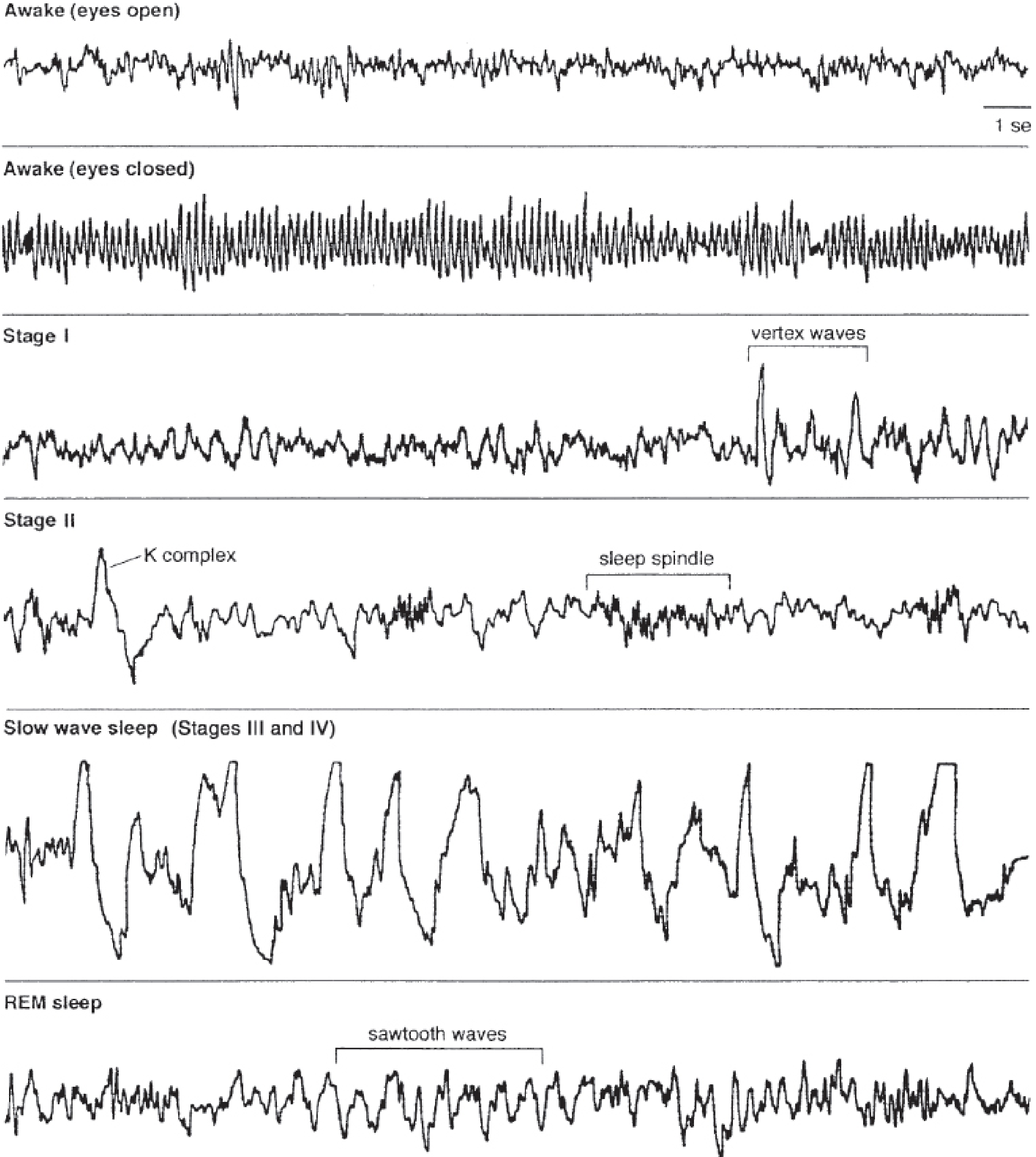
Stage W - Wakefulness
| Parameter | Finding |
|---|---|
| EEG | Low-voltage, mixed frequency; alpha waves (8-13 Hz) with eyes closed (posterior); beta waves with eyes open |
| EOG | Voluntary eye movements, eye blinks |
| EMG | High tonic activity + voluntary movement bursts |
- Alpha activity is most prominent in occipital regions with eyes closed
- Eyes open: high-frequency beta waves dominate (alert state)
Stage N1 (formerly Stage 1) - Light Sleep
| Parameter | Finding |
|---|---|
| EEG | Low-voltage, mixed-frequency; theta waves (4-7 Hz); vertex sharp waves (V waves) centrally |
| EOG | Slow, rolling eye movements |
| EMG | Tonic activity slightly decreased from wakefulness |
Key features:
- Transition from wakefulness to sleep - loss of alpha activity
- Arousal threshold is very low; person may not perceive this as sleep
- Decreased awareness of sensory stimuli (especially visual); mental activity becomes dreamlike
- Constitutes approximately 3-5% of total sleep time in young adults
- Pupils become small; eyes may rove slowly side to side
Stage N2 (formerly Stage 2) - Intermediate Sleep
| Parameter | Finding |
|---|---|
| EEG | Low-voltage background with sleep spindles (11-16 Hz bursts, ≥0.5 s) and K-complexes |
| EOG | No eye movements |
| EMG | Low tonic activity |
Key features:
- Sleep spindles: 11-16 Hz (classically 12-14 Hz) biparietal bursts lasting 0.5-2 seconds; generated by thalamo-cortical circuits
- K-complexes: High-amplitude biphasic waveforms - a negative sharp wave followed by a positive slow wave, ≥0.5 s duration, over central regions. Thought to reflect cortical response to arousing stimuli while maintaining sleep
- This is the first stage subjectively perceived as "sleep"
- Arousal threshold higher than N1
- Constitutes approximately 50-60% of total sleep time - the largest portion of sleep
- Eye movements cease; muscle tone further decreases
Stage N3 (formerly Stages 3 and 4) - Slow-Wave Sleep (SWS) / Deep Sleep
| Parameter | Finding |
|---|---|
| EEG | High-amplitude (≥75 µV) slow delta waves (0.5-2 Hz), occupying ≥20% of the epoch; most prominent over frontal regions |
| EOG | No eye movements |
| EMG | Very low tonic activity |
Key features:
- Also called delta sleep, SWS (slow-wave sleep), deep sleep
- Highest arousal threshold - most difficult stage to awaken from; a person awakened from N3 often feels confused and groggy ("sleep inertia")
- Old classification: Stage 3 = delta waves 20-50% of epoch; Stage 4 = delta waves >50% of epoch. The AASM combined these as N3 because the biological distinction was not meaningful
- Sleep spindles and K-complexes disappear
- Constitutes approximately 10-20% of total sleep time; decreases significantly with age; virtually absent in persons over 70 years
- Growth hormone (GH) is secreted predominantly during N3
- Parasomnias arising from N3: sleepwalking (somnambulism), sleep terrors, confusional arousals, sleep-related eating disorder
Stage R - REM Sleep (Rapid Eye Movement Sleep)
| Parameter | Finding |
|---|---|
| EEG | Low-voltage, mixed frequency (similar to N1/wakefulness); sawtooth waves (2-6 Hz triangular waves); theta activity |
| EOG | Rapid conjugate eye movements in all directions |
| EMG | Tonic atonia (generalized hypotonia/atonia of skeletal muscles) with phasic muscle twitches |
Key features:
- Also called paradoxical sleep (EEG looks like wakefulness but person is asleep and hardest to arouse in terms of conscious integration)
- Called desynchronized sleep because of the irregular, non-synchronized firing pattern
- Tonic components (persistent throughout REM):
- Activated, desynchronized EEG
- Skeletal muscle atonia (mediated by glycinergic inhibition of motor neurons from the pons - sublateral dorsal nucleus)
- Small pupils
- Phasic components (episodic):
- Bursts of rapid eye movements
- Brief muscle twitches (can affect face, limbs)
- Penile/clitoral tumescence
- Irregular heart rate and respiratory rate
- Sawtooth waves on EEG
- Dreaming is most vivid, narrative, emotional, and visual during REM sleep (though dreaming can occur in NREM too)
- Extraocular muscles and diaphragm are spared from atonia
- REM sleep behavior disorder (RBD): Loss of normal REM atonia causing acting out of dreams
- Constitutes approximately 20-25% of total sleep time in young adults
- Newborns: ~50% REM; falls rapidly postnatally; by adulthood ~25%; elderly ~20%
Sleep Cycle Architecture
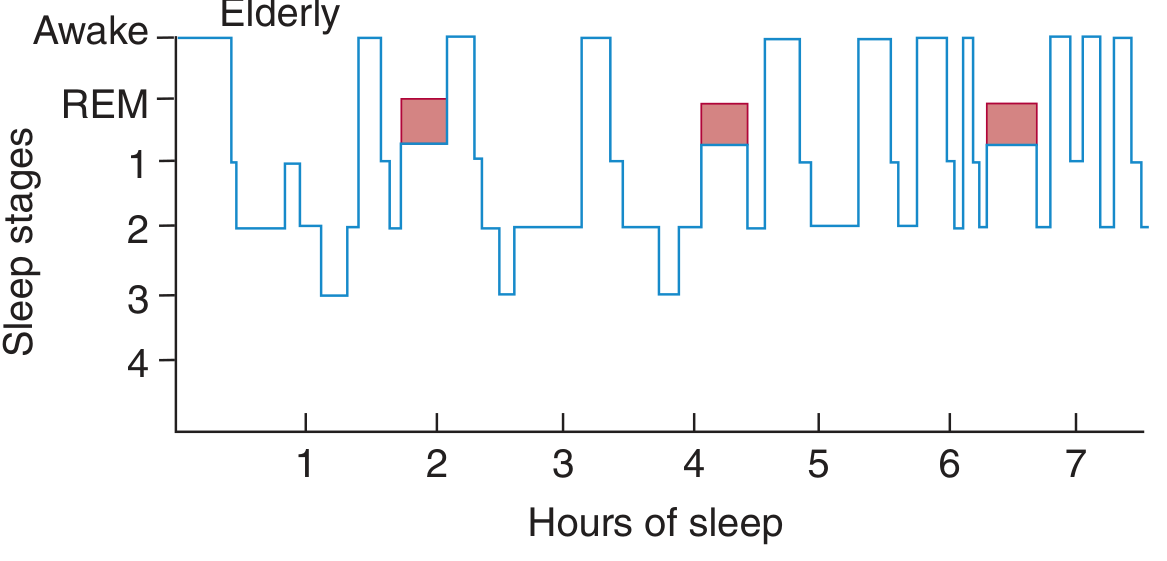
A normal young adult follows this pattern across the night:
N1 → N2 → N3 → N2 → REM (first cycle ~70-100 min)
This NREM-REM cycle repeats 4-6 times per night, each cycle lasting approximately 90-100 minutes.
Key points about cycle progression:
- Early night: Cycles contain more N3 (deep slow-wave sleep)
- Late night / early morning: Cycles contain progressively more REM and less N3; the latter cycles consist essentially of N2 and REM only
- First REM period is brief (5-10 min); REM periods lengthen as the night progresses
- The 90-100 minute ultradian cycle is stable within individuals
Distribution of Sleep Stages (% of Total Sleep Time)
| Stage | % of Total Sleep Time |
|---|---|
| Stage N1 | 3-5% |
| Stage N2 | 50-60% |
| Stage N3 | 10-20% |
| REM (Stage R) | 20-25% |
Changes with Age
| Age Group | N3 (SWS) | REM |
|---|---|---|
| Premature neonate | - | ~80% |
| Full-term neonate | - | ~50% |
| Young adult | 10-20% | 20-25% |
| Elderly (>70 yrs) | Virtually absent | ~20% |
- Sleep cycle in neonates is ~60 min (vs. 90-100 min in adults)
- With age, N3 decreases markedly; REM is relatively preserved
Neurochemistry of Sleep
| State | Dominant Neurotransmitters | Key Brain Regions |
|---|---|---|
| Wakefulness | Norepinephrine, Serotonin, Histamine | Locus coeruleus, Raphe nuclei, Tuberomammillary nucleus |
| NREM sleep | GABA↑, Histamine↓ | VLPO (ventrolateral preoptic area), Thalamus |
| REM sleep | Acetylcholine dominant; NE & 5-HT suppressed | Pontine cholinergic nuclei (pedunculopontine, LDT) |
The reciprocal interaction model (Hobson & McCarley):
- REM ON cells: Cholinergic pontine neurons - promote REM
- REM OFF cells: Noradrenergic (locus coeruleus) and serotonergic (raphe) neurons - suppress REM
- During REM: acetylcholine activity maximal, norepinephrine and serotonin at their lowest
Adenosine acts as a sleep-promoting homeostatic factor; it accumulates during wakefulness (promoting sleep pressure) and is cleared during sleep. Caffeine works by blocking adenosine receptors.
Summary Table - EEG Features by Stage
| Stage | Frequency | Amplitude | Special Features |
|---|---|---|---|
| Awake (eyes open) | Beta (>13 Hz) | Low | Desynchronized |
| Awake (eyes closed) | Alpha (8-13 Hz) | Medium | Posterior dominant |
| N1 | Theta (4-7 Hz) | Low | Vertex sharp waves, slow rolling eye movements |
| N2 | Mixed low | Low | Sleep spindles (12-14 Hz), K-complexes |
| N3 | Delta (0.5-2 Hz) | High (≥75 µV) | >20% delta per epoch |
| REM | Mixed (theta/beta) | Low | Sawtooth waves, REMs, muscle atonia |
Clinical Correlates (Exam Favorites)
| Condition | Stage Involved | Mechanism |
|---|---|---|
| Somnambulism (sleepwalking) | N3 | Incomplete arousal from SWS |
| Sleep terrors (pavor nocturnus) | N3 | Abrupt arousal from SWS |
| Nightmares | REM | Vivid emotional dreams |
| REM Sleep Behavior Disorder | REM | Loss of REM atonia; acts out dreams |
| Narcolepsy | REM | Abnormal direct entry into REM (Sleep-onset REM periods, SOREMP); loss of orexin/hypocretin |
| Sleep paralysis | REM-wake transition | REM atonia persists into wakefulness |
| GH secretion | N3 | Pulse of GH at onset of first deep NREM |
| Enuresis (bed-wetting) | N3 | Arises from deep NREM |
Sources
- Adams and Victor's Principles of Neurology, 12th Ed., Ch. 18 (Stages of Sleep)
- Kaplan & Sadock's Comprehensive Textbook of Psychiatry (Stages of Sleep, Organization of Sleep)
- Ganong's Review of Medical Physiology, 26th Ed. (Distribution of Sleep Stages)
- Guyton and Hall Textbook of Medical Physiology (EEG Changes at Different Sleep Stages)
This is a shared conversation. Sign in to Orris to start your own chat.